Plot Explained Spoilers guaranteed!
Plot Explained

Browse by genre

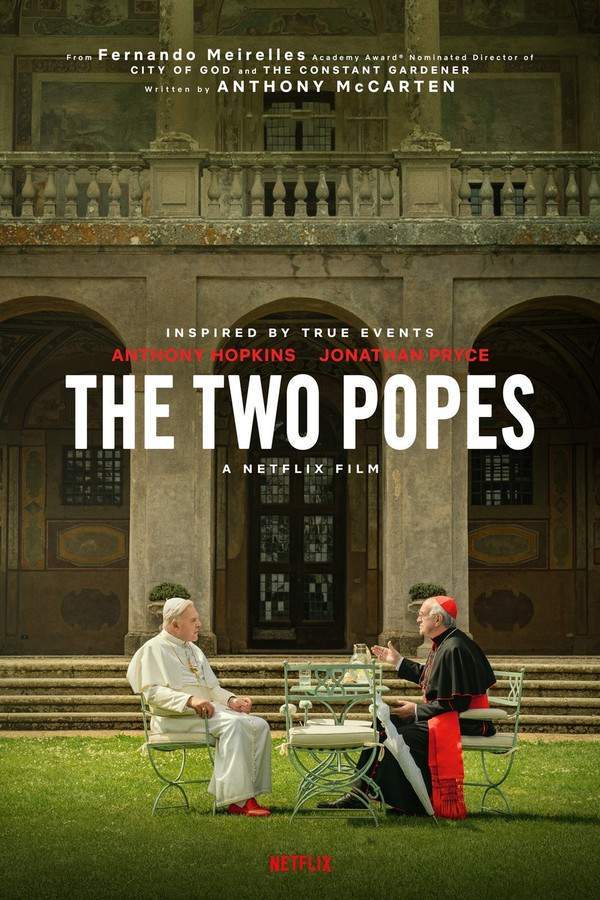
The Two Popes (2019) movie poster

Plot Summary

The Two Popes (2019) Plot Summary Explained

Release, runtime and language
2019 · 125 min · English
Echo score 78
JustWatch #19,401 11
Directed by
Fernando Meirelles
Starring
Anthony Hopkins, Luis Gnecco, Juan Minujín, Cristina Banegas, Achille Brugnini, Fabricio Martin
Budget
$40M

Inside the Vatican, Pope Benedict XVI prepares to resign, a first in centuries. Argentina's Cardinal Jorge Bergoglio believes he's destined for a quiet life of prayer, but is surprised when he is elected Pope Francis. This unlikely encounter explores their contrasting personalities and beliefs as they discuss faith, tradition, and the future of the Catholic Church, forging a unique bond in the process.

On this page (6)
  1. 1 Where to watch
  2. 2 What happens: full plot
  3. 3 Plot questions answered
  4. 4 Movie threads
  5. 5 Movies like The Two Popes
  6. 6 Every angle

Where to watch

Where to Watch The Two Popes (2019)

Where can you watch The Two Popes? Stream, rent or buy it in the US, including on Netflix and Netflix Standard: current JustWatch availability with up-to-date prices.

Streaming availability powered by JustWatch

Full plot summary · contains spoilers

What Happens in The Two Popes: Full Plot Summary

The whole story of The Two Popes (2019) explained, from the opening scene to the final frame: every key event, every twist and what it all adds up to. Read it as a quick recap before the sequel, to check a scene you missed, or to finally understand what really happened.

In April 2005, Cardinal Jorge Mario Bergoglio (Jonathan Pryce), the Archbishop of Buenos Aires, receives a crucial summons to Vatican City following the passing of Pope John Paul II. Known for his popularity in Argentina, Bergoglio harnesses his passion for football to connect with the masses, invigorating the faith among the people.

With the demise of John Paul, a liberal pontiff, the church is plunged back into the contentious discussions surrounding issues like homosexuality, abortion, contraception, and the ordination of women and married men. In this tense atmosphere, Cardinal Joseph Ratzinger, later elected as Pope Benedict XVI (Anthony Hopkins), represents a more conservative ideology and appears to be the natural successor. Tensions surface between Ratzinger and Bergoglio, as their differing beliefs imply an underlying animosity.

As Cardinal Martini (Achille Brugnini) and other cardinals participate in this pivotal conclave, Ratzinger, originally from Germany, is chosen by the 115 cardinals from around the globe to become Pope Benedict XVI after a decisive election where he garners the necessary votes quickly. Although Bergoglio places second in the voting, his heart isn't set on the papacy. Instead, he feels let down by the church's reluctance to embrace reforms.

Fast forward seven years, the Catholic Church grapples with the turmoil of the Vatican leaks scandal, overshadowing Benedict’s papacy with public scrutiny regarding his involvement in cover-ups tied to the egregious actions of pedophile priests, including the infamous Peter Hullermann, whom Ratzinger relocated despite his known history of abusing children. With an alarming number of followers turning their backs on the church under Ratzinger’s leadership, Bergoglio, despite submitting his resignation as Archbishop, faces silence from the Vatican.

Summoned unexpectedly to the Vatican, Bergoglio is set to engage in a critical meeting with the Pope at the Palace of Castel Gandolfo, marking a significant moment as Benedict receives a Cardinal at his summer residence for the first time. Their conversation pivots around the fundamental roles of God and the institution of the church, revealing stark differences in their views. Notably, Benedict stands firm against Bergoglio's perspectives on offering forgiveness to priests accused of sexual crimes, highlighting a contentious debate on church policies.

In a spirited exchange, Bergoglio asserts that Jesus embodies mercy, arguing that communion should be seen as a provision of grace rather than a mere reward, while Benedict fears that accepting Bergoglio's resignation would be interpreted as a denunciation of his leadership. Tensions mount as discussions about the church’s future unveil their clashing ideologies.

After an enlightening dinner, during which Bergoglio speaks of his intense love for football, the dialogue shifts to personal stories, recalling Bergoglio’s journey to priesthood. He shares memories from his youth and his gradual commitment to the Jesuit life, influenced along the way by Father Jalics (Lisandro Fiks) and other significant figures.

Benedict, adamant against accepting Bergoglio's resignation, contemplates the repercussions for the church's stability, leading their conversation to a more personal space where they engage in lighter topics, such as watching Benedict's favorite TV show, Kommissar Rex. However, the engaging banter eventually gives way to serious conversations about legacy, repentance, and guilt stemming from their tumultuous pasts, particularly regarding Bergoglio's connection to the Dirty War and the subsequent repercussions he feels for not protecting his Jesuit friends.

As the narrative unfolds, both leaders offer confessions, finding solace in each other's burdens, eventually stepping out to greet the public in a rare moment of camaraderie. Meanwhile, the world watches as Pope Benedict XVI eventually announces his resignation, paving the way for Cardinal Bergoglio to ascend and become Pope Francis. Their shared experience culminates fine moments, including a joint viewing of the 2014 FIFA World Cup Final, symbolizing a hopeful new chapter for the Church and its followers.
Last updated: November 15, 2024 at 16:42

Was this helpful?

Plot questions answered

The Two Popes Plot Explained: Your Questions Answered

The questions people ask most about The Two Popes (2019): what happens in the confusing scenes, why the characters do what they do, the twists, hidden details and what the ending means. Each answer contains spoilers.

Q1

Why did Cardinal Bergoglio want to resign as Archbishop of Buenos Aires?

Bergoglio submitted his resignation out of frustration with the Catholic Church's handling of major scandals, particularly the sexual abuse crisis and the Vatican leaks. He felt the church was failing to embrace necessary reforms and had become disconnected from its people. When his resignation was submitted, he received no response from the Vatican, deepening his sense of disillusionment with the institution's leadership.

Foreshadowing: Earlier in the film, Bergoglio expresses disappointment that the church refused to adopt progressive reforms during the 2005 conclave.

  • bergoglio resignation
  • archbishop of buenos aires
  • vatican scandals
  • church reform
Q2

Why did Pope Benedict XVI decide to resign?

Pope Benedict XVI resigned primarily due to the mounting pressure from the Vatican leaks scandal and the church's sexual abuse crisis. His decision was also influenced by his inability to effectively address the declining faith of followers and his perceived complicity in covering up crimes committed by pedophile priests, including the Peter Hullermann case. Benedict felt he lacked the physical and mental strength to lead the church through these challenges.

Foreshadowing: The Vatican leaks scandal and public scrutiny over his involvement in priest abuse cover-ups loom throughout the latter portion of Benedict's papacy.

  • pope benedict resignation
  • vatican leaks scandal
  • papacy resignation
  • 2013 resignation
Q3

What was the Vatican leaks scandal?

The Vatican leaks scandal involved the unauthorized disclosure of confidential documents that revealed corruption, mismanagement, and financial improprieties within the Vatican. The scandal intensified public scrutiny of Pope Benedict XVI, particularly regarding his alleged involvement in covering up crimes committed by pedophile priests. This dramatically damaged the church's reputation and contributed to Benedict's decision to step down.

Foreshadowing: The scandal emerges seven years into Benedict's papacy, coinciding with Bergoglio's increasing frustration with church leadership.

  • vatican leaks scandal
  • paoletto gabriele
  • document leak
  • church corruption
Q4

What is the Dirty War and why does Bergoglio feel guilty?

The Dirty War was Argentina's brutal military dictatorship from 1976 to 1983, during which thousands of people were abducted, tortured, and killed. Bergoglio served as a Jesuit leader during this period and admits to feeling guilty for not doing enough to protect his Jesuit friends who were targeted by the regime. He confesses to Benedict that he failed to shield them from the military junta, carrying this burden of responsibility for decades.

Foreshadowing: The film hints at Bergoglio's troubled past through his reluctance to discuss his time in Argentina before moving to Rome.

  • dirty war
  • argentina military junta
  • bergoglio guilt
  • jesuit persecution
Q5

Why did Bergoglio finish second in the 2005 papal election?

Bergoglio received significant support in the 2005 conclave, finishing second to Joseph Ratzinger. However, he was not eager to become Pope and actually felt relieved when Ratzinger was elected. Bergoglio's progressive views on issues like homosexuality, women's ordination, and married priests put him at odds with the conservative faction of cardinals who ultimately supported Ratzinger's candidacy.

Foreshadowing: The film establishes early on that Bergoglio's beliefs differ significantly from Ratzinger's conservative ideology.

  • 2005 conclave
  • bergoglio votes
  • papal election
  • cardinal voting
Q6

What was the Peter Hullermann case?

Peter Hullermann was a German priest known to have a history of sexually abusing children. Despite his criminal record, Pope Benedict XVI (then Cardinal Ratzinger) approved Hullermann's transfer to another parish in Munich in 1980, where he continued to abuse victims. This became a major point of controversy during Benedict's papacy, symbolizing the church's systemic failure to protect children and holding Benedict personally accountable for the cover-up.

Foreshadowing: The film references this case during the debate between Bergoglio and Benedict about forgiving priests accused of sexual crimes.

  • peter hullermann
  • priest abuse cover-up
  • munich transfer
  • catholic church scandal
Q7

Why did Pope Benedict summon Bergoglio to Castel Gandolfo?

Pope Benedict summoned Bergoglio to his summer residence at Castel Gandolfo for a rare meeting that marked the first time a Pope received a Cardinal at this location. The meeting was initiated to address Bergoglio's submitted resignation and to have a direct conversation about the future of the church. Benedict also wanted to understand Bergoglio's perspective on church reform and potentially reconcile their ideological differences before making any decisions about leadership.

Foreshadowing: This unexpected summons comes after years of tension between the two cardinals and growing pressure on Benedict's papacy.

  • castel gandolfo meeting
  • bergoglio summoned
  • vatican summer residence
  • papal audience
Q8

Who was Father Jalics and what was his connection to Bergoglio?

Father Jalics was a Jesuit priest who significantly influenced Bergoglio's journey toward priesthood. The film references Jalics as one of the key figures who guided Bergoglio during his spiritual development. Their relationship highlights the Jesuit formation that shaped Bergoglio's religious convictions and his commitment to a life of service within the Catholic Church.

Foreshadowing: Bergoglio mentions his Jesuit formation and the mentors who guided his early religious life.

  • father jalics
  • jesuit mentor
  • bergoglio jesuit
  • spiritual formation
Q9

How did Bergoglio and Benedict's relationship evolve during their meetings?

Initially, Bergoglio and Benedict engaged in heated debates about church ideology, particularly regarding forgiveness for priests accused of sexual crimes and the nature of communion. However, as they shared personal stories, Bergoglio about his path to priesthood and his guilt over the Dirty War, Benedict about the burdens of leadership, their relationship shifted. They moved from ideological opponents to two men who understood each other's burdens, eventually appearing together publicly in a rare display of unity.

Foreshadowing: Their bond develops gradually through intimate conversations about faith, guilt, legacy, and personal failures.

  • bergoglio benedict friendship
  • two popes relationship
  • vatican reconciliation
  • unusual friendship
Q10

Why do Bergoglio and Benedict watch the World Cup together at the end?

The ending shows Bergoglio (now Pope Francis) and Benedict watching the 2014 FIFA World Cup Final together, symbolizing their reconciliation and the hope for a new direction in the Catholic Church. This moment represents the bridging of their ideological divide and Benedict's acceptance of the church's transformation under his successor. It serves as a visual metaphor for the church embracing a more compassionate and modern approach while honoring its traditions.

Foreshadowing: Earlier in the film, Bergoglio shares his deep love for football, which he used to connect with people in Buenos Aires.

  • world cup final 2014
  • pope francis benedict
  • church future
  • reconciliation ending

Movie threads

More Movies Like The Two Popes, by Mood & Story

Curated lists built around what makes The Two Popes tick: the same mood, the same kind of story or the same emotional payoff. Each list explains why these movies belong together.

Dialogue-Driven Two-Handers like The Two Popes

Intimate dramas where two opposing figures debate the future of an institution. For viewers who enjoyed the philosophical debates in The Two Popes, this list features movies like it that are built around intense conversations between two characters. These similar drama films explore themes of faith, ideology, and institutional change through quiet, character-driven storytelling.

  • dialogue-heavy
  • cerebral
  • claustrophobic
  • ideological
  • character-driven
  • solemn
  • Tone: melancholic, cerebral
  • Pacing: slow, dialogue-driven
Why these movies?

The story pattern: The narrative hinges on a series of conversations between two characters with fundamentally different worldviews. Through their debate, they challenge each other's convictions, reveal personal histories, and gradually find a grudging respect or understanding, even if their core disagreements remain.

Why they belong together: Movies are grouped here for their shared focus on a two-character structure, slow and deliberate pacing driven by dialogue, and the exploration of weighty ideological or moral conflicts within an institutional setting.

Movies about Legacy and Atonement like The Two Popes

Stories of leaders grappling with personal and institutional failure, seeking hope. If you liked The Two Popes for its themes of personal guilt and institutional reform, you'll find similar stories here. These films feature characters confronting their pasts and the legacies they've inherited, often ending on a bittersweet note of cautious hope and change.

  • reflective
  • introspective
  • solemn
  • hopeful
  • character-driven
  • guilt
  • Tone: melancholic, bittersweet
  • Pacing: slow, reflective
Why these movies?

The story pattern: The protagonist, often a leader or figure of authority, is forced to confront a difficult past—either their own personal failings or systemic sins of an organization they represent. The story unfolds through reflection and difficult choices, leading to a resolution that acknowledges past pain while cautiously opening a door to a different future.

Why they belong together: These films share a melancholic and reflective tone, a medium-to-heavy emotional weight centered on themes of guilt and repentance, and a narrative pattern that moves from confronting a troubled past towards a bittersweet, hopeful resolution.

If you liked this

Movies Like The Two Popes

Similar movies to The Two Popes: the same genre, themes or kind of story. Each one comes with its own plot summary, timeline and ending explained.

Browse all movie summaries

Every angle

The Two Popes (2019) Explained: Plot, Timeline & Characters

Everything about The Two Popes in one place: what happens in the plot summary, the timeline in chronological order, the characters and meaning and a spoiler-free summary. What's After the Movie adds the cast, box office and post-credit scenes.

Coming soon on iOS and Android

The Plot Explained Movie Summary App

Plot summaries, endings explained and timelines on your phone. Catch up on any movie in minutes, save your favorites and never miss a twist again.

Be the first to know when we launch. Your email stays private, always.

Learn more about the app