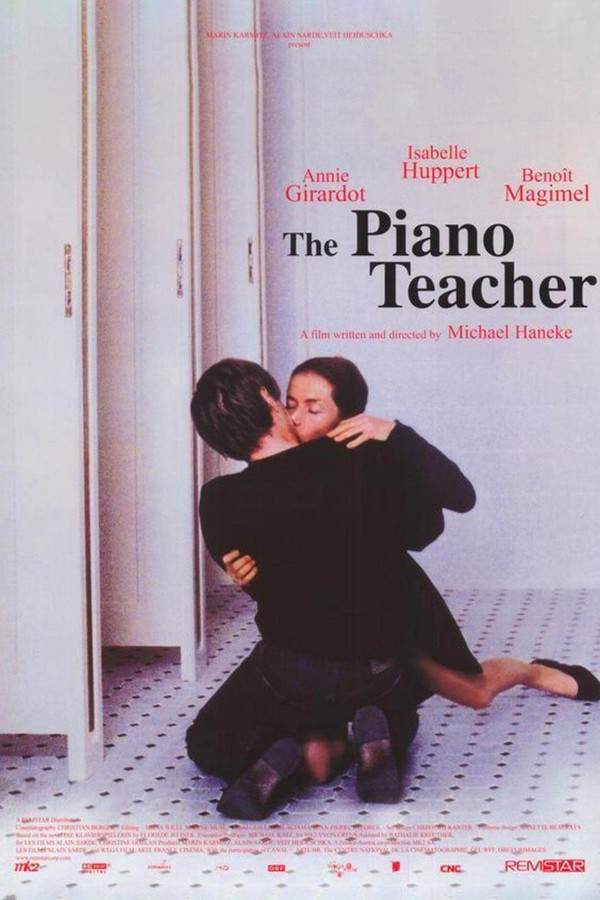
In Vienna, piano teacher Erika Kohut leads a life defined by rigid routine and underlying darkness, influenced by her overbearing mother. Seeking escape, she indulges in secret pleasures and visits clandestine cinemas. Her carefully constructed world is challenged when a young and flirtatious student enters her life, disrupting her composure and forcing her to confront long-suppressed desires and the complexities of her past.
Find where to stream, rent, or buy The Piano Teacher (2002) in the US with current JustWatch availability, up-to-date pricing, and platform listings for subscription, rental, and digital purchase options.
Warning: spoilers below!
Haven’t seen The Piano Teacher yet? This summary contains major spoilers. Bookmark the page, watch the movie, and come back for the full breakdown. If you're ready, scroll on and relive the story!
Trace every key event in The Piano Teacher (2002) with our detailed, chronological timeline. Perfect for unpacking nonlinear stories, spotting hidden connections, and understanding how each scene builds toward the film’s climax. Whether you're revisiting or decoding for the first time, this timeline gives you the full picture.
Last updated: November 16, 2024 at 14:39
Find frequently asked questions about the The Piano Teacher (2002) timeline, including chronological order, nonlinear jumps, cause-and-effect links, and scene sequence clarifications. This timeline FAQ helps explain when key events happen, how moments connect, and why the story unfolds in that specific order.
Erika sabotages Anna out of jealousy after seeing her socialize with Walter. Consumed by rivalry and emotional turmoil, she retreats to a coatroom during a psychological break, breaks a glass, and conceals the shards in Anna's coat pocket. This act injures Anna's hand and bars her from the jubilee concert, clearing Erika's path to perform in her place.
Earlier, Erika watches Anna and Walter together with visible distress, establishing her volatile emotional state.
Despite being moved by Walter and sharing a connection over classical composers, Erika votes against his acceptance because she recognizes the danger of having him as a student. His youth and passion trigger her repressed desires, and she fears losing control. She cites his interpretation of Schubert's Andantino as her official reason, using professional judgment as a mask for her emotional conflict.
Their meeting at the recital establishes immediate mutual admiration, hinting at the attraction Erika tries to suppress.
Erika's letter outlines her expectations for a masochistic relationship, explicitly detailing her paraphilic desires including the need for dominance, humiliation, and specific sexual boundaries. She demands he remain silent and focused solely on her during encounters. The letter shocks and repels Walter, who sought a conventional romantic connection, causing him to leave abruptly.
Earlier in the lavatory, Erika humiliates Walter and demonstrates her need for control, hinting at the darker desires revealed in her letter.
Walter forces himself on Erika at her apartment, disregarding her pleas for him to stop. This violent sexual assault is the culmination of the distorted power dynamic between them. Erika had hinted at her desire for dominance and submission in her letter, but Walter's attack ignores her consent entirely, transforming her psychological games into actual violence.
The letter's mention of masochistic desires and Erika's earlier submission at the ice rink establish the troubled dynamic that escalates to assault.
Facing Walter's arrival at the concert hall, Erika experiences overwhelming despair and acts on long-suppressed self-destructive impulses. She deliberately stabs herself in the shoulder with a hidden kitchen knife, then lets the weapon fall as she exits into the streets. This act represents both surrender to her internal darkness and a rebellious rejection of the constraining life that repressed her.
The film established her history of self-harm and sexual repression, building toward this moment of ultimate expression of her psychological pain.
Erika lives in a constrained apartment with her overbearing elderly mother, whose dominance over her life is a central source of Erika's psychological damage. The oppressive relationship shapes her personality, contributing to her loneliness and sexual repression. Her mother's control represents the rigid structure Erika rebels against through her secret pleasures and eventually through her self-destruction.
The opening scenes establish the oppressive home environment that drives Erika's need for escape.
Erika is haunted by her father's long confinement in a psychiatric asylum, which contributes to her psychological instability and creates a facade of aloofness. This family trauma underlies her deep-seated loneliness, emotional complications, and the darker aspects of her psyche. The stigma and burden of this past influence her relationship with her mother and her own mental state.
The summary mentions this haunted background early, establishing the psychological foundation for her later behavior.
After Walter leaves her room in disgust at her letter, Erika attempts to apologize and reclaim power in their dynamic. At the ice rink, she shifts from her earlier dominance to submission, taking Walter into a janitorial closet. However, she becomes overwhelmed during their physical encounter and vomits, demonstrating her inability to reconcile her desires with actual intimacy.
Her letter outlined her desire for submission, which she attempts to fulfill at the ice rink.
Anna cannot perform because Erika deliberately hid broken glass shards in her coat pocket. When Anna puts on her coat, the glass cuts her hand, causing an injury that bars her from the concert. Erika then manipulates the situation by feigning sympathy to Anna's mother and offering to take Anna's place, effectively stealing her opportunity.
Erika's jealousy after seeing Anna with Walter foreshadows her destructive action.
Erika leads a double life, hiding unusual paraphilic interests including voyeurism, sadomasochism, and self-harm. She visits clandestine cinemas to indulge these desires, which contrast sharply with her composed exterior at the conservatory. These secret pleasures represent her attempt to escape the rigid control her mother and societal expectations impose on her.
The opening establishes her secret电影院 visits as the escape valve for her repressed desires.
Discover curated groups of movies connected by mood, themes, and story style. Browse collections built around emotion, atmosphere, and narrative focus to easily find films that match what you feel like watching right now.
Stories where oppressive environments and inner turmoil lead to a character's descent.Movies like The Piano Teacher that feature intense psychological turmoil and a claustrophobic atmosphere. If you appreciated the unsettling exploration of repressed desire and self-destruction, these similar dramas delve into the dark corners of the human mind with unflinching honesty.
These narratives typically follow a protagonist trapped in a rigid, controlling environment—be it familial, societal, or self-imposed—whose carefully constructed world is shattered by an external catalyst. The story arc charts their psychological deterioration, often culminating in self-destructive or shocking acts as a release from immense pressure.
Movies are grouped here for their shared focus on intense psychological distress, an oppressive or claustrophobic mood, and themes of repression leading to explosive, often tragic, consequences. They deliver a similarly heavy and unsettling viewing experience.

Narratives centered on manipulative relationships, shifting control, and dangerous fixation.If you were captivated by the twisted teacher-student relationship and power games in The Piano Teacher, these films explore similar themes of obsession, control, and psychological manipulation in intense, character-driven stories.
The plot hinges on a volatile relationship where power is constantly negotiated, challenged, and inverted. The journey explores the psychological effects of this dynamic on all parties involved, often leading to coercion, emotional violence, and a tragic conclusion where no one emerges unscathed.
These films are united by their deep exploration of unhealthy, obsessive relationships where power is the central currency. They share a dark tone, high emotional intensity, and a focus on the psychological damage inflicted by these intricate power games.
Don't stop at just watching - explore The Piano Teacher in full detail. From the complete plot summary and scene-by-scene timeline to character breakdowns, thematic analysis, and a deep dive into the ending - every page helps you truly understand what The Piano Teacher is all about. Plus, discover what's next after the movie.
Read a complete plot summary of The Piano Teacher, including all key story points, character arcs, and turning points. This in-depth recap is ideal for understanding the narrative structure or reviewing what happened in the movie.
Discover the characters, locations, and core themes that shape The Piano Teacher. Get insights into symbolic elements, setting significance, and deeper narrative meaning - ideal for thematic analysis and movie breakdowns.