Plot Explained Spoilers guaranteed!
Plot Explained

Browse by genre

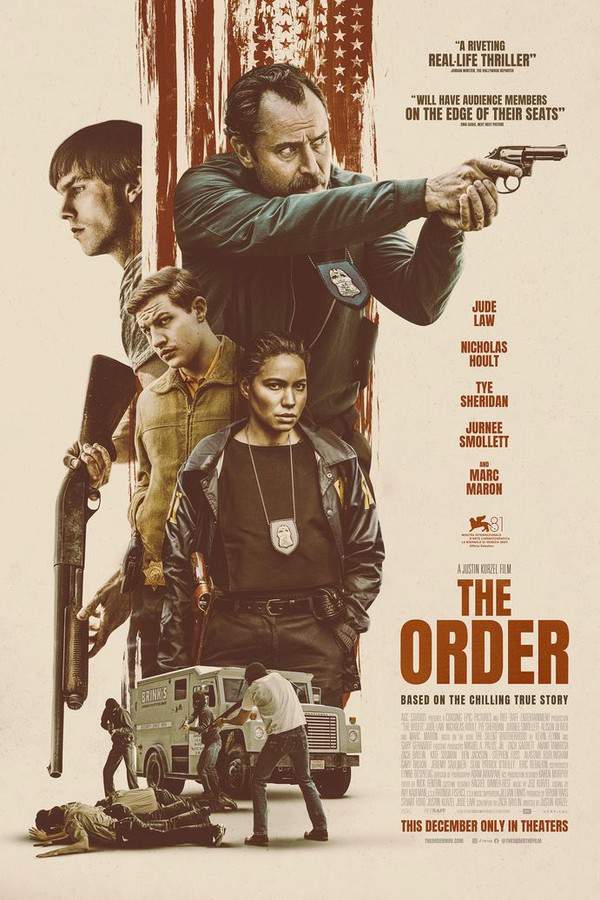
The Order (2024) movie poster

Ending Explained

The Order (2024) Ending Explained – Final Scene & Meaning

Release, runtime and language
2024 · 1 h 54 m · English
Echo score 82
Directed by
Justin Kurzel
Starring
Marc Maron, Jude Law, Nicholas Hoult, Daniel Doheny, Sebastian Pigott, Tye Sheridan

In 1983, a string of increasingly violent bank robberies, counterfeiting operations, and armored car heists terrorized communities across the Pacific Northwest. As law enforcement struggled to understand the crimes, a lone FBI agent in the quiet town of Coeur d’Alene, Idaho, began to suspect a connection between the events.

On this page (7)
  1. 1 What happens at the end
  2. 2 Final events in order
  3. 3 Ending questions answered
  4. 4 The book behind the movie
  5. 5 Movie threads
  6. 6 Movies like The Order
  7. 7 Every angle

Ending explained · contains spoilers

What Happens at the End of The Order?

How The Order (2024) ends, what the final scene means, which earlier moments set it up and how to read the ending if the film leaves it open. The full ending explained, with every spoiler.

The ending of The Order reveals that Bob Mathews, the leader of the violent white supremacist cult The Order, is ultimately killed in a fiery confrontation with the FBI. After years of criminal activities, including bank robberies, bombings, and the assassination of a political commentator, Bob refuses to surrender when surrounded at his hideout in Washington. Instead, he fights to the death, shooting at the FBI agents as they try to arrest him. The house is set on fire to smoke him out, and in a dramatic final moment, Bob chooses to die rather than face justice, barricading himself inside and refusing to surrender. His death marks the end of the real-life cult he led—the FBI successfully dismantled The Order, arresting or prosecuting its remaining members. The film emphasizes that Bob's actions were inspired by racist propaganda like The Turner Diaries and that he was a real person who committed these heinous crimes. The ending highlights the tragic outcome of extremist ideology, with Bob's death symbolizing the failure of his violent beliefs and the authorities' effort to prevent further violence. After the chaos, Terry Husk, the FBI agent, takes a brief moment to himself, going hunting for deer, reflecting a return to normalcy after the intense events. The film’s conclusion underscores the real historical fight against domestic terrorism rooted in hatred and bigotry.

Last updated: June 25, 2025 at 08:44

Was this helpful?

The last 4 events

How The Order Ends: The Final Events in Order

The last events of The Order (2024) in chronological order, the run-up to the ending explained above. The complete timeline has all 15 events, scene by scene.

Open the full timeline
  1. Assassination plan: Alan Berg

    Mathews orders Pierce to Denver to assassinate Alan Berg, a Hebrew radio host who frequently sparred with anti-Semitic callers. The hit marks a turn toward high-profile political violence.

    When
    1980s
    Where
    Denver, Colorado
  2. Armored car robbery on a California highway

    The group holds up an armored car on a remote California highway, stealing millions in cash. Husk recognizes the scale of the operation and its potential to fund a broader insurgent campaign.

    When
    1980s
    Where
    California (remote highway)
  3. Arrest attempt and Bowen's death

    A gun dropped at the California crime scene leads investigators to Tony Torres, who becomes an informant. During a later attempt to arrest Mathews, Bowen provides covering fire but Mathews shoots and kills Bowen as he escapes.

    When
    1980s
    Where
    California (initial confrontation); Bowen's death nearby
  4. Whidbey Island final confrontation

    Mathews and his companions retreat to a safe house on Whidbey Island, planning to declare war on the federal government. The FBI orders the house burned to flush Mathews out, and he dies when a cache of ammunition detonates in the blaze.

    When
    End of confrontation
    Where
    Whidbey Island, Washington

Ending questions answered

The Order Ending: Your Questions Answered

The questions people ask most about the ending of The Order (2024): what the final scene means, how the twist works, what happens to each character and how to read the ending. Each answer contains spoilers.

Q1

Why does Bob Mathews refuse to surrender to the FBI?

Bob Mathews refuses to surrender because he would rather die than face justice for his crimes. After years of orchestrating violent crimes including bank robberies, bombings, and murder, Bob chooses to fight to the death rather than be arrested. This decision reflects his fanatical commitment to his extremist ideology and refusal to accept capture or trial.

Foreshadowing: Earlier in the film, Bob's unwavering dedication to The Order's violent mission hints at his inability to compromise or surrender.

  • bob mathews
  • surrender
  • death
  • the order
  • fbi confrontation
Q2

How does Bob Mathews die in the end?

Bob Mathews dies in a fiery confrontation at his hideout in Washington. When the FBI surrounds his location, he opens fire on the agents trying to arrest him. The FBI sets the house on fire to smoke him out, but Bob barricades himself inside and refuses to surrender, ultimately dying in the blaze.

Foreshadowing: The film establishes Bob's violent resistance throughout, making his refusal to surrender consistent with his character.

  • bob mathews death
  • fiery confrontation
  • hideout
  • washington
Q3

Does the FBI successfully dismantle The Order?

Yes, the FBI successfully dismantles The Order by the film's end. Bob Mathews' death marks the end of the cult's leadership, and the authorities arrest or prosecute the remaining members. The FBI's investigation connects the string of escalating crimes across the Pacific Northwest and brings the group to justice.

Foreshadowing: The film's procedural investigation builds toward this resolution, showing the FBI methodically connecting the crimes.

  • fbi
  • the order
  • dismantle
  • arrest
  • members
  • justice
Q4

Why does Terry Husk go hunting at the end?

Terry Husk goes hunting for deer after the intense confrontation ends, symbolizing his return to normalcy after the traumatic events. The hunting scene provides a quiet, reflective moment that contrasts with the violence and chaos of the investigation, showing the FBI agent processing what happened and returning to his personal life.

Foreshadowing: The steady, methodical pacing of the investigation contrasts with moments of personal stillness throughout the film.

  • terry husk
  • hunting
  • deer
  • normalcy
  • return
Q5

Is The Order based on a true story?

Yes, The Order is based on a real-life white supremacist cult that operated in the Pacific Northwest during the 1980s. The film emphasizes that Bob Mathews was a real person who committed these heinous crimes, and that his actions were inspired by racist propaganda like The Turner Diaries. The ending underscores the real historical fight against domestic terrorism rooted in hatred and bigotry.

Foreshadowing: The film's title and setting in 1983 signal its basis in historical events.

  • true story
  • real life
  • the order
  • bob mathews
  • turner diaries
Q6

What is the significance of the house being set on fire?

The house fire serves as the method the FBI uses to force Bob out of hiding, but he chooses to remain inside rather than surrender. This moment highlights Bob's fanatical commitment to his cause over his own survival. The fire also creates a dramatic, cinematic end to the confrontation while visually representing the destruction of his ideology.

Foreshadowing: Earlier bombings and violent incidents throughout the film establish fire as a tool of destruction associated with The Order's activities.

  • house fire
  • smoke out
  • barricade
  • surrender
  • dramatic ending
Q7

What does the ending say about extremist ideology?

The ending highlights the tragic outcome of extremist ideology, showing Bob's death as the failure of his violent beliefs. The film conveys that while Bob and The Order caused significant harm through racism, terrorism, and murder, their movement ultimately collapsed under the weight of their violence. The authorities' success in dismantling the group demonstrates the defeat of domestic terrorism rooted in hatred and bigotry.

Foreshadowing: The film consistently emphasizes the destructive nature of the group's ideology through their increasingly violent actions.

  • extremism
  • ideology
  • racism
  • terrorism
  • failure
  • domestic terrorism
Q8

Why does the ending feel bittersweet?

The ending feels bittersweet because while the main antagonist is killed and The Order is dismantled, this victory comes at a cost. The film acknowledges the loss of life and the lasting impact of the violence, leaving no pure sense of triumph. The emotional weight comes from the disturbing themes of racism, terrorism, and the tragic death of a deputy, which prevent the ending from being celebratory despite the villain's defeat.

Foreshadowing: The film's heavy emotional tone and the loss of a deputy earlier in the story set up this unresolved grief.

  • bittersweet
  • victory
  • loss
  • emotional
  • tragic
  • deputy death
Q9

What happens to the other members of The Order?

The remaining members of The Order are arrested or prosecuted by the FBI following Bob Mathews' death. With their leader eliminated, the organization collapses, and the authorities successfully bring the group to justice for their string of crimes including bank robberies, counterfeiting, armored car heists, bombings, and assassination.

Foreshadowing: The investigation throughout the film identifies multiple members within the extremist cell, building toward their eventual capture.

  • remaining members
  • arrest
  • prosecution
  • justice
  • the order members

Movie threads

More Movies Like The Order, by Mood & Story

Curated lists built around what makes The Order tick: the same mood, the same kind of story or the same emotional payoff. Each list explains why these movies belong together.

Methodical crime procedurals with oppressive dread like in The Order

Stories where a relentless investigation uncovers a terrifying, escalating threat. If you liked the investigative pace and building tension of The Order, explore more movies like it. This collection features crime dramas and thrillers where law enforcement races against time to unravel a complex, violent conspiracy, creating a suspenseful and gritty viewing experience.

  • suspenseful
  • methodical
  • oppressive
  • gritty
  • anxious
  • somber
  • Tone: dark, tense, somber
  • Pacing: steady, methodical
Why these movies?

The story pattern: The narrative follows a linear, procedural structure focused on piecing together a puzzle. The journey is driven by the investigators' growing comprehension of a dangerous and often hidden network, leading to high-stakes confrontations. The emotional core lies in the heavy weight of the crimes and the moral burden on those trying to stop them.

Why they belong together: These films are grouped by their shared focus on a steady, methodical pacing that builds suspense, a dark and gritty tone centered on real-world violence, and a heavy emotional weight derived from the disturbing nature of the crimes and the personal toll on the characters involved.

Bleak chronicles of violent ideological descent like in The Order

Films tracing the grim path of characters consumed by extremist beliefs. For viewers who appreciated the exploration of domestic terrorism and moral conflict in The Order, this list features similar movies about ideological extremism. These stories depict the grim descent into violence, the internal dynamics of radical groups, and the devastating consequences for everyone involved.

  • bleak
  • gritty
  • somber
  • oppressive
  • violent
  • ideological
  • Tone: dark, bleak, somber
  • Pacing: steady, escalating
Why these movies?

The story pattern: The plot follows a downward spiral, often starting with a sense of purpose or grievance that transforms into organized violence. It explores the character arcs of both the extremists, showing their radicalization and personal downfall, and the law enforcement or civilians caught in the crossfire, facing profound moral dilemmas.

Why they belong together: These movies share a dark tone centered on disturbing real-world themes, a high intensity driven by escalating violence, and a mixed or bleak ending that reflects the tragic and unresolved nature of ideological conflict. The emotional journey is heavy, focusing on the human cost of extremism.

If you liked this

Movies Like The Order

Similar movies to The Order: the same genre, themes or kind of story. Each one comes with its own plot summary, timeline and ending explained.

Browse all movie summaries

Every angle

The Order (2024) Explained: Plot, Ending, Timeline & Characters

Everything about The Order in one place: what happens in the plot summary, the timeline in chronological order, the characters and meaning, the ending explained and a spoiler-free summary. What's After the Movie adds the cast, box office and post-credit scenes.

Coming soon on iOS and Android

The Plot Explained Movie Summary App

Plot summaries, endings explained and timelines on your phone. Catch up on any movie in minutes, save your favorites and never miss a twist again.

Be the first to know when we launch. Your email stays private, always.

Learn more about the app