Plot Explained Spoilers guaranteed!
Plot Explained

Browse by genre

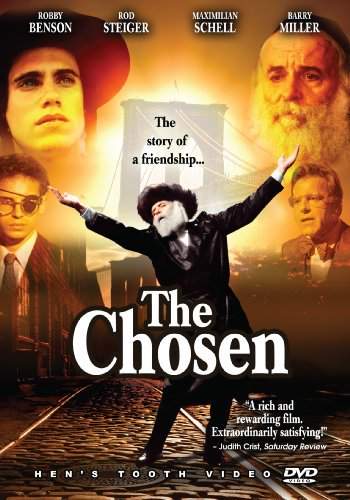
The Chosen (1982) movie poster

Plot Summary

The Chosen (1982) Plot Summary Explained

Release, runtime and language
1982 · 108 min · English
JustWatch #15,700 1,092
Directed by
Jeremy Kagan
Starring
Rod Steiger, Robert John Burke, Ron Rifkin, Maximilian Schell, Robby Benson, Barry Miller

Within a gloomy mansion, a young woman's life is upended when she becomes the target of a sinister power. As a malevolent force takes hold, it threatens to consume her completely. She finds herself battling to retain her identity and confront the darkness within before it destroys her soul and those around her.

On this page (7)
  1. 1 Where to watch
  2. 2 What happens: full plot
  3. 3 Plot questions answered
  4. 4 The book behind the movie
  5. 5 Movie threads
  6. 6 Movies like The Chosen
  7. 7 Every angle

Where to watch

Where to Watch The Chosen (1982)

Where can you watch The Chosen? Stream, rent or buy it in the US, including on Kanopy, Plex and Tubi TV: current JustWatch availability with up-to-date prices.

Streaming availability powered by JustWatch

Full plot summary · contains spoilers

What Happens in The Chosen: Full Plot Summary

The whole story of The Chosen (1982) explained, from the opening scene to the final frame: every key event, every twist and what it all adds up to. Read it as a quick recap before the sequel, to check a scene you missed, or to finally understand what really happened.

Williamsburg, Brooklyn, New York City, 1944. In a predominantly Jewish neighborhood, Reuven "Robert" Malter and Daniel "Danny" Saunders are two 15-year-old boys whose paths have never crossed until fate intervenes. Reuven, a bright and popular Modern Orthodox Jew, grapples with the impact of his mother's death during the early years of the Holocaust nearly a decade ago. His father, David Malter, a Talmudic scholar and devoted Zionist, hopes to establish a Jewish homeland where they can live freely, away from the global persecution that has afflicted their people.

On the other hand, Danny is a Hasidic Jew, the eldest son of Reb Isaac Saunders, a revered Rabbi who migrated to the United States with his family and followers from Russia before the October Revolution of 1917. Unlike Reuven, Danny is trapped by the expectations of his faith, burdened with the prospect of succeeding his father as Rabbi, even though he harbors aspirations of becoming a psychologist—a dream he feels he cannot share. Despite his photographic memory and keen intelligence, he struggles with mathematics and feels confined by the traditions that dictate his life.

Their first encounter occurs during a heated softball game between their schools which turns into an unexpected spiritual duel. Danny’s aggressive batting style leads to a fateful incident where he accidentally shatters Reuven's glasses, injuring his left eye. Following this accident, Danny makes a visit to the hospital where Reuven is recovering, offering an apology that marks the beginning of a profound friendship that transcends their different Jewish backgrounds. Reuven soon learns that Danny’s relationship with his father is largely devoid of emotional communication, where conversations only blossom during religious discussions. He also uncovers Danny's secret desire to pursue psychology rather than the rabbinic path his father envisions.

As the events of World War II unfold and reach their conclusion in 1945, Reuven experiences a similar silence when he faces the disapproval of Reb Saunders after he expresses support for a secular Jewish state in Palestine, an idea vehemently opposed by the Hasidic community. Tension escalates when Reb Saunders forbids Danny from speaking to Reuven, even though Danny discreetly conveys his own limitations: “I won't go against my father. I won't!” In the wake of these events, Reuven must navigate his feelings of isolation, anguish, and anger after his father suffers a stroke and is hospitalized. He spends his time in introspection and solitude, even getting involved in smuggling weapons for the Jewish underground resistance in Palestine.

In November 1947, a significant announcement from the UN regarding the establishment of Israel reaches Reuven and his ailing father, which ignites hope of returning to their homeland. Shortly after, Danny reappears in Reuven's life, eager to rekindle their friendship after a two-year separation. He shares the news that his father has accepted the reality of their situation, acknowledging that the new state of Israel is now a fact. Throughout this transition, Danny comes to realize that the silence imposed by his father can serve dual purposes—pain and beauty alike—in his personal growth.

By 1948, both friends find themselves once again caught between the divergent philosophies of father and son. As they learn more about Reb Saunders' intentions behind raising Danny in silence, it becomes clear that Reb wished for his son to cultivate empathy and understanding of suffering rather than merely intellect. When it is revealed that Danny possesses both intelligence and compassion, Reb finally offers his blessing for Danny’s aspiration to study psychology, stating, “He will be a tzadik for the world.” With newfound openness, Reb Saunders approaches Danny to seek forgiveness for the pain of his upbringing, resulting in a heartfelt exchange that leaves both boys in tears.

In an emotional conclusion taking place in 1950, a transformed Danny arrives at Reuven's house en route to his studies at Columbia University. He has shed his Hasidic appearance, symbolizing a new chapter in his life. Reuven shares his own plans to study at a yeshiva in Israel, optimistically accompanied by a nearly recovered David Malter. With Danny’s younger brother set to follow in their father's religious footsteps, the deep bond of friendship between Reuven and Danny faces an inevitable transition. As they navigate the complexities of life, the two young men savor the bittersweet experience of understanding pain while finding solace in their profound camaraderie.
Last updated: May 26, 2025 at 22:02

Was this helpful?

Plot questions answered

The Chosen Plot Explained: Your Questions Answered

The questions people ask most about The Chosen (1982): what happens in the confusing scenes, why the characters do what they do, the twists, hidden details and what the ending means. Each answer contains spoilers.

Q1

Why was Danny forbidden from speaking to Reuven?

Danny was forbidden from speaking to Reuven after Reuven expressed support for a secular Jewish state in Palestine. Reb Saunders, who led the Hasidic community, strongly opposed this idea because the Hasidic community was against establishing a secular Jewish state. When Reuven spoke favorably about the secular Zionist position, Reb Saunders viewed this as a threat to his community's values and ordered Danny to stop communicating with Reuven.

Foreshadowing: Earlier, Reuven had learned that Danny's father disapproved of any discussions that deviated from strict religious tradition.

  • forbidden friendship
  • reb saunders
  • zionism
  • hasidic opposition
Q2

What was Danny's secret ambition?

Danny secretly wanted to become a psychologist rather than follow in his father's footsteps as a rabbi. Despite possessing a photographic memory and exceptional intelligence, Danny felt trapped by the expectations of his Hasidic upbringing that demanded he succeed his father as the community's leader. He hid this dream because he feared disappointing his father and violating the traditions that defined his family.

Foreshadowing: Danny's secret was known only to Reuven and David Malter, highlighting how isolated Danny felt within his own community.

  • psychologist
  • rabbi
  • hasidic expectations
  • photographic memory
  • secret dream
Q3

Why did Reuven's father suffer a stroke?

David Malter suffered a stroke due to the extreme stress from overwork. After Reuven was forbidden from seeing Danny, Reuven's father took on additional work to support his son during his emotional distress while also continuing his Talmudic studies, writing for Zionist publications, and caring for his ailing son. The combination of physical exhaustion and emotional strain from the conflict with Reb Saunders triggered the stroke.

Foreshadowing: The tension between the two families had been building since the softball incident, and Reuven's growing isolation worsened matters.

  • david malter
  • stroke
  • stress
  • overwork
  • zionist work
Q4

Why did Reb Saunders raise Danny in silence?

Reb Saunders raised Danny in silence because he wanted his son to develop empathy and compassion rather than just intellectual brilliance. Reb Saunders recognized that Danny possessed exceptional intelligence but lacked emotional depth. By deliberately maintaining a distant, silent relationship except during religious discussions, Reb hoped his son would learn to understand suffering and human pain, qualities he believed were essential for a true religious leader.

Foreshadowing: This explanation comes in 1948, after both boys have experienced significant emotional hardship.

  • reb saunders
  • silence
  • parenting
  • compassion
  • empathy
  • emotional development
Q5

What does 'He will be a tzadik for the world' mean?

When Reb Saunders finally gave Danny his blessing to study psychology, he called him 'a tzadik for the world.' In Hebrew, tzadik means 'righteous person' or 'saint.' Reb was acknowledging that Danny would use his intelligence and compassion not just for the Hasidic community, but for all of humanity. It was his father's way of saying that Danny could still fulfill a spiritual purpose, even as a secular psychologist, by helping people outside the strict religious framework.

Foreshadowing: This moment marks the complete transformation in Reb Saunders' thinking about his son's future.

  • tzadik
  • righteous
  • blessing
  • psychology
  • reb saunders
  • spirituality
Q6

Why did Reuven get involved in smuggling weapons?

Reuven got involved in smuggling weapons for the Jewish underground resistance in Palestine as a way to channel his anger and isolation after his friend Danny was taken from him. Feeling abandoned and angry following the stroke his father suffered, Reuven sought meaning through action, supporting the Zionist cause that his father believed in. This dangerous activity represented both his loyalty to his father's dream of a Jewish homeland and his personal response to feeling helpless.

Foreshadowing: This occurs during the period when Reuven is most isolated, after Danny has been forbidden from seeing him.

  • weapons smuggling
  • underground
  • palestine
  • zionist
  • reuven anger
Q7

How did the 1947 UN vote establishing Israel affect the characters?

The November 1947 UN vote to establish the state of Israel had a profound impact on both families. For Reuven and David Malter, it represented the fulfillment of their lifelong Zionist dreams, a hope for a homeland free from persecution. For Danny, it marked a turning point because his father finally accepted the reality of Israel as a fact, which allowed him to reconsider his opposition to Danny's friendship with Reuven. This historical moment essentially lifted the barrier that had kept the two friends separated for two years.

Foreshadowing: This announcement comes after years of Zionist activism by David Malter and tension with the Hasidic community.

  • un vote
  • israel 1947
  • zionism
  • hope
  • homeland
  • historical significance
Q8

Why did Danny change his Hasidic appearance by the end of the movie?

Danny changed his Hasidic appearance in 1950 as a symbol of his transformation and departure from the rigid religious life he was expected to follow. When he arrived at Reuven's house en route to Columbia University to study psychology, he had shed the traditional Hasidic clothing and appearance. This external change represented his internal liberation, the freedom to pursue his own identity and dreams rather than living according to his father's expectations. It was both a literal and metaphorical breaking away from the constraints that had defined his youth.

Foreshadowing: This transformation is the culmination of the entire film's journey toward self-discovery.

  • hasidic appearance
  • transformation
  • columbia university
  • psychology
  • identity change
Q9

What triggered the friendship between Reuven and Danny?

The friendship between Reuven and Danny began after an accident during a softball game. Danny's aggressive batting accidentally shattered Reuven's glasses, injuring his left eye and requiring hospitalization. Danny visited Reuven in the hospital to apologize, and this gesture of responsibility and remorse opened the door to their friendship. Despite coming from different Jewish worlds, Modern Orthodox and Hasidic, they discovered common ground through their shared intelligence, loneliness, and desire to understand each other's contrasting lives.

Foreshadowing: The softball game was the only place their two distinct worlds would naturally intersect.

  • softball game
  • hospital visit
  • apology
  • friendship
  • different backgrounds
Q10

Why was Danny's photographic memory significant to the story?

Danny's photographic memory was significant because it represented both his greatest asset and his burden. It made him intellectually capable of becoming a rabbi, which is why his father insisted he follow the religious path. However, this extraordinary intelligence was also what drew him toward psychology, he wanted to understand human behavior and emotions, not just memorize religious texts. His photographic memory paradoxically trapped him in a life he didn't want while also giving him the intellectual tools to eventually escape it and pursue his true passion.

Foreshadowing: Danny's ability to memorize religious texts effortlessly contrasted with his struggle to understand mathematics and emotions.

  • photographic memory
  • intelligence
  • rabbi
  • psychology
  • burden
  • talent
Q11

What caused the bittersweet ending of Reuven and Danny's friendship?

The ending was bittersweet because both friends were achieving their dreams but in opposite directions, Danny was heading to Columbia University in America while Reuven was going to study at a yeshiva in Israel. Their paths were diverging geographically and spiritually, which marked an inevitable change in their relationship. They would always be connected by their shared history and understanding of each other's pain, but they could no longer be constant companions. The film acknowledges that true friendship sometimes means accepting that people grow in different directions while still caring for each other.

Foreshadowing: This transition was foreshadowed throughout the film as both boys struggled with loyalty to their fathers versus their own desires.

  • separation
  • columbia university
  • israel
  • yeshiva
  • divergent paths
  • bittersweet ending

Movie threads

More Movies Like The Chosen, by Mood & Story

Curated lists built around what makes The Chosen tick: the same mood, the same kind of story or the same emotional payoff. Each list explains why these movies belong together.

Bittersweet Coming-of-Age Stories like The Chosen

Stories where finding your own path comes with a mix of hope and melancholy. If you liked The Chosen, you might enjoy these other movies about the bittersweet journey of growing up. This list features thoughtful dramas where characters forge their own identities against a backdrop of tradition, family, and friendship, leading to hopeful yet emotionally complex endings.

  • bittersweet
  • coming of age
  • hopeful
  • melancholic
  • thoughtful
  • introspective
  • Tone: bittersweet, hopeful, melancholic
  • Pacing: steady, character-driven
Why these movies?

The story pattern: Narratives focus on a protagonist's formative years, typically centered on a central conflict between individual aspiration and duty to family or community. The arc involves self-discovery and personal growth, culminating in an ending that feels earned and hopeful, yet acknowledges the inevitable losses and changes that come with maturation.

Why they belong together: They are grouped by their shared bittersweet tone, moderate emotional weight, and steady, character-driven pacing. They all explore the universal theme of coming of age with a blend of hope for the future and melancholy for what is left behind.

Dramas about Identity and Duty like The Chosen

Intimate stories exploring the weight of tradition on personal identity. Find movies similar to The Chosen that delve into the struggle between personal identity and familial or religious duty. These character-driven dramas are set within specific cultural contexts and explore the emotional weight of tradition with a steady, introspective pace.

  • thoughtful
  • introspective
  • strained
  • atmospheric
  • identity
  • tradition
  • Tone: thoughtful, introspective, strained
  • Pacing: steady, atmospheric
Why these movies?

The story pattern: The plot is driven by the protagonist's philosophical and emotional struggle to reconcile who they are with who they are expected to be. The narrative is linear and focused on dialogue and internal conflict rather than external action, building to a resolution that often involves a difficult, deeply personal choice.

Why they belong together: They share a moderate complexity and emotional weight, centering on the universal theme of identity formation under pressure. The similarity lies in their steady pacing, atmospheric settings, and the thoughtful examination of how tradition shapes, and sometimes conflicts with, individual growth.

If you liked this

Movies Like The Chosen

Similar movies to The Chosen: the same genre, themes or kind of story. Each one comes with its own plot summary, timeline and ending explained.

Browse all movie summaries

Every angle

The Chosen (1982) Explained: Plot, Timeline & Characters

Everything about The Chosen in one place: what happens in the plot summary, the timeline in chronological order, the characters and meaning and a spoiler-free summary. What's After the Movie adds the cast, box office and post-credit scenes.

Coming soon on iOS and Android

The Plot Explained Movie Summary App

Plot summaries, endings explained and timelines on your phone. Catch up on any movie in minutes, save your favorites and never miss a twist again.

Be the first to know when we launch. Your email stays private, always.

Learn more about the app