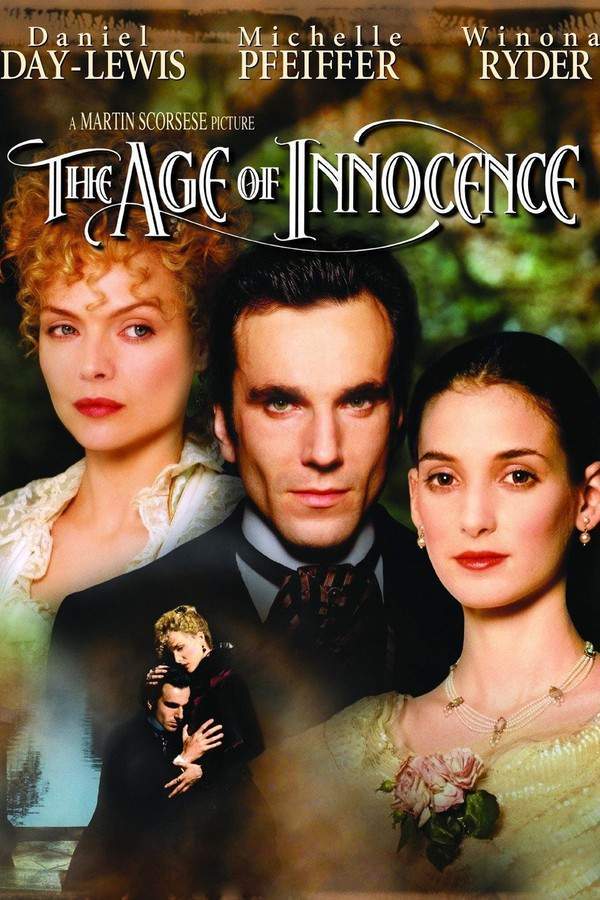
In 1870s New York, lawyer Newland Archer is engaged to the refined May Welland, representing the pinnacle of societal expectations. His life is disrupted by the return of May’s cousin, the Countess Ellen Olenska, who has lived abroad and is now considered a social outcast. As Newland becomes increasingly drawn to Ellen's unconventional spirit and experiences, he finds himself torn between his duty, his love for May, and a forbidden passion that threatens to shatter the foundations of his privileged world.
Find where to stream, rent, or buy The Age of Innocence (1993) in the US with current JustWatch availability, up-to-date pricing, and platform listings for subscription, rental, and digital purchase options.
Warning: spoilers below!
Haven’t seen The Age of Innocence yet? This summary contains major spoilers. Bookmark the page, watch the movie, and come back for the full breakdown. If you're ready, scroll on and relive the story!
Read the complete plot breakdown of The Age of Innocence (1993), including all key story events, major twists, and the ending explained in detail. Discover what really happened, and what it all means.
In 1870s New York City, a world of old-money families governs social life with strict codes of conduct, where gossip and ostracism can be as powerful as any law. In this climate, Newland Archer, a refined and dutiful lawyer, is preparing to enter a society marriage with May Welland, a match arranged to maintain calm and propriety within the upper circles. May’s cousin, Countess Ellen Olenska, returns to the city after a disastrous marriage to a Polish aristocrat. The Countess’s husband’s infidelity and her own decision to assert her independence create a palpable scandal in a society that prizes appearances over truth. Ellen’s reputation is fragile, and she faces fierce scrutiny as she attempts to find a foothold in a world that recoils from nonconformity.
Archer is briefly outraged by the double standards that punish Ellen while excusing others, and he participates in efforts to restore her standing. He persuades the van der Leuden, a leading New York clan, to host a dinner for Ellen, a move that signals his sympathy but also illustrates the delicate social maneuvering at play. Ellen, in turn, encounters Julius Beaufort, a financier who has earned his status through marriage into the Townsend family. His public charm masks a pattern of indiscretions that leaves him unpopular among the city’s elites, and his later financial downfall during a panic tests the boundaries of elite loyalty and support.
As Archer pursues May’s hand, he grows increasingly drawn to Ellen’s unconventional take on society, which stands in sharp relief to May’s perceived passivity and leisure-loving temperament. When Ellen seeks a divorce from the Count, he retaliates by threatening to expose her alleged adultery. The community pressures Archer to intervene, and while he empathizes with Ellen, he also urges her to abandon the divorce to preserve the Welland family’s reputation.
The realization that Archer has fallen in love with Ellen destabilizes his engagement to May. He tries to resolve the conflict by urging May to hurry the wedding, and while May senses the fragility of his feelings, she asks him to affirm that his love is genuine. Archer’s response seems to satisfy her—yet he cannot fully suppress his longing for Ellen, and he eventually confesses his love. Ellen, though she loves him back, declines to act on the feelings, explaining that she was prepared to endure scandal in a divorce, but Archer and May were not prepared to face the consequences.
To avoid future temptation, Ellen moves to Washington, and May accelerates the wedding plans, which proceed without a hitch—though Ellen does not attend the nuptials. Archer’s marriage becomes comfortable but lacks excitement, and he soon arranges secret meetings with Ellen, where they acknowledge that their feelings remain strong. The Count offers Ellen money and even limited personal freedom to return to him, but Ellen declines, choosing instead to live with the constraints of social expectation. Archer and Ellen continue to meet covertly, but May’s suspicions simmer as Archer’s subtler deceptions begin to unravel.
Ultimately, Ellen and Archer decide to consummate nothing and Ellen announces that she is returning to Europe, aided by a generous allowance arranged by Archer’s mentor, Mrs. Mingott. May hosts a lavish farewell party and, in a revealing moment, confesses to Archer that she is pregnant. Archer realizes that May had suspected his unconsummated affair all along, and he understands that Ellen left because she could not bring herself to pursue an affair with a married man, while the community had been quietly maneuvering to protect May’s status. The social world that seemed fixed has softened with time, yet the cost has been borne by all involved.
A quarter of a century passes, during which Archer and May raise three children. May dies of pneumonia, leaving Archer a widower. Ironically, the unwritten rules of high society fade as time moves on, and Archer’s son Ted becomes engaged to the daughter of Beaufort’s mistress, a linkage that would have been unimaginable in the old order. Ted invites Archer to Paris for a father-and-son holiday, intending to introduce him to Ellen once more. Ted reveals that, on May’s deathbed, she confessed to him that “when she asked you to, you gave up the thing you wanted most.” Archer answers with a measured truth: “She never asked me.”
The two men walk toward Ellen’s apartment, but Archer cannot bring himself to knock on the door and reconciles his longing by letting Ted go ahead. He steps away, reflecting on the complicated dance of desire, duty, secrecy, and memory that defines their lives and the society that shaped them. The years have moved beyond the old codes, yet the echoes of what was sacrificed linger in Archer’s heart.
Last updated: October 09, 2025 at 15:47
Explore frequently asked questions about The Age of Innocence (1993) with spoiler-rich answers covering the full plot summary, major story beats, character motivations, hidden details, and ending meaning. This movie summary FAQ helps explain confusing scenes, plot twists, and narrative decisions in clear, searchable detail.
Ellen returns to New York after leaving her husband, the Polish Count Olenska, because her marriage became intolerable due to his infidelities. She seeks to reclaim her independence and find support among her Welland family relatives. However, her decision to seek a divorce marks her as a social outcast in 1870s New York, where women are expected to endure unhappy marriages rather than defy convention. Her return represents a bold assertion of personal freedom over societal expectations.
Ellen loves Archer but refuses to pursue a relationship because she refuses to be the reason his life is destroyed. She explains that she was prepared to endure scandal for her own divorce, but Archer and May were not prepared to face the consequences of an affair. Ellen chooses to remove herself from the situation rather than tear apart Archer's marriage and social position.
May senses Archer's emotional distance and his growing attachment to Ellen. Her question is an attempt to secure reassurance and reaffirm his commitment. Archer's answer satisfies her temporarily, but the exchange reveals May's awareness of the threat Ellen poses to their engagement. She chooses to proceed with the wedding rather than confront the truth directly.
Ellen moves to Washington to avoid the temptation of her love for Archer. She recognizes that staying in New York, where they would continue to meet secretly, would eventually lead to a scandal that would destroy Archer's life and marriage. By removing herself, Ellen attempts to protect both Archer and his future with May from the consequences of their passion.
May hosts the farewell party for Ellen and reveals her pregnancy as a deliberate assertion of her claim over Archer. The timing is strategic, she is signaling to both Ellen and Archer that their relationship is over and that she has secured Archer's future through motherhood. The revelation also confirms that May understood all along that Archer's feelings for Ellen remained unresolved.
On her deathbed, May tells Ted that she once asked Archer to give up the thing he wanted most. However, Archer later tells Ted that May never actually asked him this. This revelation exposes May's manipulative approach, she allowed Archer to believe she was pure and innocent while using passive means to control him. It also suggests Ellen may have left based on a false premise about May's knowledge and wishes.
Earlier, May accelerates the wedding and reveals her pregnancy, hinting at her awareness of Archer's feelings.
After decades of repression, Archer finally has the opportunity to see Ellen when his son Ted brings him to Paris. However, he cannot bring himself to knock on her door. Instead, he sends Ted alone and walks away. This moment represents Archer's final choice to remain committed to duty and memory rather than fulfill his long-repressed desire. He chooses to preserve the idealized image of what might have been rather than face the reality.
Throughout the film, Archer consistently chooses social obligation over personal passion.
By the early 1900s, approximately twenty-five years after the main events, the rigid old-money social codes have relaxed significantly. This is symbolized by Archer's son Ted becoming engaged to the daughter of Beaufort's mistress, an engagement that would have been unthinkable in the 1870s. The softening of social rules allows for more flexibility in relationships and removes some of the constraints that once defined the elite world Archer inhabited.
Archer marries May because he is deeply conditioned by the social codes of his world. Even after confessing his love to Ellen, he cannot bring himself to defy society completely. May's pregnancy and the accelerated wedding proceed without complications. Archer chooses the path of least resistance, a comfortable, respectable life, over the scandal and disruption that pursuing Ellen would have caused. His marriage becomes stable but emotionally empty.
Mrs. Mingott, Archer's wealthy and influential mentor, arranges the financial support that enables Ellen to return to Europe. Despite her advanced age and being bedridden, Mrs. Mingott exercises significant power within the family structure. Her willingness to fund Ellen's departure demonstrates that even the oldest members of the elite can sometimes bend the rules when they choose to act with compassion, though Ellen's departure still represents a defeat for her independence.
Beaufort, a financier who gained status through marriage into the Townsend family, is morally compromised by his philandering and flirtations with Ellen. Although he is wealthy, the elite members resent his upstart origins. When a financial panic threatens his fortune, the very society that embraced him withdraws support. This episode reveals the transactional nature of elite loyalty, acceptance is conditional on behavior that serves the group's interests.
Discover curated groups of movies connected by mood, themes, and story style. Browse collections built around emotion, atmosphere, and narrative focus to easily find films that match what you feel like watching right now.
Stories of intense romantic longing constrained by rigid social rules.Find more movies like The Age of Innocence that delve into forbidden love within aristocratic or highly structured settings. If you enjoyed the tension between passion and propriety, these similar romance and drama stories explore the same themes of sacrifice and yearning in elegant, oppressive worlds.
The narrative typically follows a character, often established within a privileged class, whose life is upended by an outsider or a transgressive love. The central conflict is internal and external, pitting intense personal feelings against the unyielding pressure of social conventions, frequently resulting in a bittersweet resolution where duty triumphs over desire.
Movies in this thread are grouped by their focus on the immense pressure of societal expectations in elite worlds and the resulting emotional repression. They share a sophisticated, melancholic tone, a slow-burning pace that mirrors the deliberate nature of high society, and a core theme of sacrifice for the sake of appearance and stability.
Character-driven dramas where profound personal sacrifice defines the story.Discover films similar to The Age of Innocence that are defined by a central theme of emotional sacrifice. If the poignant choice to give up a great love for duty resonated with you, these recommendations feature character-driven dramas with a melancholic feel and bittersweet conclusions about the cost of conformity.
The plot revolves around a pivotal, heart-wrenching decision where a character voluntarily gives up their chance at profound happiness. The story often follows the aftermath of this choice, exploring the quiet, lifelong emotional consequences and the 'what if' that echoes through a seemingly stable but emotionally hollow life.
These films are connected by their deep exploration of sacrifice as the central emotional engine. They share a melancholic and reflective tone, a deliberate pacing that allows the weight of the choice to settle, and a bittersweet ending that acknowledges the pain of loss alongside the acceptance of a different, often lonelier, path.
Don't stop at just watching - explore The Age of Innocence in full detail. From the complete plot summary and scene-by-scene timeline to character breakdowns, thematic analysis, and a deep dive into the ending - every page helps you truly understand what The Age of Innocence is all about. Plus, discover what's next after the movie.
Track the full timeline of The Age of Innocence with every major event arranged chronologically. Perfect for decoding non-linear storytelling, flashbacks, or parallel narratives with a clear scene-by-scene breakdown.
Discover the characters, locations, and core themes that shape The Age of Innocence. Get insights into symbolic elements, setting significance, and deeper narrative meaning - ideal for thematic analysis and movie breakdowns.
Discover movies like The Age of Innocence that share similar genres, themes, and storytelling elements. Whether you’re drawn to the atmosphere, character arcs, or plot structure, these curated recommendations will help you explore more films you’ll love.
The Age of Innocence (1993) Scene-by-Scene Movie Timeline
The Age of Innocence (1993) Movie Characters, Themes & Settings
The Age of Innocence (1993) Spoiler-Free Summary & Key Flow
Movies Like The Age of Innocence – Similar Titles You’ll Enjoy
Persuasion (2022) Film Overview & Timeline
Innocence (2001) Complete Plot Breakdown
The Wings of the Dove (1997) Film Overview & Timeline
The Portrait of a Lady (1996) Full Summary & Key Details
Autumn in New York (2000) Detailed Story Recap
Innocence (1983) Full Summary & Key Details
Northanger Abbey (1987) Plot Summary & Ending Explained
The Age of Innocence (1934) Story Summary & Characters
The Innocent (1976) Movie Recap & Themes
Age of Innocence (1977) Plot Summary & Ending Explained
Illicit (1931) Movie Recap & Themes
Age of Indiscretion (1935) Ending Explained & Film Insights
The Heiress (1949) Story Summary & Characters
That Dangerous Age (1949) Ending Explained & Film Insights
The Age of Consent (1932) Spoiler-Packed Plot Recap