Plot Explained Spoilers guaranteed!
Plot Explained

Browse by genre

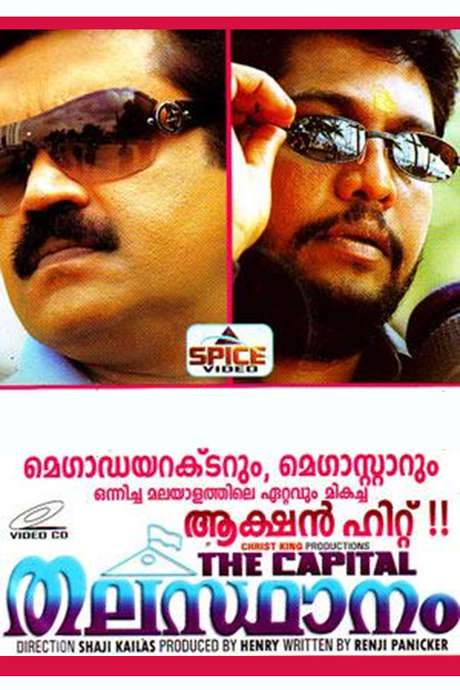
Thalasthanam (1992) movie poster

Plot Summary

Thalasthanam (1992) Plot Summary Explained

Release, runtime and language
1992 · More mins · Malayalam
Directed by
Shaji Kailas
Starring
Vijayakumar, Sudheesh, Suresh Gopi, K. B. Ganesh Kumar, Ashokan, Idavela Babu

Thalastaanam (The Capital) is a 1992 Malayalam-language Indian film directed by Shaji Kailas. It features an ensemble cast that includes Suresh Gopi, Narendra Prasad, Geetha, M. G. Soman, Biyon and Vijayakumar, with the latter making his on‑screen debut in this picture.

On this page (5)
  1. 1 What happens: full plot
  2. 2 Plot questions answered
  3. 3 Movie threads
  4. 4 Movies like Thalasthanam
  5. 5 Every angle

Full plot summary · contains spoilers

What Happens in Thalasthanam: Full Plot Summary

The whole story of Thalasthanam (1992) explained, from the opening scene to the final frame: every key event, every twist and what it all adds up to. Read it as a quick recap before the sequel, to check a scene you missed, or to finally understand what really happened.

Unnikrishnan Vijayakumar is an easy-going youth who joins a law college, where he and his first-year peers are subjected to ragging by seniors led by Pappan Ashokan, a student leader with strong political clout. When Unnikrishnan opposes the harassment, Pappan violently thrashes him and humiliates him in front of the girls. In a moment of retaliation, he stabs Pappan in the college corridor, a desperate act that sets off a chain of political and personal repercussions.

G. Parameshwaran alias G.P. Narendra Prasad, a powerful political mentor to Pappan, intervenes by sending his goons to seize Unnikrishnan. Yet G.P. also sees potential in him and brings him into the party, striking a wary truce between Pappan and Unnikrishnan as part of a larger strategy. As the government of Kerala introduces a bill on self-financing colleges, the party—led by G.P.—opens a campaign of student agitation, appointing Unnikrishnan to lead the movement and mobilize thousands of students in support of their cause. The atmosphere grows tense as violence becomes a tool to press political demands, and the lines between student activism and coercive power blur.

In a calculated move to intimidate critics, G.P. schemes to immolate Unnikrishnan in public view—before the police and the press—to demonstrate the government’s weakness and to rally supporters. The plan succeeds only in tragedy: Unnikrishnan is killed, and his death becomes a weapon in G.P.’s hands against the state, while also delivering a crushing blow to his own family. Harikrishnan, Unnikrishnan’s elder brother who arrives in Kerala from Mumbai to perform the funeral rites, begins to question the official version of events and seeks the truth behind the murder.

Harikrishnan faces a chorus of resistance—from the college administration to law enforcement and local politicians—yet he refuses to walk away. He presses for a proper inquiry, but his requests to the Chief Minister go unanswered. Along the way, he encounters Meera [Geetha], an aggressive journalist who witnessed Unnikrishnan’s death. Meera’s testimony and tenacious reporting become crucial as Harikrishnan pieces together the broader conspiracy and the depths of G.P.’s political reach.

With new resolve, Harikrishnan rejects the political path laid out by G.P. and instead chooses to stand up to the violence that fueled his brother’s demise. He confronts repeated assaults from G.P.’s hoodlums, but, bolstered by college students who rally to his cause, he fights back and ultimately burns G.P. alive, ending a corrupt cycle of power and violence. The story culminates in a stark reckoning—a family’s grief, a community’s awakening, and a political landscape forced to confront its own excesses.

In the end, the film leaves audiences with a somber meditation on how a single act of courage in the face of intimidation can ignite a broader fight for justice, even as it exacts a heavy toll on those who stand in the way of entrenched power.
Last updated: October 09, 2025 at 12:37

Was this helpful?

Plot questions answered

Thalasthanam Plot Explained: Your Questions Answered

The questions people ask most about Thalasthanam (1992): what happens in the confusing scenes, why the characters do what they do, the twists, hidden details and what the ending means. Each answer contains spoilers.

Q1

Why does G.P. recruit Unnikrishnan into his party after he stabs Pappan?

G.P. sees potential in Unnikrishnan's boldness and willingness to fight back. Despite Unnikrishnan stabbing his own protégé Pappan, G.P. recognizes that a student willing to take such a drastic action against a politically connected senior could be a valuable asset for his party's student wing. G.P. brokers a truce between Pappan and Unnikrishnan, redirecting their personal vendetta into political activism that serves his larger agenda.

Foreshadowing: Early in the film, G.P.'s goons are sent to bring Unnikrishnan to his fold, showing his interest in recruiting the defiant student from the start.

  • gp
  • unnikrishnan
  • recruitment
  • politics
  • pappan
Q2

Why does G.P. arrange to immolate Unnikrishnan in public?

G.P. orchestrates the public immolation to create a political weapon against the state government. By killing Unnikrishnan in front of police and media, G.P. aims to demonstrate the government's weakness and failure to protect students, which would rally support for his party's agitation against the self-financing college bill. Unnikrishnan's death becomes both a propaganda tool and a way to intensify the political crisis.

Foreshadowing: G.P. appoints Unnikrishnan as the leader of the student movement, putting him at the center of the volatile agitation.

  • immolation
  • gp
  • political scheme
  • student agitation
Q3

How does Harikrishnan discover the truth behind Unnikrishnan's death?

Harikrishnan teams up with Meera, a journalist who witnessed Unnikrishnan's death. Her testimony provides crucial information that contradicts the official version of events. Together, they investigate the political conspiracy and uncover G.P.'s involvement in orchestrating the immolation. Meera's reporting helps surface the manipulation behind the movement and the true motives behind Unnikrishnan's killing.

Foreshadowing: Meera is introduced as an aggressive journalist who witnessed the death, positioning her as a key witness in the investigation.

  • harikrishnan
  • meera
  • investigation
  • truth
  • death
Q4

Why does Harikrishnan reject G.P.'s political offer and choose to fight him directly?

After learning the truth about his brother's murder, Harikrishnan refuses to be co-opted into G.P.'s political machinery. Instead of using the information for political gain, he chooses to stand up against the violence that claimed Unnikrishnan's life. With support from college students who rally to his cause, Harikrishnan confronts G.P.'s hoodlums directly, eventually burning G.P. alive in a final confrontation.

Foreshadowing: Throughout the investigation, Harikrishnan faces repeated assaults from G.P.'s hoodlums, yet he refuses to back down or compromise.

  • harikrishnan
  • gp
  • confrontation
  • justice
  • revenge
Q5

What triggers the final confrontation at the college campus?

The final confrontation is triggered by Harikrishnan's continued refusal to abandon his pursuit of justice despite repeated beatings and threats. His resilience inspires college students to rally behind him. When G.P.'s hoodlums attack once more, Harikrishnan and the students fight back together, culminating in Harikrishnan burning G.P. alive. The confrontation represents the climax of the struggle between student activism and political corruption.

Foreshadowing: Harikrishnan faces multiple assaults throughout the investigation, each attack strengthening his resolve to end G.P.'s grip on the community.

  • college campus
  • confrontation
  • students
  • gp death
Q6

Why does Unnikrishnan stab Pappan in the college corridor?

Unnikrishnan attacks Pappan after being subjected to violent ragging and public humiliation. When he opposes the harassment by seniors led by Pappan, he is brutally thrashed and insulted in front of female students. In a moment of desperate retaliation, Unnikrishnan stabs Pappan with a knife in the college corridor, a violent response to the bullying and degradation he endured.

Foreshadowing: The film opens with Unnikrishnan joining law college, immediately establishing the toxic environment of senior student bullying.

  • unnikrishnan
  • pappan
  • stabbing
  • ragging
  • college
Q7

What was the self-financing college bill that sparked the student agitation?

The Government of Kerala introduced a bill allowing self-financing colleges, which would allow educational institutions to operate without government funding while charging higher fees. This would have made higher education more expensive and accessible primarily to wealthier students. G.P.'s party opposed the bill and launched a massive student agitation campaign, appointing Unnikrishnan as the movement leader to mobilize thousands of students against the proposed measure.

Foreshadowing: The timeline shows the bill's introduction occurring after G.P. brings Unnikrishnan into his party, setting the stage for the political exploitation of student unrest.

  • self-financing bill
  • student agitation
  • kerala
  • education
Q8

Why does Meera's testimony become crucial in uncovering the conspiracy?

Meera is an aggressive journalist who witnessed Unnikrishnan's death at the immolation. Her firsthand account challenges the official narrative that the government was responsible. Her testimony provides Harikrishnan with credible evidence of what actually happened, helping him piece together how G.P. orchestrated the killing for political gain. Meera's reporting also helps expose G.P.'s broader plans to escalate violence against the government.

Foreshadowing: Meera is introduced during Harikrishnan's investigation, specifically as someone who was present at the scene of Unnikrishnan's death.

  • meera
  • witness
  • testimony
  • journalist
  • conspiracy
Q9

How does Unnikrishnan become the leader of the student agitation?

After recruiting Unnikrishnan into his party, G.P. strategically appoints him as the leader of the movement against the self-financing college bill. Recognizing Unnikrishnan's reputation as someone who stood up to Pappan and the college administration, G.P. channels the student's anger into organized political action. Unnikrishnan's appointment allows G.P. to mobilize thousands of students while using the ambitious young man as a public face for the agitation.

Foreshadowing: G.P. sees potential in Unnikrishnan from the moment he brings him into the party, setting up his later elevation to movement leader.

  • unnikrishnan
  • student leader
  • agitation
  • movement
  • gp
Q10

Why does Pappan accept the truce with Unnikrishnan despite being stabbed?

Pappan agrees to the truce because his political mentor G.P. brokered it as part of a larger strategy. Although Unnikrishnan stabbed him, G.P. forces both men to set aside their personal vendetta and channel their conflict into political engagement. Pappan's political ambitions depend on G.P.'s support, so he has little choice but to accept the arrangement, even though he remains hostile toward Unnikrishnan.

Foreshadowing: Pappan is established as a student leader with strong political connections, making him reliant on G.P.'s patronage.

  • pappan
  • truce
  • unnikrishnan
  • politics
  • mentor
Q11

What price does Harikrishnan pay for seeking justice for his brother?

Harikrishnan pays a heavy personal cost in his pursuit of justice. He faces constant resistance from the college administration, police, and local politicians. He endures repeated assaults from G.P.'s hoodlums, including beatings and threats. Ultimately, he must commit an act of lethal violence himself, burning G.P. alive, which makes him morally complicit in the very cycle of violence that killed his brother. The film portrays his victory as bittersweet, marked by trauma and moral compromise.

Foreshadowing: The meta notes emphasize the heavy emotional weight and the tragic cycle of violence that defines the film's conclusion.

  • harikrishnan
  • justice
  • cost
  • violence
  • brother

Movie threads

More Movies Like Thalasthanam, by Mood & Story

Curated lists built around what makes Thalasthanam tick: the same mood, the same kind of story or the same emotional payoff. Each list explains why these movies belong together.

Political corruption thrillers like Thalasthanam

Intense stories where individuals take on an entire corrupt and powerful establishment. If you liked the intense battle against a corrupt system in Thalasthanam, you'll find more movies like it here. These gritty political thrillers follow driven protagonists taking on powerful, unethical establishments, delivering stories of vengeance and justice with high emotional stakes.

  • gritty
  • tense
  • angry
  • driven
  • vengeful
  • oppressive
  • Tone: dark, tense, vengeful
  • Pacing: fast, relentless
Why these movies?

The story pattern: These stories typically follow a protagonist—an ordinary citizen, activist, or disillusioned insider—who is propelled into a conflict with a powerful, corrupt entity after a personal loss or act of injustice. The narrative arc involves uncovering layers of conspiracy, facing extreme opposition, and culminating in a direct, often violent, confrontation that underscores the high cost of challenging the system.

Why they belong together: Movies are grouped here based on their shared focus on systemic corruption as the primary antagonist, a gritty and dark tone, high narrative intensity, and a protagonist driven by a mix of vengeance and a quest for justice. The emotional journey is consistently heavy and the pacing is often fast, reflecting the urgency of the conflict.

Bittersweet revenge stories like Thalasthanam

Stories where revenge is achieved but leaves a hollow, somber victory. For viewers who appreciated the complex moral victory in Thalasthanam, this section collects movies with similar bittersweet revenge arcs. These films explore the heavy emotional toll of vengeance, where justice is served but the ending feels weighted rather than celebratory.

  • vengeful
  • somber
  • morally complex
  • heavy
  • tragic
  • driven
  • Tone: dark, somber, morally complex
  • Pacing: driven, steady to fast
Why these movies?

The story pattern: The narrative pattern involves a profound personal loss that triggers a driven, often violent, quest for retribution. The protagonist's journey is morally ambiguous, forcing them into dark choices. The story concludes with the main antagonist being defeated, but the means of victory—often through an act of violence—highlights the tragic cycle of revenge, resulting in an ending that is satisfying yet deeply somber.

Why they belong together: These films are united by their exploration of revenge not as a cathartic release, but as a traumatic and morally complex process. They share a dark tone, heavy emotional weight, and a specifically bittersweet ending feel where justice is achieved without true happiness, focusing on the lasting scars of the journey.

If you liked this

Movies Like Thalasthanam

Similar movies to Thalasthanam: the same genre, themes or kind of story. Each one comes with its own plot summary, timeline and ending explained.

Browse all movie summaries

Every angle

Thalasthanam (1992) Explained: Plot, Timeline & Characters

Everything about Thalasthanam in one place: what happens in the plot summary, the timeline in chronological order, the characters and meaning and a spoiler-free summary. What's After the Movie adds the cast, box office and post-credit scenes.

Coming soon on iOS and Android

The Plot Explained Movie Summary App

Plot summaries, endings explained and timelines on your phone. Catch up on any movie in minutes, save your favorites and never miss a twist again.

Be the first to know when we launch. Your email stays private, always.

Learn more about the app