Plot Explained Spoilers guaranteed!
Plot Explained

Browse by genre

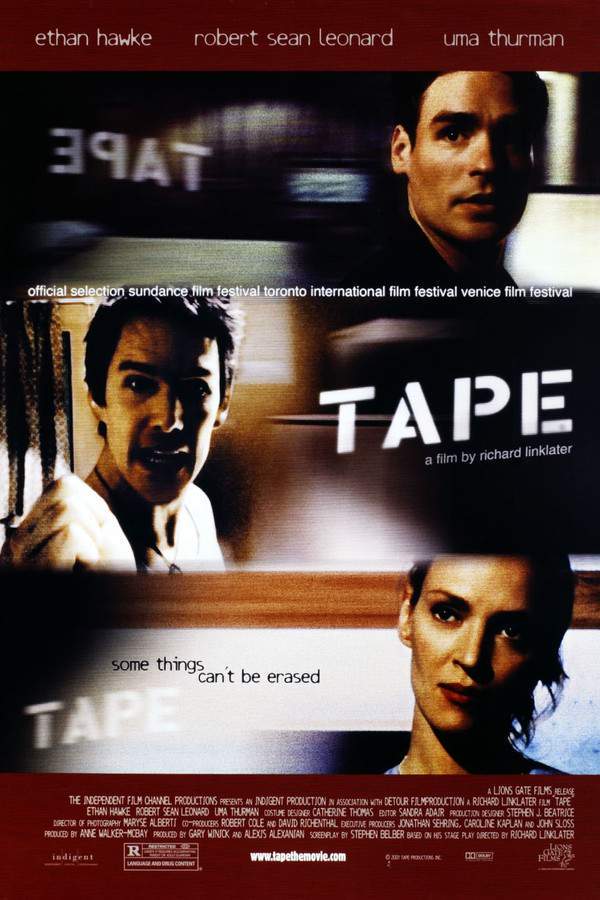
Tape (2001) movie poster

Plot Summary

Tape (2001) Plot Summary Explained

Release, runtime and language
2001 · 86 min · English
JustWatch #23,802 4

An aspiring actress finds herself embroiled in the ruthless and competitive world of show business. A seemingly routine screen test quickly becomes a disturbing audition, revealing the dark side of fame and the harsh realities she must face. The experience forces her to confront the sacrifices and potential dangers that come with pursuing her dreams in a cutthroat industry.

On this page (7)
  1. 1 Where to watch
  2. 2 What happens: full plot
  3. 3 Plot questions answered
  4. 4 The book behind the movie
  5. 5 Movie threads
  6. 6 Movies like Tape
  7. 7 Every angle

Where to watch

Where to Watch Tape (2001)

Where can you watch Tape? Stream, rent or buy it in the US, including on AMC+, Philo and Sundance Now: current JustWatch availability with up-to-date prices.

Streaming availability powered by JustWatch

Full plot summary · contains spoilers

What Happens in Tape: Full Plot Summary

The whole story of Tape (2001) explained, from the opening scene to the final frame: every key event, every twist and what it all adds up to. Read it as a quick recap before the sequel, to check a scene you missed, or to finally understand what really happened.

The film unfolds in a single, tense setting: a Lansing, Michigan motel room that becomes the entire world for the story. In this confined space, Vince—a drug dealer who also works as a volunteer firefighter and lives in Oakland—returns to his hometown to host the presence of an old high school friend, Jon Salter, a documentary filmmaker hoping to premiere or advance his work at the Lansing Film Festival. The room acts as a stage where past loyalties, shared memories, and buried tensions collide, turning a simple reunion into something far more complicated.

As the two men reconnect, the mood shifts from warmth to awkward unease. They begin with nostalgia, trading stories from their high school days and catching up on the years that have passed since. The initial warmth gives way to cracks in the façade as the conversation travels toward a darker, more intimate topic: Amy, Vince’s former girlfriend. Vince recalls their relationship and reveals a troubling detail: Amy and Jon slept together after Vince and Amy had separated, and Vince claims Amy told him that Jon had raped her. This accusation sits heavy in the room, coloring every sentiment with suspicion and fear, and Vince becomes increasingly absorbed by the idea that Jon betrayed him in more profound ways than their shared past would suggest.

The tension escalates when Vince reveals that he has a hidden tape recorder, a silent witness to their conversation. He extracts a verbal confession from Jon about the alleged incident, and the violence of what has been whispered about suddenly becomes something tangible and undeniable in the room. Jon’s horror at the contrived or coerced confession underscores a central question of the film: what is truth when trust has fractured and revenge seems so near at hand? The replay of the confession on the tape intensifies the stakes, turning the room into a pressure chamber where every word carries weight and consequence.

A dinner plan emerges as a grim, almost ritualistic test of each man’s conscience. Amy arrives, bringing with her a formal life as an Assistant District Attorney in the Lansing Justice Department. The atmosphere remains fraught with awkwardness, but the trio settles into a forced conversation about the past, the present, and the uneasy memory of what happened ten years prior at a party. Jon asks for Amy’s forgiveness for the act as he saw it; Amy counters by claiming the encounter with Jon was consensual, leaving Jon unsettled and convinced that she is denying or minimizing what occurred. The exchange exposes how memory and perception can diverge, and it lays bare the fragile nature of accountability when fear, shame, and power are at play.

Amy’s insistence on surveillance and control crystallizes in a sharp moment: she makes a phone call to the police and asks for a squad car to pick up one person for drugs and another for sexual misconduct. The gesture, whether real or feigned, adds a ticking clock to the scene—Amy informs them they have only about four minutes to make a run for it. The urgency of the moment pulls the men back into a raw, primal struggle with consequences that could reshape the lives they’ve built since their youth.

Facing the imminent possibility of arrest, Jon chooses to stay in the room to demonstrate genuine remorse, hoping to prove that his past actions do not define his future. Vince, by contrast, feels the weight of an entire night—of a past he cannot unremember and a present that could erupt at any moment—leading him to destroy evidence and attempt to erase the traces of what has occurred. He flushes the narcotics down the toilet and discards the incriminating tape, attempting to salvage what he can of his own reputation and safety.

In a final turn, Amy reveals that she did not actually call the police, and she leaves the motel room, leaving the men to face the leftovers of their confrontation. The outcome is deliberately ambiguous, hung between confession, denial, and the consequences of those choices in a world where past actions continue to echo into the present. What began as a simple reunion becomes a slow-burning study of guilt, control, and the murky line between protection and retribution.

The film’s strength lies in its claustrophobic setting and the way dialogue becomes a weapon and a shield. Every exchange is calibrated to expose how people negotiate truth when personal loyalties are at stake, how fear can drive people to disclose or withhold, and how a single encounter can redefine the boundaries of trust. The motel room becomes less a place of temporary shelter and more a crucible where long-held grievances are tested, reinterpreted, and finally left unsettled, leaving the audience to ponder how easily a night designed for reconciliation can spiral into a confrontation with the past that may never be fully resolved.

Last updated: October 09, 2025 at 15:45

Was this helpful?

Plot questions answered

Tape Plot Explained: Your Questions Answered

The questions people ask most about Tape (2001): what happens in the confusing scenes, why the characters do what they do, the twists, hidden details and what the ending means. Each answer contains spoilers.

Q1

Why does Vince record Jon's confession about Amy?

Vince plants a hidden tape recorder to obtain concrete proof of Jon's admission about the incident with Amy. His motivation is to force a verbal confession that he can use as leverage, either to expose Jon, seek revenge for perceived betrayal, or have something tangible to hold over him. The tape transforms an accusation Vince claims Amy made into undeniable evidence, elevating the stakes of their confrontation from memory and hearsay to something verifiable.

Foreshadowing: Vince's initial warmth toward Jon subtly shifts into calculated questioning as he steers the conversation toward the forbidden topic.

  • tape recorder
  • confession
  • evidence
  • revenge
  • manipulation
Q2

Why does Amy say the encounter with Jon was consensual?

Amy insists the encounter was consensual, directly contradicting what Vince claims she told him about being raped. This creates one of the film's central ambiguities: either Amy is denying or minimizing a traumatic event, or Vince distorted or fabricated all or part of what Amy supposedly told him. The film intentionally leaves this unresolved, showing how memory and perception diverge when trust has fractured.

Foreshadowing: Vince's account of Amy's claim about rape is introduced gradually, building suspicion before the full accusation emerges.

  • consent
  • memory
  • accusation
  • denial
  • truth
Q3

Why does Amy call the police if she doesn't send them?

Amy makes the call as a psychological power play, a test to see how each man will react under immediate threat of arrest. By warning them they have four minutes to run, she forces Jon and Vince into a primal choice that reveals their true characters. Whether the call was genuinely intended or a bluff, it functions as a mechanism to push both men toward confronting their guilt rather than escaping consequences.

Foreshadowing: Amy's arrival already introduces law enforcement into the dynamic, she establishes herself as an Assistant District Attorney before the call.

  • police
  • power
  • test
  • control
  • consequences
Q4

Why does Jon choose to stay in the room instead of running?

Jon decides to remain in the motel room to demonstrate genuine remorse and accept accountability for his past actions. Rather than flee and appear guilty, he chooses to face the potential legal and personal consequences head-on. This decision represents his attempt to prove that his documentary work and personal growth have transformed him, his staying becomes a moral stance rather than a calculated escape.

Foreshadowing: Jon has spent the evening discussing his documentary work and seeming to seek redemption for past transgressions.

  • remorse
  • accountability
  • choice
  • facing consequences
Q5

Why does Vince flush his drugs and destroy the tape?

Facing imminent arrest, Vince acts to protect himself rather than risk his future. Flushing the narcotics eliminates the drug possession charge, and destroying the tape removes the recorded confession that could be used against both himself (for recording someone without consent) and Jon. His destruction of evidence reflects self-preservation instincts, though it also erases the proof he previously sought to obtain, showing how panic overrides calculated revenge.

Foreshadowing: Vince's obsession with the tape shifts to panic as Amy's phone call introduces external danger.

  • self-preservation
  • evidence
  • panic
  • drugs
  • tape recorder
Q6

Why is Amy's job as Assistant District Attorney important to the story?

Amy's position as an Assistant District Attorney creates a sharp power dynamic in the room, she wields legal authority over both men. Her job adds stakes to every accusation: a rape allegation from a prosecutor carries serious weight, and Vince's drug dealing becomes even more dangerous with a law enforcement figure present. Her professional role also raises questions about whether she's using the encounter to exercise control or whether her past trauma shaped her career choice.

Foreshadowing: The tension escalates significantly when Amy reveals her profession upon arriving at the motel.

  • assistant district attorney
  • power
  • law enforcement
  • career
Q7

What actually happened between Amy and Jon ten years ago?

The film deliberately leaves the truth ambiguous. Jon admits to the encounter but believes it was consensual; Amy contradicts this by saying it was consensual from her perspective, meaning she wanted it. This creates a paradox: both claim it was consensual yet disagree about what occurred. The film suggests the truth may be unknowable or that both characters have constructed narratives that serve their own psychological needs, leaving the accusation unresolved.

Foreshadowing: The party ten years prior is referenced early in the conversation as a shared but never fully explained event.

  • ten years ago
  • party
  • ambiguous truth
  • memory
Q8

Why does Amy leave the motel room at the end?

Amy leaves after revealing she never actually called the police, abandoning both men to process the night's confrontation on their own. Her departure is ambiguous, she may have orchestrated the entire evening as a form of retribution, a test, or a way to reclaim agency over a past trauma. By leaving, she denies both men closure and forces them to live with the unresolved questions, just as she presumably has for a decade.

Foreshadowing: Throughout the evening, Amy maintains emotional distance and control, watching the two men navigate their conflict.

  • ambiguous ending
  • departure
  • control
  • unresolved
Q9

Why does Vince bring up the rape accusation after so many years?

Vince uses the reunion as an opportunity to confront Jon about a betrayal he has carried for a decade. His motivation appears twofold: genuine anger over what he believes happened to Amy, and a strategic use of the accusation to either force confession or manipulate Jon. The timing suggests Vince planned this confrontation, renting the room, inviting Amy, and recording the conversation all indicate premeditated revenge rather than spontaneous confrontation.

Foreshadowing: Vince guides the conversation from nostalgic warmth toward the darker topic of Amy incrementally.

  • betrayal
  • confrontation
  • revenge
  • decade old
Q10

Why does the entire film take place in one motel room?

The single-location setting creates claustrophobic pressure that forces the characters to confront each other without escape. The motel room functions as a crucible where past grievances must be addressed because there is nowhere to go and no distractions from the uncomfortable truth. This theatrical constraint amplifies every word and gesture, making dialogue itself the source of conflict and revealing how environment can intensify psychological tension.

Foreshadowing: The film's opening immediately establishes the motel as the sole setting and never leaves it.

  • single location
  • motel room
  • claustrophobic
  • setting

Movie threads

More Movies Like Tape, by Mood & Story

Curated lists built around what makes Tape tick: the same mood, the same kind of story or the same emotional payoff. Each list explains why these movies belong together.

Claustrophobic confession dramas like Tape

Intense character studies where trapped figures unravel dark secrets. For viewers seeking movies like Tape that use a single location to create intense pressure. These character-driven stories focus on psychological manipulation and the explosive fallout of dark secrets, delivering a tense, unsettling experience with heavy emotional weight.

  • claustrophobic
  • tense
  • unsettling
  • confrontational
  • psychological
  • pressure cooker
  • Tone: tense, confrontational, unsettling
  • Pacing: steady, real-time escalation
Why these movies?

The story pattern: The narrative typically unfolds in real-time or over a short period within one setting, like a room or an apartment. A seemingly mundane reunion or meeting escalates into a psychological battle, as characters use conversation to probe, accuse, and manipulate each other over a shared, traumatic past event.

Why they belong together: They are grouped by their shared high-intensity, tense tone and their reliance on a claustrophobic setting to amplify psychological conflict. The pacing is steady and deliberate, building dread through dialogue rather than action, and the emotional weight is almost always heavy, focusing on themes like betrayal, guilt, and moral ambiguity.

Movies about memory and manipulation like Tape

Stories where the past is a battleground and truth is contested. If you liked Tape's exploration of unreliable memory and psychological power dynamics, this thread features similar dramas and thrillers. These films focus on contested past events, moral ambiguity, and the devastating impact of manipulation on relationships.

  • unreliable narrator
  • psychological
  • morally ambiguous
  • tense
  • unsettling
  • betrayal
  • Tone: psychological, tense, morally ambiguous
  • Pacing: steady, methodical unraveling
Why these movies?

The story pattern: The plot revolves around a pivotal past event—often a crime or betrayal—that is revisited from multiple, conflicting perspectives. The narrative structure challenges the viewer's perception, as characters actively reshape the narrative for their own ends, leading to a climax where the 'truth' remains ambiguous or devastatingly revealed.

Why they belong together: These movies share a focus on themes of memory, confession, and power dynamics. They possess a moderate complexity due to their nuanced handling of subjective truth, and typically end on an ambiguous or bleak note, leaving the emotional and moral consequences unresolved. The tone is consistently tense and psychologically heavy.

If you liked this

Movies Like Tape

Similar movies to Tape: the same genre, themes or kind of story. Each one comes with its own plot summary, timeline and ending explained.

Browse all movie summaries

Every angle

Tape (2001) Explained: Plot, Timeline & Characters

Everything about Tape in one place: what happens in the plot summary, the timeline in chronological order, the characters and meaning and a spoiler-free summary. What's After the Movie adds the cast, box office and post-credit scenes.

Coming soon on iOS and Android

The Plot Explained Movie Summary App

Plot summaries, endings explained and timelines on your phone. Catch up on any movie in minutes, save your favorites and never miss a twist again.

Be the first to know when we launch. Your email stays private, always.

Learn more about the app