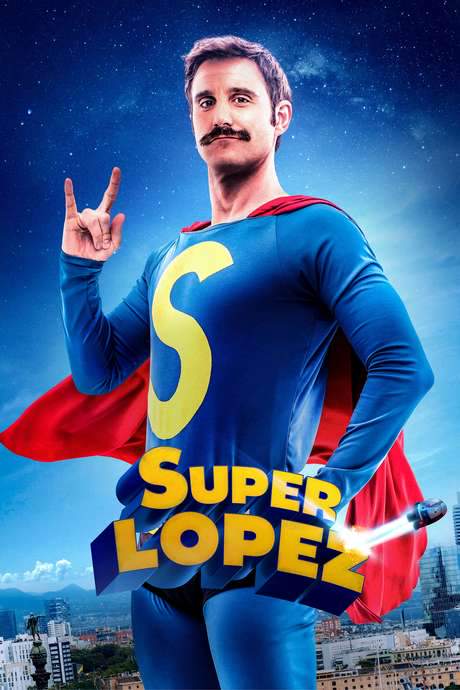
On the distant world of Chitón, a scientist named Jan (Padre Chitón) engineers what he calls the ultimate weapon: a baby with extraordinary powers built to topple the evil dictator General Skorba. To keep his mission secret, the infant is sent across the cosmos in a small starship, while Skorba’s daughter, Ágata, pursues him in a separate ship. A catastrophic collision with a satellite alters their fates—Opens a path to Earth for the child and a path to the United States for Ágata. The baby lands in Spain, and Ágata lands far away, setting in motion a clash that blends science fiction with a family tale. The infant is adopted by the López family, Dani Rovira guiding the portrayal of Juan López, who will grow up to be a hero under a carefully kept secret.
Years pass, and Juan López lives a seemingly ordinary life, gently masking his superpowers unless no one is watching. In his professional world, his boss and friend Jaime helps steer his career, and he brings in Luisa Lanas, a bright mind played by Alexandra Jiménez. A spark forms between López and Luisa, who becomes a focal point of his personal life even as he juggles the quiet burden of his hidden gifts. A dramatic moment arrives when a runaway subway careens toward disaster; López steps in to halt the train, an act of bravery that becomes public spectacle and draws Ágata’s attention. Now a powerhouse tech figure, Ágata leverages the moment to reveal her true interest in López.
Seeking connection, López receives a message from Ágata through an ultrasound device that speaks only to him. He journeys to reunite with his Earth parents and to confront the truth of his birth—an encounter that unfolds with a holographic message from his biological father and a quiet, revealing explanation of the Chitón conflict. The message urges López to learn to wield his abilities, something his Earth parents urge him to pursue, guiding him through trial after trial toward flight and mastery.
As López begins to understand his heritage, the drama intensifies when Ágata kidnaps both Jaime and Luisa, forcing López to return to the place where his powers truly belong: the circle of those who raised him. With his Earth parents’ home as a base, López, his mother Gracia Olayo (María) and others rally to rescue his friends. A climactic confrontation unfolds when Ágata unleashes a colossal mecha robot, a weapon that tests every ounce of López’s resolve and strength. His Earth father—Pedro Casablanc as Juan López (Padre)—pulls one last, desperate move, firing a shotgun to distract the attacker even as danger closes in.
The battle erupts in the shadow of a stadium, a sequence that sees López don his suit under the pressure of heat and fear. His adoptive mother’s steadfast words echo in his mind as he confronts the threat, aided by his parents, Jaime, and Luisa. The mecha’s momentum threatens to overwhelm him until López channels his gifts—ice breath and rapid reflexes—to turn the tides. A dramatic rescue culminates with Ágata captured and López restored to the safety of his loved ones. The family regroups, and a hopeful message lingers: his true home planet still waits, but for now, López has a plan.
In the aftermath, Skorba’s ship returns to Chitón, bringing Ágata back along with the man everyone believed was “Juan” in the park. The ship’s departure marks a shift in leadership for the planet, as the man steps into a new role as its leader. Back on Earth, the man’s transformation into a genuine superhero stirs mixed feelings from the press and the public, who debate the spectacle of a once-hidden guardian becoming a public figure. López and Luisa start dating, embracing a future built on trust and partnership, while a parting moment on Earth hints at the ongoing mystery of identity: a pacifier left behind by the child who once sparked a galaxy of possibilities.
In the end, the story circles back to the idea that family, duty, and choice shape a hero. López, once a clandestine savior, now stands as a bridge between two worlds. The film blends humor, heart, and a galactic-sized destiny, inviting audiences to consider what it means to be different and how that difference can be a force for good.