Plot Explained Spoilers guaranteed!
Plot Explained

Browse by genre

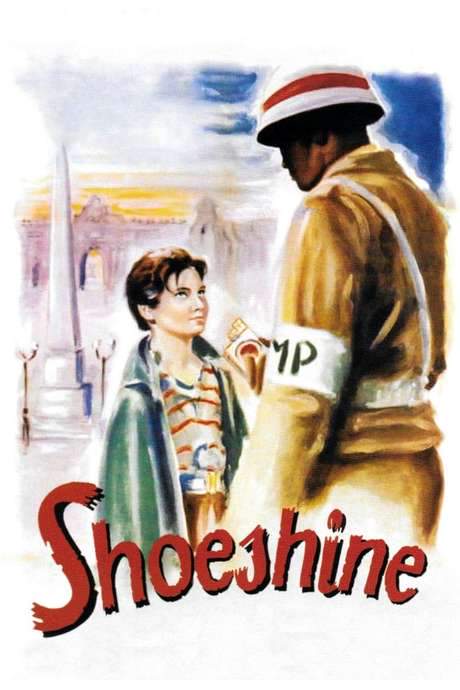
Shoeshine (1946) movie poster

Plot Summary

Shoeshine (1946) Plot Summary Explained

Release, runtime and language
1946 · 91 mins · Italian
Loading streaming availability…
Directed by
Vittorio De Sica
Starring
Franco Interlenghi, Emilio Cigoli, Antonio Nicotra, Annielo Mele, Gino Saltamerenda, Bruno Ortenzi

At a racetrack just outside Rome, two young shoeshine boys, Pasquale, an orphan, and his younger friend Giuseppe, spend their days polishing shoes and watching the horses sprint by. Dreaming of owning a mount of their own, they painstakingly save their meager earnings in hopes of finally buying a horse to ride together.

On this page (6)
  1. 1 Where to watch
  2. 2 What happens: full plot
  3. 3 Plot questions answered
  4. 4 Movie threads
  5. 5 Movies like Shoeshine
  6. 6 Every angle
Loading streaming availability…

Full plot summary · contains spoilers

What Happens in Shoeshine: Full Plot Summary

The whole story of Shoeshine (1946) explained, from the opening scene to the final frame: every key event, every twist and what it all adds up to. Read it as a quick recap before the sequel, to check a scene you missed, or to finally understand what really happened.

Two friends, Giuseppe Filippucci and Pasquale Maggi, scrape by shining shoes on the crowded streets of Rome, living frugally while saving every lira in the hope of finally buying a horse.

One day, Giuseppe’s older brother, Attilio, visits and reveals that Panza, a notorious fence, has some work for them. Panza sends the boys to fetch two blankets to sell. They turn the blankets into quick cash by selling them to a fortune teller, but this small windfall triggers a dangerous chain of events. Panza, Attilio, and another man burst into the fortune teller’s home, posing as policemen to seize the moment. They claim the fortune teller handles stolen goods and force the boys from the scene, allowing them to keep the blanket money (2,800 lira) plus an additional 3,000 lira. With this money, the boys finally have enough to realize their dream of owning a horse.

Back in the city, the situation spirals. The real police, along with the fortune teller, bring the boys to the precinct for questioning. The authorities accuse them of stealing 700,000 lira from the fortune teller’s house—clearly the work of Panza and Attilio in disguise. The boys steadfastly deny the charges and withhold knowledge of the three con men, ending up separated and sent to a juvenile detention center.

In the daunting confines of the jail, Giuseppe receives parcels from the outside world and shares his food with fellow inmates in his cell. Arcangeli, another inmate, discovers a note hidden in a bread crumb from the parcel. The note comes from Attilio’s boss, directing the conspirators to keep silent about the brothers’ involvement. Giuseppe informs Pasquale, and the two decide not to expose the truth.

The tension peaks during a police inquiry. In the chief’s office, the interrogators threaten force. A guard stages a mock beating with a sandbag while another inmate pretends to hear Giuseppe scream in pain, a ruse designed to extract confessions. Believing his friend is being harmed, Pasquale breaks and divulges Panza’s name and Attilio’s role to the chief, shocking Giuseppe when he learns of the betrayal.

A file is planted in Pasquale’s cell, and he is flogged as punishment. At their formal court hearing, Giuseppe is sentenced to one year in prison and Pasquale to two years. The wheels of fate then begin to turn toward an audacious escape. Giuseppe agrees to follow Arcangeli’s plan to slip out.

During a movie screening inside the prison, the escape unfolds. Pasquale informs the police chief where Giuseppe and Arcangeli have gone and directs them to the horse’s location. They pursue, but the pair manage to elude capture on the horse. A chase ends on a bridge, where Arcangeli bolts away while Giuseppe and Pasquale make their exit in different directions. Arcangeli flees, while Giuseppe remains on the scene as Pasquale, in a moment of desperation, strikes with his belt, sending Giuseppe tumbling from the bridge and striking the rocks below. As Pasquale weeps over his friend’s apparently dead body, the police close in and the horse disappears into the distance.
Last updated: October 09, 2025 at 12:38

Was this helpful?

Plot questions answered

Shoeshine Plot Explained: Your Questions Answered

The questions people ask most about Shoeshine (1946): what happens in the confusing scenes, why the characters do what they do, the twists, hidden details and what the ending means. Each answer contains spoilers.

Q1

Why did Pasquale reveal Panza and Attilio's names to the police?

Pasquale broke because the police staged a fake beating. While Giuseppe was being "interrogated" in one room, Pasquale heard what sounded like his friend being tortured in another room. Believing Giuseppe was being harmed, Pasquale named Panza and Attilio to the police chief to make the beating stop. The police used psychological manipulation to exploit the boys' friendship.

Foreshadowing: Earlier, the boys had sworn to keep silent about the con men to protect each other and their families.

  • pasquale betrayal
  • giuseppe
  • police interrogation
  • confession
  • panza
  • attilio
Q2

What happened to Giuseppe at the end?

During the escape chase, Pasquale confronted Giuseppe on the bridge. In a moment of desperation and perhaps unintentional violence, Pasquale struck Giuseppe with his belt. Giuseppe lost his balance and fell from the bridge onto the rocks below. The police arriving saw Giuseppe apparently dead while Pasquale wept over his friend, and the horse ran off into the distance.

Foreshadowing: The boys' friendship had already been fractured by the betrayal, and Pasquale's guilt over sending Giuseppe to prison created tension.

  • giuseppe death
  • bridge
  • pasquale
  • escape
  • tragic ending
Q3

Why did Pasquale get a longer sentence than Giuseppe?

Pasquale received two years while Giuseppe received one year primarily because Pasquale had betrayed their code of silence by naming Panza and Attilio. Additionally, a file was planted in Pasquale's cell, leading to him being flogged as punishment. The court likely viewed Pasquale's cooperation with authorities as an aggravating factor rather than a mitigating one, combined with the disciplinary infraction.

Foreshadowing: The note found in the bread crumb instructed the conspirators to keep silent, which the boys initially obeyed.

  • prison sentence
  • court
  • pasquale
  • giuseppe
  • juvenile detention
Q4

What was the note hidden in the bread crust about?

The note was from Attilio's boss and was hidden inside a bread crumb sent to Giuseppe in prison. It directed the conspirators, Panza, Attilio, and their partner, to stay silent about the boys' involvement in the fortune teller robbery. The note assured them that the boys would not expose the con men, reinforcing the boys' decision to remain silent.

Foreshadowing: This note appeared after the boys were already in detention, showing the criminal network's reach.

  • note
  • bread
  • attilio
  • conspiracy
  • silence
Q5

Why did Pasquale tell the police where to find Giuseppe?

After the escape during the movie screening, Pasquale led the police chief to the horse's location. This was likely motivated by his guilt over having already betrayed Giuseppe once. By helping the police, Pasquale may have hoped to control the outcome or prevent Giuseppe from getting hurt in a broader manhunt. However, this choice ultimately led to the tragic confrontation on the bridge.

Foreshadowing: Pasquale's earlier betrayal had already damaged his relationship with Giuseppe.

  • pasquale
  • giuseppe
  • police
  • escape
  • horse
Q6

What was the fake beating in the police station?

The police staged a mock beating to psychologically manipulate the boys. In one room, a guard struck a sandbag while another inmate pretended to hear Giuseppe screaming in pain. The ruse was designed to make Pasquale believe Giuseppe was being tortured and force him to confess. This tactic preyed on the boys' strong friendship bond.

Foreshadowing: The police had already threatened to use force in the chief's office earlier in the interrogation.

  • police torture
  • interrogation
  • psychological manipulation
  • confession
Q7

Why did Giuseppe and Pasquale keep the money from the fortune teller?

The boys kept the 2,800 lira from selling the blankets plus an additional 3,000 lira that Panza and Attilio gave them. They believed this was a legitimate payment for the blankets and saw it as their chance to finally afford the horse they'd been dreaming about. The money represented their long-held dream made tangible, making it psychologically difficult to refuse even when paired with the suspicious fake arrest scenario.

Foreshadowing: The boys had been saving every lira for a horse, making the sudden windfall irresistible.

  • money
  • fortune teller
  • horse
  • boys
  • dream
Q8

Why didn't the police catch Panza and Attilio?

The police never pursued Panza and Attilio because the boys refused to name them initially. Even after Pasquale broke and revealed their names, the authorities seemingly did not locate or arrest the actual criminals. The justice system focused on punishing the boys, who had minimal involvement, rather than the masterminds behind the con. This reflects the film's critique of a corrupt system that targets the vulnerable.

Foreshadowing: The note in the bread crust was from Attilio's boss, indicating the criminals operated with impunity.

  • panza
  • attilio
  • police corruption
  • justice system
Q9

What triggered the chain of events that destroyed the boys?

The chain began when Attilio introduced the boys to Panza for small work. The boys sold blankets to a fortune teller, then Panza and Attilio used the boys as cover for a fake police robbery. The fortune teller reported a 700,000 lira theft, and since the boys had been present, they became the scapegoats. Their dream of owning a horse directly led them into the criminal orbit that destroyed them.

Foreshadowing: The film opens with the boys dreaming of a horse, showing how their innocence makes them vulnerable.

  • downfall
  • attilio
  • panza
  • con
  • fortune teller
Q10

Why was a file hidden in Pasquale's cell?

The authorities planted a metal file in Pasquale's cell to justify punishing him after he betrayed the code of silence. This was a deliberate setup to discipline a prisoner who had cooperated with the police. The file gave the guards a pretext to flog Pasquale, demonstrating the corrupt and brutal nature of the juvenile detention system.

Foreshadowing: The boys had chosen to stay silent about the criminals while in detention, but Pasquale's later confession broke that pact.

  • file
  • planted
  • pasquale
  • flogging
  • punishment

Movie threads

More Movies Like Shoeshine, by Mood & Story

Curated lists built around what makes Shoeshine tick: the same mood, the same kind of story or the same emotional payoff. Each list explains why these movies belong together.

Movies about broken childhood dreams like Shoeshine

Hopeful ambitions of youth crushed by societal injustice and institutional failure. Explore films similar to Shoeshine where youthful innocence is destroyed by harsh realities. This collection features movies about childhood ambition, friendship tested by a cruel system, and tragic coming-of-age stories set against poverty or societal injustice.

  • tragic
  • desperate
  • somber
  • grim
  • heartbreaking
  • oppressive
  • Tone: bleak, tragic
  • Pacing: variable, building to a steady dread
Why these movies?

The story pattern: Narratives typically begin with a clear, hopeful goal or a bond of pure friendship, which is then placed under immense pressure by an unjust system—be it poverty, crime, or corrupt institutions. The journey is one of progressive disillusionment, where characters are forced to mature prematurely, often with tragic consequences.

Why they belong together: These films are grouped by their shared emotional core: a heavy, poignant exploration of lost innocence. They possess a bleak tone and high emotional intensity, focusing on the devastating impact of systemic failure on the most vulnerable.

Claustrophobic prison despair dramas like Shoeshine

Intense stories of confinement where systems break the human spirit. If you liked the prison scenes in Shoeshine, discover more movies about juvenile incarceration and institutional despair. These similar films explore the psychological decay within confining systems, featuring grim atmospheres, themes of betrayal, and bleak endings.

  • claustrophobic
  • oppressive
  • grim
  • desperate
  • psychological
  • institutional
  • Tone: grim, oppressive
  • Pacing: steady, relentless
Why these movies?

The story pattern: The narrative pattern involves characters being thrust into a dehumanizing institution. The story focuses on their struggle to survive, the psychological manipulation they endure, and the inevitable fracturing of loyalties under extreme duress. The setting itself becomes a primary antagonist.

Why they belong together: They share a grim, oppressive mood and a high-intensity viewing experience centered on confinement. The pacing often becomes steady and relentless once inside the institution, creating a palpable sense of entrapment and despair that defines the core vibe.

If you liked this

Movies Like Shoeshine

Similar movies to Shoeshine: the same genre, themes or kind of story. Each one comes with its own plot summary, timeline and ending explained.

Browse all movie summaries

Every angle

Shoeshine (1946) Explained: Plot, Timeline & Characters

Everything about Shoeshine in one place: what happens in the plot summary, the timeline in chronological order, the characters and meaning and a spoiler-free summary. What's After the Movie adds the cast, box office and post-credit scenes.

Coming soon on iOS and Android

The Plot Explained Movie Summary App

Plot summaries, endings explained and timelines on your phone. Catch up on any movie in minutes, save your favorites and never miss a twist again.

Be the first to know when we launch. Your email stays private, always.

Learn more about the app