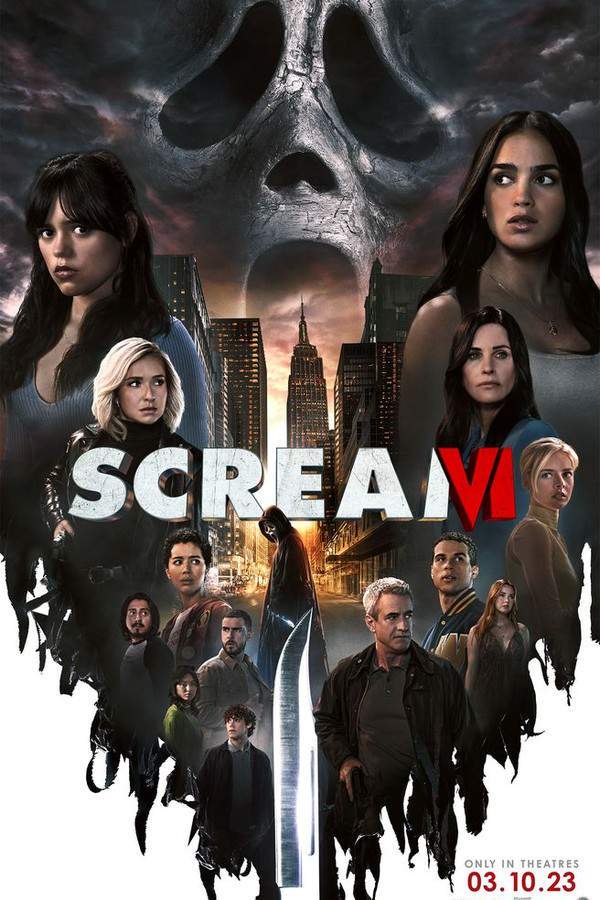
Year: 2023
Runtime: 2 h 2 m
Language: english
Directors: Tyler Gillett, Matt Bettinelli-Olpin
Echo Score: 68Budget: $35M
Following the latest Ghostface killings, the four survivors leave Woodsboro behind and start a fresh chapter.
Warning: spoilers below!
Haven’t seen Scream VI yet? This summary contains major spoilers. Bookmark the page, watch the movie, and come back for the full breakdown. If you're ready, scroll on and relive the story!
Still thinking about how Scream VI (2023) ended? Here’s a full breakdown of the ending, key final moments, major twists, and the deeper meaning behind the film’s conclusion.
The finale of Scream VI delivers a franchise-first twist by revealing that three killers are operating under the Ghostface mantle. The unmasking points to Detective Wayne Bailey and his college-aged children, Quinn and Ethan. This trio is driven by a singular, deeply personal motivation: they are the family of Richie Kirsch, the killer from the previous film who met his end at Sam Carpenter’s hands. Rather than a motive rooted in fame or sheer madness, their rampage is a calculated act of vengeance. They aimed to frame Sam for the murders, exploiting existing online conspiracy theories that painted her as a violent psychopath, thereby finishing the “movie” Richie tried to create and punishing the woman who killed him.
Sam’s confrontation with the killers serves as the thematic resolution of her character arc. Throughout the film, she battles hallucinations of her biological father, Billy Loomis, fearing that she is destined to follow in his footsteps. In the climactic struggle, Sam picks up Billy’s original mask and knife, using the persona to trick Detective Bailey before killing him. However, she ultimately rejects the identity. By dropping the mask on the ground and walking away with her sister Tara, Sam symbolically chooses her own path, proving that she is not defined by her lineage. The film draws a sharp distinction between the killers, who choose violence out of obsession and grief, and Sam, who uses violence only as a means of survival and protection.
The ending also solidifies the franchise’s new status quo. Chad and Mindy Meeks-Martin survive their injuries, preserving the “Core Four”—the group of young protagonists who have bonded through shared trauma. Kirby Reed, now an FBI agent, also survives, establishing herself as a seasoned ally for future stories. The film concludes with a self-aware post-credits scene where Mindy humorously chastises the audience for expecting a teaser, reminding them that Scream is a series that knows exactly when to subvert expectations and when to simply deliver a punchline.
Last updated: March 16, 2026 at 11:40
Read frequently asked questions about the ending of Scream VI (2023), including final-scene interpretation, twist explanations, character outcomes, and the deeper meaning behind the conclusion. This ending explained FAQ is designed for viewers searching for clear spoiler-heavy answers and ending breakdown insights.
The three killers are Detective Wayne Bailey and his children, Quinn and Ethan Bailey. This is a franchise-first twist, as previous Scream films featured solo or duo killers. The Bailey family orchestrated the Ghostface killings as part of a coordinated revenge plot.
Earlier scenes establish Detective Bailey's suspicious behavior during the investigation, and Quinn's presence at the apartment complex raises questions.
The Bailey family is driven by a personal vendetta: Detective Wayne Bailey is the father of Richie Kirsch, the killer from Scream (2022) who was killed by Sam Carpenter. They orchestrated the murders to frame Sam for the crimes, exploiting online conspiracy theories that portrayed her as violent, thereby completing Richie's original plan to make her the villain.
The film references online speculation about Sam being a potential killer, which the killers weaponize.
No. While Sam picks up Billy Loomis's original mask and knife during the climactic fight to trick Detective Bailey, she ultimately rejects the killer identity. She drops the mask on the ground and walks away with her sister Tara, symbolically choosing her own path rather than becoming her father.
Throughout the film, Sam struggles with hallucinations of Billy Loomis, fearing she will become like him.
Yes. Both Chad and Mindy Meeks-Martin survive their injuries. Their survival preserves the "Core Four" group of young protagonists, Sam, Tara, Chad, and Mindy, who have bonded through shared trauma. The film ends with them planning to attend therapy together, indicating a path toward healing.
Mindy's survival is hinted at when she regains consciousness after being attacked.
Kirby Reed survives the film and is now an FBI agent. She helps track down the Bailey family and establishes herself as a seasoned ally. Her survival sets up potential future appearances in the franchise as an established law enforcement character.
Kirby's FBI background is established earlier when she offers to help investigate the Ghostface killings.
When Sam drops Billy Loomis's mask, she symbolically rejects her genetic destiny. Throughout the film, she fears she is destined to become a killer like her father. By abandoning the mask, Sam proves she controls her own identity, she can use violence for survival but refuses to let it define her.
Sam's hallucinations of Billy and her constant fear of turning into him build toward this rejection.
Detective Wayne Bailey is revealed as the mastermind behind the Ghostface killings in Scream VI. As a police detective, he used his position to orchestrate the murders while simultaneously investigating them, framing the case to direct suspicion away from his family. He is ultimately killed by Sam during the finale.
His suspicious behavior during investigations and ease of access to crime scenes hint at his involvement.
The Bailey family exploits existing online conspiracy theories that label Sam as a violent psychopath capable of the Ghostface murders. They orchestrate the killings to make Sam appear guilty, aiming to have her convicted and executed for crimes she did not commit, fulfilling Richie's original "movie" vision of turning Sam into the villain.
Online theories about Sam's potential guilt are referenced multiple times throughout the film.
The post-credits scene features Mindy humorously chastising the audience for expecting a teaser, acknowledging the series' tendency to subvert expectations. It is a self-aware moment where the film pokes fun at typical franchise behavior while delivering a punchline instead of a cliffhanger.
This self-aware humor is consistent with the Scream franchise's meta approach to horror.
Sam's arc resolves through her actions in the finale. Though she uses Billy's mask and knife to survive, she consciously chooses not to become him. By dropping the mask and walking away with Tara, she demonstrates that lineage does not determine destiny. The film explicitly contrasts her survival-driven violence with the Bailey family's obsessive, revenge-driven killing.
Her hallucinations of Billy intensify as the film progresses, building toward this decisive moment.
Discover curated groups of movies connected by mood, themes, and story style. Browse collections built around emotion, atmosphere, and narrative focus to easily find films that match what you feel like watching right now.
Hunted through city streets in a relentless, high-stakes chase.If you enjoyed the high-stakes city chase in Scream VI, explore these movies where the urban landscape becomes a deadly playground for relentless killers. Find similar stories of survival against overwhelming odds in a contemporary setting.
Narratives typically follow a group or individual being systematically hunted through an urban landscape, using the city's infrastructure—subways, apartments, crowded streets—as both a refuge and a trap. The plot is driven by a series of attacks and narrow escapes, building towards a final confrontation against a cunning antagonist.
These movies are grouped by their shared setting and tone: the oppressive feeling of being hunted in a place you should be safe. They combine high-intensity action with psychological torment, creating a specific brand of paranoia and urban dread.
Characters haunted by past horrors, forced to confront a new threat.If you liked how Scream VI dealt with survivor's guilt and legacy trauma, discover more movies where heroes must overcome their past to survive a new threat. These films blend intense horror with deep emotional character journeys.
The narrative arc follows survivors from a previous traumatic event who are thrust back into danger. Their journey involves confronting their PTSD, survivor's guilt, and the lingering fear associated with their past, often using their hard-won experience as their primary weapon against a new, but connected, threat.
These films are united by their focus on the psychological aftermath of horror. They elevate the genre by exploring how past events shape the characters, adding heavy emotional weight and complexity to the standard slasher or thriller formula.
Don't stop at just watching - explore Scream VI in full detail. From the complete plot summary and scene-by-scene timeline to character breakdowns, thematic analysis, and a deep dive into the ending - every page helps you truly understand what Scream VI is all about. Plus, discover what's next after the movie.
Read a complete plot summary of Scream VI, including all key story points, character arcs, and turning points. This in-depth recap is ideal for understanding the narrative structure or reviewing what happened in the movie.
Track the full timeline of Scream VI with every major event arranged chronologically. Perfect for decoding non-linear storytelling, flashbacks, or parallel narratives with a clear scene-by-scene breakdown.
Discover the characters, locations, and core themes that shape Scream VI. Get insights into symbolic elements, setting significance, and deeper narrative meaning - ideal for thematic analysis and movie breakdowns.