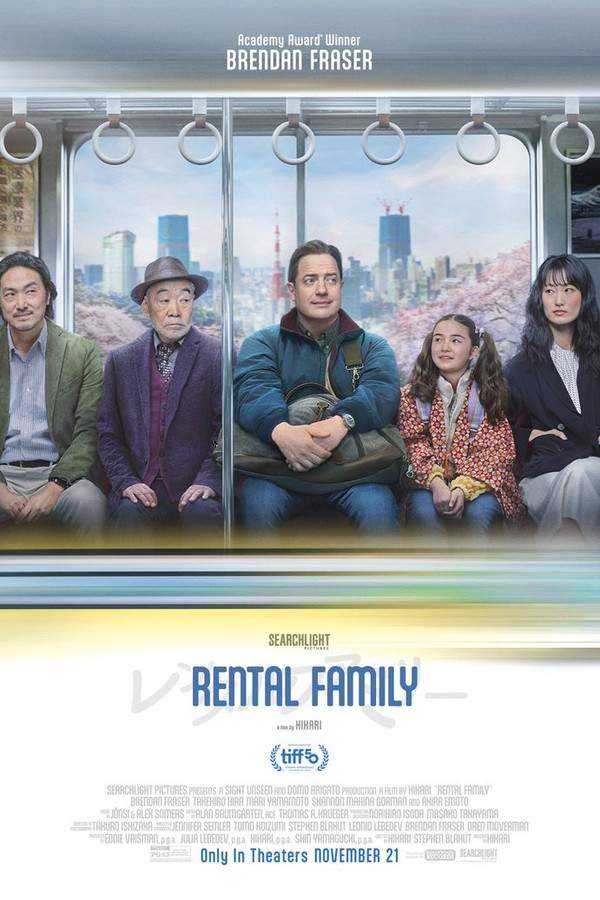
Phillip Vandarploeug, a drifting American actor trying to lock down steady work in Japan after a successful toothpaste commercial, finds himself stuck in small parts until his agent offers him an unusual assignment. He signs on with Rental Family, a peculiar agency that arranges connections between people who crave companionship, even if the premise sounds a little absurd. The outfit is led by Shinji Tada and is staffed by a small team including two other actors who handle the company’s various matchmaking gigs. Desperate for income, Phillip agrees to be the company’s token white guy and tests the waters with a series of assignments that push him to step outside his comfort zone.
In his first job, Phillip pretends to be the fiancé of a woman named Yoshie. Yoshie is a lesbian who is already married and wants to stage a traditional wedding for her parents before she and her wife relocate to Canada. Phillip nearly backs out, but his willingness to dive into the arrangement pays off on a personal level, revealing a side of connection he hadn’t anticipated. This initial success sets the tone for his next two gigs.
For his second assignment, Phillip steps into the role of the estranged American father to a young Hāfu girl named Mia, at the request of her mother Hitomi who wants him to help Mia secure a place in a private school. Mia is wary of the “father” figure, but Phillip’s patient approach slowly earns her trust and makes their time together feel meaningful rather than transactional. The third job asks Phillip to portray a journalist profiling retired actor Kikuo Hasegawa, who is under constant watch by his daughter Masami. What begins as another persona deepens into a genuine bond as Phillip learns about Kikuo’s struggles, including a dementia that complicates their growing friendship.
As Phillip grows more connected to Mia and Kikuo, the line between performative appearances and real emotion blurs. He even turns down a prestigious role that would derail these new bonds, choosing Mia’s welfare over career advancement. But tension emerges when Hitomi warns Phillip about becoming too close to Mia, and she bristles at his blunt observation that Mia’s life is already mapped out for her. Meanwhile, Masami’s protective instinct for Kikuo complicates Phillip’s attempts to help, and Aiko and Kota—two other figures connected to the Rental Family—find themselves wrestling with the company’s ethics as they witness the exploitation that can occur in this line of work. Shinji, for his part, tries to keep the operation profitable and functional, even as Phillip begins to suspect a deeper hypocrisy at the heart of the business.
The turning point arrives when Phillip agrees to help Kikuo revisit his childhood home, now overtaken by nature. A small, old box of photographs and mementos unearthed on the trip signals a deeper gratitude from Kikuo, and Phillip realizes how much these connections have mattered. Shinji reacts with anger, accusing Phillip of kidnapping, while Phillip counters that Rental Family has long used its services to fill hollow gaps in people’s lives—something Shinji himself appears to do when he maintains a fake family for his own needs. The clash culminates in Phillip’s arrest after the incident, casting a shadow over an already fragile network.
Mia’s awareness of Phillip’s true identity comes later, when a friend uncovers his past in a Japanese TV movie. She experiences a mix of anger and forgiveness, recognizing that her mother’s choices were driven by love rather than malice. Aiko and Kota rally to help Kikuo, convincing him to tell the truth about what happened, and Shinji makes a rare appearance as part of a reconciliation. Phillip is released, and the group honors Kikuo at his funeral, with Aiko, Shinji, and Kota present to pay their respects. The emotional stakes of their work remain high, but the sense of accountability begins to shift the Rental Family’s course.
In the aftermath, Mia is admitted to her new school, and she and Phillip reaffirm a friendship built on trust. Phillip continues with Rental Family, but the firm begins to phase out its controversial “apology services” that contributed to Aiko’s abuse, signaling a move toward healthier, more ethical engagements. The story closes with Phillip praying at the shrine where he and Kikuo once shared sessions, a quiet note of closure that underscores the film’s emphasis on human connection over transactional encounters.
The film features a cast that anchors these intertwined stories and adds depth to the ensemble. Denden as Asada Koji, Shun Shioya as Mikami Kenta, Nanami Kawakami as Kawai Tomoko, Yua Shiraishi as Sasaki Nanako, and the actress Fumina Suzuki contribute to the texture of Rentals Family’s world, enriching the sense of connection that threads through Phillip’s encounters.
- The cast includes Denden, Shun Shioya, Nanami Kawakami, Yua Shiraishi, and Fumina Suzuki.