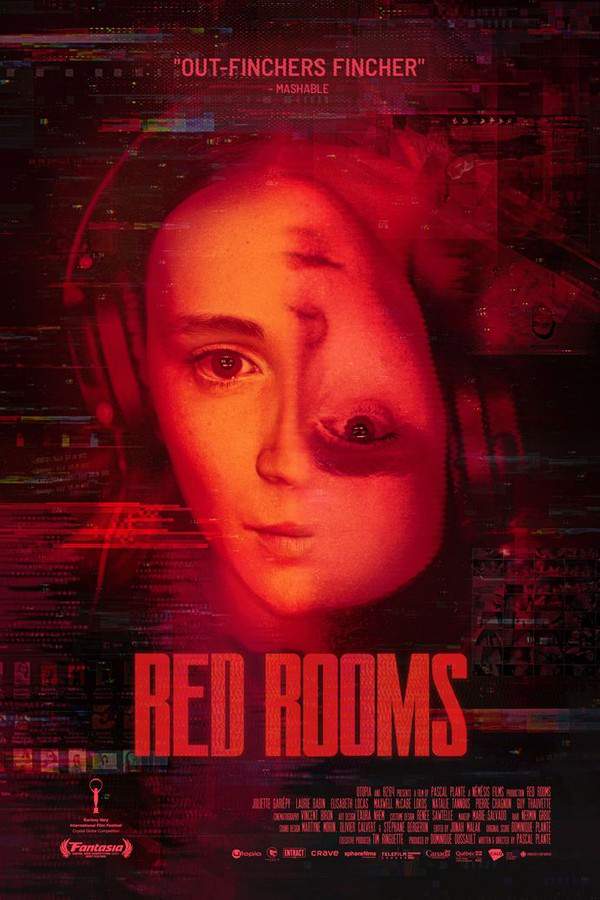
At the end of Red Rooms, the line between Kelly-Anne’s true identity and her obsession becomes blurred, leaving viewers questioning her motives. Throughout the film, she appears as a detached, almost emotionless woman, highly skilled in navigating the dark corners of the internet where the most disturbing content exists. Her obsession with the trial and the crimes against the three young girls, along with her obsession with Chevalier and the dark web videos, hint at a complex personality that might be a mix of empathy, fascination, and psychological fragility. The film suggests that Kelly-Anne might be a high-functioning sociopath or psychopath—someone with the capacity for extreme acts and a lack of typical emotional responses, yet driven by a desire to seek justice or to understand the darkness that plagues society.
Her relationship with Clem, the fan who romanticizes Chevalier, underscores the film’s critique of society’s obsession with true crime and killers—highlighting how such figures are often fetishized and glamorized, even by those who claim to oppose them. Kelly-Anne’s willingness to go to great lengths, even risking her career and mental stability, to obtain and showcase the videos of Camille’s torture reveals her compulsion and a deeply rooted need for connection to the horror. When she finally uses the videos to confront Chevalier and push the case toward a guilty plea, it feels less like an act of pure justice and more like an attempt to unravel her own inner demons.
The ending’s ambiguity is intentional: Kelly-Anne’s act of dressing as Camille and causing a scene in the courtroom suggests that she may be channeling her obsession or identity crisis—possibly impersonating Camille to process her own trauma or to stake her claim on justice. Chevalier’s silence and her seemingly unreactive demeanor throughout may imply that she’s not entirely emotionally invested in the case but rather caught in a compulsive cycle of destructive behavior. Ultimately, Red Rooms challenges viewers to question the layers of persona, obsession, and morality. It leaves us pondering whether Kelly-Anne is a disturbed observer or an active participant in the darkness, and whether her actions are driven by a genuine desire for justice or a need to validate her own fractured identity. The film’s unresolved ending ensures that the audience is left contemplating the deeper truths about human obsession, trauma, and the boundaries of morality.