Plot Explained Spoilers guaranteed!
Plot Explained

Browse by genre

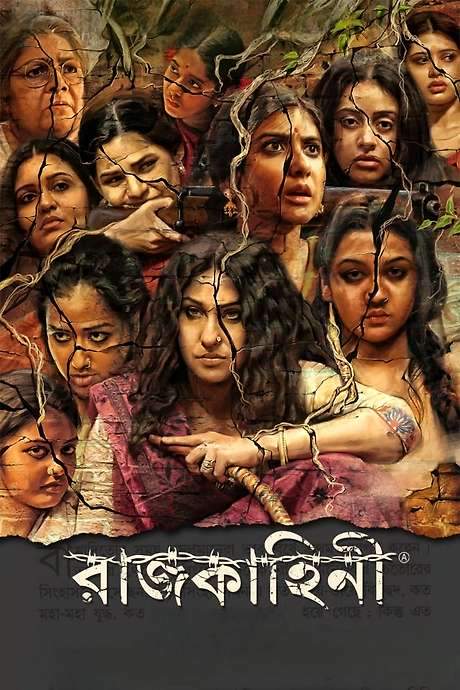
Rajkahini (2015) movie poster

Plot Summary

Rajkahini (2015) Plot Summary Explained

Release, runtime and language
2015 · 160 mins · Bengali, Bangla
Loading streaming availability…
Directed by
Srijit Mukherji
Starring
Saswata Chatterjee, Biswajit Chakraborty, Rituparna Sengupta, Rudranil Ghosh, Abir Chatterjee, Jisshu Sengupta

In August 1947, as the British prepared to partition Bengal, a grim chapter in history unfolded. Director Srijit Mukherji's film Rajkahini explores this period, focusing on a unique location: a brothel situated directly on the border separating the two nations. The story centers around eleven women living within this brothel, their lives intricately linked to the political upheaval and the uncertain future that lay ahead as the boundary lines were drawn.

On this page (5)
  1. 1 Where to watch
  2. 2 What happens: full plot
  3. 3 Plot questions answered
  4. 4 Movie threads
  5. 5 Every angle
Loading streaming availability…

Full plot summary · contains spoilers

What Happens in Rajkahini: Full Plot Summary

The whole story of Rajkahini (2015) explained, from the opening scene to the final frame: every key event, every twist and what it all adds up to. Read it as a quick recap before the sequel, to check a scene you missed, or to finally understand what really happened.

In June 1947, as the British loom over the end of imperial rule and a turbulent partition reshapes a divided Bengal, the film Rajkahini narrows its lens to a stark, lived-in border that cuts through a single brothel. The place houses eleven women and two men, a world unto itself where survival, loyalty, and a fierce sense of belonging collide with politics, violence, and shifting borders. The backdrop is the Radcliffe Line, drawn to separate India and East Pakistan, a line that snakes between Debiganj and Haldibari and touches the lives of everyone who calls this corner of Bengal home.

At the center stands Begum Jaan, Begum Jaan, the brothel’s fearless boss who keeps her house together with grit and a stubborn code of care for her women. By her side is Saleem Mirza, Saleem Mirza, a loyal Pathan bodyguard, and Sujan, Sujan, their capable man-servant and entertainer. The trio’s routine is upended as the political mood darkens and the boundary slices straight through their world, turning a sanctuary into a crossroads of danger and demand.

Across the political spectrum, two men from rival camps step into Begum Jaan’s life. A Congress man and a former friend from childhood, Prophullo Mohan Sen, Prophullo Mohan Sen, and a Muslim League representative, Ilias, travel to Debiganj with a hard proposal: evacuate the brothel and relocate its residents before the line is finalized. Begum Jaan refuses to abandon her whores or cede the space they’ve carved out for themselves, turning the meeting into a stubborn stand for autonomy.

The political chessboard grows more complex when news arrives from Delhi about the Princely States, the Nawab of Rangpur, Nawaab, and his retinue. He is moving westward to what will soon be Indian soil, his status and titles slipping away as the new order takes shape. His visit underscores the broader reality: not only is a border being drawn, but the old hierarchy is undergoing a radical, irreversible transformation. Begum Jaan taps into this mood, deciding to fight on her own terms rather than fold under pressure.

Frustration drives desperate choices. When the pair of men turn to Kabir, Kabir, the head of a criminal gang, Begum Jaan’s world is further destabilized. Kabir and his crew unleash cruelty in the name of upheaval, chasing Sujan and others through the streets and markets until Sujan sacrifices himself to shield the others. The violence reverberates through the brothel and beyond, tightening Begum Jaan’s resolve.

Inside the brothel, Master, Master, schemes to settle a personal score with Begum Jaan by ensnaring a girl. He joins forces with Kabir and the others, complicating the already perilous landscape and forcing Begum Jaan to confront the brutal prices of resistance.

The plan culminates in a furious blaze. Kabir and his gang set fire to Begum Jaan’s house, and the women—trained to shoot—fight back with discipline and courage. Losses mount quickly; Saleem Mirza falls in a brutal, memorable moment that scars Begum Jaan and hardens the rest of the women. The burning building becomes a crucible in which the women test the limits of loyalty, memory, and the will to live in a land that is being redrawn around them.

As the flames rage, those who survive—begun to see themselves as refugees in their own land—make a grim, defiant choice. They enter the inferno together, facing death in their self-styled country, while the story of the legendary Rajput queen Rani Padmini is invoked as a haunting parallel to their stand. The dawn reveals a ruin, a smoldering shell of the brothel, and the characters’ futures left open in the ashes.

In the final tableau, the broken remains of Begum Jaan’s world lie beneath a somber dawn, and the horizon holds the weight of history. A gathering crowd arrives to witness the aftermath of this stubborn stand, as the strains of a national lullaby echo softly in the background, underscoring the film’s meditation on identity, belonging, and the human cost of political realignments.
Last updated: October 03, 2025 at 06:46

Was this helpful?

Plot questions answered

Rajkahini Plot Explained: Your Questions Answered

The questions people ask most about Rajkahini (2015): what happens in the confusing scenes, why the characters do what they do, the twists, hidden details and what the ending means. Each answer contains spoilers.

Q1

Why does Begum Jaan refuse to evacuate the brothel when the political leaders ask her to leave?

Begum Jaan refuses because the brothel is not just a building, it is a self-contained world she has built and protected for the eleven women who depend on her. Leaving would mean abandoning the only home and safety these women have, and surrendering the autonomy she has carved out in a society that has always marginalised them. Her refusal is a stand for the right to exist on their own terms, regardless of which nation claims the land.

  • begum jaan
  • brothel
  • autonomy
  • partition
  • evacuation
Q2

Why do Congress and Muslim League representatives want the brothel evacuated?

The political representatives see the brothel as a problem for the new nation's image. Both sides are racing to establish moral authority in the newly forming nations, and a brothel sitting directly on the border line is an embarrassment they want removed before the official demarcation. The evacuation proposal reveals that political leaders care more about optics than the lives of marginalized women.

  • congress
  • muslim league
  • evacuation
  • partition
  • border
Q3

Why does Sujan sacrifice himself during Kabir's attack?

Sujan sacrifices himself to shield the others, particularly the women of the brothel, from Kabir and his gang who are chasing them through the streets and markets. His act is one of loyalty to Begum Jaan and the community that has given him a place to belong. The sacrifice demonstrates that survival in this world often requires paying the ultimate price.

  • sujan
  • sacrifice
  • kabir
  • protection
  • death
Q4

Why do the surviving women choose to stay in the burning brothel instead of escaping?

By the time of the fire, the women have already lost Sujan and Saleem Mirza, and their world has been destroyed. They see themselves as refugees in their own land, rejected by both new nations. Choosing to stay and face death together is their way of asserting agency and dignity in death, refusing to be displaced or scattered. The fire becomes their final act of resistance rather than surrender.

  • women
  • fire
  • resistance
  • death
  • refugees
Q5

What is the significance of the Rani Padmini reference at the end?

The women invoke Rani Padmini, the legendary Rajput queen who chose self-immolation over surrender to invading forces, to draw a parallel between their stand and a heroic chapter from Indian history. The reference elevates their act from mere desperation to a conscious choice of dignity over humiliation, linking their survival to a broader heritage of resistance. It frames their death as legendary rather than tragic.

  • rani padmini
  • legend
  • resistance
  • sacrifice
  • heroism
Q6

What is the purpose of the Nawab of Rangpur's visit in the story?

The Nawab of Rangpur passes through Debiganj moving westward to Indian soil as his princely state loses relevance under the new political order. His visit underscores that the partition is not just drawing borders, it is dismantling entire social hierarchies. For Begum Jaan, witnessing the fall of powerful figures like the Nawab reinforces her determination to fight rather than accept displacement like a vanquished ruler.

  • nawab
  • rangpur
  • partition
  • hierarchy
  • change
Q7

Why does Master betray Begum Jaan by joining forces with Kabir?

Master, a resident of the brothel, harbours a personal grudge against Begum Jaan and seeks to settle an old score. He conspires with Kabir to ensnare a girl, using the chaos of the partition to settle his personal vendetta. His betrayal represents the danger that comes from within, highlighting that even within the tight-knit community, personal animosity can undermine collective survival.

  • master
  • betrayal
  • kabir
  • conspiracy
  • grudge
Q8

Why does Kabir target Begum Jaan's brothel during the partition chaos?

Kabir, a gangster, exploits the power vacuum and lawlessness that erupts during partition. He is hired or motivated by the political forces seeking to remove the brothel, using violence and intimidation as tools. His attacks represent how opportunistic predators use national upheaval to settle scores and grab power, preying on those who have no state protection.

  • kabir
  • gangster
  • violence
  • chaos
  • exploitation
Q9

How does the Radcliffe Line actually cut through the brothel?

The Radcliffe Line, drawn to demarcate India and East Pakistan, literally passes through the building that houses the brothel. One part of the brothel falls on the Indian side, another on Pakistani territory. This surreal situation means the women and staff suddenly find themselves divided by an invisible line, with their sanctuary becoming a contested zone overnight.

  • radcliffe line
  • border
  • brothel
  • partition
  • east pakistan
Q10

Why is Saleem Mirza's death a turning point in the film?

Saleem Mirza is Begum Jaan's loyal protector, the man who has kept the women safe for years. His death during the fire is brutal and personal, it shatters Begum Jaan personally and hardens the remaining women completely. Losing him removes the last layer of security they had, making their subsequent choice to die together feel inevitable rather than impulsive.

  • saleem mirza
  • death
  • begum jaan
  • turning point
  • loss

Movie threads

More Movies Like Rajkahini, by Mood & Story

Curated lists built around what makes Rajkahini tick: the same mood, the same kind of story or the same emotional payoff. Each list explains why these movies belong together.

Historical tragedies of defiant communities like Rajkahini

Stories where a tight-knit group resists overwhelming historical forces, facing a bleak fate. Movies like Rajkahini that explore communities facing destruction from historical upheaval. If you were moved by the women's defiant stand against Partition, you'll find similar stories of collective courage and tragic loss in these powerful historical dramas.

  • defiant
  • tragic
  • somber
  • historical
  • gritty
  • oppressive
  • Tone: dark, tragic, defiant
  • Pacing: steady, inevitable
Why these movies?

The story pattern: A specific community, defined by its location or culture, is confronted with an unstoppable historical force like war, revolution, or political division. The story follows their unified, often desperate, resistance, culminating in their tragic dissolution or destruction, highlighting the human cost of grand historical events.

Why they belong together: They share a focus on community as the central character, a high-stakes historical backdrop, a tone of grim defiance, and an emotionally devastating, bleak conclusion that underscores the tragedy of the conflict.

Claustrophobic siege dramas with high intensity like Rajkahini

Tense stories of characters trapped in a single location, besieged by external threats. If you liked the tense, confined setting of Rajkahini's brothel on the border, explore more movies that use a single location to build high-stakes drama. These films create a powerful sense of claustrophobia and impending doom, similar to the experience of Rajkahini.

  • claustrophobic
  • tense
  • gritty
  • siege
  • oppressive
  • high stakes
  • Tone: dark, tense, gritty
  • Pacing: steady, building tension
Why these movies?

The story pattern: The narrative is largely confined to one primary location—a house, a bunker, a brothel—that is threatened or surrounded by hostile external forces. The story builds steady, oppressive tension as the characters' sanctuary becomes a trap, leading to a violent and often tragic confrontation.

Why they belong together: They are united by a claustrophobic setting that heightens the drama, a steady pacing that builds towards an explosive climax, a dark and gritty tone, and a high level of intensity stemming from the constant threat of violence from outside.

Every angle

Rajkahini (2015) Explained: Plot, Timeline & Characters

Everything about Rajkahini in one place: what happens in the plot summary, the timeline in chronological order, the characters and meaning and a spoiler-free summary. What's After the Movie adds the cast, box office and post-credit scenes.

Coming soon on iOS and Android

The Plot Explained Movie Summary App

Plot summaries, endings explained and timelines on your phone. Catch up on any movie in minutes, save your favorites and never miss a twist again.

Be the first to know when we launch. Your email stays private, always.

Learn more about the app