












Plot Explained Spoilers guaranteed!
Plot Explained

Browse by genre

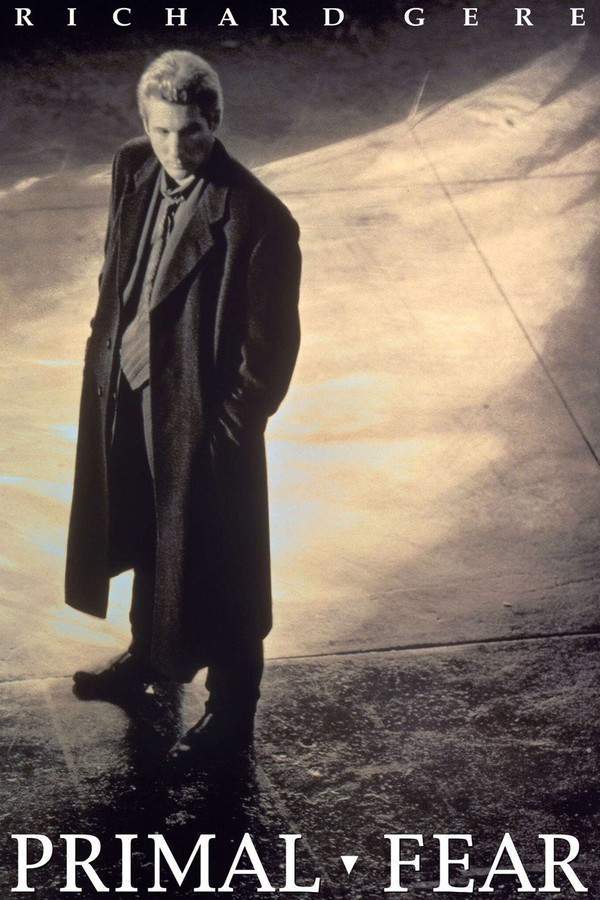
Primal Fear (1996) movie poster

Timeline

Primal Fear (1996) Timeline Explained – Every Event in Order

Release, runtime and language
1996 · 129 min · English
JustWatch #617 173
Directed by
Gregory Hoblit
Starring
Edward Norton, Laura Linney, Richard Gere

A high-stakes lawyer, Martin Vail, defends an impoverished altar boy accused of murdering a prominent archbishop. As Vail investigates the case, he finds himself battling corruption, his ambition, and a former lover who is now the prosecutor. The investigation forces him to examine his own moral compass and confront the complex web of power and deceit surrounding the crime.

On this page (7)
  1. 1 Where to watch
  2. 2 Events in order (15)
  3. 3 Timeline questions answered
  4. 4 The book behind the movie
  5. 5 Movie threads
  6. 6 Movies like Primal Fear
  7. 7 Every angle

Where to watch

Where to Watch Primal Fear (1996)

Where can you watch Primal Fear? Stream, rent or buy it in the US, including on fuboTV, Paramount Plus Essential and Paramount Plus Premium: current JustWatch availability with up-to-date prices.

Streaming availability powered by JustWatch

15 events in order · contains spoilers

Primal Fear Timeline: Events in Chronological Order

Every key event of Primal Fear (1996) in order, scene by scene, with when and where it takes place. Use it to untangle flashbacks, time jumps and parallel storylines, to refresh your memory before the sequel or to find the exact scene you are thinking of.

  1. Martin Vail's Ambition

    Martin Vail, a prominent defense attorney in Chicago, is known for his sharp legal skills and a strong desire for publicity. His career revolves around securing the freedom of high-paying clients by exploiting legal technicalities, often with little regard for the moral implications of his work.

    Where
    Chicago
  2. The Arrest of Aaron Stampler

    Vail comes across a news report about Aaron Stampler, an altar boy accused of murdering Archbishop Rushman. Intrigued by the media frenzy surrounding the case and the potential for personal gain, Vail decides to represent Aaron without charge.

    Where
    Chicago
  3. Doubts and Beliefs

    As Vail meets with Aaron in jail, he initially views the case as a publicity stunt. However, he begins to believe in Aaron's innocence as he learns more about the young man's shattered psyche and his struggles with a stutter.

    Where
    County Jail
  4. Conspiracy Unveiled

    During the trial preparations, Vail uncovers a conspiracy among civic leaders who had financial motives to eliminate the Archbishop. This revelation ties the Archbishop's past actions to the murder, raising questions about corruption within the church.

  5. The Motive Emerges

    Evidence suggesting a motive for the murder begins to surface, complicating Vail's defense. Public sentiment quickly turns against Aaron, placing immense pressure on Vail to maintain his reputation while defending a seemingly guilty client.

  6. Discovery of the Tape

    In a bold move, Vail breaks into the Archbishop's apartment and discovers a pornographic videotape. This tape implicates the Archbishop in abuse, prompting Vail to anonymously send it to Janet Venable, hoping to leverage its importance in court.

    Where
    Archbishop's Apartment
  7. Revelation of 'Roy'

    When Vail confronts Aaron about the tape, the young man reveals an alter ego named 'Roy,' who claims to have committed the murder as a reaction to years of abuse. This shocking transformation raises further doubts about Aaron's mental state and complicates the case.

    Where
    County Jail
  8. Trial Chaos

    During a tense day in court, Aaron, while on the witness stand, suddenly becomes Roy, violently threatening Janet Venable. This unexpected eruption of chaos leads to the judge dismissing the jury and switching to a bench trial.

    Where
    Courtroom
  9. Verdict of Insanity

    Ultimately, despite the evidence against Aaron, he is declared not guilty by reason of insanity. This verdict leads to his commitment in a maximum-security mental facility, stirring both relief and outrage among the public.

  10. Janet's Downfall

    Janet Venable faces severe repercussions for her role in exposing the Archbishop's crimes. After the trial, she is dismissed from her prosecutor position, highlighting the risk of uncovering powerful truths within the legal system.

  11. A Disturbing Visit

    Vail visits Aaron after the trial to inform him of his acquittal, only to be unsettled by Aaron's claim of having no memory of the courtroom scenes. This revelation leaves Vail questioning the reality of Aaron's mental state.

    Where
    Mental Facility
  12. The Chilling Confession

    In a shocking moment, just before Vail leaves, Aaron cryptically relays a message to Janet that implies he remembers everything. This revelation forces Vail to confront the chilling reality that Aaron has been manipulating perceptions all along.

    Where
    Mental Facility
  13. The Truth of the Alter Egos

    As Aaron grins, he admits to orchestrating his alter egos, including the murders of both the Archbishop and Linda. This dark confession shatters Vail's belief in Aaron's innocence, revealing the depths of Aaron's deceit and cruelty.

  14. Vail's Disillusionment

    Disillusioned by the manipulation he faced and feeling a sense of shame, Vail exits the courthouse. The revelation that he fell for Aaron's facade leaves him grappling with his morals and the monstrous nature of the crime.

    Where
    Courthouse
  15. Leaving Behind the Spotlight

    As Vail departs, Aaron's taunts resonate in his mind, symbolizing the loss of control Vail experienced. The case transforms his approach to law, making him reconsider the darker shades of justice and the potential for evil within seemingly innocent appearances.

Last updated: October 31, 2024 at 14:53

Was this helpful?

Timeline questions answered

Primal Fear Timeline Explained: Your Questions Answered

When does it happen, and why in that order? The questions people ask about the chronology of Primal Fear (1996): time jumps, flashbacks, cause and effect between scenes and the correct order of events, each answered with spoilers.

Q1

Why was Aaron Stampler found not guilty?

Aaron Stampler was declared not guilty by reason of insanity because his defense team, led by Martin Vail, successfully argued that he suffered from dissociative identity disorder. When Aaron took the witness stand, he suddenly transformed into his alter ego 'Roy' and physically threatened prosecutor Janet Venable, demonstrating the violent personality split that the defense claimed made him unable to control his actions. The judge accepted this evidence of his mental illness and committed him to a maximum-security mental facility instead of prison.

Foreshadowing: Earlier in the film, Aaron's stutter and meek demeanor contrasted sharply with sudden outbursts, hinting at the dual nature Vail would later claim.

  • aaron stapler
  • verdict
  • insanity defense
  • not guilty
  • did
Q2

What did Aaron mean by telling Vail to tell Janet her neck is okay?

When Aaron told Martin Vail to 'tell Miss Venable I hope her neck is okay,' he was revealing that he was fully aware of everything that happened during the trial. The comment refers to the moment when his alter ego 'Roy' attacked Janet on the witness stand, grabbing her by the neck. By acknowledging this, Aaron confirmed he had been consciously orchestrating his entire performance and was not genuinely experiencing memory blackouts from dissociative identity disorder.

Foreshadowing: This final message recontextualizes Aaron's earlier claims of not remembering his courtroom outbursts.

  • aaron message
  • janet
  • neck okay
  • final scene
  • confession
Q3

Was Aaron Stampler really mentally ill or faking?

Aaron Stampler was faking his dissociative identity disorder the entire time. In the film's climax, he directly admits to Martin Vail that he created and controlled his alter egos, including 'Roy.' He consciously orchestrated the murder of Archbishop Rushman and also killed Linda, the girl who could identify him. His entire performance of switching between the meek Aaron and violent Roy was a calculated manipulation to avoid prison by using the insanity defense.

Foreshadowing: The film subtly hints that Aaron's personality shifts were too convenient, occurring only at pivotal moments in the trial.

  • aaron stapler
  • faking
  • mental illness
  • dissociative identity disorder
  • roy alter ego
Q4

How did Aaron Stampler manipulate Martin Vail?

Aaron manipulated Martin Vail by exploiting Vail's desire for publicity and his ego as a skilled lawyer. He presented himself as a vulnerable, stuttering altar boy who was clearly traumatized, leading Vail to believe in his innocence and construct the multiple personality defense. Aaron carefully timed his transformations, revealing 'Roy' only when it would be most dramatic and beneficial to his defense strategy. This fooled not only Vail but also the psychiatrist Molly Arrington, who diagnosed him with DID.

Foreshadowing: Vail's initial motivation was gaining publicity from a high-profile case, which made him vulnerable to being used by someone seeking to escape justice.

  • martin vaill
  • aaron manipulation
  • deception
  • lawyer fooled
Q5

Why was Archbishop Rushman murdered?

Archbishop Rushman was murdered primarily because he had sexually abused Aaron Stampler and other altar boys for years. When Aaron revealed his alter ego 'Roy' to Vail, Roy confessed that he killed the Archbishop in retaliation for the years of abuse. Additionally, there was a financial conspiracy: civic leaders had lost money because the Archbishop refused to allow church lands to be developed, leading them to threaten him. However, Aaron's personal motive of revenge for abuse was the primary cause.

Foreshadowing: The film reveals early on that the Archbishop had been threatened and that rumors of his abuse of altar boys existed.

  • archbishop rushman
  • murder
  • motive
  • abuse
  • revenge
Q6

What was on the videotape Martin Vail found?

The videotape Vail discovered in the Archbishop's apartment contained pornographic material showing the Archbishop sexually abusing young altar boys and a girl named Linda. This tape was crucial because it confirmed the rumors of the Archbishop's abuse, provided a potential motive for Aaron, and could have incited the jury against the victim. Vail anonymously sent it to prosecutor Janet Venable, hoping she would use it to expose the Archbishop's character, though the prosecution initially sought to suppress it.

Foreshadowing: The film establishes early that rumors of the Archbishop's abuse were circulating but were being suppressed.

  • videotape
  • evidence
  • archbishop abuse
  • pornographic tape
  • discovery
Q7

Why was Janet Venable fired after the trial?

Janet Venable was fired from her position as prosecutor because she was instrumental in exposing the Archbishop's crimes during the trial. After the videotape evidence was introduced, Janet complied with Vail's strategy to reveal the Archbishop's character to the jury, which publicly humiliated the church and the legal establishment. District Attorney John Shaughnessy had wanted to suppress the abuse revelations to protect the church's reputation, and Janet's refusal to do so, combined with the scandal, led to her dismissal.

Foreshadowing: The film establishes early that powerful forces wanted to suppress any evidence of the Archbishop's misconduct.

  • janet venable
  • fired
  • prosecutor
  • dismissed
  • church scandal
Q8

Why did Aaron kill Linda?

Aaron killed Linda because she was the girl featured in the pornographic videotape found in the Archbishop's apartment, and she could potentially identify him as one of the abused altar boys. When Vail went looking for Linda as a witness, he discovered her decomposed body. Aaron later confessed to Vail that he killed Linda to eliminate someone who could connect him to the abuse and potentially expose his role in the murder, keeping his true involvement hidden.

Foreshadowing: Vail's search for Linda as a witness leads directly to the discovery of her body, establishing that someone wanted her silenced.

  • linda
  • murder
  • aaron
  • body
  • eliminate witness
Q9

What was the conspiracy involving Archbishop Rushman?

The conspiracy involved a group of influential civic leaders and developers who had suffered significant financial losses because Archbishop Rushman refused to allow church-owned land to be sold for commercial development. These powerful figures had threatened the Archbishop with death over his decision. While this financial motive existed, it was ultimately a red herring in Aaron's murder, as the real motivation was Aaron's personal revenge for years of sexual abuse.

Foreshadowing: Vail uncovers this conspiracy during his investigation, adding complexity to the case but ultimately distracting from the true motive.

  • conspiracy
  • archbishop
  • financial motive
  • church land
  • developers
Q10

What happens to Aaron Stampler at the end of the movie?

At the end of Primal Fear, Aaron Stampler is declared not guilty by reason of insanity and committed to a maximum-security mental facility. However, the twist reveals this was his goal all along - he successfully avoided prison by feigning mental illness. In the final scene, he smiles at Vail and admits to orchestrating everything, including the murders of both the Archbishop and Linda. He remains institutionalized but psychologically 'free,' having manipulated the entire legal system.

Foreshadowing: The film's dark tone and the meta notes about a bleak ending prepare viewers for this unsatisfying conclusion.

  • aaron stapler
  • fate
  • mental facility
  • institution
  • ending

Movie threads

More Movies Like Primal Fear, by Mood & Story

Curated lists built around what makes Primal Fear tick: the same mood, the same kind of story or the same emotional payoff. Each list explains why these movies belong together.

Shocking Twist Thrillers like Primal Fear

Narratives built around a devastating psychological reveal that recontextualizes everything. If you loved the jaw-dropping reveal in Primal Fear, discover more movies with brilliant psychological twists. These stories feature complex characters, cerebral plots, and endings that completely redefine the narrative, leaving you stunned and questioning what you just witnessed.

  • mind-bending
  • cerebral
  • suspenseful
  • chilling
  • manipulative
  • unsettling
  • Tone: dark, cynical, tense
  • Pacing: steady, building to a climax
Why these movies?

The story pattern: A protagonist, often an expert in their field, becomes deeply invested in uncovering the truth about a person or event. The narrative unfolds with a steady, methodical pace, presenting evidence that points in one direction. The climax features a shocking revelation, often about a character's hidden identity or true motives, that proves the protagonist was being masterfully manipulated, resulting in a bleak or morally ambiguous resolution.

Why they belong together: These films are grouped by their shared structure of a psychological 'gotcha' moment. They prioritize cerebral suspense over action, feature complex and often unreliable characters, and deliver a powerful emotional impact through a well-executed narrative surprise that is the central payoff of the story.

Bleak Legal Dramas like Primal Fear

Gritty stories where the pursuit of justice exposes a corrupt and cynical world. For viewers who appreciated the dark cynicism and moral ambiguity of Primal Fear, this list features similar crime and courtroom stories. These movies explore corruption, abuse of power, and heavy themes, often concluding with bittersweet or bleak resolutions that challenge the idea of a fair system.

  • cynical
  • tense
  • gritty
  • corruption
  • moral ambiguity
  • gripping
  • Tone: dark, cynical, unsentimental
  • Pacing: steady investigative pacing
Why these movies?

The story pattern: An idealistic or ambitious professional—a lawyer, detective, or journalist—takes on a case that promises justice or redemption. As they investigate, they uncover layers of institutional corruption, powerful conspiracies, and personal moral failings. The conflict forces them to question their own ethics, and the resolution typically leaves them disillusioned, having exposed the truth but failed to truly fix the systemic rot.

Why they belong together: These movies share a dark, unsentimental tone and a heavy emotional weight centered on themes of corruption and the failure of institutions. They offer a steady, tense pacing driven by investigation and moral dilemmas, rather than action, resulting in endings that feel more realistic and bleak than Hollywood-style victories.

If you liked this

Movies Like Primal Fear

Similar movies to Primal Fear: the same genre, themes or kind of story. Each one comes with its own plot summary, timeline and ending explained.

Browse all movie summaries

Every angle

Primal Fear (1996) Explained: Plot, Timeline & Characters

Everything about Primal Fear in one place: what happens in the plot summary, the timeline in chronological order, the characters and meaning and a spoiler-free summary. What's After the Movie adds the cast, box office and post-credit scenes.

Coming soon on iOS and Android

The Plot Explained Movie Summary App

Plot summaries, endings explained and timelines on your phone. Catch up on any movie in minutes, save your favorites and never miss a twist again.

Be the first to know when we launch. Your email stays private, always.

Learn more about the app