Plot Explained Spoilers guaranteed!
Plot Explained

Browse by genre

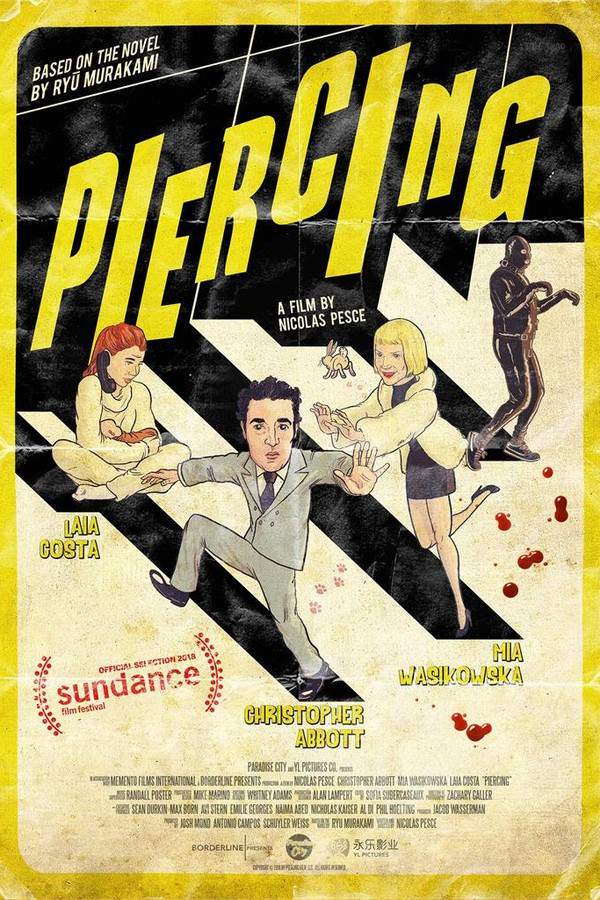
Piercing (2019) movie poster

Plot Summary

Piercing (2019) Plot Summary Explained

Release, runtime and language
2019 · 81 min · English
Echo score 58
Loading streaming availability…
Directed by
Nicolas Pesce
Starring
Marin Ireland, Mia Wasikowska, Christopher Abbott, Laia Costa, Maria Dizzia, Wendell Pierce

A businessman named Reed plans a night of dark indulgence, equipped with a specialized kit. His intentions are disrupted when he meets Jackie, a captivating call girl. As their evening progresses, their encounter spirals into a chaotic and violent situation. Reed's carefully constructed world begins to unravel, leading to a disturbing and bloody confrontation where the lines between hunter and prey become dangerously blurred.

On this page (7)
  1. 1 Where to watch
  2. 2 What happens: full plot
  3. 3 Plot questions answered
  4. 4 The book behind the movie
  5. 5 Movie threads
  6. 6 Movies like Piercing
  7. 7 Every angle
Loading streaming availability…

Full plot summary · contains spoilers

What Happens in Piercing: Full Plot Summary

The whole story of Piercing (2019) explained, from the opening scene to the final frame: every key event, every twist and what it all adds up to. Read it as a quick recap before the sequel, to check a scene you missed, or to finally understand what really happened.

Reed finds himself in a deeply unsettling situation when he stands over his infant daughter, an ice pick in hand, while his wife sleeps peacefully in the other room. Despite an overpowering impulse to harm his own child, he manages to suppress this desire. However, a chilling moment occurs when the baby looks up at him and eerily states, "You know what you have to do, right?". This prompts Reed to believe he must transfer his violent urges onto someone else, leading him to target a prostitute in a misguided attempt to protect his daughter from his malevolent intentions. He convinces his wife, Marin Ireland, that he is heading out on a business trip, but in truth, he plans to rent a hotel room, hire a sex worker, and carry out his dreadful scheme.

The evening commences with Reed checking into the hotel, where he meticulously rehearses his dark plan. He wipes away traces of himself and notes down timings after nearly succumbing to chloroform. However, his intended victim does not arrive; instead, Jackie, played by Mia Wasikowska, shows up. Jackie, armed with a variety of fetish items and a predilection for sadism, complicates Reed's dark objectives. Following a tense first interaction, she retreats to the bathroom, leaving Reed in a state of mounting anxiety. When he finally enters, he is met with a shocking scene—Jackie stabbing herself with scissors. Reed swiftly overpowers her and carries her to bed, realizing that she has likely succumbed to her earlier medication. He bandages her injuries and contemplates abandoning his murderous plot, but finds himself unable to do so when he sees Jackie emerging from the bathroom, disheveled and injured.

Determined to do the right thing, Reed decides to take Jackie to the hospital. However, a chilling whisper from her suggests she "was onto him," indicating that she might be aware of his malevolent intentions. He assures her he will wait at the hospital, but as he sits there, haunted by visions of his wife offering unsolicited advice, he grapples with the uncertainty that he may still be able to fulfill his deadly desires. Fortunately, Jackie returns, seemingly happy to see him.

After establishing a fragile trust, the pair head back to Jackie's apartment, where she offers dinner. Although Reed appears withdrawn and uninterested, their conversation becomes laden with double meanings—reflecting both their sexual tension and the underlying threat of violence. As Reed begins to hallucinate, plagued by nightmares of his oppressive mother, Jackie reveals that she has spiked his meal with drugs, resulting in him once again losing consciousness. In a fit of rage, led by jealousy upon hearing Reed call out for his wife, Jackie strikes him with a can opener.

In a dramatic turn, Reed eventually regains control, but Jackie continues to disbelieve he is capable of murder. Allowing him to tie her up under the mistaken belief that they are heading to a romantic encounter, she is surprised when Reed produces the ice pick. Just as he attempts to fulfill his sinister aim, he collapses once more. Jackie, seizing her opportunity, frees herself and discovers his notebook filled with his gruesome plans.

When Reed wakes up the following day, he is bound and gagged, while Jackie methodically pierces her skin in front of a mirror. As tension builds, she prepares to turn the ice pick against him. In a moment of dread, he cries out, prompting her hesitation. After a tense standoff, she ungags him, leading to a fraught silence between them. Reed's simple request, echoing Jackie’s earlier yearning, "Can we eat first?" hangs in the air, revealing the twisted interplay of their intentions and the chaotic path their lives have taken.
Last updated: September 18, 2026 at 08:59

Was this helpful?

Plot questions answered

Piercing Plot Explained: Your Questions Answered

The questions people ask most about Piercing (2019): what happens in the confusing scenes, why the characters do what they do, the twists, hidden details and what the ending means. Each answer contains spoilers.

Q1

Why does Reed plan to kill a sex worker?

In Piercing, Reed is consumed by a violent impulse toward his infant daughter, standing over her with an ice pick before managing to suppress the urge. Convinced he cannot be trusted near his child, he decides to redirect that destructive energy onto a stranger. Hiring a prostitute and murdering her in a hotel becomes his way of "transferring" the urge, a misguided attempt to neutralize his dark desires rather than act on them against his family.

Foreshadowing: The opening scene where Reed stands over his daughter with the ice pick directly establishes the violent impulse he later tries to displace.

  • reed
  • ice pick
  • daughter
  • prostitute
  • violent impulse
  • plan
Q2

What does the baby's line "You know what you have to do" mean?

When Reed's infant daughter looks up at him and says "You know what you have to do, right?," the line is a supernatural manifestation of Reed's own internal rationalization. The baby's words externalize the thought Reed is already constructing in his own mind: that he must act on his murderous urges somewhere other than at home. The phrase becomes the trigger for his plan to target a sex worker, framing the violence as something inevitable and necessary.

Foreshadowing: The uncanny speaking infant sets the psychological tone for the entire film, suggesting Reed's mind is already fracturing before he leaves the house.

  • baby
  • infant
  • you know what you have to do
  • supernatural
  • rationalization
Q3

Why does Jackie stab herself with scissors in the bathroom?

Jackie's self-harm with the scissors is part of her own ritualized sadism and psychological armor. She arrives expecting a client who shares her appetite for pain and control, and her self-inflicted wound is an opening act designed to establish dominance and test her partner's reaction. It also accidentally leads to her being drugged by chloroform, since Reed had already prepared the room expecting a different victim, blurring who is actually preying on whom.

Foreshadowing: The scissors scene immediately signals that Jackie is not a passive target, foreshadowing her ability to seize control later.

  • jackie
  • scissors
  • self-harm
  • sadism
  • hotel
  • bathroom
Q4

Was Jackie aware of Reed's murderous plan from the beginning?

Jackie strongly implies she suspects Reed's true intentions, telling him during the drive to the hospital that she "was onto him." However, the film deliberately leaves the depth of her awareness ambiguous. Jackie may have deduced that Reed is dangerous based on his demeanor and the unusual setup, or she may simply be performing control in her usual sadistic way. Her choice to drug him at dinner and later tie him up suggests she never fully drops her guard, regardless of how aware she truly is.

Foreshadowing: Jackie's whisper in the taxi retroactively reframes her earlier behavior, from the self-stabbing to her retreat into the bathroom, as calculated rather than reactive.

  • jackie
  • aware
  • onto him
  • suspicion
  • taxi
  • hospital
Q5

Why does Jackie drug Reed's dinner at her apartment?

Jackie spikes Reed's meal because she has identified him as a genuine threat and wants to neutralize him before he can act. After the taxi ride where she hints she knows what he planned, and after watching his increasingly erratic behavior, she decides to take control. Drugging him flips the hunter-and-prey dynamic so that she, not Reed, determines what happens next. It also gives her the opportunity to strike him with a can opener when he becomes vulnerable.

Foreshadowing: The spiked meal is set up by the earlier taxi whisper, showing Jackie has been quietly preparing countermeasures all evening.

  • jackie
  • drugged
  • dinner
  • can opener
  • apartment
  • spiked
Q6

Why does Jackie attack Reed with a can opener after drugging him?

Jackie strikes Reed with the can opener in a jealous rage after she hears him call out for his wife while hallucinating. The attack reveals that beneath Jackie's calculated sadism is a wounded, possessive emotional core. She is not simply defending herself; she is punishing Reed for treating her as disposable and for emotionally leaving her even while she controls the scene. The can opener becomes both a weapon and a twisted expression of hurt.

Foreshadowing: Jackie's earlier whispered remark in the taxi that she "was onto him" hints at her deeper personal investment beyond survival.

  • can opener
  • jealousy
  • wife
  • jackie
  • rage
  • hallucination
Q7

What does Jackie discover in Reed's notebook?

When Jackie frees herself after Reed collapses, she finds his notebook filled with his detailed plan to murder her, complete with wiped surfaces, timing notes, and step-by-step preparations. The notebook confirms everything she had been suspecting and exposes Reed's cold, methodical mindset. Reading it is what shifts her from cautious manipulator to someone actively preparing to turn his ice pick against him, completing the role reversal between them.

Foreshadowing: Reed's compulsive note-taking earlier in the hotel room plants the very evidence that will later be used against him.

  • notebook
  • plans
  • evidence
  • jackie
  • reed
  • preparation
Q8

Why does Reed hallucinate his mother during dinner?

Reed's hallucinations of an oppressive maternal figure reflect the psychological root of his violent impulses. The film suggests that his murderous urges toward his daughter are an echo of how he himself was treated, and his mother's ghost represents the internalized voice of control and punishment. These visions intensify after Jackie drugs him, breaking down the controlled persona Reed built for his plan and exposing the trauma driving his behavior.

Foreshadowing: Reed's mother also appears as an imaginary voice at the hospital, establishing her as a recurring presence in his fractured psyche.

  • hallucination
  • mother
  • trauma
  • dinner
  • repressed
  • visions
Q9

How does the power shift between Reed and Jackie throughout the night?

Piercing is built on a constantly inverting power dynamic. Reed begins as the methodical hunter who has planned every detail, but Jackie undermines him at the hotel by injuring herself and later drugging his meal. By the final morning, Reed is bound, gagged, and completely at Jackie's mercy, while she calmly pierces her own skin and prepares to use his ice pick on him. Each character repeatedly assumes the role of predator and then becomes prey, never settling into a stable position of control.

Foreshadowing: Jackie's initial self-stabbing with the scissors immediately signals that Reed's plan is not going to unfold as designed.

  • power dynamic
  • hunter
  • prey
  • inversion
  • control
  • roles
Q10

What does the ending of Piercing mean?

The ending of Piercing is deliberately cyclical and unresolved. Reed wakes up bound and gagged, Jackie is poised to kill him with his own ice pick, and when given a chance to speak he simply asks, "Can we eat first?", echoing Jackie's earlier yearning for a normal moment. By mirroring the opening scene of violence-justified-as-necessity, the film suggests that the predator-prey cycle is endless. Neither character escapes, and the final ambiguity leaves the viewer uncertain whether Reed buys time, mocks Jackie, or is genuinely lost in delusion.

Foreshadowing: Reed's compulsive need to ritualize and plan, shown throughout the film, re-emerges in his final measured request.

  • ending
  • ambiguous
  • cycle
  • can we eat first
  • ice pick
  • final scene
Q11

Why does Reed keep losing consciousness at key moments?

Reed's repeated blackouts are the mechanism that prevents him from completing his murder. First he is knocked out by the chloroform he prepared for his victim, then Jackie drugs his dinner, and he collapses again just as he is about to stab her. Each loss of consciousness occurs precisely when he is closest to carrying out the killing, suggesting that some part of him cannot actually go through with the act. His body repeatedly intervenes before his conscious plan can be fulfilled.

Foreshadowing: Reed's rehearsal and preparation with the chloroform in the hotel room sets up the first of many involuntary interruptions.

  • chloroform
  • unconscious
  • blackout
  • collapse
  • interrupted
  • plan
Q12

Is Jackie a victim or a predator in Piercing?

Jackie occupies both roles simultaneously, which is central to the film's tension. She arrives armed with sadistic intent and fetish gear, making her a predator in her own right, but she is also the targeted victim of Reed's murder plan. Her self-harm, drugging, and eventual binding of Reed show her capacity for violence, while her vulnerability after being stabbed and her jealousy-driven outburst show genuine emotional exposure. The film refuses to let viewers categorize her cleanly, sustaining the uncertainty that drives the plot.

Foreshadowing: Her initial display of fetish gear and self-inflicted wounds previews that she is neither innocent nor fully in control.

  • jackie
  • victim
  • predator
  • sadism
  • role
  • dual
Q13

Why does Reed wipe down surfaces in the hotel room?

Reed meticulously wipes down the hotel room because he is planning a murder and wants to eliminate forensic evidence. As a methodical, detail-oriented man, he treats the killing almost like a business project, recording his actions in a notebook and sanitizing the space. This obsessive preparation establishes his character as someone who intellectualizes violence, which also makes his repeated failures to follow through more disturbing and psychologically revealing.

Foreshadowing: The notebook entries and wiped surfaces later become the evidence Jackie uses to confirm her suspicions about him.

  • hotel room
  • wipe
  • evidence
  • notebook
  • preparation
  • forensic

Movie threads

More Movies Like Piercing, by Mood & Story

Curated lists built around what makes Piercing tick: the same mood, the same kind of story or the same emotional payoff. Each list explains why these movies belong together.

Predator becomes prey thrillers like Piercing

Twisted games where the killer, the seductress, and the victim are never who they seem. Movies like Piercing that turn the hunter-versus-hunted dynamic on its head, where a would-be killer meets someone far more dangerous. If you liked Piercing, you'll love these psychological thrillers and horror films built on shifting power, dark seduction, and a disturbing cycle of violence that refuses to let either side win.

  • cat and mouse
  • power shifts
  • psychological manipulation
  • dark seduction
  • violent twists
  • unsettling
  • Tone: dark, tense, unsettling
  • Pacing: variable, with sudden violent bursts
Why these movies?

The story pattern: Stories in this thread typically open with one character preparing a calculated act of domination, only to be confronted by a stranger whose surface compliance masks their own lethal intent. The narrative unfolds as a slow tightening of suspicion, with each character probing the other through loaded conversation, seduction, and bursts of shocking violence. Flashbacks, hallucinations, and ambiguous motives deepen the paranoia. Endings tend to loop, restart, or leave the true winner unclear, suggesting that the cycle of predator and prey is endless rather than resolved.

Why they belong together: These films are grouped together because they share Piercing's core recipe: a confined setting, a protagonist with a dark plan, an antagonist who refuses to be a simple victim, and dialogue that doubles as a chess match. They lean on heavy emotional weight, high intensity, variable pacing, and ambiguous conclusions, often weaving in disturbing imagery or trauma that explains the characters' obsession with control. The shared experience is one of mounting dread punctuated by sudden, graphic violence.

Surreal nightmarish horror like Piercing

Claustrophobic horror that loops reality, body, and dread into a waking nightmare. If you liked Piercing and want more movies with its claustrophobic, dreamlike dread, this collection is for you. These horror films share Piercing's surreal, hallucinatory quality, variable pacing, disturbing imagery, and ambiguous endings that loop back on themselves, trapping the viewer in a cycle of violence and psychological unraveling.

  • claustrophobic
  • surreal
  • nightmarish
  • unsettling
  • disturbing imagery
  • anxious
  • Tone: dark, surreal, nightmarish
  • Pacing: variable and disorienting
Why these movies?

The story pattern: Films in this thread often follow an unraveling protagonist whose carefully ordered life is invaded by something they cannot control, whether a stranger, a memory, or their own mind. Visual storytelling becomes fragmented, mixing domestic interiors with dream logic, recurring symbols, and bodily horror. Climaxes collapse the boundary between imagination and reality, and endings frequently restart or echo the opening, suggesting that escape from the nightmare is impossible and that the violence will repeat.

Why they belong together: These movies match Piercing on mood and atmosphere rather than a single plot point. They share the same high intensity, dark tone, variable pacing, complex layering, and heavy emotional weight, often anchored by nightmarish visuals, claustrophobic settings, and themes of maternal or domestic trauma twisted into horror. The unifying thread is the feeling of being trapped inside someone's disturbed inner world.

If you liked this

Movies Like Piercing

Similar movies to Piercing: the same genre, themes or kind of story. Each one comes with its own plot summary, timeline and ending explained.

Browse all movie summaries

Every angle

Piercing (2019) Explained: Plot, Timeline & Characters

Everything about Piercing in one place: what happens in the plot summary, the timeline in chronological order, the characters and meaning and a spoiler-free summary. What's After the Movie adds the cast, box office and post-credit scenes.

Coming soon on iOS and Android

The Plot Explained Movie Summary App

Plot summaries, endings explained and timelines on your phone. Catch up on any movie in minutes, save your favorites and never miss a twist again.

Be the first to know when we launch. Your email stays private, always.

Learn more about the app