Plot Explained Spoilers guaranteed!
Plot Explained

Browse by genre

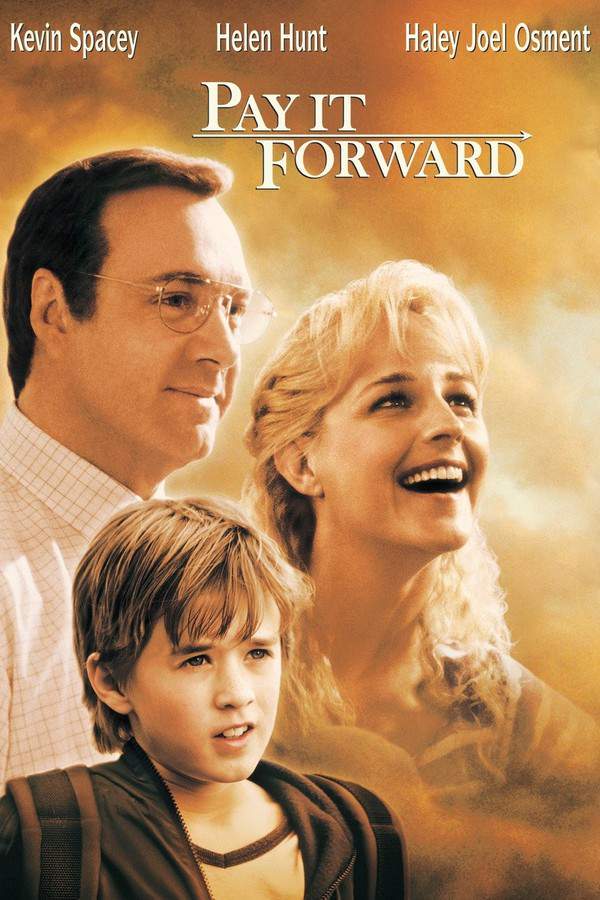
Pay It Forward (2000) movie poster

Timeline

Pay It Forward (2000) Timeline Explained – Every Event in Order

Release, runtime and language
2000 · 123 min · English
Loading streaming availability…
Directed by
Mimi Leder
Starring
Kevin Spacey, Haley Joel Osment, Helen Hunt
Budget
$40M

A social studies teacher challenges his students to devise a plan to change the world. One student’s idea to “pay forward” good deeds—reciprocating kindness with further acts of generosity—ignites a remarkable chain reaction. This unconventional assignment unexpectedly touches lives across the country, demonstrating the powerful impact of simple acts of kindness and inspiring others to join the movement.

On this page (8)
  1. 1 Where to watch
  2. 2 Events in order (15)
  3. 3 Timeline questions answered
  4. 4 The book behind the movie
  5. 5 Movie threads
  6. 6 Movies like Pay It Forward
  7. 7 Categories
  8. 8 Every angle
Loading streaming availability…

15 events in order · contains spoilers

Pay It Forward Timeline: Events in Chronological Order

Every key event of Pay It Forward (2000) in order, scene by scene, with when and where it takes place. Use it to untangle flashbacks, time jumps and parallel storylines, to refresh your memory before the sequel or to find the exact scene you are thinking of.

  1. Trevor's Assignment

    Trevor McKinney starts his seventh-grade journey in Las Vegas where he is assigned a transformative project by his social studies teacher, Eugene Simonet. The task is to create a plan that can have a positive effect on the world, an assignment that sparks an essential change in Trevor's life.

    Where
    Las Vegas
  2. Introduction of 'Pay It Forward'

    Inspired by his assignment, Trevor devises the concept of 'pay it forward', suggesting that when someone receives a favor, they should pass it on to three more people who cannot repay it. This idea forms the crux of Trevor's mission, emphasizing the importance of selfless acts in fostering goodwill.

  3. Helping Jerry

    To put his plan into action, Trevor invites Jerry, a homeless man, to live in his garage. This marks the beginning of Trevor's journey into altruism and showcases the challenges and risks of helping those in need, setting the stage for subsequent events.

    Where
    Trevor's garage
  4. Jerry's Relapse

    Jerry attempts to repay Trevor’s kindness by fixing Trevor’s mother Arlene's car, but struggles with his addiction. When Jerry relapses, Trevor experiences disappointment, illustrating the unpredictable nature of kindness and the challenges of supporting those battling addiction.

  5. Confrontation with Eugene

    The tension escalates when Arlene confronts Eugene about Trevor's initiative after learning about Jerry living in their home. This confrontation highlights the interpersonal conflicts that arise from Trevor's well-meaning actions, putting additional strain on their relationships.

  6. Dinner Setup for Eugene and Arlene

    Determined to spread kindness, Trevor attempts to arrange a romantic dinner for Eugene and Arlene. Although the first dinner does not go as planned, Trevor's persistence showcases his dedication to his 'pay it forward' initiative and his hopes for a brighter future.

  7. Running Away

    When Trevor decides to run away, it triggers Arlene to seek Eugene's help in finding him. This moment not only deepens the bond between Arlene and Eugene but also leads to significant character development as they face shared struggles.

  8. Eugene's Troubled Past

    Eugene grapples with the emotional scars of his childhood, marked by traumatic experiences, including an abusive father. This backstory adds depth to his character and complicates his relationship with Arlene, as he fears emotional vulnerability.

  9. Arlene's Confrontation with Ricky

    As Arlene gains strength from her relationship with Eugene, she confronts her estranged husband Ricky, who has relapsed into alcoholism. This decisive moment portrays Arlene's growth and her commitment to fostering a healthier environment for her son Trevor.

  10. Jerry Saves a Life

    In a poignant moment, Jerry uses his life experiences to save a suicidal jumper from a bridge. This act emphasizes the overarching theme of the movie - the profound impact one selfless act can create in inspiring kindness across the world.

    Where
    Bridge
  11. Chris Chandler's Investigation

    Journalist Chris Chandler receives a car from an anonymous benefactor, igniting her quest to uncover the origins of the 'pay it forward' concept. As she investigates, she unravels the connection back to Trevor's school project, signaling the widespread influence of his idea.

  12. Trevor's Interview

    Chris's pursuit leads to a heartfelt interview with Trevor, allowing her to explore his dreams for the 'pay it forward' project. This encounter not only enlightens the public about Trevor's intentions but also emphasizes the ripple effect of his vision.

  13. Tragic Loss

    Tragedy strikes when Trevor is fatally stabbed by a bully while defending a friend. This heartbreaking moment underscores the risks involved in standing up for others and unleashes a national impact regarding the 'pay it forward' philosophy.

  14. Public Response to Trevor's Death

    In the wake of Trevor's death, the 'pay it forward' movement gains momentum, with a massive public outpouring of grief and support. Thousands attend a vigil, highlighting how Trevor's life and vision have touched countless individuals across the nation.

    Where
    Vigil
  15. Eugene and Arlene's Bond

    Following the tragedy, Arlene and Eugene emerge as symbols of the healing power of kindness. Their evolving relationship represents how transformative acts can lead to genuine connections even amidst heartbreak.

Last updated: November 19, 2024 at 17:30

Was this helpful?

Timeline questions answered

Pay It Forward Timeline Explained: Your Questions Answered

When does it happen, and why in that order? The questions people ask about the chronology of Pay It Forward (2000): time jumps, flashbacks, cause and effect between scenes and the correct order of events, each answered with spoilers.

Q1

What is the 'pay it forward' concept in the movie?

The 'pay it forward' concept is Trevor's solution to his social studies assignment. When someone receives a favor they cannot repay, they must pass on the kindness to three other people instead of repaying the original person. This creates a multiplying ripple effect of goodwill, where each act of kindness inspires three new acts, potentially reaching millions of people exponentially.

Foreshadowing: Trevor first introduces the concept in class as his assignment, explaining it will create exponential growth in helping others.

  • pay it forward
  • kindness
  • chain reaction
  • helping others
  • favor
Q2

How does Trevor die in the movie?

Trevor is fatally stabbed while defending his friend Adam from bullies. He stands up to protect Adam against his tormentors, but one of the bullies attacks him with a knife, resulting in Trevor's death. This tragic event occurs after his 'pay it forward' movement has already begun spreading across the country.

Foreshadowing: The film establishes early on that Trevor faces bullying from other students, with Adam being his friend who is frequently targeted.

  • trevor death
  • stabbed
  • bully
  • Adam
  • tragedy
Q3

Why does Eugene Simonet have scars on his neck and body?

Eugene's physical scars are the result of severe childhood abuse. He reveals to Arlene that his father, during a drunken stupor, set him on fire when Eugene was a child. This traumatic experience explains why Eugene is emotionally guarded and hesitant to form close relationships, as he witnessed his mother repeatedly return to her abusive partner.

Foreshadowing: The marks on Eugene's body are visible throughout the film, hinting at a troubled past before his backstory is fully revealed.

  • eugene simonet
  • scars
  • childhood trauma
  • abuse
  • fire
Q4

Why does Jerry relapse after trying to help Arlene?

Jerry attempts to prove his worth by fixing Arlene's car as a way to repay Trevor for allowing him to stay in the garage. However, his struggle with addiction proves too powerful, and he relapses despite his genuine desire to turn his life around. This event disillusioned Trevor initially, showing the complex reality of helping those battling addiction.

Foreshadowing: Jerry's history of addiction is established when Trevor first brings him home, foreshadowing the inevitable struggle that follows.

  • jerry relapse
  • addiction
  • car repair
  • disappointment
Q5

Who is Chris Chandler and what role does she play?

Chris Chandler is a journalist who receives a car from an anonymous benefactor, which sparks her investigation into the origins of the 'pay it forward' movement. She traces the phenomenon back to Trevor's school project and eventually interviews him, bringing national attention to his vision. Her story interweaves with the main narrative, showing how the idea spreads beyond Las Vegas.

Foreshadowing: Chris receives the car early in the film, launching her investigation that connects the various storylines.

  • chris chandler
  • journalist
  • investigation
  • car
  • interview
Q6

Why does Arlene confront her husband Ricky?

Arlene finally confronts Ricky after he promises to stop drinking but relapses into his old habits. After gaining strength from her developing relationship with Eugene, Arlene finds the courage to demand that Ricky leave, choosing to protect herself and Trevor from his destructive behavior rather than continuing to enable his addiction.

Foreshadowing: Ricky is established as an absent, alcoholic husband who periodically returns, creating instability in Arlene and Trevor's lives.

  • arlene
  • ricky
  • confrontation
  • alcoholism
  • relapse
Q7

Why does Trevor run away from home?

Trevor runs away after his first attempt to set up a romantic dinner between Eugene and Arlene fails. His disappearance is meant to force Eugene and Arlene to work together to find him, ultimately bringing them closer. This pivotal moment triggers Arlene to seek Eugene's help, deepening their connection and setting the stage for their relationship.

Foreshadowing: Trevor's first dinner setup fails, causing him to feel his plan has collapsed and prompting his drastic decision.

  • trevor runs away
  • dinner
  • eugene
  • arlene
  • missing
Q8

How does Jerry save a person at the bridge?

Jerry, drawing on his own struggles with homelessness and despair, intervenes when he encounters a suicidal jumper on a bridge. Using his personal experience with hardship, he talks the person down and saves their life. This act fulfills the vision of 'pay it forward', someone who received help now saves another life, demonstrating the ripple effect of Trevor's original idea.

Foreshadowing: Jerry's history of addiction and homelessness positions him uniquely to understand and connect with someone in crisis.

  • jerry
  • bridge
  • suicide
  • save life
  • jumper
Q9

Why does Eugene resist pursuing a relationship with Arlene?

Eugene's resistance stems from deep-seated trauma from his childhood. After witnessing his mother repeatedly return to her abusive alcoholic partner and surviving being set on fire by his father, Eugene fears vulnerability and believes he is unworthy of love. His emotional scars make him believe he will only hurt Arlene or be hurt by getting close to someone.

Foreshadowing: Eugene's visible scars and reluctance to discuss his past hint at his traumatic childhood throughout the film.

  • eugene
  • arlene
  • trauma
  • fear
  • relationship
Q10

How does the 'pay it forward' movement spread across the country?

The movement spreads through multiple interconnected chains: Jerry saves the jumper and passes on his act of kindness; Chris Chandler investigates and publishes stories about the phenomenon; Arlene reconciles with her mother and shows compassion to Jerry; and eventually Trevor's death becomes a catalyst that brings national attention to the concept. Each person's act inspires three more, creating exponential growth in acts of kindness.

Foreshadowing: The film shows parallel storylines demonstrating different chains of 'pay it forward' happening simultaneously.

  • pay it forward
  • movement
  • spread
  • chain reaction
  • nationwide
Q11

Why does Trevor specifically choose to help the homeless man Jerry?

Trevor chooses Jerry as his first 'pay it forward' act because the concept requires helping someone who cannot repay the favor. A homeless person fits this criterion perfectly, they lack the means to reciprocate. Trevor's initial act of bringing Jerry to live in his garage represents his tangible first step toward changing the world through his assignment.

Foreshadowing: Trevor's assignment explicitly states the recipient must be unable to repay, making Jerry an ideal candidate.

  • trevor
  • jerry
  • homeless
  • help
  • garage
Q12

What happens at the vigil for Trevor?

After Trevor's death, thousands of people attend a vigil in his honor, transforming his tragic loss into a powerful moment of collective grief and inspiration. The vigil marks the moment when 'pay it forward' becomes a national movement, with people from across the country recognizing how one child's idea sparked genuine change.

Foreshadowing: The film builds toward this moment as the culmination of Trevor's vision spreading throughout the nation.

  • vigil
  • funeral
  • memorial
  • crowd
  • tribute

Movie threads

More Movies Like Pay It Forward, by Mood & Story

Curated lists built around what makes Pay It Forward tick: the same mood, the same kind of story or the same emotional payoff. Each list explains why these movies belong together.

Movies about idealism clashing with reality like Pay It Forward

Stories where a hopeful vision meets the brutal truths of the world. If you were moved by the hopeful yet heartbreaking journey in Pay It Forward, explore these movies like it. This thread features similar drama stories where a single act of kindness or a bold idea confronts the harsh realities of life, resulting in bittersweet and emotionally heavy narratives about making a difference.

  • hopeful
  • tragic
  • inspiring
  • heartbreaking
  • somber
  • uplifting
  • Tone: bittersweet, hopeful, tragic
  • Pacing: steady, character-driven
Why these movies?

The story pattern: The narrative typically centers on a protagonist with a pure, often simple, idea for improving the world. Their initial success is met with significant setbacks, often involving deep-seated personal or social issues. The story arc is defined by this constant push-and-pull between the beauty of the ideal and the pain of reality, leading to a conclusion that acknowledges the cost of change.

Why they belong together: Movies are grouped here because they share a core emotional dynamic: the tension between unwavering hope and devastating hardship. They feature steady pacing to build emotional investment, a bittersweet tone that refuses simplistic answers, and a heavy emotional weight derived from the high stakes of the characters' missions.

Ripple effect stories with interconnected lives like Pay It Forward

Stories where a single action creates an unexpected chain reaction. Fans of the interconnected storytelling in Pay It Forward will enjoy these similar movies. Discover drama and romance films where a single idea or event creates a chain reaction, linking diverse characters and storylines in a web of cause and effect, often leading to bittersweet and inspiring conclusions.

  • inspiring
  • somber
  • thought-provoking
  • interconnected
  • heartfelt
  • melancholic
  • Tone: bittersweet, uplifting, somber
  • Pacing: steady, unfolding
Why these movies?

The story pattern: These narratives often use a nonlinear or multi-perspective structure, revealing how separate storylines are subtly connected by a central catalyst. The plot unfolds by showing the far-reaching effects of a single act, demonstrating both the fragility and resilience of human connection. The journey emphasizes how small gestures can lead to significant, life-altering outcomes for a wide circle of people.

Why they belong together: These films are united by their unique plot structure and thematic focus on interconnectedness. They share a moderate narrative complexity due to multiple storylines, a steady pacing that allows each thread to develop, and a tone that balances the uplifting nature of connection with the bittersweet reality of individual struggles.

If you liked this

Movies Like Pay It Forward

Similar movies to Pay It Forward: the same genre, themes or kind of story. Each one comes with its own plot summary, timeline and ending explained.

Browse all movie summaries

Categories

Movie Lists Featuring Pay It Forward

Pay It Forward appears in these hand-built movie categories. Each one groups movies by a specific mood, theme or story type, with their plot summaries and endings explained.

View all movie categories

Every angle

Pay It Forward (2000) Explained: Plot, Timeline & Characters

Everything about Pay It Forward in one place: what happens in the plot summary, the timeline in chronological order, the characters and meaning and a spoiler-free summary. What's After the Movie adds the cast, box office and post-credit scenes.

Coming soon on iOS and Android

The Plot Explained Movie Summary App

Plot summaries, endings explained and timelines on your phone. Catch up on any movie in minutes, save your favorites and never miss a twist again.

Be the first to know when we launch. Your email stays private, always.

Learn more about the app