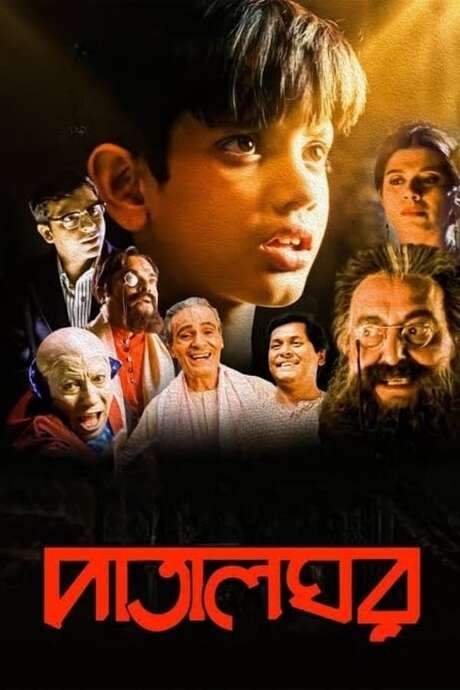
In a village shrouded by time, 150 years in the past, the brilliant scientist Aghor Sen, Soumitra Chatterjee, toils in the quiet lanes of Nischintipur. He unveils a remarkable device that can generate sound waves capable of lulling any living being into a deep sleep. The moment is tense and hopeful, because such power could reshape science and fate itself. Yet destiny bends toward trouble when the alien Vik, Biplab Chatterjee, exiled from the distant planet Nyapcha, lands near the village in a clumsy crash-landing of a space shuttle. Vik quickly learns of the sleeping-machine and sees a dangerous opportunity. Aghor Sen, ever the cautious inventor, manages to put Vik to sleep with the device, a dramatic demonstration of its power, but tragedy follows soon after: Aghor Sen dies, and with his death the instrument vanishes from the world, buried in the shadows of memory and loss. The night air in Nischintipur carries the echo of a dream that time could not quite hold.
Fast forward to the present day, and the tale tightens its grip. Dr. Bhootnath Nandy, Joy Sengupta, stumbles upon Aghor Sen’s diary, a fragmented chronicle that hints at a machine with the potential to bend sleep itself. At a public science seminar, Bhootnath deciphers the diary and publicly pleads for a quest to locate the legendary device, setting the town on a curious and wary path. The discovery attracts trouble of a different kind: Begum, Mita Vashisht, a formidable gang leader with elusive aims, learns of the diary’s contents and sends her goons to shadow Bhootnath, hoping to seize the machine before anyone else can grasp its power. The pursuit immediately broadens into a hunt that spans rival agendas, moneyed interests, and the fragile peace of a village that has spent a century in relative quiet. The instrument is rumored to lie within a secluded laboratory named Patalghar, and the only route to reach it lies through a cryptic sequence of rhymes etched in the diary. On the hamlet’s fringes, outsiders with a keen interest in property descend, fueling tension as old loyalties collide with new ambitions. In a surprising turn, Begum and Bhootnath recognize a shared peril and decide to combine forces to pursue the machine, a partnership born of necessity rather than trust.
In the middle of this escalating chase, Kartik, a very intelligent and brave boy, stands at the center of a different truth. He lives with his uncle Subuddhi, Kharaj Mukherjee, and a lawyer’s revelation shifts the ground beneath their feet: Kartik is the sole legal heir to Aghor Sen’s laboratory at Nischintipur. This revelation reframes the town’s power dynamics and places Kartik at the heart of a legacy that predates most of the current bustle. The legal claim brings both opportunity and responsibility, as the family’s quiet life is pressed into a wider drama. Subuddhi’s loyalty and practical wisdom become crucial as he navigates the murky waters of inheritance, family pride, and the looming possibility that the laboratory’s ancient secrets could either uplift or wreck their futures. In the shadows of these revelations, Bhootnath finds a surprising ally in Kartik, and a fragile friendship begins to blossom between scientist and boy, two generations bound by curiosity, duty, and a shared hunger for discovery.
Meanwhile, Vik, the orbital guest-turned-pugilist of fate, begins to wake once more, scurrying from one clue to another in a frantic quest to locate the device that altered his life so decisively. Subuddhi, ever pragmatic, teams up with the village’s theatre chief to search for a distinctive character who could embody Mahommadi Beg in a local performance—an odd yet oddly fitting plan to coax information from the unnatural arrival of Vik. In a tense forest encounter, Subuddhi meets Vik and, recognizing the creature’s potential as the theatrical embodiment of Beg, selects him for the role, weaving art and danger into a single moment of destiny. The act is playful yet heavy with implication: a performer chosen to depict a villain becomes a key piece in the puzzle that could unlock a machine capable of changing sleep itself. From this point, the lines between performance, peril, and truth blur, as Vik’s unusual talents and the story’s scientific thread converge toward a single goal.
As the path to Patalghar unfolds, Kartik and Bhootnath push forward to unravel the riddles and reclaim what was once lost. The journey brings them to the laboratory’s door, and together they rediscover the sleeping-machine, a relic of brilliant minds and reckless ambition. Yet the dramatic balance of the town’s power shifts once more, as Begum and her goons close in, driven by greed and the thrill of conquest. In a fierce duel that pits human courage against alien resilience, Vik proves formidable as the two sides collide. The struggle ends with Vik once again being subdued by the very device that once silenced an ancient intruder, a dramatic reversal that underscores the device’s double-edged power. With the machine’s sleep-inducing magic restored and the danger momentarily contained, Bhootnath carries the unconscious Vik back toward Nyapcha, leaving Kartik to bear the legacy of Aghor Sen and Bhootnath Nandy on the earth he calls home. The climactic chaos culminates in the machine’s destruction, a reckless act that marks the end of an era and the beginning of a new understanding of what such power truly means for a small village and its people.
Through these entwined journeys—of science, inheritance, friendship, and ritual theater—the narrative threads a thoughtful meditation on curiosity and the costs of ambition. It is a story of a village that becomes a crossroads for destinies, where an ancient diary, a laboratory named Patalghar, and a sleeping device converge with the lives of a boy, a scientist, a recovering alien, and a gang leader who discovers that some powers, once awakened, demand humility, courage, and a willingness to let go. In the end, while the great machine meets its final fate amid chaos and flame, the characters discover something enduring: a legacy that will live in Kartik’s stewardship and in the memory of a village that once stood still long enough to dream of a future shaped by wonder rather than fear. The tale remains a testament to resilience, imagination, and the unyielding pull of discovery that defines What’s After the Movie.