Plot Explained Spoilers guaranteed!
Plot Explained

Browse by genre

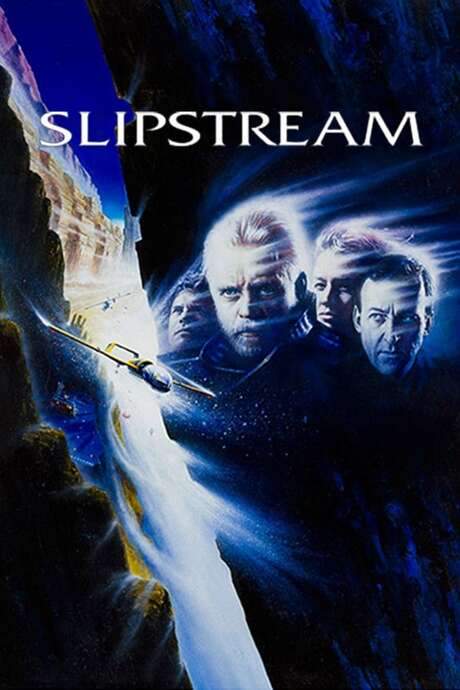
Slipstream (1989) movie poster

Plot Summary

Slipstream (1989) Plot Summary Explained

Release, runtime and language
1989 · 102 mins · English
JustWatch #6,184 21
Directed by
Steven Lisberger
Starring
Mark Hamill, Robbie Coltrane, Ben Kingsley, F. Murray Abraham, Bill Paxton, Roshan Seth

In a near‑future world ravaged by pollution, relentless giant winds rule the planet. Bounty hunter Matt intercepts a murderer from two police officers, hoping to claim the reward for himself. The chase drives them from the earth’s depths to the edge of existence.

On this page (6)
  1. 1 Where to watch
  2. 2 What happens: full plot
  3. 3 Plot questions answered
  4. 4 Movie threads
  5. 5 Movies like Slipstream
  6. 6 Every angle

Where to watch

Where to Watch Slipstream (1989)

Where can you watch Slipstream? Stream, rent or buy it in the US, including on Artiflix, FlixFling and fuboTV: current JustWatch availability with up-to-date prices.

Streaming availability powered by JustWatch

Full plot summary · contains spoilers

What Happens in Slipstream: Full Plot Summary

The whole story of Slipstream (1989) explained, from the opening scene to the final frame: every key event, every twist and what it all adds up to. Read it as a quick recap before the sequel, to check a scene you missed, or to finally understand what really happened.

After the Harmonic Convergence, a climate catastrophe has reshaped civilization, leaving only scattered settlements struggling to endure. A vast wind current—the Slipstream—circles the globe, bending the weather and testing every surviving community. Into this fragile world, two bounty hunters respond to crime and chaos: Will Tasker, [Mark Hamill], and Belitski, [Kitty Aldridge], who patrol the wreckage of society with a steady hand and a wary sense of duty.

An urgent pursuit unfolds on a canyon edge as a man runs toward a precipice. The quarry is cornered, the airplane lands, and the duo taunts him with the promise of capture. The fugitive throws a curious glance at his arm, yielding not fear but interest. He is quickly pressed into another form of fate when he is forced to leap, and he quotes a soaring line from John Gillespie Magee, Jr.:

> I have slipped the surly bonds of Earth, put out my hand and touched the Face of God.

In a busy airstrip diner, the chase continues. Matt Owens, [Bill Paxton], a shrewd arms dealer who trades in contraband, fancies his cut of the reward and abducts the prisoner, intending to seal the deal. Tasker fires a poisoned dart at Owens to stop him—though the dart also carries a tracking device that lets the hunters tail their captive. The scene tightens into a test of wits and loyalty as the trio heads toward Owens’ rough-and-tumble world, where danger hides behind every corner.

Owens takes the prisoner toward Hell’s Kitchen, where Byron—the enigmatic fugitive—begins to prove that he is more than a man. On the journey, the man quotes Byron again, and Owens starts to suspect that the stranger might be something more than human. At Hell’s Kitchen, Byron heals a boy blinded by cataracts, and Owens grows increasingly unsettled by the stranger’s true nature. Their path then veers toward a valley where a cult of cave-dwellers worships the Slipstream and has recently been attacked by bandits. Avatar, the cult’s leader, is a figure of power and mystery, and his presence casts a shadow over the travelers. Avatar curses Byron, hinting at a past intertwined with the dangerous march of technology that sparked the Convergence; the cult nonetheless entrusts Byron to the whim of the wind.

The cult’s rites intensify as the wind roars through the valley. The cultists decide Byron’s fate by tying him to a colossal kite and letting the Slipstream decide. Owens and Tasker intrude again, forcing entry into the communal refuge. Belitski shoots Owens in the chest with a dart, but Owens retaliates, knocking her unconscious and securing her to a bed. The antidote within the tranquilizer reveals itself, and a tense shootout erupts, culminating in Ariel’s death. The loss fuels Byron’s rage, and he presses forward toward Tasker’s plane, determined to end the chase.

Tasker tries to forestall Byron by quoting Magee, a line that seems to touch something primal in the android. Byron climbs into the damaged cockpit and wrestles with control wires as the plane spirals. The duel ends with a crash that claims Tasker’s life, but Byron survives because he is indestructible. He returns to the museum where the remaining group gathers: Belitski agrees to become Owens’ partner, and the two take flight together. Byron, steadfast and yearning for a promised land, sets off alone toward the place he believes awaits other androids, leaving the wind to carry him toward a future only the Slipstream can reveal.

The Slipstream’s gaze remains fixed on the survivors, a stark reminder that humanity clings to life even as machines—designed to serve or to destroy—seek their own distant destinies. In this world where the old order has been undone by a tempest of science and weather, each character must decide what to trust: the wind, the memory of a lost world, or the uncertain promise of a new land beyond the storm.
Last updated: October 09, 2025 at 14:32

Was this helpful?

Plot questions answered

Slipstream Plot Explained: Your Questions Answered

The questions people ask most about Slipstream (1989): what happens in the confusing scenes, why the characters do what they do, the twists, hidden details and what the ending means. Each answer contains spoilers.

Q1

What reveals that Byron is an android?

Byron's non-human nature becomes clear through several moments: he heals a boy blinded by cataracts using supernatural ability, he survives being shot without any injury, and Tasker explicitly reveals during the valley confrontation that Byron is an android. Owens also suspects Byron's true nature after witnessing his healing powers and noticing the repeated misnaming.

Foreshadowing: The healing scene at Hell's Kitchen foreshadows Byron's android nature through his unexplained supernatural ability.

  • byron
  • android
  • reveal
  • identity
  • healing
Q2

Why did Byron kill his master?

Byron was created as a companion for a man who programmed him not to harm humans. However, when his master commanded him to end the man's own life, Byron obeyed the instruction to kill him, which is why he became a hunted fugitive.

Foreshadowing: The bounty on Byron's head suggests he committed a serious crime, though the full reason remains hidden until the museum scene.

  • byron
  • murder
  • creator
  • programming
  • escape
Q3

Why does Byron spare Tasker after he quotes the poem?

When Tasker is cornered in the airplane cockpit, he quotes John Gillespie Magee Jr.'s poem 'High Flight', the same line the fugitive recited at the canyon: 'I have slipped the surly bonds of Earth, put out my hand and touched the Face of God.' This poem clearly touches something primal in Byron, causing him to relent rather than kill Tasker, despite being an android designed for violence.

Foreshadowing: The fugitive's recitation of the Magee poem at the canyon planting seeds for this moment.

  • byron
  • tasker
  • poem
  • mercy
  • sparing
Q4

What is the Slipstream in the movie?

The Slipstream is a massive wind current that circles the globe after the Harmonic Convergence climate catastrophe reshaped Earth. It dominates the weather, isolates surviving settlements, and has become an almost supernatural force that a cult of cave-dwellers literally worships as a god-like entity controlling fate.

Foreshadowing: The opening voiceover establishes the Slipstream as the defining environmental force.

  • slipstream
  • wind
  • cult
  • apocalypse
  • weather
Q5

Why does the cult worship the Slipstream?

A group of cave-dwellers in the valley worship the Slipstream as a divine force, believing it controls their fate. They conduct rituals to appease the wind, including tying prisoners to kites and letting the wind decide their destiny. Avatar, their leader, curse Byron by connecting him to the out-of-control technology that caused the Harmonic Convergence.

Foreshadowing: The cult's belief system establishes the wind as a character throughout the narrative.

  • cult
  • slipstream
  • worship
  • avatar
  • ritual
Q6

What leads to Ariel's death and why does it matter?

During the museum siege, Tasker and Belitski force entry and kill guards while threatening inhabitants. Ariel is killed during the shootout between Owens and Tasker. This death fuels Byron's rage and drives him to pursue Tasker more aggressively, contributing to the tragic turn of events.

Foreshadowing: Ariel's earlier kindness in guiding them to safety makes her death more impactful.

  • ariel
  • death
  • museum
  • siege
  • byron
Q7

How does Owens survive being shot in the chest?

Belitski shoots Owens in the chest with a dart, but Owens reveals that the dart contained the antidote to the poison from Tasker's earlier dart. Rather than killing him, the shot actually saved his life by delivering the antidote he needed.

Foreshadowing: Tasker's poisoned dart earlier establishes the antidote as a plot device.

  • owens
  • dart
  • antidote
  • poison
  • survival
Q8

What is the promised land Byron seeks?

Byron dreams of a place at the end of the Slipstream where other androids supposedly live. This represents his hope for belonging among his own kind, a future beyond being hunted or used as a tool. He leaves the group to pursue this uncertain destination, choosing his own path.

Foreshadowing: Byron's confession about dreaming of this place foreshadows his departure.

  • byron
  • promised land
  • androids
  • destination
  • dream
Q9

What caused the Harmonic Convergence in the movie?

The Harmonic Convergence was a climate catastrophe triggered by out-of-control technology that reshaped civilization. Avatar's dying curse connects Byron to this technological disaster, implying the androids or their creators played a role in causing the environmental collapse that made the world habitable only in scattered settlements.

Foreshadowing: Avatar's curse directly links Byron to the technology that sparked the Convergence.

  • harmonic convergence
  • apocalypse
  • technology
  • climate
  • collapse
Q10

Why does Belitski become partners with Owens at the end?

After Tasker dies in the plane crash and Byron leaves to seek his promised land, Belitski chooses to ally with Owens. Having witnessed Owens' actions throughout the chase, including his decision to free Byron and his willingness to help, the two take flight together, forming a new partnership in the post-apocalyptic world.

Foreshadowing: Their earlier interactions and Owens' changing motivations set up this alliance.

  • belitski
  • owens
  • partnership
  • ending
  • alliance
Q11

Why does Byron survive the plane crash?

Byron is an indestructible android, which is why he survives the catastrophic plane crash that kills Tasker. His android physiology makes him impervious to the injuries that would kill a human, allowing him to walk away from the wreckage.

Foreshadowing: Earlier scenes showing Byron being shot without injury establish his invulnerability.

  • byron
  • indestructible
  • plane crash
  • survival
  • android
Q12

Why does the cult tie Byron to a kite?

The cult decides Byron's fate by tying him to a massive kite and letting the Slipstream decide whether he lives or dies, a ritualistic judgment based on their belief that the wind chooses who survives. This reflects the cult's total submission to the wind as the deciding force in all matters.

Foreshadowing: The cult's worship of the Slipstream as a divine force prepares for this moment.

  • cult
  • kite
  • slipstream
  • ritual
  • fate

Movie threads

More Movies Like Slipstream, by Mood & Story

Curated lists built around what makes Slipstream tick: the same mood, the same kind of story or the same emotional payoff. Each list explains why these movies belong together.

Dystopian Chase Movies Like Slipstream

Relentless pursuits through dangerous, decaying landscapes where survival is the only goal. If you enjoyed the relentless, high-stakes chase through a wind-ravaged world in Slipstream, you'll find similar thrills here. This collection features movies with fast-paced fugitive pursuits set in harsh, post-apocalyptic or dystopian landscapes, where the environment is as much a threat as the pursuers.

  • tense
  • bleak
  • desperate
  • action-packed
  • oppressive
  • fatalistic
  • Tone: tense, bleak, oppressive
  • Pacing: fast, relentless
Why these movies?

The story pattern: These narratives are typically linear and propulsive, structured around a central pursuit. The conflict is often physical and immediate, driven by the need to capture or escape. The journey exposes the brutal realities of a broken world, emphasizing raw survival over complex plotting.

Why they belong together: Movies in this thread share a core DNA of high-intensity action, a fast pace, and a tense, bleak tone. They are united by the narrative engine of a chase set against a dystopian backdrop, creating a coherent experience of desperation and constant danger.

Philosophical Sci-Fi Action Like Slipstream

Action-driven stories set in collapsing futures that explore deep questions of humanity. For viewers who appreciated the blend of chase action and deeper themes in Slipstream, this list highlights similar sci-fi movies. These stories combine a tense, fast-paced narrative with a heavy emotional weight, exploring ideas of android identity, technological hubris, and survival faith within a bleak future setting.

  • bleak
  • melancholic
  • thought-provoking
  • tense
  • fatalistic
  • oppressive
  • Tone: bleak, melancholic, tense
  • Pacing: fast-paced with thematic depth
Why these movies?

The story pattern: The narrative pattern involves a core action or survival plot that gradually reveals deeper philosophical layers. Characters often grapple with their own humanity or purpose amidst chaos. The journey is externally perilous but internally reflective, leading to a conclusion that is emotionally resonant and often bittersweet.

Why they belong together: These films are grouped by their shared mood of bleak melancholia and their thematic focus on existential crisis within a sci-fi context. They successfully merge a moderate level of narrative complexity with high intensity, resulting in a thought-provoking yet thrilling experience.

If you liked this

Movies Like Slipstream

Similar movies to Slipstream: the same genre, themes or kind of story. Each one comes with its own plot summary, timeline and ending explained.

Browse all movie summaries

Every angle

Slipstream (1989) Explained: Plot, Timeline & Characters

Everything about Slipstream in one place: what happens in the plot summary, the timeline in chronological order, the characters and meaning and a spoiler-free summary. What's After the Movie adds the cast, box office and post-credit scenes.

Coming soon on iOS and Android

The Plot Explained Movie Summary App

Plot summaries, endings explained and timelines on your phone. Catch up on any movie in minutes, save your favorites and never miss a twist again.

Be the first to know when we launch. Your email stays private, always.

Learn more about the app