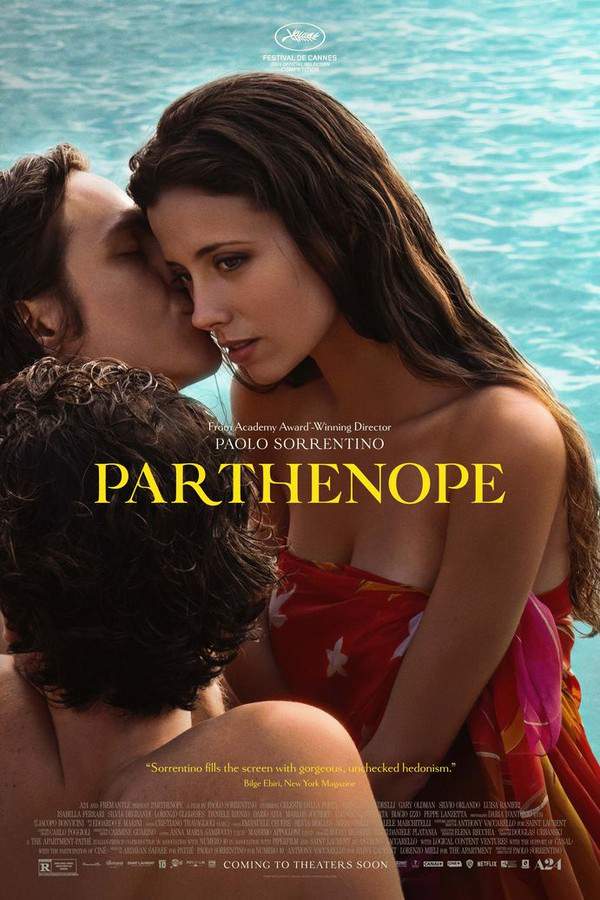
In 1950, the affluent Di Sangro family waits for the birth of their daughter in the tranquil waters of Posillipo. The moment is witnessed by her wealthy godfather Achille Lauro, her older brother Raimondo, and Madre Sandrino Governante [Francesca Romana Bergamo], a figure tied to the household’s quiet authority. Achille bestows a Naples-born name on the infant: Parthenope, a small but telling nod to a city that will shape her story.
By 1968, Parthenope’s world has grown tangled with longing and secrecy. Sandrino becomes fixated on her, while Raimondo, unable to hide a deep, troubling attachment, lingers at the edges of her life. Parthenope enrolls in an anthropology course led by the stern Professor Devoto Marotta, a man whose rigor tests his students and, in a moment of rare honesty, earns her respect. Their exchange is more than classroom banter; it marks the beginning of a mutual, uneasy understanding between mentor and student.
The tale accelerates to 1973, when Raimondo suggests a trip to Capri. Parthenope’s carefree charm draws many toward her orbit, including the writer John Cheever, whom she has read with interest. Raimondo conspires to ingratiate himself with an heiress, yet he cannot bring himself to kiss her, realizing in that moment that his true love has always been Parthenope. After Sandrino seduces Parthenope, Raimondo’s fragile psyche shatters, and he plunges to the sea from the cliffs of Capri.
Heading into 1974, Parthenope faces a harsh new reality: her father and mother blame her for Raimondo’s death. She seeks intellectual guidance from Marotta, asking him to advise on an anthropology dissertation about suicide. Instead he steers her toward a study of miracles and their cultural impact. A detour into acting briefly tempts her. She visits Flora Malva, an aging but influential acting teacher, who then sends her to Greta Cool, a fellow actress with Neapolitan roots who shares Parthenope’s sense of origin. At a party honoring Greta, Parthenope meets Roberto Criscuolo, a mafioso who escorts her into a Camorra tradition in which heirs from rival families conceive a child to symbolize unity. Parthenope becomes pregnant by Criscuolo, but terminates the pregnancy in a painful decision. Sandrino declares his love, yet Parthenope pushes away, blaming him for Raimondo’s death.
By 1982, Parthenope has become a scholar in her own right. A magazine asks her to write about the liquefaction of the blood of San Gennaro, a topic that intertwines faith, science, and Naples’ living folklore. Marotta warns her about Cardinal Tesorone, calling him a “scoundrel.” Tesorone presses Parthenope to meet him for sex, and she accepts. Marotta, preparing for retirement, suggests she apply for a teaching post at the University of Trento. At first she hesitates, torn by her deep love for Naples, but Marotta introduces her to his disabled son, a moment that leaves Parthenope both intrigued and unsettled. She chooses to stay with the possibility of further study and life in Trento.
In 2023, as Parthenope nears retirement, she speaks with two students about the lasting imprint she has left on their lives, offering careful, measured reflections on her private history. A visit to Capri rekindles memories of youth, then she returns to Naples with a quiet, enduring smile. The city’s spirit feels buoyant as she witnesses SSC Napoli clinch its third Serie A title, a moment of communal joy that seems to echo the long arc of her own life—complex, luminous, and deeply Neapolitan.