Plot Explained Spoilers guaranteed!
Plot Explained

Browse by genre

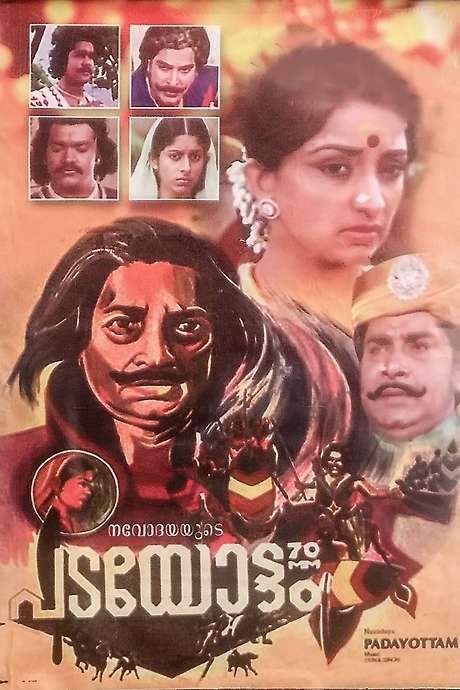
Padayottam (1982) movie poster

Plot Summary

Padayottam (1982) Plot Summary Explained

Release, runtime and language
1982 · More mins · Malayalam
Directed by
Jijo Punnoose
Starring
Mammootty, Mohanlal, Lakshmi, Sukumari, G K Pillai, Madhu

Inspired by Alexandre Dumas’s classic The Count of Monte Cristo, the film became the first Indian production shot in 70 mm. It follows Prince Udayan (Nazir), heir to the Kolathiri throne, who is betrayed by his cousin Devan (Madhu) and forced into exile. After years away, Udayan returns to Kolathiri intent on avenging the treachery and reclaiming his rightful place.

On this page (7)
  1. 1 Where to watch
  2. 2 What happens: full plot
  3. 3 Plot questions answered
  4. 4 The book behind the movie
  5. 5 Movie threads
  6. 6 Movies like Padayottam
  7. 7 Every angle

Where to watch

Where to Watch Padayottam (1982)

Where can you watch Padayottam? Stream, rent or buy it in the US, including on Sun Nxt: current JustWatch availability with up-to-date prices.

Streaming availability powered by JustWatch

Full plot summary · contains spoilers

What Happens in Padayottam: Full Plot Summary

The whole story of Padayottam (1982) explained, from the opening scene to the final frame: every key event, every twist and what it all adds up to. Read it as a quick recap before the sequel, to check a scene you missed, or to finally understand what really happened.

In the northern kingdom of Kolathirinadu, the Kolathiri Raja stands as a prosperous and respected ruler, but the realm is laced with ambition, betrayal, and a longing for rightful fate. The king’s second nephew, Udayan, is celebrated for his handsomeness, courage, and keen intelligence, and the ruler chooses him as his successor in keeping with the land’s matrilineal traditions. The royal match follows: his daughter, Parvathi, is deeply in love with Udayan, and the union is meant to solidify the royal line. Yet this decision unsettles Devan, the elder nephew, who watches his own prospects withering as Parvathi’s heart sways toward Udayan. The court, meanwhile, grows tense as two influential nobles—Kammaran and Perumana Kurup—take exception to Udayan’s ascent, nursing their own grievances and plotting to reshape the throne’s future.

From the shadows, the schemers enlist Kompan, a brutal dacoit who operates under a hollow semblance of royal pardon. Their plan hinges on drawing Udayan into a trap under the pretense of signing a peace treaty, after which Kompan can seize the crown’s prerogatives and expose the king to peril. Unwittingly, Udayan rides into the trap at Kompan’s camp, where the trap snaps shut and the news of his supposed betrayal—of the Kolathiri Raja and the realm—sweeps the land. The king, enraged by reports of Udayan’s treachery, declares him a traitor, and the heart of the kingdom trembles as the marriage alliance dissolves into a knot of fear and doubt. The consequences are swift: Kompan’s men, though ordered to kill Udayan, choose a more cruel fate for him and sell him as a slave to a ruthless ship captain—Mooppan.

As a slave, Udayan endures hardship, but his spirit remains unbroken. Onboard a slave ship, he befriends a fellow captive named Kunjali, who carries news of the kingdom’s darkest days—the deaths of Kolathiri Raja and his queen at the hands of Marakkar’s followers, a tragedy engineered by Perumana Kurup and Kompan. Kunjali’s loyalty becomes crucial when he rescues Marakkar’s daughter, Laila, with the help of his fellow slaves. The little mercy they manage to glean in their grim world seeds the seed of hope: Udayan learns from Kunjali where the treasures of Marakkar and his daughter were taken, and he discovers the truth behind the royal catastrophe. Marakkar himself is dead, but the clues point to a future where power can be reclaimed. In time, the mutiny on the ship breaks out; Moopan is killed, the slaves win their freedom, and Udayan escapes to rebuild his life.

Freedom ushers in a dramatic turn: the once-betrayed prince uses the lost wealth to reinvent himself as a prosperous merchant, a floating-palace Thampan, and a force silently rebuilding the crown’s legitimacy. The years pass, and a deliberate return to Kolathirinadu becomes possible—this time in disguise as a merchant and his daughter, a pair whose presence unsettles those who long to forget the past. Only Queen Parvathi recognizes him at a single, glinting moment, and the memory of his true identity resurfaces in her eyes. Meanwhile, Devan’s own line—his son, Chandran—falls in love with Laila, creating a new triad of loyalties, love, and revenge that threads through every corridor of the court.

Back in the capital, Thampan’s—Udayan’s—reappearance unsettles the treacherous circle of Kammaran and Kompan. The missing royal sceptre back in the palace becomes a symbol of power and legitimacy, and Kammaran—now hungry for wealth once more—seeks to force Devan to bow beneath his influence. Devan, alerted by his spies, realizes he has walked into a trap laid by Kammaran and grows wary of his old ally’s motives. To complicate matters, Laila steps forward in court to reveal the truth—she is the daughter of Marakkar and the rightful heir—turning the proceedings on their head. Perumana Kurup, cornered by the weight of evidence, refuses to accept his fate and kills himself, ending one of the most dangerous strands of the conspiracy.

With the drama of the trial behind them and the truth laid bare, Chandran emerges as a pivotal figure in the ongoing conflict. The young prince champions a path of justice, but the old wounds of Devan’s sins are not yet fully healed. In a tense showdown, Udayan challenges Kammaran and Kompan in a public duel, while Parvathi—wise and steadfast—counsels patience, insisting that Chandran not be drawn into the conflict. Chandran yields to Udayan, a moment that shocks the court and reveals the fragile line between vengeance and forgiveness. The revelation shakes Devan to his core, and Parvathi reassures him that the country’s healing must begin with accountability and humility.

In the climactic turn, the conspirators strike at the heart of the palace, but Udayan’s loyal army moves decisively to repulse them. Kammaran and Kompan are slain, and the threat to the realm dissipates as the rightful order edges back into place. The final measure is tender and symbolic: Udayan entrusts Laila to Parvathi, restoring her to the queen’s care and ensuring that the future of Marakkar’s line remains protected. Then, with the echoes of battle fading, Udayan steps away from the throne’s glare, his floating palace fading into the horizon as he vanishes into the tides of consequence, leaving the kingdom more secure than it has been in years.

The tale closes on a note of quiet hope and hard-won reconciliation. A king’s legacy, a daughter’s rightful birthright, and a warrior’s vow to protect the realm converge in a story of love tested by time, and vengeance tempered by mercy. The best of both worlds—diplomacy and daring, loyalty and ambition—collide and, in the end, guide Kolathirinadu toward a future where power is tempered by justice and the shadows of past deceits are finally laid to rest.

Last updated: October 09, 2025 at 14:42

Was this helpful?

Plot questions answered

Padayottam Plot Explained: Your Questions Answered

The questions people ask most about Padayottam (1982): what happens in the confusing scenes, why the characters do what they do, the twists, hidden details and what the ending means. Each answer contains spoilers.

Q1

Why was Prince Udayan declared a traitor?

Udayan was set up by nobles Kammaran and Perumana Kurup who enlisted dacoit Kompan to lure him into a fake peace treaty trap. Once at Kompan's camp, false news spread that Udayan had killed Moithooti, leading the Kolathiri Raja to brand him a traitor and cancel his marriage to Parvathi.

Foreshadowing: Earlier, the court tension around Udayan's ascent hinted at growing opposition from those who resented his succession.

  • Udayan
  • traitor
  • betrayal
  • Kompan
  • Kammaran
  • Perumana Kurup
  • framed
Q2

Why did Kammaran and Perumana Kurup plot against Udayan?

Both nobles resented Udayan's rise as the chosen successor to the Kolathiri throne. In the matrilineal tradition of Kolathirinadu, the king selected Udayan (the younger nephew) as heir and arranged his marriage to Parvathi, which threatened the political ambitions of these influential court figures.

Foreshadowing: The story establishes early that two nobles took exception to Udayan's ascent, nursing their own grievances.

  • Kammaran
  • Perumana Kurup
  • Udayan
  • conspiracy
  • throne
  • nobles
Q3

How did Prince Udayan become a slave?

After being framed as a traitor, Udayan was captured by Kompan's men. Rather than killing him outright, they sold him as a slave to a ruthless ship captain named Mooppan. This cruel fate transformed the prince from royal heir to captive laborer on a slave ship.

Foreshadowing: The trap was set under the pretense of signing a peace treaty, designed to draw Udayan away from royal protection.

  • Udayan
  • slavery
  • Kompan
  • Mooppan
  • slave ship
  • betrayal
Q4

What truth did Udayan learn while on the slave ship?

While in captivity, Udayan learned from fellow slave Kunjali that the Kolathiri Raja and queen were killed on Marakkar's boat. The massacre was orchestrated by Perumana Kurup (not Marakkar's followers as believed), making Udayan realize the full depth of the conspiracy against his family.

Foreshadowing: Kunjali carried news of the kingdom's darkest days, revealing the tragedy that befell the royal family.

  • Udayan
  • slave ship
  • Kunjali
  • Kolathiri Raja
  • massacre
  • Marakkar
  • Perumana Kurup
  • truth
Q5

Who was Laila and why was she important to the story?

Laila was the daughter of Marakkar, a powerful figure whose death was wrongly blamed for the Kolathiri Raja's murder. She was saved by Kunjali during the chaos surrounding the royal massacre. Her identity as Marakkar's rightful heir became crucial evidence later in court, and her presence complicated the political landscape when Chandran (Devan's son) fell in love with her.

Foreshadowing: Kunjali rescued Marakkar's daughter with the help of fellow slaves, seeding hope in their grim world.

  • Laila
  • Marakkar
  • Kunjali
  • heir
  • Chandran
  • court
  • identity
Q6

How did Udayan escape slavery and become a wealthy merchant?

Udayan led a mutiny aboard the slave ship, killing Captain Mooppan and freeing the other captives. He discovered Marakkar's hidden treasure during the mutiny, which he used to reinvent himself as a prosperous merchant known as Thampan, owner of a floating palace. This wealth became his means to return to Kolathirinadu and seek revenge.

Foreshadowing: Kunjali had earlier revealed where Marakkar's treasures were taken, providing Udayan with crucial knowledge for his future plans.

  • Udayan
  • mutiny
  • escape
  • treasure
  • Thampan
  • merchant
  • floating palace
  • revenge
Q7

How did Queen Parvathi recognize Udayan despite his disguise?

Parvathi recognized Udayan at a single glinting moment when he returned to Kolathirinadu disguised as merchant Thampan. Their past bond and her deep love for him allowed her to see through his disguise, even though he had transformed into a wealthy merchant with a fictional daughter. This recognition marked the beginning of his staged comeback.

Foreshadowing: The royal match between Udayan and Parvathi was meant to solidify the royal line, showing their strong connection.

  • Parvathi
  • Udayan
  • recognition
  • disguise
  • Thampan
  • love
  • return
Q8

Why did Perumana Kurup commit suicide in court?

When Laila revealed her true identity as Marakkar's daughter and presented herself as the rightful heir in court, she exposed Perumana Kurup's role in orchestrating the original royal massacre. Cornered by the weight of evidence and unable to deny his crimes, Perumana Kurup chose to kill himself rather than face justice.

Foreshadowing: Udayan began plotting to trap Kuruppu by leveraging Laila identity in court, knowing her testimony could expose the truth.

  • Perumana Kurup
  • suicide
  • court
  • Laila
  • identity
  • evidence
  • confession
Q9

Why did Udayan entrust Laila to Parvathi at the end?

After defeating Kammaran and Kompan, Udayan gave Laila to Parvathi's care, symbolizing reconciliation and protecting Marakkar's lineage. This act represented healing between the two women and secured Laila's future within the palace, ensuring the queen would protect the rightful heir of Marakkar.

Foreshadowing: Parvathi counselled patience throughout the conflict and sought reconciliation over vengeance.

  • Udayan
  • Laila
  • Parvathi
  • reconciliation
  • protection
  • queen
  • heir
Q10

Why did Udayan leave the kingdom after victory?

After defeating Kammaran and Kompan and securing the kingdom, Udayan chose to walk away from the throne. Rather than claim his rightful place as ruler, he stepped away from the throne's glare and vanished into the tides aboard his floating palace. This represented his personal sacrifice, he achieved justice and revenge but chose not to assume power, leaving the kingdom in the hands of those who remained.

Foreshadowing: The story emphasizes that the best of both worlds, diplomacy and daring, guided Kolathirinadu toward a future tempered by justice.

  • Udayan
  • leave
  • throne
  • sacrifice
  • kingdom
  • resolution
  • floating palace
Q11

How did Chandran become important in the final conflict?

Chandran, Devan and Parvathi's son, fell in love with Laila, creating a new triad of loyalties in the royal household. He emerged as a pivotal figure who championed justice and, in a key moment, yielded to Udayan during the confrontation, choosing forgiveness over vengeance. This shocked the court and represented the generational shift toward reconciliation rather than continued conflict.

Foreshadowing: The love between Chandran and Laila created complications that threaded through every corridor of the court.

  • Chandran
  • Laila
  • Devan
  • Parvathi
  • love
  • justice
  • yield
  • forgiveness
Q12

What happened to Prince Devan after the conspiracies were exposed?

Devan, who had become Kolathiri Raja after Udayan's exile, was shaken to his core when the truth of the conspiracies was revealed. While he was not directly involved in framing Udayan, his ascension benefited from the deception. Parvathi reassured him that the country's healing must begin with accountability and humility, and he was allowed to remain as ruler while the true villains, Kammaran and Kompan, were defeated.

Foreshadowing: Devan's own line, his son Chandran, became entangled in the consequences of his past actions.

  • Devan
  • Raja
  • confession
  • Parvathi
  • accountability
  • healing
  • throne

Movie threads

More Movies Like Padayottam, by Mood & Story

Curated lists built around what makes Padayottam tick: the same mood, the same kind of story or the same emotional payoff. Each list explains why these movies belong together.

Movies about betrayed heirs seeking revenge like Padayottam

Stories of royal heirs stripped of everything, who must rebuild to reclaim their birthright. If you liked Padayottam's story of a prince betrayed by his own family, you'll enjoy these similar movies. Discover epic tales of royal conspiracy, wrongful exile, and the long, difficult path to vengeance and rightful restoration.

  • vengeful
  • epic
  • dramatic
  • tense
  • tragic
  • hopeful
  • Tone: tense, dramatic, vengeful
  • Pacing: steady, epic scale
Why these movies?

The story pattern: The narrative follows a classic rise-fall-rise structure, beginning with the protagonist's privileged life, a pivotal act of treachery that leads to their downfall and exile, a period of hardship and growth, and a final return where they use their newfound strength and resources to achieve revenge and reclaim their position.

Why they belong together: Movies are grouped here for their shared focus on high-stakes political betrayal, the emotional weight of a protagonist's fall from grace, and the satisfying, steady-paced build towards a confrontation that restores moral order, often in a historical or aristocratic setting.

Methodical revenge stories with a steady pace like Padayottam

Patient, calculated stories where revenge is a dish best served cold, after careful planning. For viewers who enjoyed the patient, strategic vengeance in Padayottam, this list curates films with a similar slow burn feel. Explore stories where characters meticulously plot their comeback over years, leading to a tense and dramatic final confrontation.

  • tense
  • calculated
  • patient
  • vengeful
  • dramatic
  • methodical
  • Tone: tense, heavy, calculated
  • Pacing: steady, patient build
Why these movies?

The story pattern: These narratives are defined by a significant time jump or a prolonged period of preparation. The protagonist's transformation is central, often involving a secret identity or accumulated power. The plot unfolds steadily, building tension as each piece of the revenge puzzle is carefully put into place before the final, satisfying collapse of the antagonist.

Why they belong together: These films share a specific pacing and structural pattern: a steady build-up focused on the protagonist's long-term strategy rather than immediate action. They create a tense, heavy mood where the emotional payoff comes from witnessing a carefully laid plan come to fruition.

If you liked this

Movies Like Padayottam

Similar movies to Padayottam: the same genre, themes or kind of story. Each one comes with its own plot summary, timeline and ending explained.

Browse all movie summaries

Every angle

Padayottam (1982) Explained: Plot, Timeline & Characters

Everything about Padayottam in one place: what happens in the plot summary, the timeline in chronological order, the characters and meaning and a spoiler-free summary. What's After the Movie adds the cast, box office and post-credit scenes.

Coming soon on iOS and Android

The Plot Explained Movie Summary App

Plot summaries, endings explained and timelines on your phone. Catch up on any movie in minutes, save your favorites and never miss a twist again.

Be the first to know when we launch. Your email stays private, always.

Learn more about the app