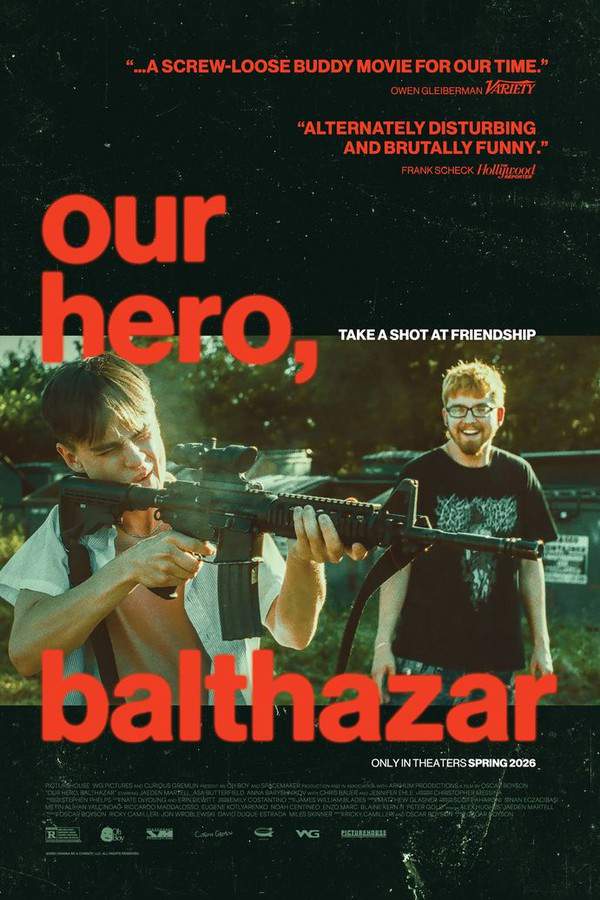
Eager to impress his activist crush, a wealthy New York teenager follows an online connection to Texas, where he's convinced he can stop an act of extreme violence.
Find where to stream, rent, or buy Our Hero, Balthazar (2026) in the US with current JustWatch availability, up-to-date pricing, and platform listings for subscription, rental, and digital purchase options.
Warning: spoilers below!
Haven’t seen Our Hero, Balthazar yet? This summary contains major spoilers. Bookmark the page, watch the movie, and come back for the full breakdown. If you're ready, scroll on and relive the story!
Trace every key event in Our Hero, Balthazar (2026) with our detailed, chronological timeline. Perfect for unpacking nonlinear stories, spotting hidden connections, and understanding how each scene builds toward the film’s climax. Whether you're revisiting or decoding for the first time, this timeline gives you the full picture.
Last updated: September 03, 2026 at 09:21
Find frequently asked questions about the Our Hero, Balthazar (2026) timeline, including chronological order, nonlinear jumps, cause-and-effect links, and scene sequence clarifications. This timeline FAQ helps explain when key events happen, how moments connect, and why the story unfolds in that specific order.
After Eleanor rejects him, Balthazar is desperate to hold onto the online connection that made him feel important, so he uses AI tools to pose as a young woman named Terra and continue the exchange. The Terra persona lets him stay close to the threat he believes he is monitoring while also feeding his craving for attention. The deception quickly spirals because deathdealer_16 turns out to be Solomon, and the relationship becomes more intimate and more dangerous than Balthazar planned.
Balthazar's early willingness to stage his videos for the camera hints at how easily he will slip into a manufactured identity.
Eleanor is a genuine activist who sees Balthazar's dramatized posts and Arkansas shooting footage as exploitation rather than advocacy, so she reacts with cold contempt instead of admiration. Her rejection exposes the gap between Balthazar's performed outrage and any real commitment to the issue. The humiliation pushes him toward the more reckless online behavior that drives the rest of the plot.
Balthazar's earlier admission that he treats each post as a performance foreshadows why a serious activist would refuse to validate him.
Balthazar needs a believable reason for Terra to disappear from the chat, so he improvises a family emergency to buy time and keep Solomon emotionally invested. The lie works only briefly because Solomon is already deeply attached to Terra and pushes to meet in person. The deception backfires and forces Balthazar to reveal himself, binding the two teenagers together through shared lies.
The pattern of Balthazar using fabricated crises to control situations begins with his false accusation against his life coach Anthony.
Solomon collects guns and notebooks full of planned shootings, but he admits to Balthazar that the fantasies function as posturing rather than a concrete plan. The line between performance and intent blurs as the story progresses, and his threats become a tool for leverage over his father rather than a stated mission. The danger turns real only when momentum, drugs, and family pressure push him past the point of fantasy.
Solomon's shelves of past ideological phases show that his obsessions tend to cycle through intensity and abandonment.
Solomon uses the threat because it is the only currency he believes his father Beaver will respond to, since normal attempts to earn approval have failed and the supplement scheme is collapsing. By framing the threat around a sales order, Solomon tries to force Beaver to treat him as valuable. The tactic reveals how thoroughly violence has become Solomon's default language for demanding attention.
Solomon's earlier loss of his gas station job and the failed pyramid scheme foreshadow his desperation for leverage.
The discharge happens inside the trailer after Solomon and Balthazar return from Beaver's escalating business conference, in the middle of a confrontation fueled by drugs, paranoia, and confrontation. The exact trigger is left ambiguous, but the chaotic handling of the rifle inside a cramped living space leads to an accidental firing. The wound instantly destroys any remaining control over the situation and sets off the final chase through the trailer park.
Balthazar's earlier moment at the local school, when he toys with the idea of aiming Solomon's rifle, foreshadows how casually they handle firearms.
With police closing in and Solomon pursuing him through the trailer park in an increasingly unhinged state, Balthazar fires the pistol he grabbed while fleeing the grandmother's shooting. The shot is meant to stop the chase and protect himself rather than as a planned execution. The act is the moment where Balthazar's performed moral authority collapses into the very violence he once claimed to oppose.
Balthazar's earlier showmanship around gun violence in his videos sets up the grim irony of him becoming an actual shooter.
The film implies that Balthazar's family wealth and connections, along with the politically useful narrative of a privileged teen confronting gun violence, make a quiet return more convenient than a public prosecution. The decision underscores the satire at the heart of the ending, where systems protect those who perform the right kind of victimhood. Returning him to a TV studio rather than a courtroom is the point.
Balthazar's privileged New York background is established in the opening scenes and quietly explains every accommodation he receives later.
Solomon is the person behind deathdealer_16, the sardonic user who first replied to Balthazar's videos and pulled him into private messages. Balthazar then assumes the Terra persona to keep that connection alive, and the two eventually meet in Texas without realizing they have been talking to each other's aliases. The reveal that hunter and hunted are the same pair of teenagers is the engine of the second half.
The unsettling intimacy of the deathdealer_16 chats foreshadows that the threat and the temptation are the same person.
When Anthony tries to intervene and pull Balthazar back from the escalating online relationship, Balthazar fabricates an accusation against him in order to justify cutting off the only adult who was trying to stop him. The lie removes the last institutional check on his behavior and protects his access to Solomon. It is also an early demonstration of how Balthazar weaponizes serious claims to serve his own narrative.
Balthazar's instinct to perform for the camera hints that he will treat personal accusations as content rather than truth.
Beaver runs a multi-level supplement business selling testosterone products, dragging Solomon in as a downline distributor with promises of money and paternal approval. When the scheme fails to generate sales, Solomon loses both income and the relationship he was chasing, which deepens his instability. The financial pressure feeds directly into his threats and his need for leverage, making the grift a structural cause of the violence rather than background detail.
Beaver's introduction as a former drug addict and porn actor establishes a pattern of using people for profit.
Solomon has spent years teaching himself to perform emotion for approval, so passing that skill to Balthazar is both a gift and a mirror. It acknowledges that Balthazar's activism is also a kind of acting, and it cements the strange mentorship between two boys who use manufactured feelings to survive. The exchange highlights how each character teaches the other the tools of his own self-destruction.
Solomon's earlier display of ideological 'phases' foreshadows his tendency to perform identities for others.
The closing television appearance frames Balthazar's confession as part of a generational 'fight for their lives,' rewarding him with exactly the kind of attention he has been chasing all film. The irony is the point: a boy who manufactured outrage, lied to peers, and killed another teenager is celebrated as a survivor and spokesperson. The ending forces the audience to weigh the cost of a dead grandmother and Solomon's life against the media's appetite for a compelling young voice.
Balthazar's opening obsession with shaping how others see his world foreshadows his hunger for a national platform.
After Eleanor's rejection and the failure of his performative activism to win him real intimacy, Balthazar becomes convinced he can intervene personally and stop a potential school shooting. The trip is framed as moral courage, but it is also a search for the connection and significance he could not get from Eleanor. Going to Texas lets him cast himself as a hero in someone else's crisis instead of facing his own.
Balthazar's early willingness to chase strangers online for content foreshadows his decision to pursue deathdealer_16 across state lines.
Discover curated groups of movies connected by mood, themes, and story style. Browse collections built around emotion, atmosphere, and narrative focus to easily find films that match what you feel like watching right now.
Stories where performative virtue masks rot and the corrupt walk away celebrated.Looking for movies like Our Hero, Balthazar? These dark satirical thrillers dissect performative activism, internet-age moral corruption, and media hypocrisy with biting irony. If you appreciated Balthazar's cynical take on gun culture and the way manipulators escape consequences, you'll find similar unsettling stories here.
These stories typically begin with a protagonist who postures, performs, or profits from a moral cause they don't truly believe in. Layers of deception and self-interest build gradually, often amplified by social media or institutional complicity. The climax delivers a violent or chaotic shock that exposes the rot underneath, but the final beat lands as ironic rather than redemptive. The manipulator frequently survives intact, even celebrated, while bystanders absorb the cost. The emotional journey is one of mounting discomfort that resolves not in catharsis but in bleak recognition.
They share a high-intensity, darkly comic sensibility and a willingness to make the audience complicit in watching a fraud succeed. The tone blends cynical humor with genuine menace, the pacing is variable, and the endings prioritize pointed satire over tidy resolution. Films cluster here because they trust the viewer to sit with discomfort rather than offering easy judgment.
Catfishing and digital manipulation escalate from petty lies into devastating violence.If you loved the catfishing setup and Texas descent in Our Hero, Balthazar, explore these thriller and drama movies where internet manipulation, online radicalization, or digital cons escalate into real-world violence. Expect tense pacing, morally complex characters, and bittersweet or devastating conclusions.
These narratives typically open with a character using the internet to perform, recruit, or deceive, often for status, money, or a crush. A seemingly small online choice pulls them into a stranger's orbit, and bonds form under false pretenses. The middle act builds uneasy camaraderie and complicity while the deception metastasizes. The final act collapses fast, with violence, accidents, or irreversible choices forcing every lie into the open. The emotional residue is rarely triumphant: even survivors carry guilt, and the people who set the trap often walk away rewarded while innocents pay the price.
They share the same structural DNA: a catfishing or digital manipulation hook, a slow-burn middle of complicity and bonding, and a third act that detonates into chaos. The tone is tense and morally murky, the pacing is variable, and the endings favor bitter irony over closure. They cluster here because they are all about the moment a screen-based lie becomes a body-based consequence.
Don't stop at just watching - explore Our Hero, Balthazar in full detail. From the complete plot summary and scene-by-scene timeline to character breakdowns, thematic analysis, and a deep dive into the ending - every page helps you truly understand what Our Hero, Balthazar is all about. Plus, discover what's next after the movie.
Read a complete plot summary of Our Hero, Balthazar, including all key story points, character arcs, and turning points. This in-depth recap is ideal for understanding the narrative structure or reviewing what happened in the movie.
Discover the characters, locations, and core themes that shape Our Hero, Balthazar. Get insights into symbolic elements, setting significance, and deeper narrative meaning - ideal for thematic analysis and movie breakdowns.