






Plot Explained Spoilers guaranteed!
Plot Explained

Browse by genre

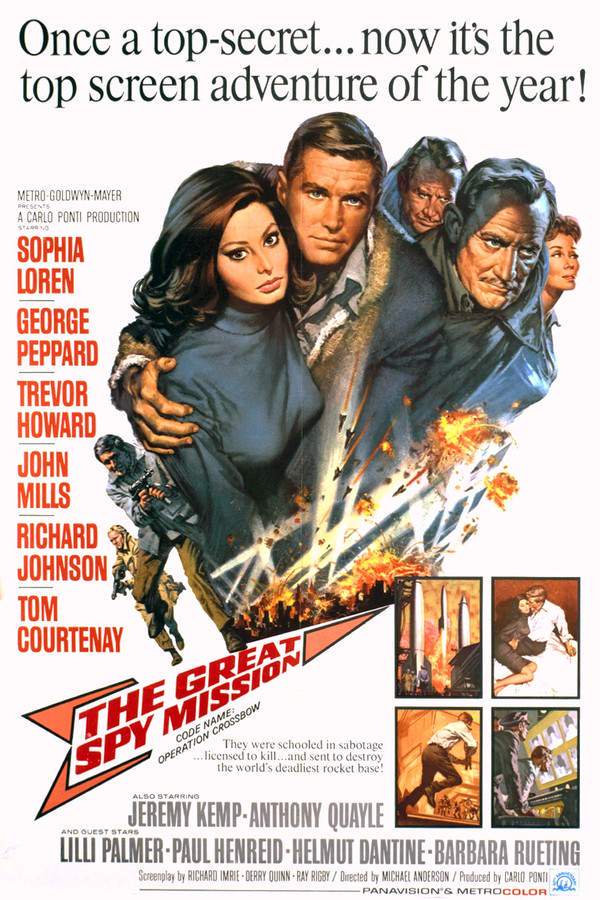
Operation Crossbow (1965) movie poster

Timeline

Operation Crossbow (1965) Timeline Explained – Every Event in Order

Release, runtime and language
1965 · 115 min · English
Directed by
Michael Anderson
Starring
Tom Courtenay, John Mills, Trevor Howard, Lilli Palmer, Anthony Quayle, Sophia Loren

During World War II, London intercepts intelligence regarding a dangerous new weapon the Nazis are developing. To avert a potential disaster, the prime minister sends a team of three specialists on a covert mission. Disguised as German soldiers, they must infiltrate a suspected Nazi facility. The team faces extreme peril and must navigate a complex web of deceit, pushing their skills and commitment to the limit in this high-stakes operation.

On this page (6)
  1. 1 Where to watch
  2. 2 Events in order (15)
  3. 3 Timeline questions answered
  4. 4 Movie threads
  5. 5 Movies like Operation Crossbow
  6. 6 Every angle

Where to watch

Where to Watch Operation Crossbow (1965)

Where can you watch Operation Crossbow? Stream, rent or buy it in the US, including on YouTube Free, Amazon Video and Apple TV Store: current JustWatch availability with up-to-date prices.

Streaming availability powered by JustWatch

15 events in order · contains spoilers

Operation Crossbow Timeline: Events in Chronological Order

Every key event of Operation Crossbow (1965) in order, scene by scene, with when and where it takes place. Use it to untangle flashbacks, time jumps and parallel storylines, to refresh your memory before the sequel or to find the exact scene you are thinking of.

  1. Introduction of the V-1 and V-2

    In 1943, as World War II raged, Germany unveiled its advanced military capabilities with the development of the V-1 flying bomb and the V-2 rocket. These innovations represented a significant leap in warfare technology, showcasing Germany's ambition to dominate aerial combat.

    When
    1943
  2. Early Testing Challenges

    The V-1 flying bomb faced numerous technical challenges during its initial tests, leading to multiple setbacks. As a response, Germany initiated the development of a crewed version to evaluate its capabilities under controlled conditions.

  3. Tragic Test Flights

    Tragically, the test pilots chosen to fly the crewed version did not survive many of their attempts, highlighting the risks involved in the project. Their untimely deaths underscored the dangerous nature of these early testing endeavors.

  4. Hanna Reitsch's Successful Flight

    The situation changed when famed aviator Hanna Reitsch successfully piloted the V-1, demonstrating its potential. Her achievements prompted a reassessment of the trim controls necessary for various speeds and weights, moving the project forward.

  5. Winston Churchill's Investigation

    Amid growing concerns regarding the flying bomb, Winston Churchill tasked his son-in-law, Duncan Sandys, with investigating the reports. Despite initial skepticism from scientific advisor Professor Lindemann due to a lack of solid intelligence, Sandys pursued the truth aggressively.

  6. Bomber Command's Raid

    In response to the threat posed by the V-1, Bomber Command launched a risky raid on Peenemünde, aiming to incapacitate the rocket complex. The operation was essential to curb the Germans' advancements in bomb technology.

    Where
    Peenemünde
  7. Shifting Production to Mittelwerk

    As the war unfolded, German production of the V-2 rocket shifted to the underground Mittelwerk facility in Southern Germany. This new site allowed for continued development despite the ongoing Allied attacks on surface facilities.

    Where
    Southern Germany
  8. Infiltration Plan by British Intelligence

    British intelligence became aware that engineers from occupied territories were being recruited for the V-2 project at the Mittelwerk facility. A team of trained volunteers—comprised of a British national, an American, and a Dutch engineer—was dispatched to infiltrate the factory.

  9. Robert Henshaw's Capture

    Upon arriving in occupied Europe, the unfolding events took a dark turn when Robert Henshaw, a key operative, was wrongfully identified as a wanted Dutch sailor. After being captured and coerced into cooperation, he met a brutal fate for refusing to comply with the Germans.

  10. John Curtis's Deception

    USAAF Lieutenant John Curtis found himself in a perilous position, masquerading as the husband of a woman named Nora. Misunderstandings led him deeper into a web of deception, where he faced unforeseen challenges while working undercover.

  11. Infiltrating the Rocket Factory

    As Curtis and agent Phil Bradley infiltrated the rocket factory, the stakes escalated. While Bradley disguised himself as a porter to avoid scrutiny, Curtis was tasked with resolving crucial issues that could jeopardize the V-2's operational success.

  12. Chaos in London

    The relentless assault of the V-1 flying bombs caused widespread devastation in London, plunging the city into chaos. This prompted a desperate nighttime raid by the Royal Air Force targeting the factory's mobile platforms to dismantle the threat.

    Where
    London
  13. Bamford's Discovery

    Amid the chaos, Bamford diligently reviewed photographs of the factory's engineering staff, hoping to uncover potential allies or threats. However, his investigation yielded no leads, compelling him to dig deeper through employee records.

  14. Curtis's Critical Move

    As tensions soared, Curtis prepared to make a decisive move within the factory, only to discover that the situation had worsened. Bamford's secret identity as a German operative was revealed, escalating the danger for the agents involved.

  15. Aftermath of the Air Raid

    The German rocket launch ultimately failed when bombs struck the facility, destroying the V-2 and halting operations. In the aftermath, Churchill commended Duncan Sandys for his efforts and assigned him the heavy responsibility of overseeing the reconstruction of war-torn cities.

Last updated: November 18, 2024 at 20:53

Was this helpful?

Timeline questions answered

Operation Crossbow Timeline Explained: Your Questions Answered

When does it happen, and why in that order? The questions people ask about the chronology of Operation Crossbow (1965): time jumps, flashbacks, cause and effect between scenes and the correct order of events, each answered with spoilers.

Q1

Why was Duncan Sandys chosen to investigate the Nazi rocket threat?

Duncan Sandys was chosen because he was Winston Churchill's son-in-law, which gave him access to the highest levels of government. Churchill personally tasked him with investigating the rumors about the flying bomb after becoming increasingly troubled by the intelligence reports. Despite skepticism from scientific advisor Professor Lindemann, Sandys aggressively pursued the investigation using photographic evidence and intelligence reports to confirm the V-1's existence.

Foreshadowing: Earlier scenes establish Churchill's personal concern about the threat, making his decision to involve his son-in-law a logical choice.

  • duncan sandys
  • winston churchill
  • son-in-law
  • investigation
  • v-1
Q2

Who was Bamford and why was his revelation as a German spy significant?

Bamford was a British officer who was interviewed but not selected for the infiltration team. Later in the film, he is revealed to be a German undercover operative embedded within British intelligence. His discovery as a spy creates a critical crisis when he uses the captured agent Phil Bradley as leverage to demand John Curtis's surrender, putting the entire mission in jeopardy.

Foreshadowing: Bamford's earlier scrutiny of photographs of engineering staff foreshadows his deeper interest in the operation's personnel.

  • bamford
  • spy
  • double agent
  • traitor
  • german operative
Q3

What happened to agent Robert Henshaw after being captured?

Upon parachuting into occupied Europe, Robert Henshaw was wrongfully identified as a Dutch sailor already wanted for murder. The Germans captured him and coerced him into agreeing to assist them. However, when he later refused to comply with their demands, he was brutally executed. His death demonstrates the high risk and fatal consequences faced by the undercover agents.

Foreshadowing: The briefing established that capture meant likely death, setting the tragic tone for Henshaw's fate.

  • robert henshaw
  • captured
  • executed
  • agent death
Q4

How was the Nazi V-2 rocket facility ultimately destroyed?

The facility was destroyed during a bombing raid by the Royal Air Force. As German forces prepared to launch the V-2 rocket, incoming bombs from the RAF raid obliterated both the rocket and the underground Mittelwerk facility. This success was achieved through the combined efforts of the infiltrating agents and the air raid, though it came at the cost of the agents' lives.

Foreshadowing: The agents' primary objective was to locate and disable the A9/A10 'New York rocket' while the RAF prepared their attack.

  • v-2 rocket
  • factory destroyed
  • bombing raid
  • mittelwerk
Q5

Why did British intelligence send agents into the V-2 rocket factory?

British intelligence learned that engineers from across occupied territories were being enlisted for the V-2 project at the underground Mittelwerk facility. To gather intelligence and potentially sabotage the operation, they selected three volunteers, a British national, an American, and a Dutch engineer, all proficient in German or Dutch. Their mission was to infiltrate the factory and support the broader effort to destroy the Nazi rocket program.

Foreshadowing: The earlier bombing of Peenemünde had forced the Germans to relocate production underground, making direct bombing less effective.

  • infiltration
  • agents
  • mittelwerk
  • sabotage
  • british intelligence
Q6

What was the A9/A10 'New York rocket' that the agents needed to disable?

The A9/A10, nicknamed the 'New York rocket,' was an advanced version of the V-2 rocket that the agents were specifically tasked with locating and disabling. The success of the RAF's nighttime raid on the factory's mobile platforms depended heavily on the agents' ability to identify and neutralize this particular rocket before it could be launched.

Foreshadowing: The description of the V-2 as a more formidable weapon than the V-1 establishes the stakes for targeting this specific rocket.

  • a9/a10
  • new york rocket
  • v-2
  • weapon
  • rocket launch
Q7

Did any of the infiltrating agents survive the mission?

The agents' sacrifices remained anonymous despite the mission's success. John Curtis was shot while trying to fend off workers after pulling a lever to open the launch doors. Phil Bradley was captured and used as leverage by Bamford before the raid. The film ends with Churchill noting that the identities of the agents would remain an enigma, highlighting the anonymous nature of their sacrifice.

Foreshadowing: The narrative repeatedly emphasizes the life-or-death stakes and the high probability of death for undercover operatives.

  • agents survival
  • john curtis
  • phil bradley
  • sacrifice
  • death
Q8

Why did Bomber Command launch a risky raid on Peenemünde?

Bomber Command launched the raid on Peenemünde in response to the growing threat posed by the V-1 flying bomb. After Winston Churchill tasked Duncan Sandys with investigating the flying bomb threat, Sandys convinced the Prime Minister to authorize the risky raid. The goal was to obliterate the rocket complex before the weapon could be fully developed and deployed against London.

Foreshadowing: Churchill's increasing concern about the flying bomb and Sandys's investigation set the stage for this desperate military action.

  • peenemunde
  • bombing
  • raid
  • rocket complex
  • bomber command
Q9

How did the V-1 flying bomb testing lead to the V-2 rocket development?

The V-1 flying bomb faced numerous technical setbacks during initial tests, prompting Germany to develop a crewed version for testing. When test pilots died during these dangerous flights, famed aviator Hanna Reitsch successfully piloted the craft, revealing that trim controls needed adjustment for varying speeds and weights. These technical challenges led Germany to shift focus toward developing the more formidable V-2 rocket, which used more advanced technology.

Foreshadowing: The early technical failures with the V-1 establish the motivation for the parallel V-2 development program.

  • v-1 flying bomb
  • hanna reitsch
  • testing
  • trim controls
  • development
Q10

What happened to Nora when John Curtis was pretending to be her husband?

USAAF Lieutenant John Curtis found himself pretending to be the husband of Nora, a desperate woman fighting for custody of her children. She was misled into believing her spouse was staying at a hotel and sought answers, leading her to tragedy at the hands of another agent. This subplot highlights the collateral damage and personal deception involved in the undercover operation.

Foreshadowing: Curtis's deception creates a moral complication that adds emotional weight to the mission.

  • nora
  • john curtis
  • deception
  • children
  • tragedy
Q11

What was Winston Churchill's role in the operation's success?

Winston Churchill initiated the investigation by assigning his son-in-law Duncan Sandys to look into the flying bomb threats. After Sandys confirmed the V-1's existence, Churchill authorized the bombing of Peenemünde and supported the infiltration plan. In the aftermath of the successful mission, Churchill congratulated Sandys, appointed him as Minister of Works, and noted that the agents' identities would remain classified forever.

Foreshadowing: Churchill's personal involvement throughout the film underscores the high-level importance of stopping the rocket threat.

  • winston churchill
  • duncan sandys
  • prime minister
  • success
  • minister of works

Movie threads

More Movies Like Operation Crossbow, by Mood & Story

Curated lists built around what makes Operation Crossbow tick: the same mood, the same kind of story or the same emotional payoff. Each list explains why these movies belong together.

High-Stakes Wartime Espionage Movies like Operation Crossbow

Films about covert agents risking everything behind enemy lines. If the tense, high-stakes spy mission of Operation Crossbow gripped you, explore more movies like it. These films feature covert operations, undercover agents, and high-risk sabotage attempts set against the backdrop of major wars, delivering suspenseful and urgent thrillers.

  • suspenseful
  • urgent
  • dangerous
  • gripping
  • claustrophobic
  • anxious
  • Tone: tense, grim
  • Pacing: fast, urgent
Why these movies?

The story pattern: These narratives typically follow a specialized team or individual agent as they are sent on a critical, clandestine mission. The plot revolves around the intricate process of infiltration, maintaining a cover, gathering intelligence or executing a sabotage plan, all while facing the looming threat of discovery and death. The journey is marked by close calls, moral compromises, and often, significant sacrifice.

Why they belong together: Movies in this thread share a tense, grim atmosphere driven by the life-or-death stakes of espionage. They feature fast pacing with urgent missions, a focus on meticulous planning under extreme pressure, and a heavy emotional weight stemming from the realities of war and the sacrifices required for victory.

Movies with Bittersweet Victories like Operation Crossbow

Stories where success is achieved, but profound sacrifices are made. If you appreciated the bitter cost of victory in Operation Crossbow, you'll find similar resonance in these films. Discover movies where the mission is a success, but the ending is emotionally complex due to sacrifice and loss, blending triumph with tragedy.

  • gripping
  • somber
  • tragic
  • solemn
  • sacrificial
  • heavy
  • Tone: bittersweet, heavy
  • Pacing: fast, driven
Why these movies?

The story pattern: The narrative arc follows a group or individual striving for a crucial, often noble goal. The plot builds towards a climax where the goal is achieved, but this success is undercut by the devastating price paid to get there—typically the loss of key characters. The ending acknowledges the victory but lingers on the emptiness and grief it created, leaving a powerful, somber impression.

Why they belong together: These films are grouped by their shared emotional trajectory: a journey with high stakes and heavy weight that culminates in a bittersweet ending. They balance the satisfaction of a mission accomplished with the poignant sadness of sacrifice, creating a deeply resonant and thought-provoking viewer experience.

If you liked this

Movies Like Operation Crossbow

Similar movies to Operation Crossbow: the same genre, themes or kind of story. Each one comes with its own plot summary, timeline and ending explained.

Browse all movie summaries

Every angle

Operation Crossbow (1965) Explained: Plot, Timeline & Characters

Everything about Operation Crossbow in one place: what happens in the plot summary, the timeline in chronological order, the characters and meaning and a spoiler-free summary. What's After the Movie adds the cast, box office and post-credit scenes.

Coming soon on iOS and Android

The Plot Explained Movie Summary App

Plot summaries, endings explained and timelines on your phone. Catch up on any movie in minutes, save your favorites and never miss a twist again.

Be the first to know when we launch. Your email stays private, always.

Learn more about the app