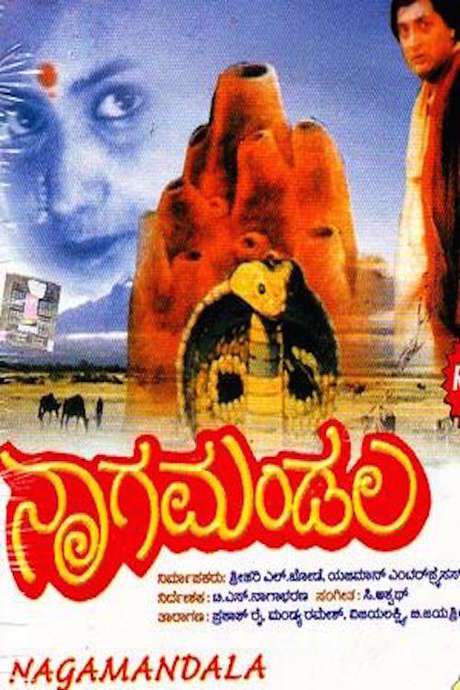
Year: 1997
Runtime: More mins
Language: Kannada
Director: T. S. Nagabharana
Adapted from Girish Karnad’s play, the film is directed by T.S. Nagabharana, scored by C. Aswath and produced by Srihari L. Khoday. It asks whether a husband is the one who marries an innocent girl for selfish pleasure or the one who offers life. G.S. Bhaskar’s contrast lighting in night and interior scenes creates a folk atmosphere.
Warning: spoilers below!
Haven’t seen Nagamandala yet? This summary contains major spoilers. Bookmark the page, watch the movie, and come back for the full breakdown. If you're ready, scroll on and relive the story!
Trace every key event in Nagamandala (1997) with our detailed, chronological timeline. Perfect for unpacking nonlinear stories, spotting hidden connections, and understanding how each scene builds toward the film’s climax. Whether you're revisiting or decoding for the first time, this timeline gives you the full picture.
Last updated: October 09, 2025 at 11:00
Find frequently asked questions about the Nagamandala (1997) timeline, including chronological order, nonlinear jumps, cause-and-effect links, and scene sequence clarifications. This timeline FAQ helps explain when key events happen, how moments connect, and why the story unfolds in that specific order.
The snake consumes the milk that Rani poured under the tree near the anthill. The milk was infused with the root Kurudamma gave Rani to drug Appanna. After consuming this magical substance, the snake is able to assume Appanna's exact physical form. This transformation allows the snake to approach Rani in the guise of her husband, which is how the supernatural relationship begins.
Earlier, Kurudamma gives Rani a root to mix with milk, warning it will help consummate the marriage, hinting at the milk's mystical properties.
The snake, after drinking the drugged milk, takes on Appanna's exact physical form and mannerisms. More importantly, the snake in Appanna's form treats Rani with tenderness and affection, qualities her real husband lacked on their wedding night. This gentle behavior is what Rani craved, so she has no reason to suspect the man in her bed is not Appanna. The deception works precisely because the snake provides what the real Appanna did not.
On their wedding night, Rani is terrified of Appanna's lustful, overbearing nature and locks herself in the pooja room, establishing her desperate need for kindness.
Appanna becomes suspicious of Rani's changed behavior and asks his gym teacher to watch the house at night. The snake, in Appanna's form, discovers the gym teacher hiding to observe what happens at night. To protect its secret identity and continued access to Rani, the snake kills the gym teacher. This murder eliminates the threat of exposure and deepens the mystery surrounding the household.
Appanna grows increasingly suspicious of Rani's cheerful demeanor and the strange nighttime patterns, prompting him to enlist outside help.
During the naga divya ritual, participants swear truth while holding a live snake. Rani chooses the snake from the anthill, the exact creature that impregnated her. Because she and the snake share a mystical connection, the snake does not harm her. The village interprets this as proof of her innocence, since a venomous snake would have struck if she had been unfaithful. This test becomes the turning point that vindicates Rani.
The snake, still in Appanna's form, had advised Rani to keep the pregnancy secret, establishing the supernatural bond between them.
During the battle at the anthill, the snake realizes that Rani's unwavering love has transformed Appanna's nature, purging the poison of selfishness and lust from him. The snake spares Appanna because of this change, allowing itself to be defeated. After witnessing this transformation and understanding the snake's role in his marriage, Appanna is humbled. He recognizes that his previous behavior drove Rani to the snake's arms, and he genuinely changes to become the husband Rani deserved.
Rani's love for the snake-in-Appanna's-form and her subsequent pregnancy seem to trigger a spiritual transformation in the real Appanna.
Kurudamma, a blind woman who cannot see the tension in Rani and Appanna's marriage, gives Rani a root to mix with Appanna's milk hoping it will help consummate their marriage. Believing this will make Rani more desirable to Appanna, Kurudamma persistently urges Rani to use it. However, the root has mystical properties that Kurudamma did not anticipate, properties that ultimately attract the snake and set the supernatural events in motion.
Kurudamma's desperation to see Rani married stems from her own advocacy of the match during the Devi festival.
The snake, while disguised as Appanna, consummates the marriage with Rani night after night. Because the snake has taken on Appanna's complete physical form, the relationship results in a normal pregnancy. The pregnancy is revealed when Rani discovers she is expecting. The snake, in Appanna's form, instructs her to keep the pregnancy secret, which she does until Kurudamma and Kappanna learn of it.
The pattern of the snake-as-Appanna visiting Rani's bed becomes repeated and symbolic throughout the film.
On their first night at Rani's maternal home, Appanna reveals his lustful and overbearing nature. Rani, who is timid and had never been intimate before, is overwhelmed and terrified by his aggressive behavior. She retreats to a corner of the room, clearly frightened. This fear establishes the emotional distance between them and motivates Kurudamma to intervene with the root, believing it will help Rani win Appanna over.
Kurudamma sees Appanna as the perfect husband during the Devi festival, not knowing his true temperament.
In the climactic battle at the anthill, the snake nearly defeats Appanna but then realizes something crucial: Rani's unwavering love, even for the snake disguised as Appanna, has transformed the real Appanna's nature. The poison of selfishness and lust has been purged from him, leaving a kind, loving man. This realization makes the snake spare Appanna's life, after which Appanna defeats the snake and throws it into the fire.
The snake, while in Appanna's form, had noted how Rani's love changed everything, hinting at this transformation.
Chelvi is a woman in the village whom Kurudamma approaches for help with the marriage situation. It is from Chelvi that Kurudamma learns about the root that can help Rani consummate her marriage. Chelvi provides both the initial smaller root and later the larger root that Kurudamma gives to Rani. While not a central character, Chelvi serves as the source of the magical element that sets the supernatural plot in motion.
Discover curated groups of movies connected by mood, themes, and story style. Browse collections built around emotion, atmosphere, and narrative focus to easily find films that match what you feel like watching right now.
Stories where supernatural intervention shatters injustice, leading to transformative healing.If you were captivated by how Nagamandala uses a folk tale to resolve marital terror, you'll enjoy these movies. This list features similar stories where magic realist elements or mythological justice intervene in harsh realities, leading to emotional transformation and hopeful, if unconventional, happy endings.
The narrative pattern begins with a character trapped in an unbearable, realistic injustice. A supernatural element is introduced, often with ambiguous morality, which creates a double life or a profound test. This leads to a climactic confrontation where the 'magic' is exposed, forcing a societal or personal reckoning. The resolution sees the real-world problem solved through the fantastical ordeal, resulting in a genuine, hard-won transformation.
These films are grouped together because they share a unique blend of heavy, tense realism with the uncanny logic of folklore. They are not pure fantasies but grounded dramas where the supernatural serves a specific moral and emotional purpose, leading to cathartic, hopeful conclusions that feel both magical and earned.

Tense stories of identity deception within a claustrophobic home, testing truth and love.Fans of the anxious suspense in Nagamandala, generated by the snake's assumption of Appanna's identity, will find similar tension here. These movies explore the terrifying premise of a deceptive double within a marriage or family, building claustrophobic dread around questions of identity and truth.
The journey typically revolves around a protagonist who feels unsafe in their own home due to a manipulative or abusive figure. The introduction of a deceptive double—whether supernatural, psychological, or human—creates a complex web of fear and confused desire. The plot builds steadily towards a moment of public or private revelation where the deception is violently or dramatically unmasked, resolving the central conflict.
These films share a very specific mood: a high-tension, anxious atmosphere generated by the theme of domestic fear compounded by identity deception. The pacing is often steady and methodical, focusing on the psychological unraveling of the protagonist and the uncanny suspense of the double's presence.
Don't stop at just watching - explore Nagamandala in full detail. From the complete plot summary and scene-by-scene timeline to character breakdowns, thematic analysis, and a deep dive into the ending - every page helps you truly understand what Nagamandala is all about. Plus, discover what's next after the movie.
Read a complete plot summary of Nagamandala, including all key story points, character arcs, and turning points. This in-depth recap is ideal for understanding the narrative structure or reviewing what happened in the movie.
Discover the characters, locations, and core themes that shape Nagamandala. Get insights into symbolic elements, setting significance, and deeper narrative meaning - ideal for thematic analysis and movie breakdowns.