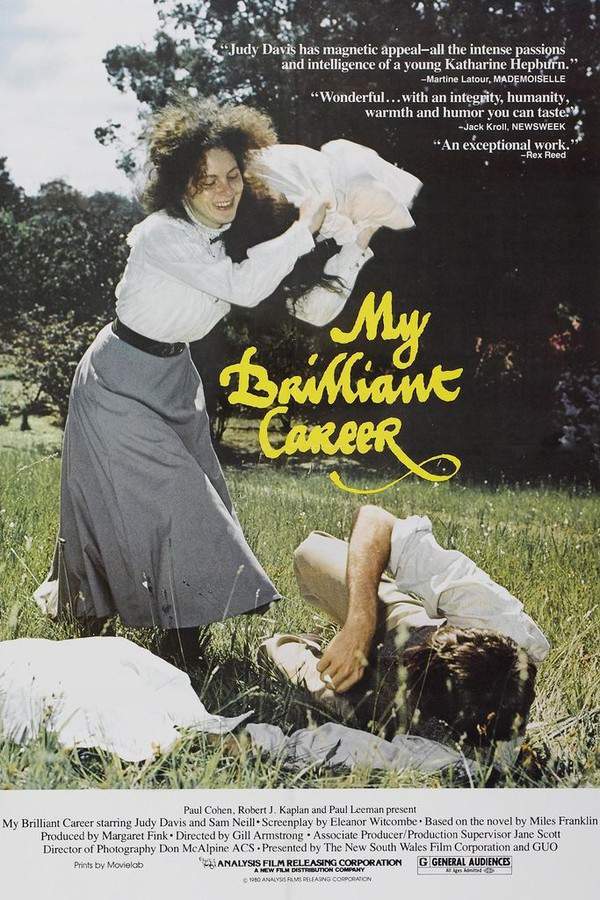
In the harsh Australian outback, Sybylla Melvyn, a spirited and determined young woman, challenges societal expectations as she strives for a career as a writer. Facing family pressures and financial difficulties, she grapples with her aspirations for literary success. A complicated romance with a local landowner further complicates her journey as she struggles to balance love and the passionate ambition that fuels her creative drive.
Find where to stream, rent, or buy My Brilliant Career (1979) in the US with current JustWatch availability, up-to-date pricing, and platform listings for subscription, rental, and digital purchase options.
Warning: spoilers below!
Haven’t seen My Brilliant Career yet? This summary contains major spoilers. Bookmark the page, watch the movie, and come back for the full breakdown. If you're ready, scroll on and relive the story!
Trace every key event in My Brilliant Career (1979) with our detailed, chronological timeline. Perfect for unpacking nonlinear stories, spotting hidden connections, and understanding how each scene builds toward the film’s climax. Whether you're revisiting or decoding for the first time, this timeline gives you the full picture.
Last updated: November 07, 2024 at 23:49
Find frequently asked questions about the My Brilliant Career (1979) timeline, including chronological order, nonlinear jumps, cause-and-effect links, and scene sequence clarifications. This timeline FAQ helps explain when key events happen, how moments connect, and why the story unfolds in that specific order.
Sybylla rejects Harry's proposal because she genuinely believes that marriage would make him unhappy. Despite loving him, she is plagued by feelings of inadequacy stemming from her self-perceived ugliness and tomboyish demeanor. She also fears that marrying someone of his social standing would trap her in a conventional life, preventing her from pursuing her ambitions as a writer. Her rejection is an act of self-sacrifice rooted in her desire to protect Harry from what she perceives as an unsuitable match.
Earlier scenes establish her deep-rooted insecurity about her appearance and her strong desire for independence from societal expectations.
Sybylla's perception of herself as ugly stems from her tomboyish nature and the harsh environment she grew up in. Living in the struggling Australian outback during a drought, she was forced into labor rather than traditional feminine pursuits. This, combined with her family's financial collapse and her father's alcoholism, shaped her self-image. Her grandmother's more refined environment briefly challenges this perception, but her deep-seated feelings of inadequacy persist throughout the film.
The opening scenes establish her as a spirited but unconventional young woman who struggles against the expectations placed on women of her time.
Sybylla becomes a governess because her family's financial situation deteriorates severely. Her father's alcoholism compounds their problems as he makes unwise financial choices, plunging the family into debt. To repay what her father owes a neighbor, Sybylla is forced to leave home and work as a governess and housekeeper. This represents the harsh economic reality facing women of her social class who had no property or inheritance.
The drought and family's descent into subsistence living directly lead to her father's drinking and subsequent need for Sybylla to contribute financially.
Sybylla is deemed unsuitable because she lacks property and dowry. Despite the neighbor's son developing feelings for her, the strict social conventions of the 1890s Australian rural society meant that a marriage required economic viability. Since Sybylla's family is in debt and she has no assets or inheritance, she is considered an improper match. This rejection further deepens her feelings of inadequacy and reinforces her determination to seek independence through writing.
The film's emphasis on the family's financial struggles and the strict class distinctions in rural Australia set the context for this rejection.
Sybylla chooses writing because she views it as her only path to true independence and self-fulfillment. Marriage to Harry would provide financial security but, in her view, would sacrifice her identity and ambitions to a conventional domestic life. Having experienced the drudgery of rural life and the limitations placed on women, she sees her writing talent as the means to forge her own destiny. The manuscript she submits at the end represents her rejection of societal expectations in favor of pursuing her creative passion.
Her early description of writing as a passion and her refusal to accept conventional women's roles foreshadow this final decision.
The drought forces Sybylla's family into subsistence living, meaning they struggle to grow enough food to survive. Combined with her father's poor financial decisions and subsequent alcoholism, the family descends into poverty. This environmental catastrophe sets in motion the chain of events that leads to Sybylla's hardships: her need to work as a governess, her vulnerability to unsuitable suitors, and her ultimate drive to find another way out of poverty through her writing.
The opening establishes the harsh Australian outback as both a literal and metaphorical obstacle Sybylla must overcome.
When Sybylla goes to her grandmother's property, she experiences a significantly more pleasant environment with better living conditions. This is where she meets Harry Beecham, who proposes marriage to her. The contrast between her grandmother's comfortable home and her family's dilapidated house highlights the class differences in her world. However, even in this better environment, she struggles to accept happiness due to her deep-seated insecurities.
This respite from hardship introduces the possibility of love and better circumstances, setting up the central conflict of the film.
Sybylla is sent back home because the neighbor's son has developed romantic feelings for her and begun making advances. Her family, concerned for her safety and welfare, decides to remove her from this uncomfortable situation. This protective action ironically highlights the double standard of the time, they remove her to protect her from an unsuitable man, yet later she is deemed unsuitable to marry him due to her lack of property.
The employer's son pursuing her establishes another potential marriage opportunity that is ultimately denied to her based on economic grounds.
The ending implies that Sybylla's journey toward becoming a writer is just beginning. By placing her manuscript in the mailbox, she takes the first concrete step toward publication and financial independence. The epilogue reveals this narrative is based on her first book, suggesting she ultimately succeeded in her literary ambitions. This hopeful final image contrasts with the sacrifices she made, rejecting love and enduring hardship, to pursue her creative dreams.
The opening suggestion that this is a story from her first book confirms the success of her chosen path.
Sybylla's father turns to alcoholism primarily as a response to the mounting financial pressures on the family. The drought, poor financial decisions, and the struggle to survive in the harsh Australian outback all contribute to his descent into drinking. His alcoholism then creates a feedback loop, worsening the family's financial situation further as he becomes less able to provide for them, ultimately forcing Sybylla into work.
The family's struggles are established from the opening, with the father's drinking increasing as their situation deteriorates.
Discover curated groups of movies connected by mood, themes, and story style. Browse collections built around emotion, atmosphere, and narrative focus to easily find films that match what you feel like watching right now.
Stories of spirited women forging their own path against rigid societal expectations.If you admired Sybylla's independent spirit in My Brilliant Career, you'll enjoy these other films about strong-willed women fighting for their dreams. This list features similar period dramas and character-driven stories where women challenge societal constraints to define their own brilliant careers and lives.
The narrative follows a female protagonist's struggle for autonomy, typically set against a backdrop of restrictive social conventions. The central conflict arises from her ambition—be it artistic, intellectual, or personal freedom—clashing with familial and societal pressures, often involving romantic entanglements that force a choice between love and self-fulfillment.
Movies are grouped here for their shared focus on a specific character archetype: the rebellious, ambitious woman. They share a hopeful yet grounded tone, a steady character-driven pace, and a thematic core centered on feminism, self-discovery, and the personal cost of non-conformity.
Character-driven stories where creative passion demands a painful personal cost.Fans of My Brilliant Career who were moved by Sybylla's choice between writing and love will find similar themes here. Explore more movies about the bittersweet cost of ambition, where characters achieve artistic or professional success but must make a heartfelt sacrifice, resulting in a powerfully resonant ending.
These narratives follow a protagonist's single-minded pursuit of a creative or intellectual goal. The central dramatic tension is a romantic relationship that offers comfort and love but threatens to derail their ambition. The story culminates in a conscious, difficult choice, leading to a bittersweet resolution where professional fulfillment is achieved alongside personal loss.
These films are linked by a core narrative pattern: the conflict between love and career/art. They share a specific emotional mix—hopeful determination mixed with romantic melancholy—and a consistent ending feel that is bittersweet, acknowledging victory and loss in equal measure.
Don't stop at just watching - explore My Brilliant Career in full detail. From the complete plot summary and scene-by-scene timeline to character breakdowns, thematic analysis, and a deep dive into the ending - every page helps you truly understand what My Brilliant Career is all about. Plus, discover what's next after the movie.
Read a complete plot summary of My Brilliant Career, including all key story points, character arcs, and turning points. This in-depth recap is ideal for understanding the narrative structure or reviewing what happened in the movie.
Discover the characters, locations, and core themes that shape My Brilliant Career. Get insights into symbolic elements, setting significance, and deeper narrative meaning - ideal for thematic analysis and movie breakdowns.
Discover movies like My Brilliant Career that share similar genres, themes, and storytelling elements. Whether you’re drawn to the atmosphere, character arcs, or plot structure, these curated recommendations will help you explore more films you’ll love.
My Brilliant Career (1979) Plot Summary & Movie Recap
My Brilliant Career (1979) Scene-by-Scene Movie Timeline
My Brilliant Career (1979) Spoiler-Free Summary & Key Flow
Movies Like My Brilliant Career – Similar Titles You’ll Enjoy
Career Girls (1997) Complete Plot Breakdown
Somersault (2006) Full Movie Breakdown
Muriel's Wedding (1995) Ending Explained & Film Insights
Under Capricorn (1949) Ending Explained & Film Insights
The Sundowners (1960) Complete Plot Breakdown
Take My Hand (2024) Story Summary & Characters
The Year My Voice Broke (1987) Story Summary & Characters
My Dear Secretary (1948) Spoiler-Packed Plot Recap
Career Bed (1969) Film Overview & Timeline
Me Myself I (1999) Ending Explained & Film Insights
Career (1959) Full Summary & Key Details
A Woman Rebels (1936) Full Movie Breakdown
My Life So Far (1999) Plot Summary & Ending Explained
Faraway Downs (1000) Complete Plot Breakdown
Brilliant Lies (1996) Full Summary & Key Details