Year: 1997
Runtime: 155 min
Language: English
Budget: $35M
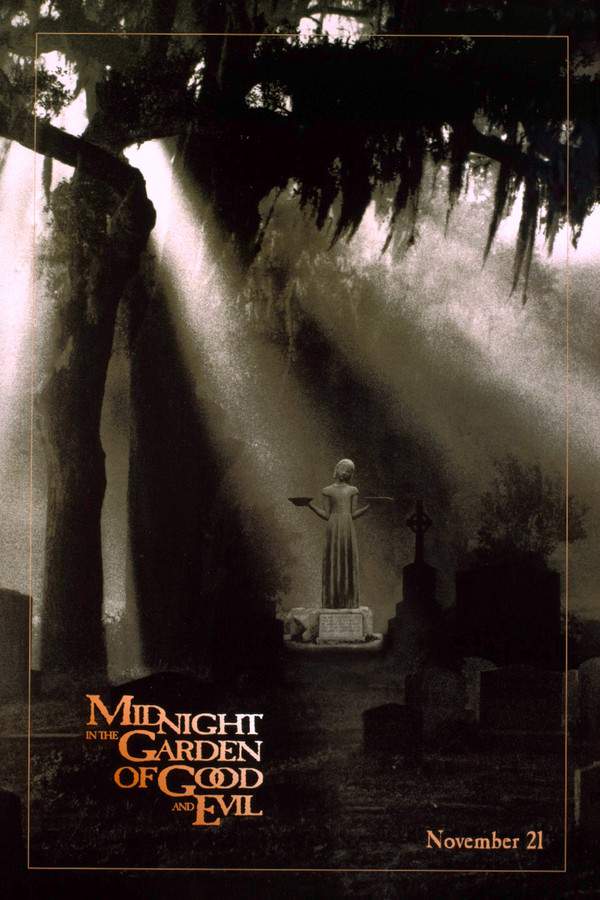
While searching for a story in Savannah, journalist John Kelso finds himself drawn into the city's unique social circles and hidden secrets. He becomes fascinated by the enigmatic Jim Williams, a local antiques dealer, and becomes entangled in a murder trial following Williams' shooting of Danny Hansford. As John investigates, he encounters Mandy, a captivating singer, and uncovers a web of eccentric personalities and questionable actions, ultimately questioning the concepts of justice and morality.
Find where to stream, rent, or buy Midnight in the Garden of Good and Evil (1997) in the US with current JustWatch availability, up-to-date pricing, and platform listings for subscription, rental, and digital purchase options.
Warning: spoilers below!
Haven’t seen Midnight in the Garden of Good and Evil yet? This summary contains major spoilers. Bookmark the page, watch the movie, and come back for the full breakdown. If you're ready, scroll on and relive the story!
Trace every key event in Midnight in the Garden of Good and Evil (1997) with our detailed, chronological timeline. Perfect for unpacking nonlinear stories, spotting hidden connections, and understanding how each scene builds toward the film’s climax. Whether you're revisiting or decoding for the first time, this timeline gives you the full picture.
Last updated: November 22, 2024 at 15:36
Find frequently asked questions about the Midnight in the Garden of Good and Evil (1997) timeline, including chronological order, nonlinear jumps, cause-and-effect links, and scene sequence clarifications. This timeline FAQ helps explain when key events happen, how moments connect, and why the story unfolds in that specific order.
Jim Williams shot and killed Billy Hanson during a confrontation at his Mercer House. Hanson had stormed into the party earlier that evening demanding payment he was owed, even threatening Williams with a broken bottle. The situation escalated, resulting in Williams fatally shooting Hanson. The exact circumstances of the shooting became the central mystery of the murder trial.
Earlier that evening, Hanson confronted Williams at the gala about money owed, creating visible tension that foreshadowed the violent confrontation to come.
Williams was acquitted because he claimed self-defense during his trial, testifying that Hanson attacked him. However, the testimony was actually false. John Kelso discovered crucial evidence about the true circumstances of the shooting, which ultimately led to Williams' acquittal despite the deception.
The trial revelation that Williams gave false testimony explains why the case had such a controversial outcome.
Jim Williams gave false testimony in court because he wanted to be vindicated and avoid conviction for Hanson's murder. Rather than admitting the truth about the confrontation, he claimed self-defense, fabricating a story that would justify the shooting in the eyes of the law.
After Kelso left Savannah, Williams suffered a fatal heart attack in his study. Before his death, he was haunted by visions of Billy Hanson's ghost, suggesting he was tormented by guilt over the murder and his false testimony. His death came shortly after his acquittal, adding a tragic and bittersweet conclusion to his story.
Williams' conversation with Kelso about truth being a matter of perspective hints at his unsettled conscience.
John Kelso decided to stay in Savannah after witnessing the murder investigation and learning about the upcoming trial. Williams encouraged him to remain and document the trial for a book he was planning to write. Kelso's curiosity about Williams and the mysterious circumstances of Hanson's death drove him to investigate further.
In their final conversation, Williams told Kelso that truth is simply a matter of perspective, suggesting that reality can be shaped by how one chooses to interpret events. This reflects his own willingness to lie under oath and his ability to justify his actions through personal interpretation rather than absolute truth.
Mandy Nichols was a sultry torch singer performing in Savannah who became romantically involved with John Kelso during his stay. She was partnered with Joe Odom, a piano player. Kelso's attraction to Mandy became a significant personal storyline as he navigated his investigation and time in the city.
After being acquitted, Williams began seeing Hanson's ghost haunting him in his study. This vision represented his guilt over killing Hanson and his deception during the trial. The haunting spectral figure symbolized the psychological consequences of his actions that he could not escape, even after gaining legal freedom.
The earlier confrontation where Hanson brandished a broken bottle and the violent murder created the psychological foundation for this haunting.
At Williams' funeral, the spiritualist Minerva warned Kelso not to become too entangled in the past. This cryptic message suggested that digging too deeply into the events surrounding Hanson's murder and Williams' life could have negative consequences, advising him to focus on moving forward rather than dwelling on the past.
The film closes on the famous Bird Girl statue in Savannah's Bonaventure Cemetery, a haunting image that symbolizes the film's themes of mortality, memory, and the passage of time. The statue gazes out over the horizon as graves surround it, creating a poignant visual metaphor for death, legacy, and the lingering presence of the past.
Billy Hanson confronted Jim Williams at the Christmas gala demanding payment he was owed. The argument turned aggressive when Hanson threatened Williams with a broken bottle before storming off. This dispute over money appeared to be the primary motive behind the later shooting, though the exact nature of their financial relationship remained unclear.
This confrontation directly led to the murder the following morning, establishing the causal chain of events.
Jim Williams lived as a semi-closeted homosexual in an era when such identity was largely repressed and socially unacceptable. Despite his wealth and public success as an antiques dealer, he had to hide his true sexual orientation from Savannah society, adding a layer of complexity to his character and the pressures he faced.
Discover curated groups of movies connected by mood, themes, and story style. Browse collections built around emotion, atmosphere, and narrative focus to easily find films that match what you feel like watching right now.
Moody tales where a unique setting becomes a character in a slow-burn mystery.If you enjoyed the atmospheric Savannah setting of Midnight in the Garden of Good and Evil, you'll find similar vibes in these movies. This list features moody mysteries where a distinct Southern locale, full of eccentric characters and buried secrets, drives a slow-burning narrative.
An outsider, often a journalist or newcomer, arrives in a distinctive Southern community and becomes entangled in a local mystery. The investigation unfolds slowly, revealing the town's complex social hierarchies, eccentric inhabitants, and dark past, with the setting itself acting as a central, oppressive force.
Movies in this thread share a specific atmospheric quality rooted in the American South, a slow, reflective pacing, and a focus on character and place over fast-paced plot. They often explore themes of decayed aristocracy, hidden truths, and the blurred lines between good and evil within a unique cultural context.
Crime stories that focus on moral ambiguity and complex characters over action.For viewers who liked the character-focused murder investigation in Midnight in the Garden of Good and Evil, this list highlights similar movies. These crime dramas are less about fast-paced action and more about the psychological and moral complexities of the people involved, leading to bittersweet or ambiguous conclusions.
A crime occurs, but the narrative quickly shifts its focus from 'whodunit' to 'why' and what the event reveals about the people and community involved. The protagonist's personal journey and moral questioning become the central arc, often resulting in an ending that is morally complex rather than neatly resolved.
This thread groups movies that share a moderate intensity and a deliberate, slow pacing, using a crime plot as a framework for deeper character exploration. They prioritize atmosphere and moral questioning over suspenseful thrills, often featuring a journalist or outsider perspective and concluding with a bittersweet tone.
Don't stop at just watching - explore Midnight in the Garden of Good and Evil in full detail. From the complete plot summary and scene-by-scene timeline to character breakdowns, thematic analysis, and a deep dive into the ending - every page helps you truly understand what Midnight in the Garden of Good and Evil is all about. Plus, discover what's next after the movie.
Read a complete plot summary of Midnight in the Garden of Good and Evil, including all key story points, character arcs, and turning points. This in-depth recap is ideal for understanding the narrative structure or reviewing what happened in the movie.
Discover the characters, locations, and core themes that shape Midnight in the Garden of Good and Evil. Get insights into symbolic elements, setting significance, and deeper narrative meaning - ideal for thematic analysis and movie breakdowns.
Get a quick, spoiler-free overview of Midnight in the Garden of Good and Evil that covers the main plot points and key details without revealing any major twists or spoilers. Perfect for those who want to know what to expect before diving in.