Plot Explained Spoilers guaranteed!
Plot Explained

Browse by genre

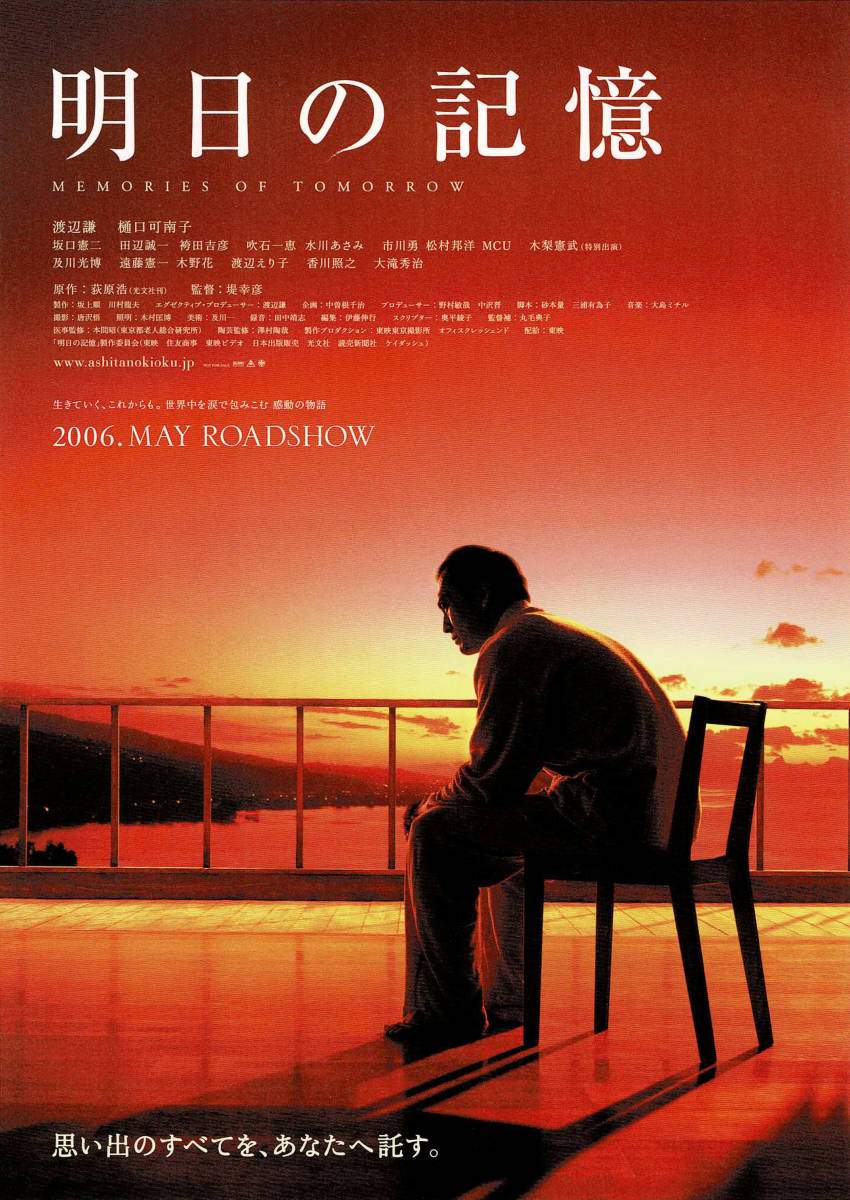
Memories of Tomorrow (2007) movie poster

Timeline

Memories of Tomorrow (2007) Timeline Explained – Every Event in Order

Release, runtime and language
2007 · 122 min · Japanese
Directed by
Yukihiko Tsutsumi

A successful executive finds his life and relationships unraveling as he struggles with a mysterious condition causing memory loss. He must face the heartbreaking consequences of his fading recollections and confront the unsettling prospect of his own mortality, desperately trying to piece together the fragments of his past before they disappear completely.

On this page (5)
  1. 1 Events in order (12)
  2. 2 Timeline questions answered
  3. 3 Movie threads
  4. 4 Movies like Memories of Tomorrow
  5. 5 Every angle

12 events in order · contains spoilers

Memories of Tomorrow Timeline: Events in Chronological Order

Every key event of Memories of Tomorrow (2007) in order, scene by scene, with when and where it takes place. Use it to untangle flashbacks, time jumps and parallel storylines, to refresh your memory before the sequel or to find the exact scene you are thinking of.

  1. Future Glimpse

    The film opens in the year 2010, presenting a poignant snapshot of a man's life ravaged by Alzheimer's disease. This haunting vision sets the emotional tone for the unfolding narrative, underscoring the devastating effects of memory loss.

    When
    2010
  2. Early Life Introduction

    The narrative shifts back to 2004, diving into the life of Masayuki Saeki, a highly esteemed executive in the bustling advertising industry. His character embodies the quintessential Japanese white-collar worker, marked by meticulous organization and a strong work ethic.

    When
    2004
    Where
    Tokyo
  3. Master of His Craft

    In 2004, Masayuki is celebrated for his industrious nature and exceptional performance at work. He sets high expectations for himself and his team, striving toward perfection in every project he undertakes.

    When
    2004
    Where
    Tokyo
  4. Emerging Memory Lapses

    Masayuki begins experiencing troubling memory lapses, which lead to confusion and stress as he struggles to remember crucial appointments and workplace details. This unsettling phase marks the beginning of his alarming decline, shaking his confidence.

    Where
    Tokyo
  5. Diagnosis

    Following a series of concerning symptoms, Masayuki receives a shocking diagnosis: Alzheimer’s disease. The news plunges him into a tumult of emotions, including anger, disbelief, and despair, as he confronts the reality of his condition.

    Where
    Tokyo
  6. Professional Decline

    As Masayuki's memory deteriorates further, he finds it increasingly difficult to perform at work. Eventually, he makes the heart-wrenching decision to leave his job, marking a significant change in his identity and daily routine.

    Where
    Tokyo
  7. Home Life Changes

    With Masayuki staying at home, his loving wife Emiko takes on the role of his primary caregiver. Their once-equal partnership begins to shift, highlighting the strain that his illness places on their relationship.

    Where
    Saeki Residence
  8. Emotional Strain

    The emotional burden of caregiving begins to manifest in tensions at home. As Masayuki's condition worsens, the challenges escalate, making it increasingly difficult for both him and Emiko to cope.

    Where
    Saeki Residence
  9. The Second Childhood

    As Alzheimer's progresses, Masayuki experiences a regression into a state reminiscent of childhood, where he struggles with basic comprehension and memory. This transformation drastically alters his dynamics with his family.

    Where
    Saeki Residence
  10. Profound Impact

    The film poignantly illustrates the deeper implications of Alzheimer's on Masayuki's family, showcasing the emotional, psychological, and practical hurdles they face. Emiko's unwavering love is tested as she navigates the challenges of caregiving.

    Where
    Saeki Residence
  11. Struggles with Acceptance

    Both Masayuki and Emiko grapple with the struggle of accepting the realities of the disease. As memories fade and communication becomes strained, the film explores their attempts to hold onto the past while facing the present.

  12. The Journey Together

    Masayuki and Emiko's journey reflects the profound bond forged through adversity. As they confront the challenges posed by the disease, they navigate the complexities of love and loss, revealing the depth of their commitment to one another.

Last updated: November 08, 2024 at 01:44

Was this helpful?

Timeline questions answered

Memories of Tomorrow Timeline Explained: Your Questions Answered

When does it happen, and why in that order? The questions people ask about the chronology of Memories of Tomorrow (2007): time jumps, flashbacks, cause and effect between scenes and the correct order of events, each answered with spoilers.

Q1

Why was Masayuki Saeki forced to leave his job?

Masayuki had to leave his advertising executive position because his Alzheimer's disease progressively impaired his ability to perform his work duties. As his memory deteriorated, he could no longer remember crucial appointments, workplace details, or navigate the Tokyo business environment he once mastered. His meticulous nature and high standards made it impossible for him to continue working when he could no longer meet his own expectations or deliver the quality of work that had defined his career.

Foreshadowing: His early memory lapses at work, where he struggled to recall crucial meetings and details, foreshadowed his eventual inability to function in his professional role.

  • masayuki saeki
  • job
  • alzheimer
  • work
  • memory loss
  • career
Q2

How did Alzheimer's disease affect Masayuki and Emiko's relationship?

The disease fundamentally shifted their relationship dynamic, transforming an equal partnership into a caregiver-patient relationship. Emiko took on the demanding role of Masayuki's primary caregiver at home, which created increasing emotional tension and strain. While her love remained unwavering, the physical and emotional burden of constant care-giving began to fray their connection, leaving both struggling to cope with the changing nature of their bond.

Foreshadowing: The shift from equal partners to caregiver and patient was hinted at when Masayuki began staying home and Emiko assumed responsibility for his daily care needs.

  • masayuki
  • emiko
  • marriage
  • relationship
  • caregiver
  • alzheimer
  • love
Q3

What does the opening scene in 2010 reveal about Masayuki's future?

The opening scene serves as a heartbreaking preview of Masayuki's condition at the film's end, showing a man whose life has been devastated by advanced Alzheimer's. This glimpse establishes the emotional weight of the story from the start, letting viewers understand the tragic trajectory they are about to witness as the narrative shifts back to 2004 when Masayuki was still a thriving, meticulous executive.

Foreshadowing: The 2010 opening directly foreshadows the 'second childhood' state that Masayuki will regress to as the disease runs its course.

  • 2010
  • opening scene
  • future
  • timeline
  • alzheimer
  • progression
Q4

What does the film mean by Masayuki experiencing a 'second childhood'?

As Alzheimer's progressively destroyed Masayuki's memories and cognitive abilities, he regressed to a state resembling childhood, struggling with basic comprehension, requiring help with daily tasks, and losing the sophisticated mental faculties that had defined his adult life. This poignant metaphor captures how the disease stripped away his hard-earned professional identity, leaving him dependent on others for basic care, much like a child depends on parents.

Foreshadowing: This regression was foreshadowed by his increasing inability to perform simple tasks and his growing confusion about even familiar surroundings.

  • second childhood
  • regression
  • identity
  • memory loss
  • alzheimer
  • decline
Q5

What causes Masayuki's memory loss to progress so rapidly?

Alzheimer's disease is a progressive neurodegenerative condition that causes memory deterioration over time. In Masayuki's case, he experienced sudden onset of memory lapses, struggling to recall appointments, work details, and familiar Tokyo streets. The film's narrative shows this decline accelerating from troubling forgetfulness to complete inability to function independently, reflecting the devastating nature of early-onset Alzheimer's.

Foreshadowing: His initial memory lapses at work, where he forgot crucial appointments and details, marked the beginning of this irreversible progression.

  • memory loss
  • progression
  • alzheimer
  • causes
  • decline
  • disease
Q6

Why is Masayuki's meticulous personality significant to his story?

Masayuki's meticulous, well-organized nature makes his decline particularly tragic because he was defined by his intellectual excellence and professional competence. The contrast between who he once was, a detail-oriented executive who set high standards for himself and his team, and who he becomes as the disease progresses creates profound emotional impact. His inability to accept his diminishing capabilities likely intensified his anger and despair after diagnosis.

Foreshadowing: The film establishes his meticulous character in 2004 specifically to highlight the devastating contrast when he loses those same cognitive abilities.

  • meticulous
  • personality
  • character
  • tragedy
  • identity
  • work ethic
Q7

Why does the film jump between 2004 and 2010?

The non-linear structure serves to heighten the emotional impact by showing viewers the tragic endpoint first. Opening in 2010 with Masayuki's advanced condition establishes the devastating outcome, then shifting to 2004 allows audiences to witness his decline unfold while already knowing its destination. This technique creates a bittersweet viewing experience, knowing that every successful moment is leading toward inevitable loss.

Foreshadowing: The structure itself foreshadows the finality of Alzheimer's, there is no recovery or reversal shown in the 2010 timeline.

  • timeline
  • structure
  • 2004
  • 2010
  • narrative
  • non-linear
Q8

What emotional journey does Masayuki go through after his diagnosis?

Following his Alzheimer's diagnosis, Masayuki experiences a turbulent emotional progression: initial shock and disbelief at the shocking news, followed by intense anger at his fate, then deep despair as he confronts the reality of his deteriorating condition. This emotional arc reflects the psychological burden of confronting one's own mortality and the loss of identity that comes with memory deterioration.

Foreshadowing: The timeline shows his emotional state shifting from anger and disbelief in the early stages to the more passive acceptance required to survive the disease's progression.

  • diagnosis
  • emotions
  • anger
  • despair
  • acceptance
  • psychological
  • alzheimer
Q9

How does caregiving affect Emiko as Masayuki's wife?

Emiko's life becomes increasingly centered around her husband's care needs as his condition worsens. The strain of constant caregiving manifests in growing emotional tensions at home. While her love remains steadfast, the physical exhaustion and emotional burden of watching her husband regress while managing his daily needs takes a profound toll on her own well-being and life prospects.

Foreshadowing: The shift in their relationship dynamics, with Emiko taking on primary caregiving responsibilities, was established early once Masayuki stopped working.

  • emiko
  • caregiver
  • burden
  • strain
  • family
  • wife
  • support
Q10

What happens to Masayuki by the end of the film?

By the film's conclusion, Masayuki has regressed into what the narrative describes as a 'second childhood,' requiring full-time care from his wife Emiko. The ending is definitively sad, showing no recovery or hope, only the continued progression of his Alzheimer's into its most advanced stages, where he has lost nearly all memory of his former life and independence.

Foreshadowing: The 2010 opening already revealed this endpoint, confirming the film's sad conclusion reflects the inevitable progression of his disease.

  • ending
  • conclusion
  • final
  • second childhood
  • decline
  • outcome

Movie threads

More Movies Like Memories of Tomorrow, by Mood & Story

Curated lists built around what makes Memories of Tomorrow tick: the same mood, the same kind of story or the same emotional payoff. Each list explains why these movies belong together.

Dramas about the unraveling mind like Memories of Tomorrow

Intimate portrayals of a character's psyche and memories fading away. This collection gathers movies like Memories of Tomorrow that explore the tragic theme of cognitive decline. If you were moved by the portrayal of memory loss and its impact on identity, these similar dramas about deteriorating health and the fragility of the mind will resonate with you.

  • heartbreaking
  • somber
  • tragic
  • reflective
  • desperate
  • emotional
  • Tone: melancholic, tragic
  • Pacing: slow, contemplative
Why these movies?

The story pattern: Stories in this thread follow a linear or episodic descent as a central character loses their grip on reality, memories, or their own identity. The conflict is often internal, pitting the character against their own fading consciousness, while external relationships strain under the weight of their decline.

Why they belong together: These movies are grouped by their somber, reflective tone and their shared focus on the devastating psychological and emotional impact of a character's mental deterioration, creating a consistently heavy and melancholic viewing experience.


Movies about family caregiving like Memories of Tomorrow

Stories about the emotional toll of caring for a loved one in decline. For viewers who appreciated the marital strain and caregiving aspects of Memories of Tomorrow, this list features similar heavy dramas. These films focus on the emotional journey of families supporting a loved one through a difficult illness, capturing the heartbreaking sacrifices and relationship challenges.

  • heartbreaking
  • somber
  • emotional
  • family strain
  • caregiving
  • sacrifice
  • Tone: somber, emotional
  • Pacing: slow, steady
Why these movies?

The story pattern: The narrative pattern centers on a family unit grappling with the prolonged illness or disability of one of its members. The journey is not just about the patient's suffering but equally about the caregiver's emotional exhaustion, shifting roles, and the bittersweet acts of love that define their new reality.

Why they belong together: These films are connected by their intense focus on the caregiver's perspective, the heavy emotional weight of the subject matter, and the realistic portrayal of how a health crisis can test and transform the closest of relationships.

If you liked this

Movies Like Memories of Tomorrow

Similar movies to Memories of Tomorrow: the same genre, themes or kind of story. Each one comes with its own plot summary, timeline and ending explained.

Browse all movie summaries

Every angle

Memories of Tomorrow (2007) Explained: Plot, Timeline & Characters

Everything about Memories of Tomorrow in one place: what happens in the plot summary, the timeline in chronological order, the characters and meaning and a spoiler-free summary. What's After the Movie adds the cast, box office and post-credit scenes.

Coming soon on iOS and Android

The Plot Explained Movie Summary App

Plot summaries, endings explained and timelines on your phone. Catch up on any movie in minutes, save your favorites and never miss a twist again.

Be the first to know when we launch. Your email stays private, always.

Learn more about the app