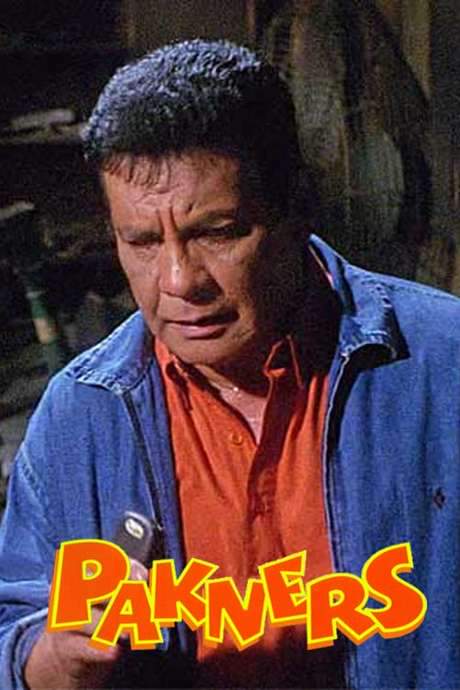
Parding is regarded as handsome in his province, where girls of all kinds fall for him. When a restless urge to seek better prospects pulls him toward Manila, the small-town charm meets a larger, more complicated world. In the city, he crosses paths with a rough-edged crew led by Dodong and Gigi, a duo who pull him into a life that fuses camaraderie with constant risk. The initial arrangements are simple: they welcome him into their shared space, hoping the move will bring them all a slice of luck. But soon enough, misfortune threads its way through the group, turning everyday odds into a sketchy game of chance where every decision carries weight.
The turning point arrives when Dodong, along with allies Siano and Dodie, thwarts a robbery at a bank and, more importantly, saves a wave of production people from a television studio. Grateful for the narrow escape and the predictable chaos they’ve managed to avert, the studio owner’s brother, Robert, decides to reward them with an opportunity: employment at the station. Dodong seizes the chance and lays out a plan to bring his friends along—himself, Parding, and the rest of the crew—into a legitimate line of work. The offer is granted, and the group finds themselves donning the station’s emblematic utility roles, a modest gateway into a world where fame and influence seem within reach but still tantalizingly out of reach.
Inside the station, Parding’s talents begin to reveal themselves in unexpected ways. He stumbles into a DJ booth and becomes entranced by the artistry of a disc jockey whose rap skills and memory appear extraordinary, even when the man is drunk. The next day, the original DJ is incapacitated by inebriation, and Parding stepping in to host the radio show becomes a watershed moment. His voice carries a rare blend of rhythm and recall, qualities that instantly win him a devoted audience. Among his new fans are two women whose paths intersect with his in different ways: Annie, a blind girl whose world brightens with the sound of his broadcasts, and Ingrid, the station owner’s sister who bears the scars of a troubled marriage to Gabby.
From the moment Parding’s voice reaches Annie and Ingrid, the narrative threads deepen. He promises Annie that he will pay for her operation, a gesture of genuine care that grounds him amid the glitter and glittering noise of the media world. With Ingrid, Parding’s relationship grows more complicated—romance flickers into focus, and through Ingrid’s eyes the story peels back another layer of the city’s underbelly: Gabby’s violent pattern and his involvement in illicit activities. The dynamics at play are not merely about music and fame; they reveal a society where power, money, and fear intertwine, affecting ordinary lives in stubborn, lasting ways.
Tension escalates during a high-stakes payoff between Gabby and his associate Richard at the television station. What begins as a private transaction escalates into a broadcast spectacle, aired nationwide with Ingrid, Robert, and Parding connected to the moment by proximity and presence. The exposure of this exchange forces Gabby and Richard to flee, pursued by their own henchmen. Yet the pursuit is met with resistance from Dodong, Parding, Gigi, and the rest of the gang, who close ranks to ensure that the scheme cannot escape into the light. The confrontation underscores a central theme: in a world where screens amplify every act, truth and accountability can surface in the most unexpected places.
In the aftermath, Ingrid makes a decisive choice that reshapes the lives of those around her. She steps forward to shoulder the costs of Annie’s operation, turning what could have been a personal retreat into a public act of solidarity. The operation succeeds, and Annie’s sight returns, bringing a hopeful clarity to a story that had kept its focal point on sound, sight, and the voices that bridge them. At the moment of recovery, Annie’s gaze lands on Parding—the enigmatic radio voice that had felt so distant and intimate at once—marking a quiet but poignant ending to a journey defined by dreams pursued in the glare of city lights and the shadow of hard realities.
Cast highlights anchor the film in a recognizable, hometown mood. Dennis Padilla and Ogie Alcasid contribute with their own unique presences, while Andrew E brings the character of Parding to life, a role that anchors the story’s rise from provincial charm to metropolitan notoriety. The film also features the talents of Janno Gibbs and Gelli De Belen, whose performances enrich the ensemble and add texture to the emotional arcs that unfold across Manila’s bustling backdrop.
Selected cast:
- Dennis Padilla
- Ogie Alcasid
- Andrew E as Perding Pogi
- Janno Gibbs
- Gelli De Belen
What makes this story resonate is not only the arc of a young man who finds his voice in a crowded media landscape, but also the way it intertwines personal loyalty, community loyalty, and the moral complexities that accompany ambition. The film traverses a spectrum from lighthearted camaraderie to serious social issues, including domestic abuse and corruption, all while maintaining a steady, human-centered focus on how individuals navigate fame, money, and the desire to help those they care about. It captures a specific slice of life in which people from different walks of life collide in a shared space—where the sound of a radio show can become a beacon of hope, and where a promise to pay for surgery can change a life forever. The narrative remains faithful to its core, expanding with care on the relationships formed, the costs of ambition, and the quiet victories that emerge when truth and kindness intersect in a city that never stops listening.