Plot Explained Spoilers guaranteed!
Plot Explained

Browse by genre

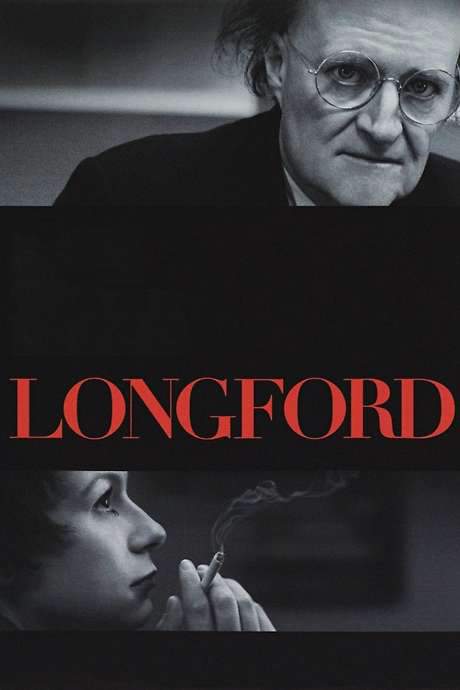
Longford (2006) movie poster

Timeline

Longford (2006) Timeline Explained – Every Event in Order

Release, runtime and language
2006 · 88 mins · English
Directed by
Tom Hooper
Starring
Andy Serkis, Lee Boardman, Jim Broadbent, Samantha Morton, Kika Markham, Alex Blake

A portrait of Lord Longford, the tire‑less British Labour peer who devoted his life to prison reform and the controversial cause of securing clemency for a convicted woman. His relentless crusade to win her release sparked fierce political debate, personal attacks and conflict, highlighting his commitment to compassion over public opinion.

On this page (5)
  1. 1 Events in order (13)
  2. 2 Timeline questions answered
  3. 3 Movie threads
  4. 4 Movies like Longford
  5. 5 Every angle

13 events in order · contains spoilers

Longford Timeline: Events in Chronological Order

Every key event of Longford (2006) in order, scene by scene, with when and where it takes place. Use it to untangle flashbacks, time jumps and parallel storylines, to refresh your memory before the sequel or to find the exact scene you are thinking of.

  1. Radio discussion about Saints book turns confrontational

    The film opens in 1987 with Lord Longford invited to discuss his book Saints on a live radio show. Listeners call in and challenge his defense of Hindley, especially after she has confessed to two additional murders. Longford declines to discuss Hindley on air, politely steering the conversation away from the topic.

    When
    1987
    Where
    Radio studio
  2. Hindley writes to Longford and requests a meeting with Brady

    The story's main arc begins in the late 1960s at the House of Lords, where Longford receives a letter from Myra Hindley asking for books and for a meeting with Ian Brady. He warns Hindley that contact with Brady could hurt any parole chances. Hindley is surprised by the idea of parole and the potential for reform.

    When
    late 1960s
    Where
    House of Lords
  3. Longford begins a parole campaign

    Motivated by his belief in universal redemption, Longford starts a personal campaign to win Hindley's parole. He reminds Hindley that the trial judge believed rehabilitation might be possible once away from Brady's influence. His stance meets heavy public, media, and political backlash.

    When
    late 1960s–1970s
    Where
    Campaign activities / public sphere
  4. Hindley's conversion and doubts about authenticity

    As Hindley converts to Catholicism and appears to reform, Longford questions whether the change is genuine or a manipulation to secure parole. He debates the depth of her remorse while press scrutiny grows. This tension frames his ongoing faith-driven pursuit.

    When
    late 1960s–1970s
    Where
    Prison / Hindley's surroundings
  5. Brady warns Longford of Hindley

    Ian Brady writes to Longford and demands a prison visit, claiming Hindley is manipulative and only seeks freedom. Brady's warning deepens Longford's internal conflict about Hindley and the real meaning of rehabilitation.

    When
    late 1960s–1970s
    Where
    Brady's prison / correspondence
  6. Public and familial backlash against Longford

    Longford endures fierce criticism from tabloid media, politicians, and his own family for backing Hindley. He defends his core belief that people can be reformed, despite the reputational cost. His wife urges him to abandon the cause.

    When
    1970s–1980s
    Where
    Media / family discussions
  7. Brass Tacks debate on Hindley's parole

    In 1977, Longford appears on the first Brass Tacks episode to debate Hindley's parole. Ann West and Patrick Kilbride publicly oppose release, threatening Hindley if she is freed. The program becomes a focal point for the moral and political conflict over parole.

    When
    1977
    Where
    Brass Tacks studio
  8. Hindley reveals further murders; body located

    By 1986 Hindley reveals to Longford that she and Brady were responsible for two more murders, shocking public opinion and complicating his campaign. She later helps police locate the body of one victim, underscoring how intimately involved she still is with the case.

    When
    1986
    Where
    Prison / investigation scene
  9. Parole prospects and public hostility

    As Hindley's parole case nears evaluation by the Parole Board, public hostility grows stronger. Longford maintains his position, arguing rehabilitation, while critics argue the victims' families' pain should bar parole.

    When
    1986–1987
    Where
    Parole Board (UK) / public sphere
  10. Radio interview tests Longford's resolve

    The late 1980s see Longford on a radio show again, facing callers who challenge his stance. He contends that his friendship with Hindley enriched his life and that he does not regret his support, despite the controversy.

    When
    late 1980s
    Where
    Radio studio
  11. Private doubts deepen after the Downey tape

    Privately, Longford wrestles with doubts as he listens to an audio recording of Lesley Ann Downey's abuse. The haunting tape intensifies the moral weight of his involvement in Hindley's parole saga.

    When
    late 1980s
    Where
    Private space
  12. Final visits in the late 1990s

    In the late 1990s, Longford, now frail and over ninety, visits Hindley on the prison grounds. Hindley, in her late 50s with deteriorating health, confronts the reality that parole may never come. Their relationship remains complex, defined by faith, guilt, and unresolved questions.

    When
    late 1990s
    Where
    Prison grounds
  13. Epilogue: outcomes disclosed

    The film ends with on-screen messages noting Longford's death in August 2001 and Hindley's death in November 2002, indicating that Hindley never won parole. The narrative frames Longford's lifelong devotion and the lasting consequences of his campaign.

    When
    2001–2002
    Where
    Credits

Last updated: October 09, 2025 at 15:04

Was this helpful?

Timeline questions answered

Longford Timeline Explained: Your Questions Answered

When does it happen, and why in that order? The questions people ask about the chronology of Longford (2006): time jumps, flashbacks, cause and effect between scenes and the correct order of events, each answered with spoilers.

Q1

Why did Myra Hindley write to Lord Longford?

Hindley wrote to Longford from prison in the late 1960s requesting books and, more controversially, asking for a chance to meet Ian Brady, her former partner accused of three murders. This letter initiated Longford's involvement in her case and sparked his decades-long campaign for her parole.

  • myra hindley
  • letter
  • lord longford
  • prison
  • ian brady
Q2

What motivated Lord Longford to believe in Myra Hindley's redemption?

Longford was a devout Catholic and lifelong advocate for prison reform who believed fundamentally in the possibility of redemption for every person. He argued that rehabilitation was a test of the justice system's humanity and pointed to the trial judge's suggestion that Hindley's release might someday be possible if she demonstrated genuine reform away from Brady's influence.

  • redemption
  • faith
  • prison reform
  • catholic
  • rehabilitation
Q3

What warning did Ian Brady give Lord Longford about Myra Hindley?

Ian Brady wrote to Longford from prison claiming that Hindley was manipulative and only sought freedom, warning Longford against helping her. This warning created significant internal conflict for Longford, forcing him to question whether Hindley's apparent reformation was genuine or a strategy to secure parole.

  • ian brady
  • warning
  • manipulation
  • prison letter
Q4

Why did Myra Hindley reveal additional murders in 1986?

In 1986, Hindley disclosed to Longford that she and Brady were responsible for two additional murders that had not previously come to light. This revelation shocked public opinion and complicated the parole campaign. She later helped police locate the body of one victim, adding new complexity to the case and reshaping public perception of her involvement.

  • additional murders
  • 1986
  • confession
  • body location
Q5

What was the Brass Tacks debate about Hindley's parole?

In 1977, Longford appeared on the first Brass Tacks television program to debate Hindley's parole. Ann West and Patrick Kilbride, representing victims' families, publicly opposed her release and threatened Hindley if she were freed. The program became a focal point for the national moral and political conflict over whether Hindley should ever be granted parole.

  • brass tacks
  • 1977
  • debate
  • parole
  • victims families
Q6

Why did Lord Longford face such intense public backlash?

Longford endured fierce criticism from tabloid media, politicians, and his own family for defending Hindley, who was one of Britain's most hated criminals. The public viewed his campaign as defending a child murderer and dismissing the suffering of victims' families. Despite this reputational cost, Longford maintained that showing mercy and believing in rehabilitation reflected the best aspects of a humane Christian tradition.

  • public backlash
  • media criticism
  • politicians
  • family opposition
Q7

What was the Downey tape and how did it affect Longford?

The Downey tape was an audio recording of Lesley Ann Downey, one of Hindley and Brady's child victims, being abused. Longford privately listened to this haunting recording in the late 1980s, which intensified the moral weight of his involvement in Hindley's case and deepened his private doubts about whether he was right to advocate for her release.

  • downey tape
  • audio recording
  • lesley ann downey
  • moral doubt
Q8

Why was Myra Hindley never released from prison?

Despite Longford's decades-long campaign, Hindley was never granted parole. By the late 1990s, her health deteriorated and the legal climate shifted against her release. Public hostility remained strong, particularly from victims' families. Hindley died in prison in 2002, having never achieved the parole that Longford fought for throughout much of his life.

  • parole denied
  • death 2002
  • prison
  • never released
Q9

Why did Longford continue his campaign despite years of criticism?

Longford continued because his Catholic faith taught that every person could be redeemed, regardless of their crimes. He believed that refusing to accept the possibility of rehabilitation would make society less humane. Even as critics labelled him a sentimentalist or fool, Longford maintained that his friendship with Hindley enriched his life and that his stance represented core Christian values of mercy and compassion.

  • faith
  • mercy
  • christian values
  • compassion
  • persistence
Q10

What role did Myra Hindley's conversion to Catholicism play in the case?

Hindley converted to Catholicism during her imprisonment, which Longford saw as evidence of genuine reform. However, Longford himself questioned whether her conversion was authentic or simply a manipulation to improve her chances of parole. This tension between genuine remorse and strategic behavior remained central to the debate over whether she deserved release.

  • catholic conversion
  • remorse
  • genuine faith
  • manipulation

Movie threads

More Movies Like Longford, by Mood & Story

Curated lists built around what makes Longford tick: the same mood, the same kind of story or the same emotional payoff. Each list explains why these movies belong together.

Movies about divisive moral crusades like Longford

Stories of individuals who wage lonely, controversial battles based on unwavering principles. If you were fascinated by the principled, lonely struggle in Longford, this thread gathers similar movies about real-life figures or fictional characters who champion controversial causes. These somber dramas explore the immense personal toll of fighting for compassion, justice, or redemption against a tide of public outrage and political pressure.

  • moral struggle
  • divisive
  • steadfast
  • unflinching
  • contemplative
  • serious
  • Tone: dark, somber, serious
  • Pacing: slow, deliberate
Why these movies?

The story pattern: Narratives in this thread typically follow a linear, often biographical, path chronicling a long-term campaign. The central conflict is not physical but ideological, pitting an individual's steadfast faith against institutional inertia and societal anger. The emotional journey is one of increasing isolation and sacrifice, where small victories are often overshadowed by the immense personal cost.

Why they belong together: Movies are grouped here for their shared focus on a singular, principled protagonist, a tone of serious moral contemplation, and a heavy emotional weight derived from a real-world, divisive ethical dilemma. The pacing is usually deliberate, allowing the full weight of the struggle to build over time.

Grim true crime character studies like Longford

Character-driven dramas that explore the complex psychology behind notorious real-life crimes. For viewers who appreciated Longford's deep dive into the personalities and psychological impact of a notorious crime, this section features similar movies. These films are slow-burn, character-focused dramas that examine true crime stories from a moral and psychological perspective, often dealing with themes of manipulation, public scrutiny, and the search for redemption.

  • unflinching
  • psychological
  • somber
  • true crime
  • moral complexity
  • grim
  • Tone: dark, psychological, grim
  • Pacing: slow, deliberate
Why these movies?

The story pattern: The narrative pattern avoids sensationalism, instead focusing on the long-term ripple effects of a horrific act. The story is often told through the perspective of someone connected to the crime—an investigator, a family member, or an advocate—and explores their psychological and moral descent or struggle. The structure is typically linear, building a nuanced portrait over time.

Why they belong together: These films are connected by their basis in true crime, their dark and serious tone, and their preference for psychological depth over thriller-paced plotting. They share a high intensity derived from the disturbing nature of the crimes and the heavy emotional weight of confronting complex human behavior.

If you liked this

Movies Like Longford

Similar movies to Longford: the same genre, themes or kind of story. Each one comes with its own plot summary, timeline and ending explained.

Browse all movie summaries

Every angle

Longford (2006) Explained: Plot, Timeline & Characters

Everything about Longford in one place: what happens in the plot summary, the timeline in chronological order, the characters and meaning and a spoiler-free summary. What's After the Movie adds the cast, box office and post-credit scenes.

Coming soon on iOS and Android

The Plot Explained Movie Summary App

Plot summaries, endings explained and timelines on your phone. Catch up on any movie in minutes, save your favorites and never miss a twist again.

Be the first to know when we launch. Your email stays private, always.

Learn more about the app