Plot Explained Spoilers guaranteed!
Plot Explained

Browse by genre

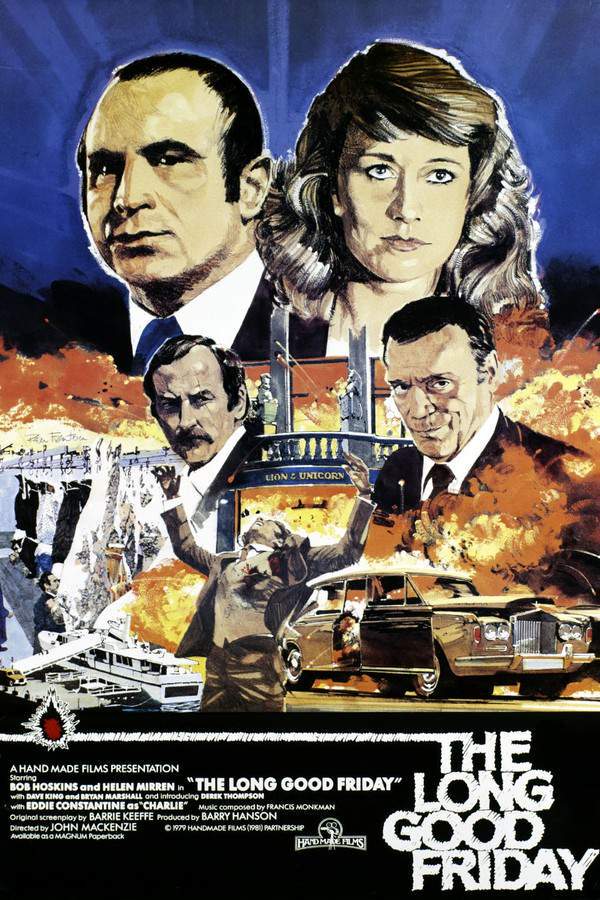
The Long Good Friday (1982) movie poster

Plot Summary

The Long Good Friday (1982) Plot Summary Explained

Release, runtime and language
1982 · 114 min · English
JustWatch #2,682 5
Directed by
John Mackenzie
Starring
Helen Mirren, Bob Hoskins, Paul Freeman, Bryan Marshall, Kevin McNally, P.H. Moriarty

In 1970s London, crime boss Harold Shand strives for a legitimate business while battling a series of bombings that jeopardize his operations. As he investigates a possible traitor within his organization, Shand’s ruthless quest to protect his criminal empire and secure his future brings him into conflict with the American Mafia, creating a dangerous power struggle.

On this page (6)
  1. 1 Where to watch
  2. 2 What happens: full plot
  3. 3 Plot questions answered
  4. 4 Movie threads
  5. 5 Movies like The Long Good Friday
  6. 6 Every angle

Where to watch

Where to Watch The Long Good Friday (1982)

Where can you watch The Long Good Friday? Stream, rent or buy it in the US, including on HBO Max, Plex and Shout! Factory TV: current JustWatch availability with up-to-date prices.

Streaming availability powered by JustWatch

Full plot summary · contains spoilers

What Happens in The Long Good Friday: Full Plot Summary

The whole story of The Long Good Friday (1982) explained, from the opening scene to the final frame: every key event, every twist and what it all adds up to. Read it as a quick recap before the sequel, to check a scene you missed, or to finally understand what really happened.

A dubious figure, Colin, is seen making a precarious money drop, hastily pocketing some cash from a suitcase before the deal. Meanwhile, in a secluded farmhouse, three men are in the process of splitting the cash when they are ambushed by gunmen. Outside a local pub, Colin’s accomplices are snatched away and meet a grim fate. Tragically, Colin meets his end at a swimming pool shortly after.

The narrative unfolds further to reveal the dominant gangster of the London underworld, Harold Shand, in what is regarded as Bob Hoskins' breakout role. He is in the midst of orchestrating a lucrative alliance with a group of wealthy, dubious Americans to fuel the exceptionally profitable London docklands development flourishing in the 1980s.

On Good Friday, while Shand’s mother is at church, her waiting chauffeur is killed when a devastating explosion obliterates her car. The news sends shockwaves through Shand, who is furious about the deteriorating code of conduct within the criminal world. This decline starkly mirrors the gradual decay of his own empire throughout the film. Faced with an ultimatum to rectify the situation within a mere 24 hours or risk losing the Americans’ backing, Shand’s pressure mounts.

The tension escalates when Shand learns of his friend Colin’s murder as well as the shocking discovery of a bomb at his casino, which fortunately fails to detonate. In an effort to cover up Colin’s death, the car bomb incident, and another explosion at a restaurant where he planned to dine, Shand frantically mobilizes informants and various underworld leaders, keen on unearthing the masterminds behind these traumatic events. Though his methods are ruthless, Shand insists that his actions abide by civil conventions.

As he navigates through the chaos, he expresses deep-seated grief over the erosion of neighborhoods, loss of reverence for the church, and the diminishing respect for his power and honor in an increasingly dismal England. Despite this, he professes a profound appreciation for the country’s rich history and feels compelled to create magnificent structures on the sites of abandoned dockyards.

Shand uncovers that the bombings are orchestrated by the IRA, retaliating for the relatively insignificant theft of £5,000 by Colin. It also becomes evident that the three men from the farmhouse earlier were linked to the IRA. The IRA make a connection between Shand and Colin, as the latter was acting as a courier without Shand’s awareness. Shand’s right-hand man chillingly informs him that attempting to confront the IRA is futile, stating, "they're fanatics," and emphasizes that eliminating a few will only lead to many more arising in their place. This ominous revelation indicates an inescapable takeover of Shand’s empire by the IRA.

In a desperate bid to regain control, Shand agrees to meet with the IRA under the guise of making a payment of £60,000, but instead, he ambushes and kills them. Despite his violent maneuver, the Americans abandon the deal, deeming him merely a gangster. In a final confrontation, he admonishes them for their lack of guts and vision, declaring he will turn his sights towards the Germans and will not be deterred. However, as he exits the meeting, the tables turn; he is captured by the IRA, marking the definitive end of his reign.
Last updated: October 25, 2024 at 11:03

Was this helpful?

Plot questions answered

The Long Good Friday Plot Explained: Your Questions Answered

The questions people ask most about The Long Good Friday (1982): what happens in the confusing scenes, why the characters do what they do, the twists, hidden details and what the ending means. Each answer contains spoilers.

Q1

Why does the IRA target Harold Shand?

The IRA retaliates against Shand because his associate Colin stole £5,000 from them. While this amount is relatively small, the IRA views the theft as a serious breach of their code. The three men ambushed at the farmhouse were IRA members who had been handling the money, and Colin was revealed to be acting as a courier without Shand's knowledge, making Shand indirectly responsible in the IRA's eyes.

Foreshadowing: Earlier scenes show Colin quickly pocketing cash from a suitcase during a money drop, establishing his untrustworthy nature.

  • ira
  • retaliation
  • bombing
  • colin
  • money theft
  • £5000
Q2

Why do the American investors abandon Harold Shand?

The Americans abandon Shand after he ambushes and kills the IRA members during a supposed payment meeting. Despite Shand believing this violent action would demonstrate his strength and capability, the Americans view him as merely a gangster rather than the legitimate business partner they sought. They lack the "guts and vision" Shand hoped they would share, and they refuse to associate with someone who operates through murder and chaos.

Foreshadowing: Shand's right-hand man warns him that eliminating a few IRA members will only create more, suggesting the violent approach would backfire.

  • americans
  • investors
  • docklands deal
  • abandon
  • gangster
Q3

Why does Shand's right-hand man say confronting the IRA is futile?

Shand's right-hand man explains that the IRA are "fanatics" - meaning they cannot be intimidated or bribed into submission. He warns that killing a few IRA members will only result in many more rising to take their place. This reflects the IRA's ideological commitment and decentralized structure, making them an enemy that cannot be simply eliminated through violence like other criminal rivals.
Foreshadowing: The rapid succession of bombings and attacks demonstrates the IRA's capability to strike repeatedly.

  • ira
  • fanatics
  • right-hand man
  • warning
  • futile
Q4

What happens to Harold Shand at the end?

After the Americans abandon him, Shand is captured by the IRA. This marks the definitive end of his reign as the dominant gangster of London's underworld. His ambitions for legitimacy through the docklands development are shattered, and he loses both his criminal empire and the legitimate future he was trying to build.

Foreshadowing: The repeated warnings about the IRA's determination and the futility of violence against them foreshadow this inevitable downfall.

  • capture
  • ending
  • ira
  • reign
  • downfall
Q5

Why is the car bomb attack on Shand's mother timed for Good Friday?

The IRA plants the bomb on Good Friday, likely for symbolic resonance. The attack occurs while Shand's mother is inside church, making the timing particularly poignant - a religious day of mourning becoming the backdrop for violence against Shand's family. This further escalates Shand's fury over the declining code of conduct in the criminal underworld.

Foreshadowing: The film's title itself hints at the significance of this particular Friday.

  • good friday
  • car bomb
  • mother
  • symbolism
  • church
Q6

Why doesn't the bomb at Shand's casino explode?

The bomb planted at Shand's casino fails to detonate, whether by malfunction or intentional restraint by the IRA. This failed bombing adds to the series of threats against Shand's empire while also demonstrating the IRA's ability to strike at his operations. The failed detonation creates additional tension without causing the casualties the IRA may have intended.

Foreshadowing: The string of bombings throughout the film shows escalating pressure on Shand.

  • casino
  • bomb
  • failed detonation
  • ira
Q7

What does Harold Shand mean by the erosion of England?

Shand expresses grief over the decay of traditional English neighborhoods, the loss of reverence for the church, and the diminishing respect for his own power and honor. He feels England is becoming increasingly dismal and lost. Despite being a criminal, he claims to appreciate England's rich history and feels compelled to create magnificent structures on abandoned dockyards - essentially trying to rebuild what has been lost, though through illegitimate means.

Foreshadowing: This theme of decline runs throughout the film, mirrored by the gradual collapse of Shand's own empire.

  • england
  • decline
  • neighborhoods
  • church
  • history
  • docklands
Q8

Why does Harold Shand insist his actions abide by civil conventions?

Despite orchestrating murders and violence, Shand repeatedly insists that his methods abide by civil conventions. This reflects his desire to be seen as a businessman rather than a common criminal. He wants legitimacy - both in the eyes of the Americans he's partnering with and perhaps in his own self-image. Shand distinguishes between the old criminal code of honor and the chaotic violence represented by the IRA's attacks.

Foreshadowing: This tension between criminality and legitimacy drives Shand's failed attempt to become a legitimate businessman.

  • civil conventions
  • code of conduct
  • legitimacy
  • criminal honor
Q9

Was Colin working for the IRA without Shand's knowledge?

Yes, Colin was acting as a courier for the IRA without Shand's awareness. The IRA connected Colin to Shand because Colin was known to work within Shand's organization. This connection made Shand a target for the IRA's retaliation, even though Shand himself had no involvement in the original £5,000 theft. Colin was essentially operating as a double agent, using his position in Shand's network for IRA operations.

Foreshadowing: Colin's suspicious behavior during the money drop - quickly pocketing extra cash - hints at his untrustworthiness.

  • colin
  • ira
  • courier
  • betrayal
  • double agent
Q10

Why does Shand attack the IRA despite his right-hand man's warnings?

Shand attacks the IRA because he faces a 24-hour ultimatum from his American partners to restore order or lose their backing. Desperate to maintain control and prove his value to the Americans, he arranges a meeting under the guise of making a £60,000 payment but instead ambushes the IRA members. This desperate gamble reflects Shand's inability to accept that traditional criminal tactics won't work against ideologically motivated opponents.

Foreshadowing: The ticking 24-hour clock creates mounting pressure that leads Shand to make this fatal decision.

  • ira ambush
  • 24 hours
  • ultimatum
  • desperate attack
Q11

What is the docklands development that Shand is pursuing?

The docklands development is a major legitimate business venture Shand is pursuing in 1980s London. He seeks to partner with wealthy Americans to transform abandoned dockyards into magnificent new structures. This represents Shand's attempt to transition from criminal gangster to legitimate businessman, using his profits from crime to build something lasting and respectable in postwar England's changing landscape.

Foreshadowing: Shand's speech about creating magnificent structures on abandoned sites reflects his vision for this development.

  • docklands
  • development
  • americans
  • legitimate business
  • london

Movie threads

More Movies Like The Long Good Friday, by Mood & Story

Curated lists built around what makes The Long Good Friday tick: the same mood, the same kind of story or the same emotional payoff. Each list explains why these movies belong together.

Crime Boss Under Siege stories like The Long Good Friday

Powerful criminals face a relentless, unseen threat that dismantles their empire. Find movies like The Long Good Friday where a criminal kingpin's empire is threatened by a hidden foe. These tense, fast-paced thrillers explore power struggles, betrayal, and the violent downfall of organized crime figures. If you liked Harold Shand's desperate battle, you'll find similar gripping tales here.

  • tense
  • ruthless
  • paranoid
  • furious
  • gritty
  • bleak
  • Tone: tense, bleak, ruthless
  • Pacing: fast, relentless
Why these movies?

The story pattern: These stories follow a similar arc: a successful criminal establishment is suddenly attacked by an unknown antagonist. The protagonist, often a prideful and ruthless leader, must race against time to identify the threat, leading to internal suspicion, brutal confrontations, and the inevitable unraveling of their power structure.

Why they belong together: They are grouped by a shared narrative structure of a powerful figure being systematically challenged, a consistently high-tension and paranoid mood, and a focus on the brutal realities of maintaining criminal power, often culminating in a definitive and bleak conclusion.

Gritty and furious urban thrillers similar to The Long Good Friday

Fast-paced, angry thrillers set against a backdrop of urban decay and violence. Discover movies with a similar feel to The Long Good Friday's gritty, high-tension atmosphere. These films share a fast pace, heavy emotional weight, and a bleak tone, often set in decaying urban landscapes. If you liked the relentless anger and tension of this London crime story, explore these similar high-intensity thrillers.

  • gritty
  • tense
  • furious
  • bleak
  • angry
  • ruthless
  • Tone: tense, bleak, angry
  • Pacing: fast, relentless
Why these movies?

The story pattern: The narrative pattern is often linear and straightforward, focusing on a protagonist's desperate reaction to a cascade of violent events. The journey is less about complex mystery and more about the visceral, emotional descent into chaos, driven by external threats and the character's own ruthless nature.

Why they belong together: They are connected by a potent mix of high intensity, a consistently tense and bleak tone, fast pacing, and a heavy emotional weight rooted in gritty, urban settings. The shared viewing experience is one of sustained stress, moral ambiguity, and a visceral sense of impending doom.

If you liked this

Movies Like The Long Good Friday

Similar movies to The Long Good Friday: the same genre, themes or kind of story. Each one comes with its own plot summary, timeline and ending explained.

Browse all movie summaries

Every angle

The Long Good Friday (1982) Explained: Plot, Timeline & Characters

Everything about The Long Good Friday in one place: what happens in the plot summary, the timeline in chronological order, the characters and meaning and a spoiler-free summary. What's After the Movie adds the cast, box office and post-credit scenes.

Coming soon on iOS and Android

The Plot Explained Movie Summary App

Plot summaries, endings explained and timelines on your phone. Catch up on any movie in minutes, save your favorites and never miss a twist again.

Be the first to know when we launch. Your email stays private, always.

Learn more about the app