











Plot Explained Spoilers guaranteed!
Plot Explained

Browse by genre

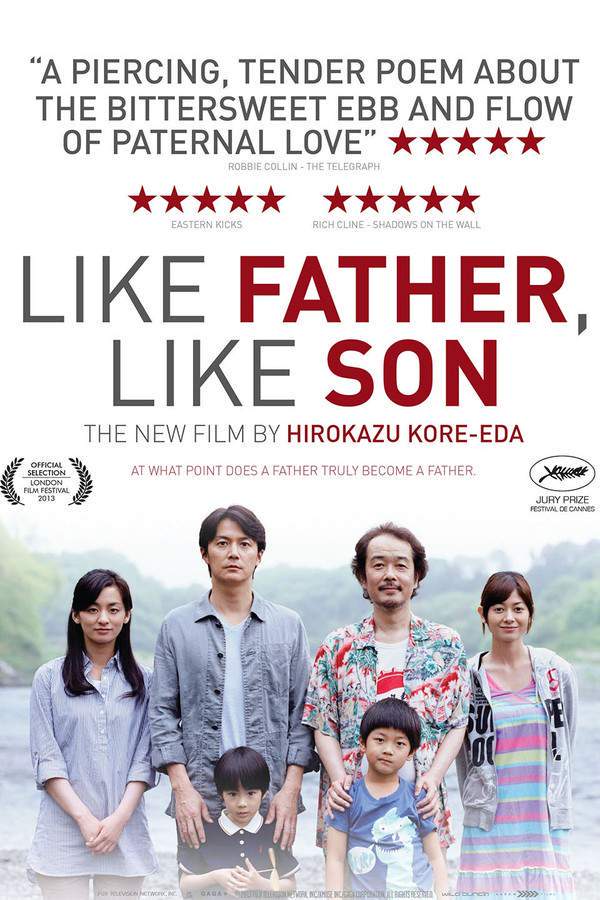
Like Father, Like Son (2014) movie poster

Timeline

Like Father, Like Son (2014) Timeline Explained – Every Event in Order

Release, runtime and language
2014 · 121 min · Japanese
JustWatch #25,368 1
Directed by
Hirokazu Koreeda
Starring
Lily Franky, Machiko Ono, Masaharu Fukuyama, Yoko Maki

In modern Japan, architect Ryota’s meticulously planned life is thrown into turmoil when he learns his infant son was swapped at birth with another family’s child. Forced to confront this unexpected truth, Ryota must navigate a complex moral and emotional crisis, grappling with questions of identity, responsibility, and the very definition of family. As he interacts with the other family and his biological son, Ryota's rigid worldview begins to soften, leading to a profound understanding of human connection and the enduring power of love.

On this page (5)
  1. 1 Where to watch
  2. 2 Events in order (14)
  3. 3 Timeline questions answered
  4. 4 Movie threads
  5. 5 Every angle

Where to watch

Where to Watch Like Father, Like Son (2014)

Where can you watch Like Father, Like Son? Stream, rent or buy it in the US, including on AMC+, Philo and Sundance Now: current JustWatch availability with up-to-date prices.

Streaming availability powered by JustWatch

14 events in order · contains spoilers

Like Father, Like Son Timeline: Events in Chronological Order

Every key event of Like Father, Like Son (2014) in order, scene by scene, with when and where it takes place. Use it to untangle flashbacks, time jumps and parallel storylines, to refresh your memory before the sequel or to find the exact scene you are thinking of.

  1. Ryōta's Professional Dedication

    Ryōta Nonomiya is introduced as a highly devoted architect whose passion for his career leads him to neglect his family. This sets the stage for the emotional strife that ensues as the dynamics of his family life come into play.

  2. Alarm at the Hospital

    One day, Midori receives a distressing call from the hospital where Keita was born, triggering instant concern. Ryōta feels a wave of dread wash over him as they both rush to find out what has happened.

    Where
    Hospital
  3. The Shocking Revelation

    Upon their arrival at the hospital, Ryōta and Midori learn of a devastating mix-up: their biological son, Ryūsei, was switched at birth with Keita. This revelation plunges the couple into an emotional crisis, forcing them to confront their parenting choices.

    Where
    Hospital
  4. Meeting the Saiki Family

    As Ryōta and Midori navigate their tumultuous emotions, they meet Yukari and Yūdai Saiki, the other parents involved in the switch. The Saikis embody a more grounding approach to parenthood, instilling warmth and understanding in the midst of chaos.

  5. First Glimpse of Ryūsei

    After sharing photographs, Ryōta and Midori finally catch a glimpse of their biological son, Ryūsei. This moment ignites a mix of love, longing, and confusion, as it brings the reality of their situation into sharper focus.

  6. The First Child Exchange

    Deciding to explore their complex feelings, Ryōta and Midori agree to exchange children with the Saikis for one Saturday. This day marks the beginning of a delicate relationship intertwined with love and loss as both families experience new dynamics.

    When
    Saturday
  7. Permanent Child Swap Decision

    As the exchanges continue, both families struggle with the overwhelming emotions and ultimately decide to swap children permanently. This decision brings forth a new set of challenges as they grapple with loss and familial bonds.

  8. Ryūsei's Emotional Turmoil

    Ryūsei, feeling the weight of the switch, begins to experience emotional turmoil, leading him to run away to his original family. This prompts Ryōta to intervene, showcasing the intense bond and struggle for connection.

  9. Building a Bond

    Through challenges and shared moments, Ryōta begins to form a bond with Ryūsei as he gradually opens up to their family. This relationship flourishes as they navigate their complicated circumstances together.

  10. The Discovery on Keita's Camera

    While exploring Keita's camera, Ryōta discovers poignant photographs that capture his vulnerable moments, many taken while he slept. This emotional revelation leaves him overwhelmed, emphasizing his feelings of guilt and sadness.

  11. Confrontation with Loss

    Filled with regret and emotion, Ryōta grapples with the weight of lost connections with both sons. The struggle to reconcile his past and present becomes palpable, leading to introspection about his role as a father.

  12. Return to the Saiki Family

    In a bid for closure and healing, Ryōta returns to the Saiki family with his sons. This visit marks a turning point as the families begin the process of healing and reconnecting with one another.

  13. Convergence of Families

    As both families converge, a sense of hope emerges from the lingering emotional turmoil. Each family member starts to stitch back the bonds that were torn, realizing their connections are still intact.

  14. A New Chapter Begins

    The film closes with both families stepping into a shared space, signaling the start of a new chapter. Their collective journey embodies themes of love, forgiveness, and the complex nature of family ties.

Last updated: November 16, 2024 at 18:26

Was this helpful?

Timeline questions answered

Like Father, Like Son Timeline Explained: Your Questions Answered

When does it happen, and why in that order? The questions people ask about the chronology of Like Father, Like Son (2014): time jumps, flashbacks, cause and effect between scenes and the correct order of events, each answered with spoilers.

Q1

Why did Ryōta neglect his family for his career?

Ryōta was a highly dedicated architect who poured most of his energy into his career. This professional dedication came at the cost of spending time with his wife Midori and their son Keita. His obsession with work created emotional distance in his family, which becomes a key point of reflection once the baby mix-up is revealed.

Foreshadowing: The film opens by establishing Ryōta's workaholic nature, setting up his eventual transformation.

  • ryota
  • architect
  • career
  • neglect
  • family
Q2

How did the hospital discover the baby mix-up?

Midori received a call from the hospital where Keita was born, alerting the family to a concerning issue. Ryōta and Midori rushed to the hospital where they were informed that their biological son Ryūsei had been switched at birth with Keita due to a mix-up at the facility.

Foreshadowing: Ryōta feels a sense of dread immediately after Midori receives the call, hinting at the magnitude of the revelation.

  • hospital
  • mix-up
  • birth
  • discovery
  • keita
  • ryusei
Q3

Why did the families decide to swap children permanently?

After several emotional trial exchanges where both families spent time with each other's sons, they concluded that the children should remain with their biological families. This decision was driven by the belief that biological bonds and the children's original family environments would serve their best interests, despite the immense emotional pain it caused.

Foreshadowing: The first Saturday exchange serves as a testing period that eventually leads to the permanent decision.

  • swap
  • permanent
  • decision
  • saiki family
  • biological
Q4

Why did Ryūsei run away from the Nonomiya family?

Ryūsei experienced intense emotional turmoil after being permanently switched to the Nonomiya family. Despite Ryōta's efforts to bond with him, Ryūsei felt disconnected and deeply missed the Saiki family who raised him. This emotional distress led him to run away back to his original family.

Foreshadowing: Ryūsei's difficulty adjusting was hinted at during the trial exchanges when he showed signs of discomfort.

  • ryusei
  • run away
  • emotional turmoil
  • saiki family
Q5

What did Ryōta discover on Keita's camera?

While looking through Keita's camera, Ryōta discovered a series of touching photographs. The images captured Ryōta in vulnerable moments, many taken while he was asleep. These photos represented Keita's perspective of his father, showing love and attention that Ryōta had been too busy to notice or reciprocate.

Foreshadowing: Keita's attempt to capture his father's vulnerable moments reflects his longing for connection that Ryōta had missed due to his work commitments.

  • keita
  • camera
  • photographs
  • vulnerable
  • emotional discovery
Q6

Why did seeing the photos make Ryōta cry?

The photographs overwhelmed Ryōta with emotion because they revealed how much Keita loved him despite his neglectful behavior as a father. Seeing himself through his son's eyes, vulnerable, sleeping, unaware, made Ryōta realize the depth of the bond he had missed and the guilt he carried for not being more present.

Foreshadowing: This moment connects back to Ryōta's earlier neglect, showing how his absence had unintended consequences.

  • crying
  • guilt
  • realization
  • fatherhood
  • love
Q7

How did Ryōta's relationship with Ryūsei develop over time?

Ryōta's bond with Ryūsei developed gradually through shared challenges and persistent efforts to connect. As Ryōta invested more time and emotional energy into being present, Ryūsei slowly opened up to the family. The difficult experience of Ryūsei running away and Ryōta bringing him back strengthened their connection.

Foreshadowing: The initial coldness between Ryōta and Ryūsei at their first meeting contrasts with their eventual warmer relationship.

  • ryusei
  • bond
  • relationship
  • growth
  • father son
Q8

What did the Saiki family teach Ryōta about fatherhood?

The Saiki family, who lived a simpler and more grounded lifestyle, showed Ryōta the importance of warmth, patience, and emotional presence in parenting. Through observing how Yukari and Yūdai interacted with their children, Ryōta began to understand that parental love is about connection rather than perfection or achievement.

Foreshadowing: The contrast between Ryōta's rigid, career-focused approach and the Saikis' nurturing style is evident from their first meeting.

  • saiki family
  • fatherhood
  • parenting
  • learn
  • values
Q9

How did the two families reconcile after the difficult swap?

After months of emotional struggle, Ryōta returned to the Saiki family with both sons, seeking closure and healing. This visit marked a turning point where both families acknowledged their shared pain and began to rebuild their connections. Rather than remaining separated, they chose to move forward together, stitching back the bonds that were torn apart.

Foreshadowing: The film shows both families converging in a shared space, indicating their willingness to maintain relationships despite the trauma.

  • reconcile
  • healing
  • families
  • together
  • closure
Q10

What does the ending of the film signify?

The ending signifies a new chapter where both families choose to remain connected despite the trauma they experienced. The final scene shows both families stepping into a shared space together, symbolizing hope, forgiveness, and the recognition that family bonds extend beyond biological connections. However, the bittersweet tone acknowledges that emotional scars remain.

Foreshadowing: The film closes on a hopeful yet realistic note, reflecting the complex nature of the relationships formed.

  • ending
  • new chapter
  • hope
  • forgiveness
  • family bonds

Movie threads

More Movies Like Like Father, Like Son, by Mood & Story

Curated lists built around what makes Like Father, Like Son tick: the same mood, the same kind of story or the same emotional payoff. Each list explains why these movies belong together.

Movies about identity and family crises like Like Father, Like Son

Stories where contemporary lives are disrupted by profound personal revelations. Find movies similar to Like Father, Like Son that explore modern dilemmas of identity and family. If you liked the emotional depth and moral complexity of Ryota's story, these films feature ordinary people grappling with life-shattering revelations about parenthood, love, and self.

  • contemplative
  • heartfelt
  • intimate
  • somber
  • emotional
  • moral dilemma
  • Tone: bittersweet, contemplative
  • Pacing: slow, deliberate
Why these movies?

The story pattern: The narrative pattern typically begins with a stable, often meticulously controlled life that is suddenly fractured by an unavoidable truth or moral quandary. The plot then follows a gradual, internal journey as the protagonist navigates grief, confusion, and the difficult process of rebuilding their understanding of family and self, often without a clear-cut resolution.

Why they belong together: These films are grouped together because they share a focus on intimate, emotionally heavy dramas that use a specific personal crisis as a lens to examine broader themes of nature versus nurture, biological versus chosen bonds, and the true meaning of family in the modern world.

Slow burn emotional dramas like Like Father, Like Son

Films that build profound emotional impact through quiet, intimate storytelling. Discover movies with a similar pacing and emotional weight to Like Father, Like Son. These slow burn dramas focus on intimate character studies and heavy themes, delivering a bittersweet and contemplative viewing experience for those who appreciate deeply felt stories.

  • slow burn
  • melancholic
  • heartfelt
  • somber
  • emotional
  • contemplative
  • Tone: bittersweet, melancholic, hopeful
  • Pacing: slow burn, deliberate
Why these movies?

The story pattern: Stories in this thread unfold with a deliberate pace, emphasizing character development and emotional states over complex plotting. The central conflict is often internal—a struggle with grief, acceptance, or a fractured relationship. The climax is typically not an explosive event, but a quiet moment of realization or connection that carries the cumulative emotional weight of the entire film.

Why they belong together: These movies are united by their specific combination of slow pacing, heavy emotional weight, and a bittersweet tone. They create a similar viewing atmosphere that is contemplative, deeply moving, and focused on the gradual unfolding of human emotion.

Every angle

Like Father, Like Son (2014) Explained: Plot, Timeline & Characters

Everything about Like Father, Like Son in one place: what happens in the plot summary, the timeline in chronological order, the characters and meaning and a spoiler-free summary. What's After the Movie adds the cast, box office and post-credit scenes.

Coming soon on iOS and Android

The Plot Explained Movie Summary App

Plot summaries, endings explained and timelines on your phone. Catch up on any movie in minutes, save your favorites and never miss a twist again.

Be the first to know when we launch. Your email stays private, always.

Learn more about the app