







Plot Explained Spoilers guaranteed!
Plot Explained

Browse by genre

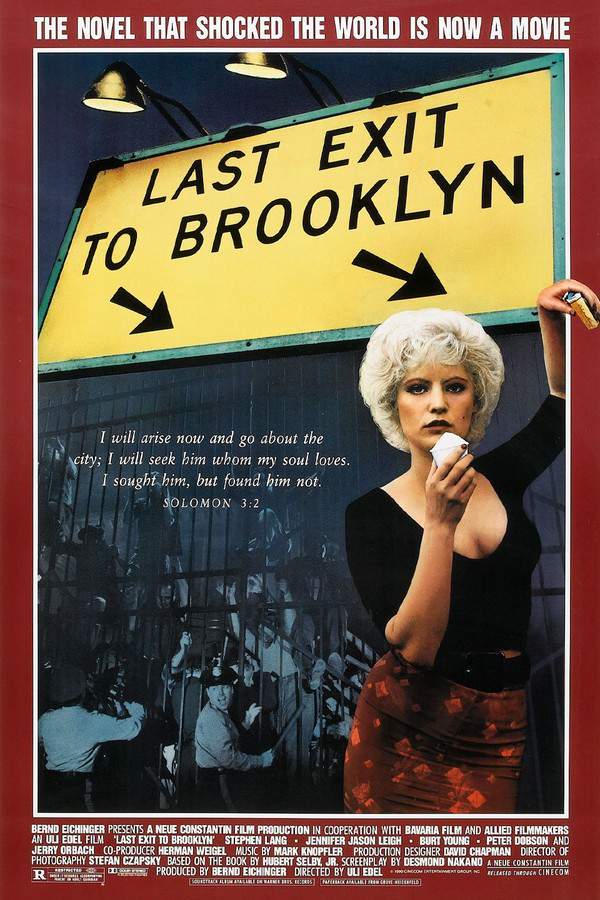
Last Exit to Brooklyn (1989) movie poster

Characters & Themes

Last Exit to Brooklyn (1989) Characters, Setting & Themes Explained

Release, runtime and language
1989 · 103 mins · English
JustWatch #12,210 8
Directed by
Uli Edel
Starring
Stephen Lang, Burt Young, Ricki Lake, Jennifer Jason Leigh, Alexis Arquette, Stephen Baldwin

Based on the controversial novel, the film follows a gritty portrait of 1950s Brooklyn, where a diverse group of residents struggle against harsh social pressures. A union strike leader confronts his hidden homosexuality, a prostitute unexpectedly falls for a client, and a family reels from the shock of their daughter’s out‑of‑wedlock pregnancy.

On this page (8)
  1. 1 Where to watch
  2. 2 Characters explained (9)
  3. 3 Where & when it takes place
  4. 4 Themes & meaning (3)
  5. 5 Character & meaning questions
  6. 6 Movie threads
  7. 7 Movies like Last Exit to Brooklyn
  8. 8 Every angle

Where to watch

Where to Watch Last Exit to Brooklyn (1989)

Where can you watch Last Exit to Brooklyn? Stream, rent or buy it in the US, including on Amazon Prime Video, Hoopla and Kanopy: current JustWatch availability with up-to-date prices.

Streaming availability powered by JustWatch

9 main characters · contains spoilers

Last Exit to Brooklyn Characters Explained: Who Is Who

The main characters of Last Exit to Brooklyn (1989), heroes and villains: what drives them, how they change over the course of the story and what each of them reveals about the film's bigger ideas.

  • Harry Black (Stephen Lang)

    A shop steward who relishes his new role as strike secretary, finding it more lucrative and a refuge from his wife who doesn’t know he is gay. He becomes a key figure in the strike, falls for Regina, is injured during a riot, and is later fired for misusing expenses. He is ultimately beaten by Vinnie and his associates, underscoring the personal costs of the conflict.

    • 🧑‍💼 Union Leader
    • 💔 Hidden Desires
    • 🥊 Violence
  • Tralala

    played by Jennifer Jason Leigh

    A prostitute who lures sailors to an empty lot to be robbed by Vinnie. She experiences a period of romantic hope with a kindly sailor, but when he goes to war, she descends into depression and descends into drunken, public acts that lead to a gang rape. She ends up catatonic, illustrating the brutal consequences of poverty and exploitation.

    • 💄 Prostitution
    • 🧩 Trauma
    • 🥀 Exploitation
  • Georgette

    played by Alexis Arquette

    A young transgender woman who harbors a crush on Vinnie. Her presence intersects with the strike, violence, and personal betrayals, illustrating the precarious position of gender nonconformity in this era.

    • 🏳️‍🌈 LGBTQ
    • 💔 Unrequited Love
    • 🧭 Marginalization
  • Vinnie

    played by Peter Dobson

    An ex-convict and pimp who profits from manipulation and violence. He tries to pull Georgette into his schemes and exacerbates the conflicts surrounding the strike, contributing to the film’s brutal arc of power and exploitation.

    • 💰 Pimp & Crime
    • 👊 Violence
    • 🕳️ Corruption
  • Big Joe

    played by Burt Young

    One of the striking workers and a father figure who confronts Tommy over his daughter’s pregnancy. His rough exterior masks a capacity for defense and reconciliation, especially as family ties clash with labor struggles.

    • 👨‍👧 Family
    • 🥊 Masculinity
    • 🕊️ Reconciliation
  • Tommy

    played by John Costelloe

    A factory worker known for riding a motorcycle, he becomes the man his girlfriend Mary Black’s father, Big Joe, worries about. He agrees to marry Joe’s daughter, but the couple’s plans are overshadowed by the strike’s turmoil and the pregnancy.

    • 🏍️ Rebellion
    • 💔 Romance
    • 🕊️ Family
  • Mary Black

    played by Maia Danziger

    Big Joe’s daughter, pregnant by Tommy. Her situation places a personal stake in the strike’s outcome and the decisions of those around her, reflecting the film’s theme of family and responsibility amid hardship.

    • 👧 Family
    • 🤰 Pregnancy
    • 🧭 Social Pressure
  • Boyce

    played by Jerry Orbach

    The union leader who negotiates between the factory and union reps. His authority wavers as Vinnie’s influence grows; he ultimately risks the respect of his peers when he sides with the strikers before being caught up in the conflict.

    • 🤝 Leadership
    • 🗳️ Negotiation
    • ⚖️ Power
  • Regina

    A transgender woman who enters a relationship with Harry. Her presence complicates the union’s politics and adds emotional depth to Harry’s personal life as he navigates love and loyalty.

    • 🏳️‍🌈 LGBTQ
    • 💘 Love

Last updated: November 22, 2025 at 15:54

Was this helpful?

Setting

Where and When Does Last Exit to Brooklyn Take Place?

The setting of Last Exit to Brooklyn (1989): the year and time period, the places and locations, and how they shape the characters, the mood and the tension of the story.

Time period

1952

The story unfolds in 1952, a postwar era in New York City marked by labor tension and social change. Industrial strikes and economic precarity color the urban landscape, influencing every interaction. The period sense is reinforced by the rigid gender norms and the looming uncertainties of the era.

Location

Brooklyn, New York

Brooklyn in the early 1950s is depicted as a hard-edged, working-class borough. A six-month factory strike splits neighborhoods, with crowded tenements, vacant lots, and a waterfront that becomes the arena for confrontations. The city’s postwar energy and proximity to industry shape daily life, from strike offices to riot-filled streets.

  • 🏙️ Urban Brooklyn
  • ⚖️ Labor strike
  • 🧭 Postwar city life
  • 🏘️ Working-class neighborhoods

Last updated: November 22, 2025 at 15:54

Was this helpful?

3 major themes

Last Exit to Brooklyn Meaning: Themes & Message Explained

What is Last Exit to Brooklyn (1989) really about? The emotional, social and philosophical themes the film keeps returning to, its symbolism and the message beneath the surface.

  • Labor Struggle

    The film centers on a long strike and the power dynamics within a union and its leadership. It shows how workers seek better conditions while the line between legitimate leadership and self-interest blurs. Personal loyalties are tested as organizers navigate money, influence, and the pressure to concede to management.

  • Gender Identity

    Georgette and Regina present LGBTQ perspectives in a harsh 1950s setting. Their lives intersect with labor tensions and violence, highlighting marginalization, desire, and the costs of living openly in a hostile society. The relationships reveal vulnerability, longing, and social exclusion.

  • Violence

    The story escalates into riots, beatings, and a gang rape, illustrating how power imbalances turn personal turmoil into public brutality. Prostitution, pimping, and street crimes expose the fragility of dreams in a city on edge. The violence leaves lasting scars on both victims and bystanders.

Last updated: November 22, 2025 at 15:54

Was this helpful?

Character & theme questions

Last Exit to Brooklyn Characters & Meaning: Your Questions Answered

The questions people ask about Last Exit to Brooklyn (1989): who the characters really are, their relationships, what the symbols mean, where it takes place and what the movie is really about. Each answer contains spoilers.

Q1

What is the setting of the film?

The film is set in Brooklyn, New York, during the early 1950s. It portrays a hard-edged, working-class borough with crowded tenements, vacant lots, and a waterfront that becomes the arena for confrontations. The postwar industrial environment shapes daily life, with factory strikes splitting neighborhoods and influencing every interaction.

  • brooklyn setting
  • new york 1950s
  • working class borough
  • postwar brooklyn
Q2

When does the story take place?

The story unfolds in 1952, a postwar era in New York City marked by labor tension and social change. This period was characterized by industrial strikes, economic precarity, rigid gender norms, and the looming uncertainties of the Cold War era. The setting captures a city on edge, grappling with both economic and social transformations.

  • 1952
  • postwar era
  • new york city
  • 1950s
  • labor tension
Q3

What is the main theme of labor struggle about?

The film centers on a long factory strike and the power dynamics within the union and its leadership. It shows how workers seek better conditions while the line between legitimate leadership and self-interest blurs. Personal loyalties are tested as organizers navigate money, influence, and pressure to concede to management, revealing the complexities of labor movements.

  • labor strike
  • union
  • workers
  • factory strike
  • labor movement
Q4

How does the film explore gender identity?

Georgette and Regina present LGBTQ perspectives in a harsh 1950s setting. Their lives intersect with labor tensions and violence, highlighting marginalization, desire, and the costs of living openly in a hostile society. The relationships reveal vulnerability, longing, and social exclusion faced by transgender individuals during this era.

  • gender identity
  • transgender
  • LGBTQ
  • 1950s discrimination
  • georgette
  • regina
Q5

What role does violence play in the film?

The story escalates into riots, beatings, and a gang rape, illustrating how power imbalances turn personal turmoil into public brutality. Prostitution, pimping, and street crimes expose the fragility of dreams in a city on edge. The violence leaves lasting scars on both victims and bystanders, serving as a stark commentary on social brutality.

  • violence
  • riots
  • brutality
  • gang rape
  • exploitation
Q6

Who is Harry Black and what is his role?

Harry Black is a shop steward who becomes the strike secretary, finding the role more lucrative and a refuge from his wife who doesn't know he is gay. As a key figure in the strike, he enters a relationship with Regina, representing the closeted gay man navigating both labor politics and personal identity in 1950s Brooklyn.

  • harry black
  • shop steward
  • union leader
  • gay character
  • strike secretary
Q7

Who is Tralala and what does she represent?

Tralala is a prostitute who lures sailors to be robbed by Vinnie. She experiences a brief period of romantic hope with a kindly sailor, but when he goes to war, she descends into depression and self-destruction, ultimately becoming a victim of brutal violence. She illustrates the brutal consequences of poverty and exploitation faced by women in postwar Brooklyn.

  • tralala
  • prostitute
  • exploitation
  • poverty
  • vulnerability
Q8

Who is Georgette in the film?

Georgette is a young transgender woman who harbors a crush on Vinnie. Her presence in the story intersects with the strike, violence, and personal betrayals, illustrating the precarious position of gender nonconformity in 1950s America. She represents the marginalization faced by transgender individuals during this era.

  • georgette
  • transgender woman
  • vinnie
  • gender nonconformity
Q9

Who is Vinnie and what is his role?

Vinnie is an ex-convict and pimp who profits from manipulation and violence. He tries to pull Georgette into his schemes and exacerbates the conflicts surrounding the strike. He represents the exploitation and brutal arc of power that pervades the film, contributing to the cycle of violence that defines much of the narrative.

  • vinnie
  • pimp
  • ex-convict
  • exploitation
  • violence
Q10

Who is Big Joe and what is his significance?

Big Joe is one of the striking workers and a father figure who confronts Tommy over his daughter's pregnancy. His rough exterior masks a capacity for defense and reconciliation, especially as family ties clash with labor struggles. He represents the intersection of personal family concerns with broader labor and social conflicts.

  • big joe
  • striking worker
  • father figure
  • family
  • pregnancy
Q11

How does the film portray working-class life in Brooklyn?

The film depicts Brooklyn as a hard-edged, working-class borough in the early 1950s. Postwar energy and proximity to industry shape daily life, from strike offices to riot-filled streets. The crowded tenements, vacant lots, and waterfront locations create a visceral portrait of a community struggling against harsh social and economic pressures.

  • working class
  • brooklyn
  • tenements
  • postwar
  • labor
  • neighborhoods
Q12

How does the postwar era influence the story?

The 1952 postwar setting brings specific social dynamics: labor tensions from economic precarity, rigid gender norms, and societal hostility toward marginalized groups. The era's uncertainties permeate every interaction, creating an environment where personal struggles with identity, poverty, and violence become intertwined with broader social and economic forces.

  • postwar
  • 1950s social norms
  • economic precarity
  • social change
  • era

Movie threads

More Movies Like Last Exit to Brooklyn, by Mood & Story

Curated lists built around what makes Last Exit to Brooklyn tick: the same mood, the same kind of story or the same emotional payoff. Each list explains why these movies belong together.

Gritty urban tragedies like Last Exit to Brooklyn

Bleak ensemble dramas about interconnected lives unraveling in a decaying city. Movies like Last Exit to Brooklyn that present a grim, multi-perspective look at life in a harsh urban environment. If you liked the interconnected stories of struggle and despair in 1950s Brooklyn, explore these similarly complex and tragic portraits of city life.

  • gritty
  • tragic
  • raw
  • oppressive
  • somber
  • harsh
  • Tone: dark, bleak, tragic
  • Pacing: steady, deliberate
Why these movies?

The story pattern: These films follow a mosaic of characters whose lives are connected by their shared, oppressive environment. The narrative structure is often complex, jumping between perspectives to build a comprehensive and devastating critique of a society. Individual tragedies accumulate to create a powerful statement on systemic failure.

Why they belong together: Movies are grouped here for their shared commitment to a bleak, realistic tone, their complex interweaving of multiple character arcs, and their unflinching focus on the harsh realities of urban life. They deliver a heavy emotional impact through cumulative despair.

High-intensity social decay dramas like Last Exit to Brooklyn

Unflinching stories where systemic violence and exploitation crush marginalized characters. If you were gripped by the intense violence and disturbing themes in Last Exit to Brooklyn, these movies offer a similar experience. Discover other powerful dramas that explore systemic exploitation, graphic violence, and the tragic lives of marginalized people without pulling punches.

  • raw
  • oppressive
  • harsh
  • brutal
  • disturbing
  • tragic
  • Tone: dark, raw, oppressive
  • Pacing: steady, intense
Why these movies?

The story pattern: The narrative pattern involves characters trapped in cycles of violence and exploitation, often with little hope of escape. The plot is driven by confrontations with harsh societal forces—crime, poverty, bigotry—leading to traumatic events that leave deep emotional scars. Endings are typically devastating or mixed, reflecting the difficulty of overcoming such circumstances.

Why they belong together: These films are united by their high intensity, dark tone, and heavy emotional weight derived from unflinching depictions of social horrors. They share a raw, oppressive mood and a focus on how systemic issues lead to personal tragedy, making them a cohesive group for viewers seeking this specific, challenging experience.

If you liked this

Movies Like Last Exit to Brooklyn

Similar movies to Last Exit to Brooklyn: the same genre, themes or kind of story. Each one comes with its own plot summary, timeline and ending explained.

Browse all movie summaries

Every angle

Last Exit to Brooklyn (1989) Explained: Plot, Timeline & Characters

Everything about Last Exit to Brooklyn in one place: what happens in the plot summary, the timeline in chronological order, the characters and meaning and a spoiler-free summary. What's After the Movie adds the cast, box office and post-credit scenes.

Coming soon on iOS and Android

The Plot Explained Movie Summary App

Plot summaries, endings explained and timelines on your phone. Catch up on any movie in minutes, save your favorites and never miss a twist again.

Be the first to know when we launch. Your email stays private, always.

Learn more about the app