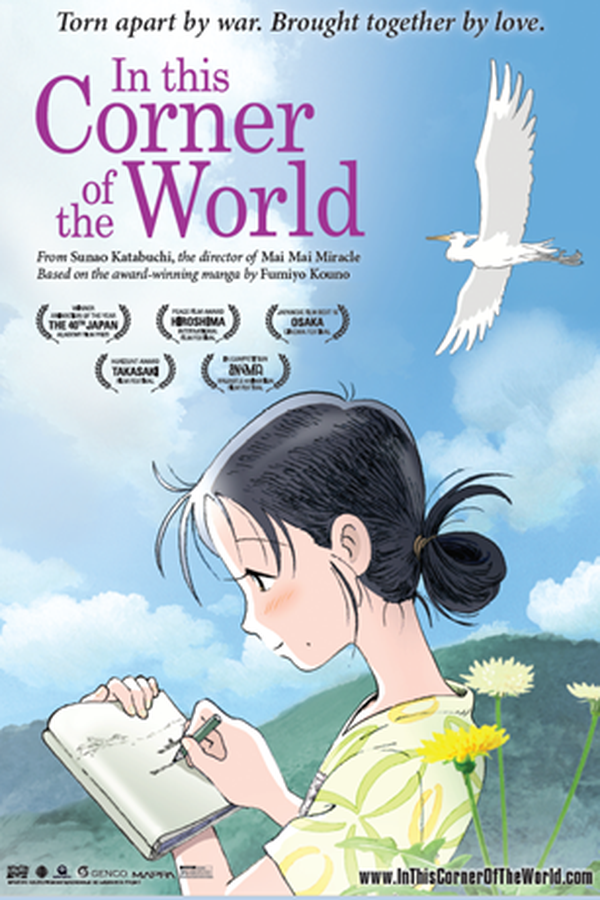
In 1944, Suzu Urano moves to the Kure district of Hiroshima, where she begins a new life. Her peaceful existence is tragically interrupted by the atomic bombing of the city. The animated drama follows Suzu’s experiences as she and her family face the hardships of wartime Japan, demonstrating remarkable strength and finding moments of hope amidst the destruction and loss.
Find where to stream, rent, or buy In This Corner of the World (2017) in the US with current JustWatch availability, up-to-date pricing, and platform listings for subscription, rental, and digital purchase options.
Warning: spoilers below!
Haven’t seen In This Corner of the World yet? This summary contains major spoilers. Bookmark the page, watch the movie, and come back for the full breakdown. If you're ready, scroll on and relive the story!
Trace every key event in In This Corner of the World (2017) with our detailed, chronological timeline. Perfect for unpacking nonlinear stories, spotting hidden connections, and understanding how each scene builds toward the film’s climax. Whether you're revisiting or decoding for the first time, this timeline gives you the full picture.
Last updated: November 16, 2024 at 11:24
Find frequently asked questions about the In This Corner of the World (2017) timeline, including chronological order, nonlinear jumps, cause-and-effect links, and scene sequence clarifications. This timeline FAQ helps explain when key events happen, how moments connect, and why the story unfolds in that specific order.
Tetsu visited Suzu in December 1944 while serving in the Imperial Navy. This was likely his last chance to see her before potentially being deployed, as the war was turning against Japan and military casualties were mounting. His visit was prompted by his longstanding feelings for her, which he had carried since their school days in Eba.
Earlier in the film, Suzu had painted a picture for Tetsu after his brother's death at sea, showing her compassion for his grief.
Suzu rejected Tetsu's confession because she genuinely loved her husband Shusaku. Despite Tetsu declaring his love for her during his visit, Suzu assured him that her heart belonged to her husband. Her decision reflected her commitment to her marriage and her sense of duty, even as wartime pressures created difficult emotional circumstances.
Suzu's marriage to Shusaku in 1943 was portrayed as a loving partnership, not an arranged convenience.
Shusaku stepped aside because he recognized that Tetsu might not return from the war. Rather than stand between them, he gave them space for a private conversation, showing his understanding of both Tetsu's feelings and Suzu's need for closure. This act demonstrated Shusaku's maturity and confidence in his marriage.
Shusaku's character was established as kind and considerate throughout the film.
Suzu lost her right hand during the American air raids on Kure in 1945. The exact details are not fully specified in the summary, but she sustained severe injuries during one of the bombings that resulted in the permanent loss of her right hand, adding to the physical and emotional toll she endured throughout the war.
The air raids on Kure escalated significantly in early 1945, with increasing destruction.
Harumi, Suzu's niece, was killed by a time-delayed bomb explosion. Unlike conventional bombs that detonate immediately upon impact, this bomb had a delayed fuse. Harumi was likely unaware of the danger and was near the unexploded bomb when it eventually detonated, resulting in her tragic death.
The film depicts the fear and unpredictability of delayed-action bombs in wartime Japan.
Suzu was not in Hiroshima on August 6, 1945 because she was in Kure, approximately 15 miles away. On that fateful morning, she was actually at a doctor's appointment in Kure, which is why she survived the atomic bombing. This mundane errand saved her life, though she would later learn of the catastrophic destruction of her hometown.
The film establishes that Suzu lived in Kure, not Hiroshima, though Hiroshima was nearby.
Suzu's mother left their home in Eba (near Hiroshima) to search for supplies during the chaotic period following the bombing. She is presumed to have been killed in the initial blast or its aftermath. Suzu's father later died from illness that may have been caused by radiation exposure. Both parents perished as a direct result of the atomic bombing.
The film establishes that Eba was located near Hiroshima, making Suzu's family vulnerable to the bomb's effects.
Sumi survived because she was staying at their grandmother Ito's family home in rural Kusatsu, which was far enough from Hiroshima to escape the immediate blast and radiation effects of the atomic bomb. Kusatsu was a rural area that remained relatively untouched by the bombing, making it a place of relative safety during the attack.
Grandmother Ito's home in Kusatsu was established as a separate location from the urban areas targeted by the bomb.
Suzu and Shusaku decided to adopt an orphaned girl after the war because they wanted to build a family despite their losses. Having endured the deaths of family members and the destruction of their previous life, they chose hope and renewal by taking in a child who had lost her parents. This act represented their determination to rebuild and find purpose in post-war Japan.
The film emphasizes Suzu's resilience and her gradual recovery of hope after the war's end.
Suzu's painting for Tetsu was a compassionate gesture she made in her youth, depicting the sea that Tetsu gazed upon while mourning his brother who drowned. The painting symbolized her empathy and understanding of his grief. This early act of kindness established the emotional connection between Suzu and Tetsu that persisted throughout their lives.
This painting sets up Tetsu's enduring feelings for Suzu, which he confesses years later.
Suzu found strength through the support of her surviving family and friends, including her sister Sumi and husband Shusaku. After learning of her parents' deaths and Sumi's illness, she initially fell into deep despair. However, the arrival of American food aid, her reunion with Shusaku, and eventually adopting a daughter helped her gradually rebuild her will to live, embodying the film's theme of resilience amid tragedy.
The film's conclusion emphasizes hope and renewal through the adopted daughter learning to sew.
Discover curated groups of movies connected by mood, themes, and story style. Browse collections built around emotion, atmosphere, and narrative focus to easily find films that match what you feel like watching right now.
Stories where ordinary people's lives are irrevocably changed by the horrors of war.If you liked the poignant portrayal of civilian life during wartime in 'In This Corner of the World', discover more movies like it. This collection features similar stories about ordinary people, their resilience, and the quiet tragedies of war that focus on personal survival over battlefield action.
These narratives follow a steady, often linear progression that contrasts peaceful, mundane beginnings with the brutal intrusion of conflict. The plot focuses on adaptation, survival, and the small, human moments that persist even in the face of immense loss and destruction.
Movies in this thread are united by their intimate perspective on historical conflict. They share a melancholic tone, heavy emotional weight, and a focus on the resilience of the human spirit when faced with societal collapse and personal trauma.

Journeys of enduring great sadness yet finding a fragile hope to continue.For viewers who appreciated the bittersweet ending and theme of resilience in 'In This Corner of the World', this list gathers similar movies. These films feature characters who endure heavy emotional trials and find a nuanced, hopeful-but-sad conclusion, blending profound loss with the strength to rebuild.
The emotional journey follows a character through a series of devastating events, building towards an ending that acknowledges the permanence of loss while offering a glimmer of hope—often through human connection, a new beginning, or quiet acceptance. The resolution feels earned, not saccharine.
This thread groups films based on a specific emotional arc: a descent into heavy sadness followed by a complex, non-bleak resolution. They share a high emotional intensity, a straightforward or moderate narrative complexity that focuses on feeling, and a conclusively bittersweet ending feel.
Don't stop at just watching - explore In This Corner of the World in full detail. From the complete plot summary and scene-by-scene timeline to character breakdowns, thematic analysis, and a deep dive into the ending - every page helps you truly understand what In This Corner of the World is all about. Plus, discover what's next after the movie.
Read a complete plot summary of In This Corner of the World, including all key story points, character arcs, and turning points. This in-depth recap is ideal for understanding the narrative structure or reviewing what happened in the movie.
Discover the characters, locations, and core themes that shape In This Corner of the World. Get insights into symbolic elements, setting significance, and deeper narrative meaning - ideal for thematic analysis and movie breakdowns.
Discover movies like In This Corner of the World that share similar genres, themes, and storytelling elements. Whether you’re drawn to the atmosphere, character arcs, or plot structure, these curated recommendations will help you explore more films you’ll love.
In This Corner of the World (2017) Plot Summary & Movie Recap
In This Corner of the World (2017) Scene-by-Scene Movie Timeline
In This Corner of the World (2017) Spoiler-Free Summary & Key Flow
Movies Like In This Corner of the World – Similar Titles You’ll Enjoy
Suzume (2023) Detailed Story Recap
Grave of the Fireflies (1988) (1989) Ending Explained & Film Insights
JAPAN, Our Homeland (2007) Ending Explained & Film Insights
Nagasaki 1945 ~ The Angelus Bells (2005) Spoiler-Packed Plot Recap
Summer with Kuro (1990) Full Summary & Key Details
Hiroshima: Out of the Ashes (1990) Film Overview & Timeline
Grave of the Fireflies (2005) Complete Plot Breakdown
Rhapsody in August (1991) Full Movie Breakdown
Girls in Summer Dresses: Hiroshima, August 6, 1945 (1988) Full Movie Breakdown
Raining Fire (1988) Ending Explained & Film Insights
Natsunagu! (1000) Ending Explained & Film Insights
Tomorrow (1988) Ending Explained & Film Insights
Children of Hiroshima (1952) Story Summary & Characters
Cocoon: Aru Natsu no Shoujo-tachi yori (2025) Film Overview & Timeline
Hiroshima (1953) Ending Explained & Film Insights