Plot Explained Spoilers guaranteed!
Plot Explained

Browse by genre

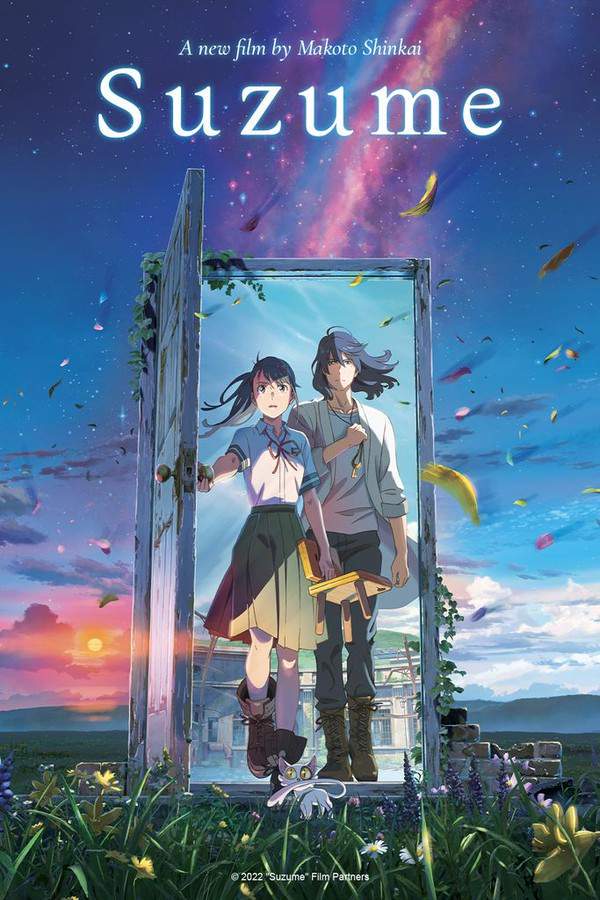
Suzume (2023) movie poster

Plot Summary

Suzume (2023) Plot Summary & Ending Explained

Release, runtime and language
2023 · 122 min · Japanese
Echo score 84
JustWatch #21,940 1
Directed by
Makoto Shinkai
Starring
Shôta Sometani, Kana Hanazawa, Ryûnosuke Kamiki, Sairi Itô, Ann Yamane, Eri Fukatsu
Budget
$13M

In Kyushu, Japan, 17-year-old Suzume lives with her aunt, still grappling with the unresolved mystery of her mother's disappearance. Her quiet life is disrupted by the arrival of Souta, a young man searching for an ancient door. Their journey leads them into the mountains, where Suzume realizes the door holds a dangerous power, unleashing calamities across Japan. They must now embark on a perilous quest to close the doors and prevent further disasters, facing unknown challenges and uncovering secrets along the way.

On this page (7)
  1. 1 Where to watch
  2. 2 What happens: full plot
  3. 3 Plot questions answered
  4. 4 How it ends
  5. 5 Movie threads
  6. 6 Movies like Suzume
  7. 7 Every angle

Where to watch

Where to Watch Suzume (2023)

Where can you watch Suzume? Stream, rent or buy it in the US, including on Crunchyroll, Hulu and Netflix: current JustWatch availability with up-to-date prices.

Streaming availability powered by JustWatch

Full plot summary · contains spoilers

What Happens in Suzume: Full Plot Summary

The whole story of Suzume (2023) explained, from the opening scene to the final frame: every key event, every twist and what it all adds up to. Read it as a quick recap before the sequel, to check a scene you missed, or to finally understand what really happened.

As the film opens, we are taken back by a heartfelt flashback to a serene field where a young Suzume Iwato wanders alone, her voice echoing as she calls out for her mother. This touching moment is brightened by a gentle smile, and as Suzume's tears fade, we shift to her older self who awakens from this poignant dream.

Now a teenager living with her aunt Tamaki Iwato in Kyushu, Suzume's daily life takes an unexpected turn when she encounters Sota Munakata, who ignites a familiar spark within her. While she navigates the trials of high school, the memory of this mysterious stranger lingers in her mind, drawing her further into an intriguing journey.

Driven by her curiosity, Suzume seeks answers at an abandoned onsen resort, where she discovers a door leading to a mesmerizing starry realm known as the Ever-After. Despite her initial inability to enter this magical space, her determination to uncover its mysteries compels her to try further.

Her adventure escalates when she comes across a frozen cat statue, which, upon thawing, transforms into a living feline that quickly vanishes, leaving Suzume pondering the meaning behind this encounter. Suddenly, an earthquake’s tremors break her reverie, and a swirling vortex manifests, revealing chaos only Suzume can see.

In the midst of this turmoil, she finds herself back at the onsen, where Sota battles an entity known as "The Worm." With his mentorship, Suzume aids him in sealing away this malevolent force, which erupts in a deluge of rain as a result.

After the turmoil, Suzume cares for Sota, tending to his injuries while learning that he is a "closer," a protector of the Earth against the Worm's devastating influence. The mysterious cat reappears at her window, its likeable demeanor revealing a surprising connection to Suzume. However, its attention shifts to Sota, and with intense resolve, the cat morphs him into a three-legged chair—a bizarre twist that irrevocably links him to her life.

As the chase for the feline named Daijin intensifies, they end up on a boat, which Daijin hijacks toward the Ehime Ferry. Meanwhile, social media explodes with tales regarding the unusual running chair, dubbed "Daijin," highlighting its crucial role in warding off the Worm. Suzume and Sota soon realize that removing Daijin had unleashed dark forces upon them.

Their quest leads them to meet Chika Amabe, an exuberant young girl who, after a mishap with her oranges, inspires Suzume and Sota to lend a helping hand. In their continued mission, they encounter the Worm once again through another door in Shikoku. Sota explains to Suzume that to close this portal, she must delve into the collective memories of the area’s past inhabitants. Through this journey of empathy, Suzume unlocks those secrets, enabling them to secure the doorway.

After a heartfelt goodbye to Chika, Suzume and Sota remain focused on finding Daijin. They soon wind up at the home of Rumi Ninomiya, a caring woman whose children mistake Sota for a sophisticated toy robot. While Suzume assists Rumi, the pair catch sight of Daijin once more, prompting them to pursue once again.

Their relentless pursuit brings them to a derelict amusement park, where an eerie portal pulsates with energy, necessitating sealing to thwart further chaos. A climactic confrontation at the Ferris wheel results in a desperate attempt to reverse Sota's transformation into a chair, leading to a tumble from their precarious spot, and ultimately, a return to Rumi’s home for respite.

Later, navigating in Tokyo, Sota reveals the ancient legend of Namazu—the formidable Worm that could devastate the city if unleashed. Meanwhile, unexpected news from Tomoya Serizawa about Sota's personal struggles deepens their perilous situation.

As they venture out again, the sight of Daijin looming at the Tokyo gate creates an air of dread. Awareness dawns that the Worm is on the brink of escaping, intensifying their race against time. Daijin reveals he has made Sota the keystone in this impending disaster, intertwining their fates; it becomes clear to Suzume that she must embrace her new role with urgency.

With Sota firmly established as the keystone, Suzume places him upon the Worm, sealing the gateway and sacrificing any chance of altering his destiny. Daijin's sorrow is evident as Suzume bids him farewell, each word laden with emotion.

Following this pivotal juncture, Suzume is drawn to Sota's grandfather, Hitsujiro, in the hospital, where he shares his knowledge of the Worm and its gates, hinting at a deeper connection that may offer hope. Hitsujiro suggests that if Suzume can reach the Ever-After, she might have the means to save Sota.

As she departs, Tamaki, in a frantic search, finally finds her. Joined by Serizawa, they set off to locate Sota, leading to revelations and tensions reflecting on Tamaki’s actions being manipulated by a dark force, Sadaijin, that takes form as a menacing black cat.

Arriving at Tamaki's childhood home—a haunting site steeped in tragedy—Suzume uncovers a doorway leading to the Ever-After, where both Daijin and Sadaijin dwell. With the Worm threatening to break free, Sadaijin takes battle form against this evil, while Suzume discovers Sota ensnared in chair-like confinement.

Ultimately, Daijin embraces his fate as a keystone, enabling Sota to regain his humanity, but only after beseeching Suzume to restore his original position. With Daijin’s sacrifice, the Worm is defeated, and the Ever-After sealed away.

As Suzume gazes upon the horizon, she is transported back to her younger self, now grieving her mother. The older Suzume comforts her, promising brighter days ahead filled with love alongside Sota. She gifts her younger self the cherished chair crafted by her mother’s care.

As they part ways, Sota returns to his duties as a closer, promising to reunite with Suzume. The young woman rediscovers connections with Tamaki, introducing her to Rumi and embracing her academic dreams while cherishing the serendipitous meetings with Chika, reinforcing that Sota's return—bringing closure and joy—will illuminate her journey ahead.
Last updated: November 17, 2024 at 13:44

Was this helpful?

Plot questions answered

Suzume Plot Explained: Your Questions Answered

The questions people ask most about Suzume (2023): what happens in the confusing scenes, why the characters do what they do, the twists, hidden details and what the ending means. Each answer contains spoilers.

Q1

What is the Worm and why is it a threat to Japan

The Worm (Namazu) is an ancient entity that dwells behind the doors to the Ever-After. When the doors open, the Worm can escape and unleash devastating calamities across Japan, including massive earthquakes and natural disasters. The film depicts multiple instances where the Worm's escape causes chaos, making it a constant threat that Sota and Suzume must work to contain by sealing the doors.

Foreshadowing: The opening scenes immediately establish the stakes through Suzume's ability to see the swirling vortex caused by the Worm.

  • worm
  • namazu
  • earthquake
  • disaster
  • calamity
  • threat
  • japan
Q2

What is the Ever-After realm

The Ever-After is a magical starry realm accessible through ancient doors found throughout Japan. It serves as a place where the spirits of the dead reside, and it is closely connected to the Worm. The realm exists between the living world and the afterlife, and its doors must be kept closed to prevent the Worm from escaping into the real world.

Foreshadowing: Suzume first discovers this realm at the abandoned onsen resort, where she sees the mesmerizing starry sky beyond the door.

  • ever-after
  • door
  • starry realm
  • spirit world
  • afterlife
  • magical realm
Q3

What is a closer and what does Sota do

Sota Munakata is a 'closer,' which is a protector tasked with sealing doors that connect to the Ever-After. His role is to prevent the Worm from escaping by closing these portals whenever they open. Closers have the ability to see the Worm and the dimensional disturbances caused by the doors, making them essential to protecting Japan from supernatural disasters.

Foreshadowing: Sota appears at the onsen already trained to fight the Worm, demonstrating his experience as a closer.

  • closer
  • sota munakata
  • protector
  • seal door
  • worm fighter
Q4

Why does Daijin turn Sota into a chair

Daijin transforms Sota into a three-legged chair as part of a deliberate scheme to make him a 'keystone', an object that can be used to permanently seal a door. By transforming Sota, Daijin essentially traps him in a form that can anchor the sealing ritual. This ties directly into the film's climax where Sota must be placed upon the Worm to close the gateway.

Foreshadowing: Daijin shows unusual interest in Sota from their first meeting, hinting at this deeper plan.

  • daijin
  • chair
  • sota transformation
  • keystone
  • cat magic
Q5

What is a keystone and how does it work

A keystone is a special object or being that serves as the anchor for sealing a door to the Ever-After. When placed upon a door or the Worm itself, a keystone permanently locks the gateway shut. In the film's climax, both Sota and later Daijin become keystones, sacrificing their freedom to prevent the Worm from devastating Japan.

Foreshadowing: The mechanics of keystones are explained when Sota reveals the legend of Namazu in Tokyo.

  • keystone
  • seal
  • door
  • anchor
  • ritual
  • closing mechanism
Q6

Why does Suzume have to sacrifice Sota to stop the Worm

At the Tokyo gate, the Worm is about to escape and Suzume realizes the only way to seal it is by using a keystone. She places the chair-formed Sota onto the Worm, effectively using his transformed state to lock the gateway. This forces her to accept that Sota may be lost forever, as the keystone becomes part of the sealed door.

Foreshadowing: Earlier, Sota explains the legend of Namazu and the necessity of keystones, setting up this impossible choice.

  • sacrifice
  • sota
  • seal
  • worm
  • keystone
  • final battle
Q7

What is the difference between Daijin and Sadaijin

Daijin is the white-spotted black cat who causes chaos by opening doors and transforming Sota into a chair. Sadaijin is the pure black cat who acts as Tamaki's manipulator and later becomes an ally to Suzume in the final battle. Both are supernatural beings associated with the Ever-After, but they have opposing roles, one creates the crisis while the other helps resolve it.

Foreshadowing: The two cats have distinct appearances throughout, with Daijin being more playful and Sadaijin appearing more ominous.

  • daijin
  • sadaijin
  • cats
  • tamaki
  • ever-after
  • black cat
Q8

How does Suzume save Sota at the end

After the initial sealing, Suzume travels to the Ever-Through with help from Sota's grandfather Hitsujiro. In the magical realm, she finds Sota trapped in chair form and pleads with Daijin, who had become the keystone. Daijin agrees to take Sota's place as the keystone, allowing Sota to return to human form while Daijin remains permanently sealed.

Foreshadowing: Hitsujiro's explanation about reaching the Ever-After provides the hope for rescue before the final confrontation.

  • save
  • sota
  • ever-after
  • daijin
  • rescue
  • keystone swap
Q9

What is the meaning of the ending scene with younger Suzume

At the film's conclusion, Suzume returns to her childhood memory of grieving for her mother. The older Suzume appears to comfort her younger self, reassuring her that brighter days are coming and that she will find love. This symbolizes Suzume finally processing and healing from her unresolved maternal grief, achieving the emotional closure she needed throughout the film.

Foreshadowing: The film opens with this exact childhood scene, establishing Suzume's core emotional wound.

  • ending
  • childhood
  • mother
  • grief
  • healing
  • emotional closure
  • suzume
Q10

Why can Suzume see the Worm and the doors when others cannot

Suzume possesses a unique ability to perceive the dimensional disturbances caused by opening doors to the Ever-After. This ability manifests as swirling vortexes and the Worm itself visible only to her. This connection stems from her unresolved grief over her mother's disappearance, which seems to have opened her perception to the supernatural world. Her empathy ability to unlock memories of past inhabitants also links to this sensitivity.

Foreshadowing: From her first encounter with Sota, she sees things others cannot, and her dream of her mother establishes this theme early.

  • suzume
  • perception
  • supernatural ability
  • grief
  • see worm
  • door vision
Q11

Why does removing Daijin from the chair cause the Worm to attack

When Suzume and Sota first remove Daijin from the chair, they inadvertently break the magical containment that was preventing the Worm's influence. Daijin, despite causing chaos, was unknowingly serving as a partial seal against the Worm's power. Once removed, the Worm's connection to the living world strengthens, causing increased manifestations and disasters across Japan.

Foreshadowing: Social media buzzes about the 'running chair' warding off the Worm, hinting at this protective function.

  • daijin
  • remove
  • worm attack
  • disaster
  • containment
  • chair function

Ending explained

What Happens at the End of Suzume?

How Suzume (2023) ends, in short: the final scene, the last twist and what it means for the characters. The full ending explained, with every spoiler, lives on its own page.

Read the full ending explained

Suzume’s journey in the film is about confronting her past and accepting her inner child to move forward in life. Throughout her adventure, she encounters memories of her childhood, including the loss of her mother in a tsunami — a traumatic event that she had repressed over the years. When Suzume meets her older self in the Ever-After, she receives the courage to face her pain and acknowledges that her memories of her mother are not lost but kept safe by her future self. She encourages her younger self to embrace her future and push through her darkness, trusting that she will find her loved ones and create a better life.

The climax of the story involves Suzume and her friends racing to seal the enormous worm, a spirit of natural disasters that threatens to cause catastrophic earthquakes across Japan. Souta, who had been struggling with his destiny, accepts that he must become a keystone—a vessel for sealing the worm. In a heartfelt sacrifice, Souta transforms into the keystone alongside Suzume, and she mourns him as she pierces the worm, causing it to explode into a shower of vibrant colors. This act ultimately saves Japan from disaster but leaves Suzume devastated, as she has lost her friend and love in the process.

Continue reading the ending (2 more paragraphs)

After the sealing, Suzume journeys to her hometown, where she finds the door to the Ever-After — the spiritual realm where souls find their rest. She enters to find her mother and reconnect with her past, guided by the presence of her older self, who had given her the strength to carry on. She also encounters Sadaijin and Daijin, two keystones symbolizing the divine forces involved in sealing the worm, with Daijin sacrificing itself and helping to recover Souta’s human form. Although Daijin was wounded and sad after being hurt by Suzume, it still showed loyalty and genuine care, ultimately helping the others to complete their mission.

The story emphasizes themes of healing, acceptance, and the importance of confronting one’s inner traumas to find peace. Suzume’s journey highlights that facing the darkness within can lead to resolution and renewal, not just for herself but for everyone around her. Overall, the ending suggests that through courage, sacrifice, and acceptance, even the deepest wounds can be healed, and new beginnings can emerge from the shadows of the past.

Suzume ending explained in full

Movie threads

More Movies Like Suzume, by Mood & Story

Curated lists built around what makes Suzume tick: the same mood, the same kind of story or the same emotional payoff. Each list explains why these movies belong together.

Magical healing journeys like Suzume

High-stakes quests where personal grief and magical calamity collide. Explore movies like Suzume where a high-stakes magical quest is intertwined with a deeply personal story of loss and healing. These films combine epic fantasy action with a heavy emotional core, often featuring melancholic yet hopeful tones and bittersweet victories.

  • epic
  • anxious
  • uplifting
  • melancholic
  • urgent
  • cathartic
  • Tone: hopeful, melancholic
  • Pacing: fast, urgent
Why these movies?

The story pattern: Stories in this thread begin with a rupture in the natural or magical order, forcing a protagonist on a desperate journey. This external crisis mirrors an internal wound, such as grief or trauma. As they travel to seal the magical threat, they must also confront and heal their personal pain, leading to a resolution that saves the world but often involves a poignant personal cost.

Why they belong together: These films are grouped by their powerful blend of high-intensity magical action and heavy emotional themes. They share a specific narrative rhythm: a fast-paced chase against disaster, driven by a character's need for emotional closure, ultimately resulting in a cathartic, hopeful-but-bittersweet conclusion.

Movies with melancholic whimsy like Suzume

Stories that balance dark themes with a visually charming and hopeful spirit. Find films similar to Suzume that masterfully balance melancholic themes with whimsical charm. If you liked the mix of earthquake disaster and child grief with magical cats and a sentient chair, you'll enjoy these stories that find light in the darkness.

  • whimsical
  • melancholic
  • dreamlike
  • anxious
  • uplifting
  • nostalgic
  • Tone: bittersweet, whimsical, hopeful
  • Pacing: variable, energetic
Why these movies?

The story pattern: These narratives often feature a protagonist coping with a significant loss or trauma. The world around them is infused with magical or whimsical elements that soften the harsh reality, creating a dreamlike atmosphere. The central conflict involves confronting a large-scale threat or personal demon, but the journey is punctuated by moments of lightness, quirky humor, and visual beauty, leading to a resolution that affirms connection and hope.

Why they belong together: They are grouped by their distinctive, almost contradictory tone: a sincere engagement with melancholy and anxiety, presented through a framework that is visually inventive, charming, and fundamentally optimistic. This creates a specific, emotionally complex viewing experience that is both heavy and uplifting.

If you liked this

Movies Like Suzume

Similar movies to Suzume: the same genre, themes or kind of story. Each one comes with its own plot summary, timeline and ending explained.

Browse all movie summaries

Every angle

Suzume (2023) Explained: Plot, Ending, Timeline & Characters

Everything about Suzume in one place: what happens in the plot summary, the timeline in chronological order, the characters and meaning, the ending explained and a spoiler-free summary. What's After the Movie adds the cast, box office and post-credit scenes.

Coming soon on iOS and Android

The Plot Explained Movie Summary App

Plot summaries, endings explained and timelines on your phone. Catch up on any movie in minutes, save your favorites and never miss a twist again.

Be the first to know when we launch. Your email stays private, always.

Learn more about the app