Plot Explained Spoilers guaranteed!
Plot Explained

Browse by genre

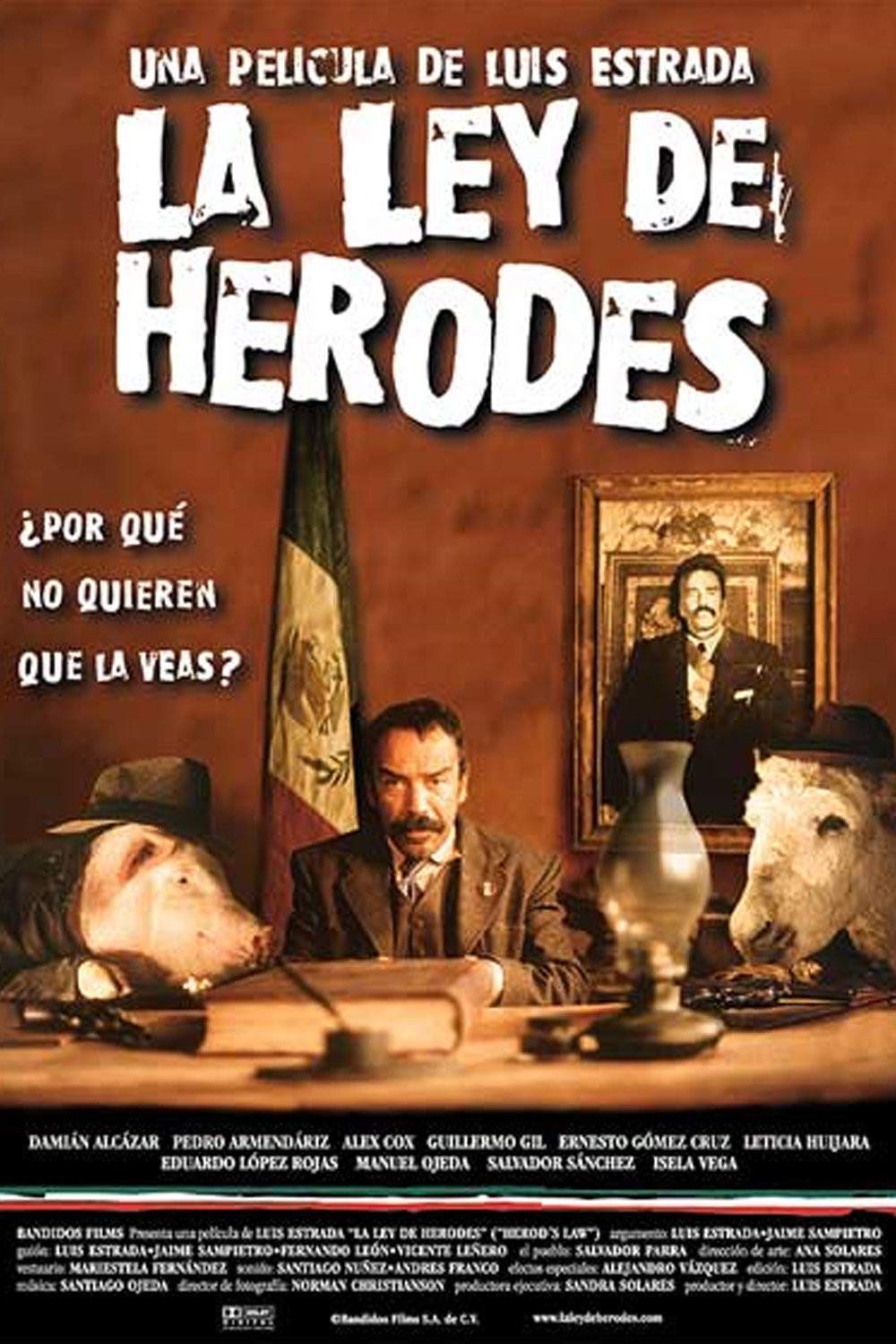
Herod’s Law (1999) movie poster

Characters & Themes

Herod’s Law (1999) Characters, Setting & Themes Explained

Release, runtime and language
1999 · 123 mins · Spanish
Directed by
Luis Estrada
Starring
Alex Cox, Isela Vega, Jesús Ochoa, Damián Alcázar, Maya Zapata, José Manuel Poncelis

In a remote Mexican town during the 1940s, the last three mayors have been murdered in quick succession. A simple janitor is installed as the new mayor, hoping to bring modernization and peace. However, the entrenched system soon corrupts him; he begins to abuse his authority, surrounding himself with opportunists, hypocrites and criminals.

On this page (7)
  1. 1 Characters explained (12)
  2. 2 Where & when it takes place
  3. 3 Themes & meaning (4)
  4. 4 Character & meaning questions
  5. 5 Movie threads
  6. 6 Movies like Herod’s Law
  7. 7 Every angle

12 main characters · contains spoilers

Herod’s Law Characters Explained: Who Is Who

The main characters of Herod’s Law (1999), heroes and villains: what drives them, how they change over the course of the story and what each of them reveals about the film's bigger ideas.

  • Juan Vargas (Damián Alcázar)

    A naïve head of a landfill who ascends to political power and progressively embraces corruption. He learns to manipulate the system, impose heavy fines, and extract wealth, all while maintaining the veneer of legitimacy. His moral decline and reliance on fear and coercion drive the town’s transformation.

    • 🗡️ Anti-hero
    • 💼 Politician
    • 💸 Corruption
  • Doña Lupe (Isela Vega)

    The town brothel madam who leverages money and influence to shape Vargas’s decisions. She tests his resolve with bribes and threats, and becomes a catalyst for his early crimes. Her continued presence reveals the town’s tolerance of exploitation under corrupt rule.

    • 🧭 Power broker
    • 💄 Prostitute
    • 💵 Exploitation
  • Gloria (Leticia Huijara)

    Vargas's wife, who is initially supportive but grows disillusioned as his corruption deepens. She ultimately elopes with the American, taking the money with her, signaling the collapse of their partnership.

    • 💑 Spouse
    • 🎭 Betrayal
    • 💸 Wealth
  • López (Pedro Armendáriz Jr.)

    The governor's subordinate who assigns Vargas the interim presidency, enabling his rise. He later flees after plotting a failed political assassination, illustrating the collateral damage within the power structure.

    • 🏛️ Authority
    • 🕵️‍♂️ Scheming
    • 🧭 Political intrigue
  • Ramírez (Juan Carlos Colombo)

    A pragmatic official who suggests Vargas for the role and navigates the shifting political terrain as the landfill administrator later on. He embodies bureaucratic opportunism fueling the town’s rot.

    • 🧭 Bureaucracy
    • 🗺️ Opportunism
    • 🪙 Corruption
  • Filemón (Jos Manuel Poncelis)

    played by José Manuel Poncelis

    The town drunk who becomes a pawn and is killed to conceal Vargas’s crimes. His death underscores how the vulnerable are exploited and discarded by those in power.

    • 🍶 Vulnerable
    • 🗡️ Victim
    • 🎭 Crime
  • Doctor Morales (Eduardo López Rojas)

    An educated town figure linked to the opposition who Vargas frames as a conspirator. He is exiled as part of Vargas’s attempts to erase accountability.

    • 🏥 Intellectual
    • 🧠 Oppression
    • 🏛️ Framing
  • Pek (Salvador Sánchez)

    Vargas’s secretary who denounces him as the worst municipal president. His defiance helps surface the town’s discontent and challenges Vargas’s legitimacy.

    • 🗣️ Whistleblower
    • 🧭 Moral compass
    • 🏙️ Local politics
  • Tiburón (Jorge Zárate)

    Doña Lupe’s enforcer who Vargas kills during a confrontation, marking a turning point in his consolidation of power.

    • 🗡️ Enforcer
    • 💀 Violence
  • Gobernador Sánchez (Ernesto Gómez Cruz)

    The state governor who orders a replacement to secure party control around elections, embodying the political machine behind Vargas’s ascent.

    • 🏛️ Government
    • 🗳️ Political machine
    • 🧭 Authority
  • Nuevo Alcalde (Jesús Ochoa)

    The interim mayor chosen to fill the vacancy, illustrating the recurring pattern of power turnover in corrupt local governance.

    • 🏢 Mayor
    • 🧭 Transition
    • 🔗 Political lineage
  • Alcalde Alfredo García (Luis de Icaza)

    A newly appointed mayor arriving to San Pedro, continuing the cycle of political control that mirrors Vargas’s own arrival.

    • 🏙️ Mayor
    • 🔗 Continuity
    • 🧭 Political cycle

Last updated: October 05, 2025 at 08:30

Was this helpful?

Setting

Where and When Does Herod’s Law Take Place?

The setting of Herod’s Law (1999): the year and time period, the places and locations, and how they shape the characters, the mood and the tension of the story.

Time period

1952

The events unfold around the 1952 general elections in Mexico, during a period of PRI dominance. The rural town acts as a microcosm of national political manipulation and state control. The era underscores the cycle of power, corruption, and political theater that defines the story.

Location

San Pedro de los Saguaros, Mexico

San Pedro de los Saguaros is a remote Mexican town depicted as impoverished, where illiterate peasants mingle with a corrupt local elite. The setting highlights the social gulf between the townsfolk and the political machine that rules them. The town is notable for Doña Lupe's brothel, the poor infrastructure, and the tense atmosphere leading up to the elections.

  • 🏚️ Impoverished town
  • 🗳️ Political setting
  • 🧭 Social critique

Last updated: October 05, 2025 at 08:30

Was this helpful?

4 major themes

Herod’s Law Meaning: Themes & Message Explained

What is Herod’s Law (1999) really about? The emotional, social and philosophical themes the film keeps returning to, its symbolism and the message beneath the surface.

  • Power and Corruption

    Juan Vargas begins as a naive official but quickly embraces power, exploiting legal tools and fines to enrich himself. His ascent demonstrates how political authority can be corrupted by personal greed within a flawed system. The narrative traces his descent into brutal actions and the hollowness of his supposed justice.

  • Class Divide

    The town's illiterate peasants and marginalized residents are central to the conflict, exposed to exploitation by elites and opportunists alike. Doña Lupe's brothel and the town’s power brokers symbolize a rigid social hierarchy that Vargas manipulates. The contrast between wealth and poverty fuels fear, coercion, and the erosion of trust.

  • Law and Power

    Vargas learns to weaponize the constitution and bureaucratic mechanisms to justify harsher taxes and penalties. The legal framework becomes a tool for personal gain, blurring the line between legality and crime. The town's governance relies on manipulated laws to extract wealth and control the populace.

  • Descent into Violence

    As power corrupts, Vargas becomes increasingly ruthless, killing Doña Lupe's enforcer Tiburón and the town drunk Filemón to cover up crimes. The violence escalates as fear and pride clash within the community, culminating in a mob confrontation. The ending underscores the cycle of violence that accompanies corrupt leadership.

Last updated: October 05, 2025 at 08:30

Was this helpful?

Character & theme questions

Herod’s Law Characters & Meaning: Your Questions Answered

The questions people ask about Herod’s Law (1999): who the characters really are, their relationships, what the symbols mean, where it takes place and what the movie is really about. Each answer contains spoilers.

Q1

Where is Herod's Law set?

The film takes place in San Pedro de los Saguaros, a remote and impoverished Mexican town where illiterate peasants live alongside a corrupt local elite. The setting emphasizes the social divide between the townsfolk and the political machine that controls them.

  • san pedro de los saguaros
  • setting
  • mexican town
  • location
Q2

When does the story take place?

The events unfold around the 1952 general elections in Mexico, during the period of PRI dominance. The era reflects the cycle of power, corruption, and political theater that defines the narrative.

  • 1952
  • mexican elections
  • time period
  • 1940s
  • 1950s
Q3

What is the main theme of Herod's Law?

The film explores power and corruption as Juan Vargas transforms from a naive landfill worker into a ruthless leader who exploits legal tools and fines for personal gain. His descent demonstrates how political authority can be corrupted by personal greed within a flawed system.

  • power
  • corruption
  • political corruption
  • theme
Q4

How does the movie address class divide?

The class divide is central to the conflict, showing how illiterate peasants and marginalized residents are exploited by elites and opportunists. Doña Lupe's brothel and the town's power brokers symbolize a rigid social hierarchy that Vargas manipulates to his advantage.

  • class divide
  • social hierarchy
  • poverty
  • exploitation
Q5

How does the film portray law and power?

Vargas learns to weaponize the constitution and bureaucratic mechanisms to justify harsher taxes and penalties. The legal framework becomes a tool for personal gain, blurring the line between legality and crime as the town's governance relies on manipulated laws to extract wealth and control the populace.

  • law
  • constitution
  • bureaucracy
  • legal system
Q6

Who is Juan Vargas?

Juan Vargas is the protagonist, a naive head of a landfill who ascends to political power as mayor of San Pedro de los Saguaros. He initially hopes to bring modernization and peace but quickly embraces corruption, exploiting his authority to enrich himself while maintaining a veneer of legitimacy.

  • juan vargas
  • protagonist
  • mayor
  • protagonist
Q7

Who is Doña Lupe in the story?

Doña Lupe is the town brothel madam who wields significant money and influence over local politics. She tests Vargas's resolve with bribes and threats and becomes a catalyst for his early crimes, revealing the town's tolerance of exploitation under corrupt rule.

  • doña lupe
  • brothel madam
  • character
Q8

How does violence escalate in the film?

As Vargas's corruption deepens, he becomes increasingly ruthless, killing Tiburón (Doña Lupe's enforcer) and later the town drunk Filemón to cover up crimes. The violence escalates as fear and pride clash within the community, culminating in a mob confrontation that underscores the cycle of violence accompanying corrupt leadership.

  • violence
  • tiburón
  • filemón
  • murder
  • escalation
Q9

What is the political context of the movie?

The film is set during the 1952 Mexican general elections under PRI dominance. The rural town serves as a microcosm of national political manipulation and state control, illustrating how the party machinery maintains power through local proxies.

  • pri
  • mexican politics
  • elections
  • political machine
Q10

Who is Pek and what is his role?

Pek is Vargas's secretary who eventually denounces him as the worst municipal president. His defiance surfaces the town's discontent and challenges Vargas's legitimacy, representing the rare voice of conscience within the corrupt system.

  • pek
  • secretary
  • denouncement
  • character
Q11

What is the movie's message about corruption?

Herod's Law presents a cynical thesis that power inherently corrupts. The narrative traces Vargas's moral decline from hope to tyranny, showing how the political system transforms well-intentioned officials into brutal autocrats. The ending, where Vargas is rewarded with higher office, completes the cycle of corruption.

  • corruption cycle
  • political system
  • moral decline
  • ending

Movie threads

More Movies Like Herod’s Law, by Mood & Story

Curated lists built around what makes Herod’s Law tick: the same mood, the same kind of story or the same emotional payoff. Each list explains why these movies belong together.

Movies about political corruption like Herod’s Law

Stories where well-intentioned protagonists are destroyed by the system they join. If you liked the moral descent in Herod’s Law, explore more movies like it. These films feature characters navigating corrupt systems, often becoming part of the problem themselves. They share a dark, cynical tone and a heavy emotional weight, perfect for viewers interested in gritty political dramas.

  • cynical
  • corrosive
  • desperate
  • gritty
  • sinister
  • satirical
  • Tone: dark, cynical
  • Pacing: steady, grim progression
Why these movies?

The story pattern: The narrative typically follows an idealistic outsider entering a corrupt system. Through a series of moral compromises, often justified as necessary for survival or progress, the protagonist steadily abandons their principles. The arc is a tragic transformation, where the hero becomes the villain, revealing the systemic nature of the corruption.

Why they belong together: These films are grouped by their shared focus on the theme of moral decay within systems of power. They create a cohesive experience through a dark tone, steady pacing that allows the corruption to feel inevitable, and a heavy emotional weight that leaves viewers contemplating the ease of ethical compromise.

Dark satirical movies similar to Herod’s Law

Dark comedies that use grim humor to expose systemic absurdity and hypocrisy. Fans of the cynical satire in Herod’s Law will appreciate these similar movies. They use dark comedy to critique power and hypocrisy, blending drama with a caustic, witty tone. These stories are for viewers who enjoy morally complex narratives where the laughter is laced with bitterness.

  • satirical
  • caustic
  • cynical
  • absurd
  • gritty
  • uncomfortable
  • Tone: dark, satirical, caustic
  • Pacing: steady, character-driven
Why these movies?

The story pattern: The narrative often unfolds within a confined setting, like a small town or institution, where ridiculous rules and blatant hypocrisy are presented as normal. Characters navigate this absurd world, and the comedy arises from the stark contrast between noble ideals and corrupt realities. The plot serves as a vehicle for social critique.

Why they belong together: These films are united by their specific blend of tone: a dark, caustic sensibility where humor underscores tragedy. The pacing is often steady, allowing the satire to build, and the emotional impact is heavy despite the comedic elements. They share a cynical mood and a focus on themes like hypocrisy and greed.

If you liked this

Movies Like Herod’s Law

Similar movies to Herod’s Law: the same genre, themes or kind of story. Each one comes with its own plot summary, timeline and ending explained.

Browse all movie summaries

Every angle

Herod’s Law (1999) Explained: Plot, Timeline & Characters

Everything about Herod’s Law in one place: what happens in the plot summary, the timeline in chronological order, the characters and meaning and a spoiler-free summary. What's After the Movie adds the cast, box office and post-credit scenes.

Coming soon on iOS and Android

The Plot Explained Movie Summary App

Plot summaries, endings explained and timelines on your phone. Catch up on any movie in minutes, save your favorites and never miss a twist again.

Be the first to know when we launch. Your email stays private, always.

Learn more about the app