


Plot Explained Spoilers guaranteed!
Plot Explained

Browse by genre

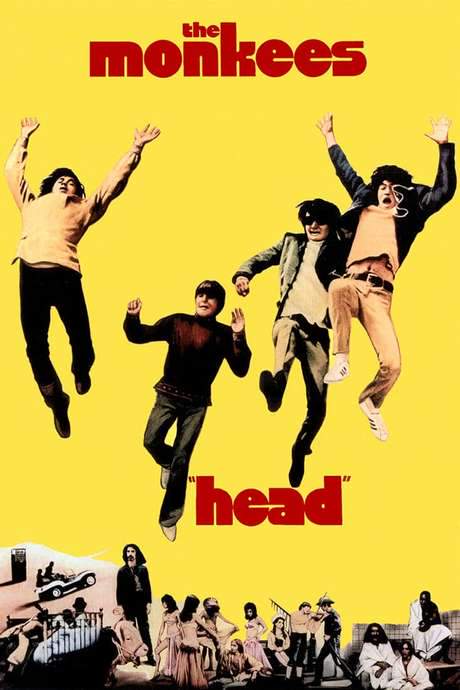
Head (1968) movie poster

Timeline

Head (1968) Timeline Explained – Every Event in Order

Release, runtime and language
1968 · 86 mins · English
JustWatch #18,463 10
Starring
Jack Nicholson, Charles Macaulay, Helena Kallianiotes, Bob Rafelson, Teri Garr, Dennis Hopper

Following the Monkees in a surreal, free‑form sequel to their TV series, the band wanders through a string of musical set pieces and quirky vignettes. Guided only by John Brockman’s therapist, the sequences blend humor with anti‑establishment commentary, creating a whimsical, off‑beat portrait of pop‑culture rebellion.

On this page (6)
  1. 1 Where to watch
  2. 2 Events in order (15)
  3. 3 Timeline questions answered
  4. 4 Movie threads
  5. 5 Movies like Head
  6. 6 Every angle

Where to watch

Where to Watch Head (1968)

Where can you watch Head? Stream, rent or buy it in the US, including on fuboTV: current JustWatch availability with up-to-date prices.

Streaming availability powered by JustWatch

15 events in order · contains spoilers

Head Timeline: Events in Chronological Order

Every key event of Head (1968) in order, scene by scene, with when and where it takes place. Use it to untangle flashbacks, time jumps and parallel storylines, to refresh your memory before the sequel or to find the exact scene you are thinking of.

  1. Groupie kiss reveals indistinguishability

    The Monkees share a kiss with the same groupie, who then reveals they may be indistinguishable from one another. The moment seeds doubt about their own identities and roles within the manufactured pop machine. It sets up the film's ongoing meta-question: who are these four men, really?

    When
    Before the bridge dedication
    Where
    Backstage area
  2. Entering the mystery vignette and questioning reality

    The men enter a noir-styled mystery world as part of the film's mosaic of genres. They try to act natural and solve clues, but the set and story press back against them. The scene underscores their struggle with being both real people and scripted characters.

    When
    During the mystery vignette
    Where
    Mysterious town set
  3. War movie segment tests their agency

    In a battlefield scenario, the action feels staged and their choices are constrained by the script. They attempt to improvise, only to be guided by the director's invisible hand. The sequence highlights the tension between free action and predetermined lines.

    When
    During the war vignette
    Where
    War-torn set
  4. Western detour challenges autonomy

    A Western-style shootout and frontier oddities push the Monkees to act as if they control their fate. Yet quick cuts and the audience's gaze remind them they're in a movie's machinery. They struggle to assert individuality within a painted world.

    When
    During the western vignette
    Where
    Old West town set
  5. Desert adventure wears them down

    In a desert voyage, they improvise to escape the mirage of control. The sand and heat amplify their sense of entrapment inside a manufactured saga. They search for a sign of true choice, only to be redirected by the camera's purpose.

    When
    During the desert vignette
    Where
    Desert set
  6. Confronting the filmmakers on set

    The Monkees voice their complaints to producers Jack Nicholson and Bob Rafelson, who are on the set but not part of the film. They push back against the perceived limits of the director's authority. The moment blurs the line between within-film action and real-world control.

    When
    Between vignettes
    Where
    Film set
  7. Smashing through painted walls

    The quartet deliberately smashes through the painted paper walls that separate the fake movie world from reality. The breach is both a literal escape attempt and a metaphor for breaking the script's boundaries. The chaos signals their growing insistence on authentic agency.

    When
    During a breach of the set
    Where
    Studio backlot
  8. Walking off the set into the street

    They step off the set and walk into the street, drawing the ire of actors, crew, and onlookers. The action amplifies the sense that nothing in the film can confine them. Yet every move seems watched by an unseen director's eye.

    When
    After escaping the set
    Where
    Street outside the studio
  9. Attacking other actors for no reason

    In a moment of chaos, they physically attack other actors for no clear motive. The scene underscores how their attempts at autonomy spiral into disruptive, dangerous behavior. It also intensifies the pursuit by those who are offended or frightened.

    When
    During chaotic pursuit
    Where
    Studio stage/filming area
  10. Chased by everyone they've disrupted

    From every vignette's fallout, crowds and crew close in, forcing the Monkees to flee. The pursuit becomes a literal chase through the film's messy, meta landscape. They realize the price of attempting to break free is ongoing surveillance and pursuit.

    When
    Mid chase
    Where
    Studio grounds; across various sets
  11. Approaching the bridge and shoving through crowds

    The Monkees reach a bridge, shoving others out of the way as they rush forward. The structure becomes a symbol of crossing from one world to another—yet the crowd's reaction reveals the fragility of their rebel act. Tension peaks as they approach escape.

    When
    Final chase scene
    Where
    Bridge
  12. Realization that words are scripted

    Under mounting pressure, they realize every word and deed was predetermined by the movie's script and the director's control. The intrusion of the script erodes any sense of genuine freedom they believed they had. The meta-awareness marks a turning point toward the film's ultimate reveal.

    When
    Climax before the leap
    Where
    On/around the bridge and on the road
  13. They jump off the bridge

    In a desperate act, they leap from the bridge and plummet into the water far below. The moment looks like a final escape but is framed as another scripted beat. The fall underscores the tragedy of their attempted emancipation from the film's machinery.

    When
    Climax
    Where
    Bridge over water
  14. Director hauls their bodies away in a giant aquarium

    The director pulls the soaked bodies away in a huge aquarium, converting the tableau into a portable prop. The image emphasizes the film’s cynical metafiction, reclaiming them as assets for future projects. The men are left silent, staring through the glass into nothingness.

    When
    After the dive
    Where
    Studio set; aquarium trailer
  15. Aquarium rolled into the studio warehouse for reuse

    The aquarium is wheeled into a slot at the studio warehouse, as if the Monkees can be used again whenever the director chooses. This ending cements the film’s bleak meditation on puppetry and control. The audience is left with a chilling sense that the Monkees’ identities exist only as long as a director desires.

    When
    Final shot
    Where
    Studio warehouse

Last updated: October 09, 2025 at 12:38

Was this helpful?

Timeline questions answered

Head Timeline Explained: Your Questions Answered

When does it happen, and why in that order? The questions people ask about the chronology of Head (1968): time jumps, flashbacks, cause and effect between scenes and the correct order of events, each answered with spoilers.

Q1

Why do the Monkees jump off the bridge in Head?

The Monkees jump off the bridge as a desperate attempt to escape the director's control and the manufactured reality of the film. After realizing every word and action has been scripted, they see suicide as the ultimate way to break free from the narrative's grip. However, the film reveals this too was scripted, their death is just another scene, and they are pulled from the water and stored in an aquarium like used props.

Foreshadowing: Earlier scenes show the Monkees repeatedly trying to break free by improvising lines, smashing through painted walls, and walking off set, all of which fail to escape the director's influence.

  • monkees bridge jump
  • suicide scene
  • escape attempt
  • film meta commentary
Q2

What does the aquarium ending mean in Head?

The aquarium ending represents the Monkees being reduced to reusable props within the Hollywood system. After their dramatic bridge jump, the director retrieves their bodies and places them in a glass container, then wheels them into a studio warehouse where they can be pulled out and used again for future projects. This chilling image symbolizes how creative entities are commodified and controlled by those in power.

Foreshadowing: The groupie scene early on establishes that the Monkees may be indistinguishable from one another, hinting at their lack of individual identity within the manufactured system.

  • aquarium ending
  • hollywood metaphor
  • prop storage
  • puppet imagery
  • studio warehouse
Q3

Why can't the Monkees escape the director's control in Head?

The Monkees cannot escape because the director and script control every aspect of their existence within the film, even their attempts at rebellion and escape are predetermined. When they try to improvise, break the fourth wall, or physically leave the set, the script accommodates these actions as part of the narrative. Their freedom is an illusion; the director's authority extends to every choice they believe they're making.

Foreshadowing: The mystery vignette shows the Monkees attempting to solve clues naturally, but the set itself pushes back against their efforts, establishing that the environment is designed to contain them.

  • director control
  • script authority
  • lack of free will
  • hollywood control
  • meta film
Q4

What is the significance of the groupie scene at the beginning of Head?

The opening groupie scene establishes the film's central theme of identity and individuality. After kissing all four Monkees, the groupie remarks they are indistinguishable from one another, this plants the seed that the band members lack distinct personalities and are interchangeable parts of a manufactured pop machine. This moment sets up the Monkees' later struggle to prove they have genuine identity and choice beyond their scripted roles.

Foreshadowing: This scene directly parallels the final image of the Monkees being stored in the aquarium as identical, interchangeable props.

  • groupie scene
  • identity
  • indistinguishable
  • manufactured band
  • pop machine
Q5

Why do the Monkees attack other actors in Head?

The Monkees attack other actors without clear motive during the chaotic pursuit as a manifestation of their frustration with being trapped in the film. Having realized they cannot exercise genuine agency, their attempts at autonomy devolve into violent, aimless behavior. This scene underscores how their desperation to assert freedom transforms into destructive action, and it intensifies the chase against them.

Foreshadowing: Earlier moments of trying to improvise lines and break the script have already shown their growing frustration with constrained choices.

  • monkees violence
  • attack scene
  • frustration
  • loss of control
  • chaotic pursuit
Q6

What is the movie Head about?

Head is a surreal, meta-commentary film featuring The Monkees as fictionalized versions of themselves who gradually realize they are trapped within a controlled cinematic reality. The film follows their increasingly desperate attempts to exercise genuine choice, flirting with the script, confronting producers, breaking through set walls, but ultimately reveals that even their rebellions are scripted. The film uses humor and musical numbers to mask a dark exploration of creativity, consent, and the performative nature of Hollywood.

Foreshadowing: The chaotic opening at the bridge dedication signals from the start that this will be a collage of surreal moments rather than a conventional narrative.

  • head 1968 meaning
  • movie about
  • monkees film analysis
  • meta commentary
  • hollywood satire
Q7

Why does Head include so many different movie genres?

Head incorporates multiple genres, mystery, war movie, western, desert adventure, because the film is deliberately structured as a kaleidoscopic procession that mirrors the Monkees' TV show format while subverting it. Each vignette becomes another test of whether the Monkees can exercise real agency within different narrative constraints. The genre-hopping also emphasizes how thoroughly they are trapped within manufactured entertainment, forced to perform whatever role the script demands.

Foreshadowing: The opening dedication scene sets up this collage structure by bursting into chaotic musical mayhem, establishing the film's rejection of linear storytelling.

  • genre segments
  • movie genres
  • vignettes
  • collage structure
  • experimental film
Q8

What is Jack Nicholson's role in Head?

Jack Nicholson appears as a producer on set who the Monkees directly confront about their lack of creative control. Though Nicholson is present at the filming location, he is notably not part of the actual film, a meta-detail that underscores the layers of Hollywood authority controlling the Monkees. Their complaint to Nicholson and Bob Rafelson represents one of several moments where the characters attempt to break free by addressing the filmmakers directly.

Foreshadowing: This confrontation foreshadows the eventual revelation that the director controls every aspect of their existence, including their complaints.

  • jack nicholson cameo
  • bob rafelson
  • producer
  • on set
  • confrontation scene
Q9

Why do the Monkees break the fourth wall in Head?

The Monkees break the fourth wall repeatedly, pointing out they're actors, addressing the camera, complaining to producers, to dramatize their struggle for autonomy within the manufactured reality of the film. These moments of meta-awareness are the band's primary method of testing whether they can exercise genuine choice outside their scripted roles. Each break exposes the illusion of freedom and reinforces the film's theme that true escape from control is impossible.

Foreshadowing: The early scene where they flub their TV show lines establishes their pattern of attempting to deviate from the script.

  • fourth wall
  • breaking
  • meta
  • actor awareness
  • self aware
Q10

Is the bridge scene in Head meant to represent suicide?

The bridge scene functions as a suicide metaphor, though it's deliberately ambiguous. The Monkees leap from the bridge in what appears to be a desperate act of liberation from the director's control, the ultimate break from manipulation. However, the film immediately reveals this dramatic gesture was itself scripted, making the suicide attempt both a literal act within the story and a commentary on how even the most extreme attempts at freedom are co-opted by the system.

Foreshadowing: Their earlier actions, smashing through walls, walking off set, build toward increasingly drastic measures of escape, culminating in this apparent self-destruction.

  • suicide metaphor
  • bridge jump
  • death scene
  • desperate escape
  • liberation
Q11

What is the meaning of the Monkees smashing through painted walls in Head?

When the Monkees deliberately smash through the painted paper walls separating the fake movie world from reality, it represents their literal and symbolic attempt to break free from the film's manufactured constraints. The walls are both set decorations (artificial) and boundaries (limiting), so destroying them symbolizes rejecting the脚本's control. However, as with all their escape attempts, this breakthrough is ultimately absorbed back into the narrative.

Foreshadowing: This scene occurs after the Monkees have already questioned their reality during the mystery and war vignettes, showing their frustration escalating.

  • painted walls
  • set breaking
  • escape attempt
  • boundary crossing
  • artificial reality

Movie threads

More Movies Like Head, by Mood & Story

Curated lists built around what makes Head tick: the same mood, the same kind of story or the same emotional payoff. Each list explains why these movies belong together.

Surreal and meta-narrative movies like Head

Movies that blend reality and fiction in a playful, chaotic, and self-referential structure. If you liked the chaotic, self-referential structure of Head, explore more movies that deconstruct storytelling. These films share a playful, surreal approach to narrative, blending reality and performance in ways that challenge the viewer. Discover similar meta-commentaries on art and identity.

  • metafictional
  • surreal
  • playful
  • anxious
  • dreamlike
  • satirical
  • Tone: whimsical, satirical
  • Pacing: fast, chaotic
Why these movies?

The story pattern: The narrative is non-linear and often presented as a series of vignettes or set pieces. The central conflict revolves around questioning reality, performance, and authorship, with characters frequently aware they are in a story.

Why they belong together: These films are grouped by their shared experimental structure and thematic focus on deconstructing narrative itself. They create a specific viewing experience defined by intellectual playfulness, visual chaos, and a persistent, underlying commentary on the nature of art.

Movies about the anxiety of celebrity like Head

Stories exploring the existential dread and loss of identity faced by public figures. For viewers who appreciated Head's portrayal of the Monkees as trapped performers, this section collects films with similar themes. Find stories that explore the dark side of fame, the loss of autonomy, and the surreal pressure of living under public scrutiny.

  • trapped
  • anxious
  • existential
  • rebellious
  • satirical
  • claustrophobic
  • Tone: bleak, whimsical
  • Pacing: variable, reflective
Why these movies?

The story pattern: Characters journey through a world they no longer control, facing the absurdity and constraints of their manufactured identity. The story often escalates into a surreal critique of the media machine, culminating in a feeling of inescapable entrapment.

Why they belong together: They share a central theme of existential entrapment within a public role, often using surreal or satirical elements to highlight the dissonance between the public image and the private self. The tone balances playful presentation with a bleak underlying message.

If you liked this

Movies Like Head

Similar movies to Head: the same genre, themes or kind of story. Each one comes with its own plot summary, timeline and ending explained.

Browse all movie summaries

Every angle

Head (1968) Explained: Plot, Timeline & Characters

Everything about Head in one place: what happens in the plot summary, the timeline in chronological order, the characters and meaning and a spoiler-free summary. What's After the Movie adds the cast, box office and post-credit scenes.

Coming soon on iOS and Android

The Plot Explained Movie Summary App

Plot summaries, endings explained and timelines on your phone. Catch up on any movie in minutes, save your favorites and never miss a twist again.

Be the first to know when we launch. Your email stays private, always.

Learn more about the app