Plot Explained Spoilers guaranteed!
Plot Explained

Browse by genre

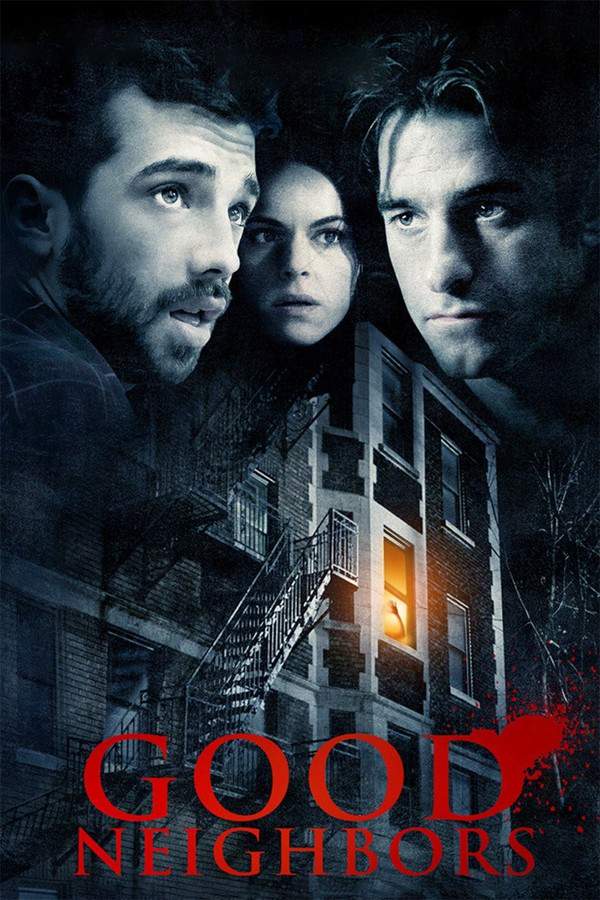
Good Neighbors (2011) movie poster

Plot Summary

Good Neighbors (2011) Plot Summary Explained

Release, runtime and language
2011 · 96 min · English
JustWatch #5,852 6

When a string of disturbing murders rocks their community, Spencer, Louise, and Victor find themselves drawn together by a shared obsession with the crimes. As they investigate, they uncover unsettling truths about themselves and their neighbors, realizing that the danger might be far more personal than they initially thought. Their search for answers exposes hidden connections and tests the limits of their fragile friendship.

On this page (6)
  1. 1 Where to watch
  2. 2 What happens: full plot
  3. 3 Plot questions answered
  4. 4 Movie threads
  5. 5 Movies like Good Neighbors
  6. 6 Every angle

Where to watch

Where to Watch Good Neighbors (2011)

Where can you watch Good Neighbors? Stream, rent or buy it in the US, including on Hoopla, Amazon Video and Apple TV Store: current JustWatch availability with up-to-date prices.

Streaming availability powered by JustWatch

Full plot summary · contains spoilers

What Happens in Good Neighbors: Full Plot Summary

The whole story of Good Neighbors (2011) explained, from the opening scene to the final frame: every key event, every twist and what it all adds up to. Read it as a quick recap before the sequel, to check a scene you missed, or to finally understand what really happened.

Louise works as a waitress in a Chinese restaurant in the Notre-Dame-de-Grâce neighborhood of Montreal, where she spends her days and nights immersed in the latest newspaper coverage of a string of brutal serial murders and rapes in the area. She pours over each victim’s story, searching for clues, and the pattern begins to haunt her when the newest victim turns out to be a coworker who had mentioned a blond, muscular man she had met at a bar and who had a drink with her after she finished her shift at midnight. That detail grips Louise with growing fear, nudging her toward a darker vigilance about the people around her. Her quiet world is already colored by the companionship of her two cats, Tia Maria and Mozart, who share the small apartment with her and bluntly remind her of the loneliness that human company rarely fills.

Louise’s neighbor, Spencer, uses a wheelchair and keeps a careful distance from others, valuing his privacy and solitude even as he is drawn into the orbit of his neighbors’ concerns. Across the hall lives Victor, an awkward, talkative elementary school teacher who has recently moved into the building and quickly ingratiates himself with Louise and Spencer. Victor’s presence adds a new energy to Louise’s routines; he becomes the person she allows to walk her home after a shift, especially on nights following the murder of her coworker, when a police officer’s questions echo the fear in her statements and she feels the most exposed.

As the days unfold, Spencer reveals more about his own past—he was paralyzed in a car accident that killed his wife—and he rejects Victor’s sympathy, revealing a blunt, unyielding temperament. He even reacts with anger when Victor tries to make the building more accessible with a wheelchair ramp, underscoring a sharp unease between his private life and the changing dynamics around him.

Victor, who has developed a crush on Louise, imagines a life with her that goes beyond friendship, even telling his brother at a party that they are engaged. At that same party, Victor presents his cat from China, Balthazar, which is brought over after customs quarantine and becomes an instant focus of Louise’s affection. Louise, for her part, is drawn to the cat and to the idea of a growing closeness with Victor, who begins to show her warmth as she helps him navigate the uneasy currents in their building.

Meanwhile, Spencer slips out at night through the fire escape to enjoy the city’s nocturnal life, an act that looks ordinary to him but soon takes a disturbing turn when he is seen in the act of a sexual encounter with a woman who appears dead. The morning after, one of Victor’s friends spots Spencer, and Victor dismisses the idea that it could be him, trying to maintain his confidence about the fragile web of friendships in the building.

The tension thickens when Valérie, a harsh Francophone neighbor whose cruelty has been noted, poisons Louise’s cats on Christmas morning, deepening Louise’s sense of vulnerability and isolation. In the wake of the loss, Louise spends even more time at Victor’s apartment, preferring the company and quiet of his place, and even taking Balthazar with her to her own home.

Driven by sensationalist media reports, Louise begins to plot revenge against Valérie, who she holds responsible for the tragedy that has unspooled in their building. She seduces Victor and collects a sample of his semen, which she carefully saves for later use. After cleansing herself, she visits Spencer for a drink and flirts with him again, blurring lines and deepening the undertow of danger in their shared space.

Louise calls in sick from work, then launches her plan to frame Valérie for murder by using Victor’s semen to fabricate evidence of rape and murder. She violates Valérie’s corpse in order to plant the sample in a way that echoes the serial killer profile she has been watching unfold in the headlines. Returning home, she encounters Spencer, who has decided to go out, and she hands him her bag of “evidence” to exchange the murder kit for him—an exchange that leaves him surprised but willing to help. Victor, looking out his window, notices the exchange and begins to suspect that Spencer may be the killer after all.

A tense arrangement forms as Victor, now wary of Spencer, intervenes with Louise before she heads to Spencer’s door. He explains what he has told the police and reveals his own suspicions about Spencer, proposing a plan to trap him. Spencer, in turn, hints at framing Victor, unaware that Louise has already spoken with Victor and that he, Victor, intends to turn the danger back onto Spencer. The two men’ s plans collide as Spencer arranges a dinner party intended to serve as a trap.

Louise, keeping a careful watch, leaves Victor’s window open as part of Spencer’s plan, and soon a patrol car of investigating officers sits across from the building. The plan unfolds: Spencer bursts into Victor’s apartment, the police rush in on their tips, and Victor confronts him while chasing him onto the fire escape. Spencer tries to reveal the truth about who killed Valérie, but Victor lashes out and kicks him, sending him off the fire escape to the snow below. Louise, meanwhile, shows almost disinterested indifference to the escalating confrontation, returning to the safety of caring for Tia Maria and Mozart as she feeds the cat and smiles at Spencer’s rage from a distance.

As Victor looks down at Spencer bleeding in the snow, an officer urges him to call 911, and the moment crystallizes the tragedy of the night. The same officer affirms that Victor did the right thing, while Louise quietly acts on her own agenda—she opens the window for the cat, slips into Spencer’s apartment, and climbs onto the top of his fish tank, leaving the fate of the night’s tangled web unresolved in a way that lingers in the imagination.
Last updated: October 09, 2025 at 15:41

Was this helpful?

Plot questions answered

Good Neighbors Plot Explained: Your Questions Answered

The questions people ask most about Good Neighbors (2011): what happens in the confusing scenes, why the characters do what they do, the twists, hidden details and what the ending means. Each answer contains spoilers.

Q1

Why does Louise become so obsessed with the serial murder cases?

Louise becomes obsessed with the murders because they represent a way to escape her own loneliness. Working as a waitress in a Chinese restaurant, she fills her空闲 time reading newspaper accounts of each victim. When her own coworker becomes the latest victim, a woman who had described meeting a blond, muscular man, the murders become personal and directly threaten her sense of safety in her own neighborhood.

Foreshadowing: Earlier scenes show Louise spending all her free time reading murder coverage, establishing her fixation before it becomes directly relevant to her life.

  • Louise
  • obsession
  • serial murders
  • coworker victim
  • neighborhood danger
Q2

Who actually killed Valérie?

Louise killed Valérie. After Valérie poisoned Louise's cats on Christmas morning, Louise crafted a revenge plan inspired by the serial killer cases she had been following. She seduced Victor to obtain a semen sample, then visited Valérie's apartment, violated her corpse, and planted the sample to make it look like the serial killer's work.

Foreshadowing: Louise's obsessive study of the murder cases and her detailed knowledge of the killer's signatureM.O. foreshadow her ability to replicate the method.

  • Valérie murder
  • Louise killer
  • framing
  • revenge
  • serial killer copycat
Q3

Why does Louise frame Valérie for murder?

Louise frames Valérie because Valérie poisoned her two cats, Tia Maria and Mozart, on Christmas morning. The loss devastates Louise, who was already isolated and had turned to her cats for companionship. Consumed by grief and influenced by the sensationalist media coverage of the serial killings, Louise decides to frame Valérie as the serial killer's next victim, making it appear the killer raped and murdered her.

Foreshadowing: Valérie's cruelty toward the neighbors has been established throughout the film, making her a logical target for Louise's rage.

  • Louise revenge
  • Valérie poisoning cats
  • framing
  • grief
  • animal death
Q4

Is Spencer the serial killer?

The film never confirms whether Spencer is the serial killer. What is established is that he sneaks out at night through his window, and Victor's friend witnesses him in a sexual encounter with a woman who appears dead the next morning. However, the film leaves this ambiguous, Spencer could be the killer, or he could be involved in necrophilia, or the scene could be misinterpreted. The ambiguity serves the film's dark, cynical tone.

Foreshadowing: Spencer's nighttime escapades are shown early in the film, and his reclusive, bitter personality makes him a suspect from the start.

  • Spencer
  • serial killer
  • nocturnal activities
  • ambiguity
  • mystery
Q5

What was Victor's plan to trap Spencer?

Victor devised a plan to lure Spencer into a trap by proposing a dinner party. He believed Spencer was the serial killer and intended to use the gathering to expose him. Victor also manipulated the situation by telling the police what he knew, hoping they would arrive during the confrontation.

Foreshadowing: Victor had been suspicious of Spencer since seeing him with the apparently dead woman, and his growing concern about Louise's safety motivated him to take action.

  • Victor
  • Spencer
  • trap plan
  • dinner party
  • police intervention
Q6

What was Spencer's plan for the dinner party?

Spencer used the dinner party as a counter-trap against Victor. He broke into Victor's apartment intending to frame him for the murders, knowing that Victor had been spending time with Louise and was suspected by the police. Spencer's plan was to plant evidence pointing to Victor as the serial killer.

Foreshadowing: Earlier tensions between Spencer and Victor, particularly Spencer's anger about the wheelchair ramp, establish a rivalry that makes Spencer's scheme believable.

  • Spencer
  • dinner party trap
  • framing Victor
  • break-in
  • rivalry
Q7

How did Spencer fall from the fire escape?

Spencer fell from the fire escape during a confrontation with Victor. As the police arrived based on tips from both men, Victor chased Spencer onto the fire escape. In the struggle, Victor kicked Spencer, causing him to fall from the building into the snow below. Victor claimed self-defense, and the police accepted his version of events.

Foreshadowing: The mutual distrust between Victor and Spencer had been building throughout the film, with each man plotting against the other.

  • Spencer fall
  • Victor
  • fire escape
  • struggle
  • police arrival
Q8

Why does Louise enter Spencer's apartment at the end?

Louise enters Spencer's apartment after the confrontation because she sees an opportunity to take control of the situation. With Spencer presumably dead or severely injured and Victor in police custody, Louise slips into his apartment and climbs on top of his fish tank. This final move suggests she has orchestrated events to eliminate both men and potentially claim his apartment or belongings, demonstrating her cold, calculating nature.

Foreshadowing: Louise's manipulation of both Victor and Spencer throughout the film, combined with her detached demeanor during the chaos, foreshadows her willingness to exploit the situation.

  • Louise
  • Spencer apartment
  • fish tank
  • ending
  • control
  • manipulation
Q9

Why does Valérie poison Louise's cats?

Valérie poisoned the cats simply out of cruelty. She is established as a harsh, abusive Francophone neighbor who delights in causing suffering to others. On Christmas morning, she poisons Tia Maria and Mozart, devastating Louise. The act is motiveless beyond pure malice, reflecting the film's dark view of human nature.

Foreshadowing: Valérie's cruel personality is established early through her interactions with the other tenants.

  • Valérie
  • poisoning cats
  • cruelty
  • Christmas
  • Louise grief
Q10

Why does Louise seduce Victor to get a semen sample?

Louise seduces Victor specifically to obtain a sample of his semen, which she needs to frame Valérie as the serial killer's next victim. By collecting Victor's genetic material, she can plant it on Valérie's body to make it appear the killer raped and murdered her, replicating the M.O. she had studied so obsessively in the newspapers. This also allows her to potentially frame Victor as the killer if needed.

Foreshadowing: Louise's media-obsessed study of the serial killer cases directly informs her method of framing.

  • Louise
  • Victor
  • semen sample
  • framing
  • revenge plan
  • manipulation
Q11

What is the significance of Balthazar the cat?

Balthazar, Victor's cat brought from China, represents hope and connection for Louise. After her own cats are poisoned, she becomes attached to Balthazar and begins spending more time at Victor's apartment. The cat symbolizes the possibility of a relationship with Victor and serves as a coping mechanism for her grief. In the end, Louise opens her window for the cat, suggesting she may have taken it as her own.

Foreshadowing: Louise's instant affection for Balthazar at the party signals her growing bond with Victor and her need for companionship.

  • Balthazar
  • cat
  • Louise
  • Victor
  • companionship
  • hope
Q12

Why does Spencer react so strongly to Victor installing a wheelchair ramp?

Spencer's strong negative reaction to the wheelchair ramp reveals his deep discomfort with being seen as disabled or needing help. He was paralyzed in a car accident that killed his wife, and he fiercely guards his independence and privacy. The ramp represents unwanted pity and assistance, which wounds his pride. This conflict also foreshadows his suspicious nature and isolation.

Foreshadowing: Spencer's reclusive behavior and rejection of Victor's friendship establish his defensive posture around his disability.

  • Spencer
  • wheelchair ramp
  • disability
  • independence
  • pride
  • conflict

Movie threads

More Movies Like Good Neighbors, by Mood & Story

Curated lists built around what makes Good Neighbors tick: the same mood, the same kind of story or the same emotional payoff. Each list explains why these movies belong together.

Neighborhood Suspense Thrillers like Good Neighbors

When the familiar safety of a neighborhood becomes a cage of suspicion. If the claustrophobic tension and disturbing neighbor dynamics of Good Neighbors gripped you, explore more movies like it. This list features psychological thrillers where community paranoia and hidden crimes unravel the fabric of a neighborhood, creating an atmosphere of pervasive distrust.

  • paranoid
  • claustrophobic
  • suspenseful
  • unsettling
  • manipulative
  • gloomy
  • Tone: dark, unsettling, paranoid
  • Pacing: variable, building tension
Why these movies?

The story pattern: Stories often begin with a crime or disruption that shatters the peace of a small community. The narrative follows characters as they investigate, turning suspicion inward on their friends and neighbors. This leads to a breakdown of social trust, revealing dark secrets and manipulative intentions hidden beneath a veneer of normality, often culminating in a personal and devastating confrontation.

Why they belong together: These films are grouped by their shared core premise: the invasion of danger into a mundane, familiar setting. They excel at building a specific kind of dread that comes from the violation of safe spaces, focusing on psychological manipulation, the fragility of social bonds, and the terrifying possibility that the monster lives next door.

Movies about Dangerous Obsession like Good Neighbors

Characters whose single-minded fixation leads them down a morally destructive path. Fans of Good Neighbors who were fascinated by the characters' destructive obsession with the murders will find similar themes here. Discover movies where a protagonist's fixation spirals out of control, blurring the lines between investigator and perpetrator, and resulting in a bleak moral collapse.

  • obsessive
  • unsettling
  • gloomy
  • psychological
  • dark
  • heavy
  • Tone: dark, bleak, heavy
  • Pacing: variable, character-driven
Why these movies?

The story pattern: The narrative follows a protagonist who becomes intensely focused on an external mystery or goal. As they delve deeper, their obsession begins to isolate them and distort their perception. The line between solving a problem and becoming part of it blurs, often leading the character to enact their own form of justice or vengeance, resulting in a tragic and bleak conclusion where they are permanently damaged by their journey.

Why they belong together: These films are united by a central character arc of moral decay driven by obsession. They share a heavy emotional weight and a dark, often bleak tone, exploring how a seemingly noble or curious pursuit can corrode a person's soul and lead to unintended, devastating consequences.

If you liked this

Movies Like Good Neighbors

Similar movies to Good Neighbors: the same genre, themes or kind of story. Each one comes with its own plot summary, timeline and ending explained.

Browse all movie summaries

Every angle

Good Neighbors (2011) Explained: Plot, Timeline & Characters

Everything about Good Neighbors in one place: what happens in the plot summary, the timeline in chronological order, the characters and meaning and a spoiler-free summary. What's After the Movie adds the cast, box office and post-credit scenes.

Coming soon on iOS and Android

The Plot Explained Movie Summary App

Plot summaries, endings explained and timelines on your phone. Catch up on any movie in minutes, save your favorites and never miss a twist again.

Be the first to know when we launch. Your email stays private, always.

Learn more about the app