Year: 2000
Runtime: 99 min
Language: japanese
Director: Takao Okawara
Budget: $13M
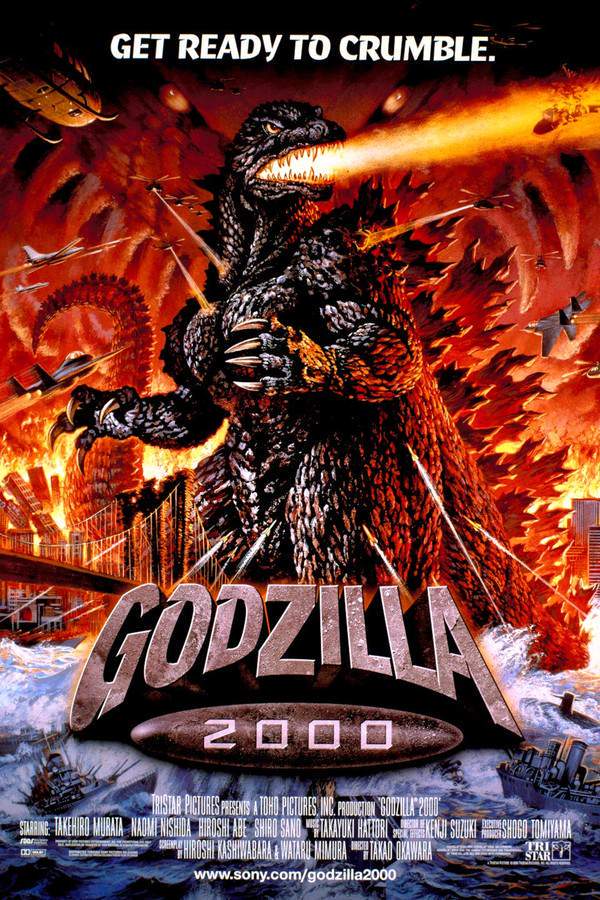
A colossal monster emerges from the ocean, unleashing devastation across Japan. Its immense size and ferocious attacks leave a trail of destruction, prompting a nationwide effort to understand its sudden appearance and stop its rampage. The creature's fiery breath and sharp claws threaten the safety of countless lives, testing the resilience of the nation and its people.
Find where to stream, rent, or buy Godzilla 2000 (2000) in the US with current JustWatch availability, up-to-date pricing, and platform listings for subscription, rental, and digital purchase options.
Warning: spoilers below!
Haven’t seen Godzilla 2000 yet? This summary contains major spoilers. Bookmark the page, watch the movie, and come back for the full breakdown. If you're ready, scroll on and relive the story!
Trace every key event in Godzilla 2000 (2000) with our detailed, chronological timeline. Perfect for unpacking nonlinear stories, spotting hidden connections, and understanding how each scene builds toward the film’s climax. Whether you're revisiting or decoding for the first time, this timeline gives you the full picture.
Last updated: November 19, 2024 at 16:26
Find frequently asked questions about the Godzilla 2000 (2000) timeline, including chronological order, nonlinear jumps, cause-and-effect links, and scene sequence clarifications. This timeline FAQ helps explain when key events happen, how moments connect, and why the story unfolds in that specific order.
The UFO is an alien spacecraft carrying extraterrestrial beings who have traveled to Earth seeking Godzilla's unique genetic material. These aliens need Godzilla's DNA because it contains extraordinary regenerative properties called Organizer G1 (Regenerator G1 in North American releases). The aliens plan to use these regenerative abilities to rejuvenate and restore their own deteriorating bodies, essentially using Godzilla's genetic code as a tool for their own immortality.
Earlier, the UFO recharges itself using solar energy while observing Godzilla, hinting at its dependence on external power sources.
After absorbing some of Godzilla's DNA during their confrontation, the UFO exits its spacecraft and transforms into a humanoid creature called Millennian, which briefly resembles Godzilla. However, when Millennian attempts to fully harness Godzilla's regenerative powers, its body undergoes a grotesque mutation and transforms into Orga. Orga becomes nearly indestructible due to the absorbed genetic material and even attempts to create a perfect clone of Godzilla by extracting more of its DNA.
The UFO's initial desire for genetic information foreshadows its transformation process.
Orga had become nearly indestructible because it absorbed Godzilla's regenerative DNA, making it capable of healing from most attacks. However, when Godzilla unleashes its atomic breath, the intense heat and radiation overwhelm Orga's regenerative abilities before they can activate. The atomic breath incinerates Orga's upper body completely, killing the creature despite its enhanced durability. This also destroys Orga's attempt to clone Godzilla, as the genetic material is destroyed in the blast.
Earlier in the film, Godzilla's atomic breath is shown to be its most devastating weapon.
Mitsuo Katagiri, the leader of the Crisis Control Intelligence (CCI) team, dies when the roof of the CCI headquarters collapses during Godzilla's rampage through Tokyo. Katagiri was observing the chaos from the building alongside Yuji Shinoda when Godzilla's destruction causes the roof to crumble, trapping and killing him. His death underscores the film's theme that humanity's attempts to understand and control forces like Godzilla ultimately lead to tragedy.
The CCI headquarters is repeatedly threatened throughout the film as Godzilla approaches Tokyo.
Yuji Shinoda's reflection that "Godzilla exists in us" serves as the film's thematic conclusion, suggesting that Godzilla is not merely an external monster but a manifestation of humanity's own darker nature. The creature represents the destructive potential born from human ambition, arrogance, and the consequences of tampering with forces beyond our control. The quote implies that Godzilla is a symbol of the violent and self-destructive impulses that reside within humanity itself.
The film establishes that the aliens seek to use Godzilla's power, paralleling human attempts to exploit nature.
When the UFO lands on Tokyo Opera City Tower, it issues a broadcast declaring the beginning of a new "thousand-year kingdom" on Earth. This proclamation signifies the aliens' intention to conquer and rule Earth for a millennium, using Godzilla's regenerative DNA to ensure their immortality. The invasion declaration marks the point where the alien threat escalates from a mysterious presence to an explicit hostile force with territorial ambitions.
The UFO's digital infiltration of Tokyo's computer systems demonstrates its intent to gather intelligence before the invasion.
Organizer G1 (known as Regenerator G1 in North American releases) is the name Yuji Shinoda gives to Godzilla's extraordinary regenerative ability. This biological mechanism allows Godzilla to rapidly heal from injuries and regrow damaged tissue, making the creature nearly impossible to kill through conventional means. The alien UFO specifically seeks this genetic property because it could be used to regenerate and preserve alien life forms, making it the most valuable biological material on Earth.
Shinoda's research explains why previous attempts to stop Godzilla have failed.
During the initial confrontation with the Japan Self Defense Forces and the UFO, Godzilla retreats into the ocean depths. This retreat occurs because the UFO presents a new threat that Godzilla has not encountered before. The alien vessel proves capable of challenging Godzilla, and after a brief clash, Godzilla withdraws to recover and reassess this unprecedented adversary. The retreat allows the UFO to also recharge using solar energy, setting up the next phase of conflict.
The UFO's interest in Godzilla is established from their first encounter.
The Japan Self Defense Forces deploy Full Metal Missiles against Godzilla in the opening battle, but the creature's regenerative abilities allow it to survive and continue attacking. Despite being hit by these powerful weapons, Godzilla's Organizer G1 enables rapid healing of any damage caused. The missiles prove insufficient to kill or even significantly slow down Godzilla, demonstrating the monster's near-invulnerability to conventional military technology and setting up the stakes for the alien threat.
This battle establishes that human military technology cannot stop Godzilla.
The UFO chooses to land on Tokyo Opera City Tower in Shinjuku because it needs access to Tokyo's master computer systems. From this elevated position, the UFO initiates a digital infiltration, hacking into the city's technological infrastructure to search for all available data about Godzilla. The location provides both a strategic vantage point and direct access to the information the aliens seek about their genetic target.
The UFO's digital capabilities are demonstrated when it first activates and ascends from the Japan Trench.
The aliens specifically need Godzilla's genetic code that contains the Organizer G1/Regenerator G1 - the biological mechanism responsible for the monster's regenerative abilities. This genetic information represents an extraordinary biological phenomenon that allows rapid cell regeneration and tissue repair. The aliens intend to extract this genetic data and apply it to their own bodies to achieve rejuvenation and potentially immortality, making Godzilla's DNA the most valuable biological resource they have ever encountered.
The UFO's interest in Godzilla is immediate and intense from their first encounter.
Throughout the film, Godzilla evolves from a simple monster threat to a symbolic representation of humanity's own destructive potential. The concluding narration by Shinoda suggests that Godzilla was born from the same ambition and arrogance that characterize human civilization. The aliens' attempt to exploit Godzilla's power mirrors humanity's tendency to exploit nature. The film's ending implies that the real horror is not the monster itself but the human capacity to create and unleash destructive forces.
The entire narrative shows humanity provoking and attempting to control forces beyond their understanding.
Discover curated groups of movies connected by mood, themes, and story style. Browse collections built around emotion, atmosphere, and narrative focus to easily find films that match what you feel like watching right now.
Movies where colossal monsters clash amidst the ruins of civilization.If you enjoyed the colossal monster action in Godzilla 2000, explore more movies like it. This collection features similar stories of kaiju rampages, alien threats, and large-scale destruction, delivering fast-paced, tense, and visually spectacular sci-fi thrillers.
These narratives typically follow a straightforward pattern: a mysterious and immense threat emerges, humanity scrambles to understand and counter it, leading to a climactic, destructive showdown. The focus is on spectacle and survival, often with themes exploring human arrogance in the face of nature or cosmic power.
Movies are grouped here for their shared emphasis on kaiju spectacle, high-intensity action, and a tense, destructive atmosphere. They deliver a specific cinematic experience centered on awe-inspiring scale and the chaos of battling behemoths.
Stories where defeating the monster comes at a heavy, sobering cost.For viewers who appreciated the grim, reflective conclusion of Godzilla 2000, this list highlights similar movies with bittersweet endings. These films balance monstrous threats with heavy emotional weight, where victory feels hollow and leaves characters and audiences pondering the cost.
The narrative pattern involves confronting a seemingly unstoppable force. The climax achieves a technical victory, but the aftermath reveals the profound price paid—be it the death of allies, widespread devastation, or the unsettling knowledge that the threat was a symptom of a deeper, unresolved problem, like humanity's dark nature.
These films are connected by their shared emotional structure: a high-stakes conflict resolves not with jubilation, but with a somber, bittersweet tone. They prioritize heavy emotional weight and a conclusion that lingers on the cost of survival, creating a more complex and memorable impact.
Don't stop at just watching - explore Godzilla 2000 in full detail. From the complete plot summary and scene-by-scene timeline to character breakdowns, thematic analysis, and a deep dive into the ending - every page helps you truly understand what Godzilla 2000 is all about. Plus, discover what's next after the movie.
Read a complete plot summary of Godzilla 2000, including all key story points, character arcs, and turning points. This in-depth recap is ideal for understanding the narrative structure or reviewing what happened in the movie.
Discover the characters, locations, and core themes that shape Godzilla 2000. Get insights into symbolic elements, setting significance, and deeper narrative meaning - ideal for thematic analysis and movie breakdowns.