








Plot Explained Spoilers guaranteed!
Plot Explained

Browse by genre

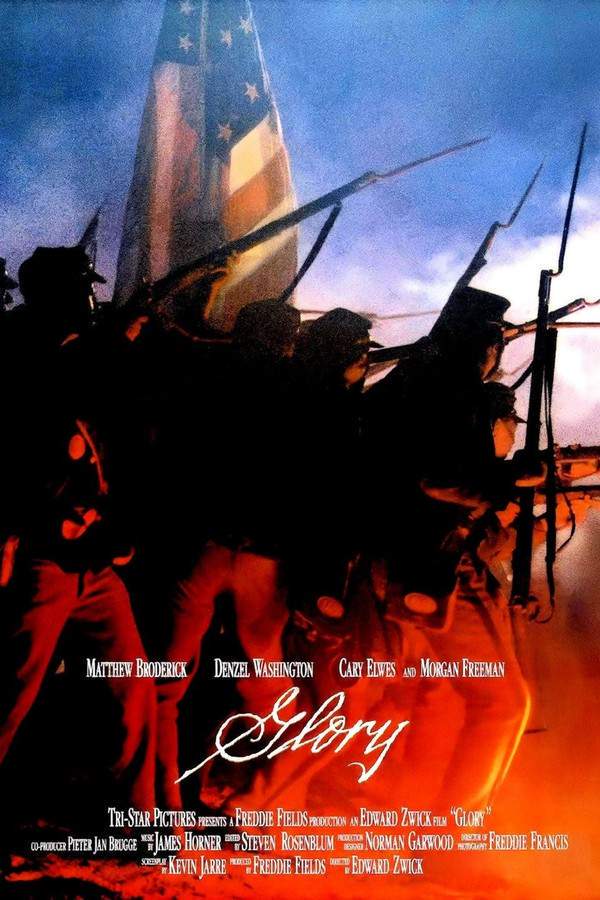
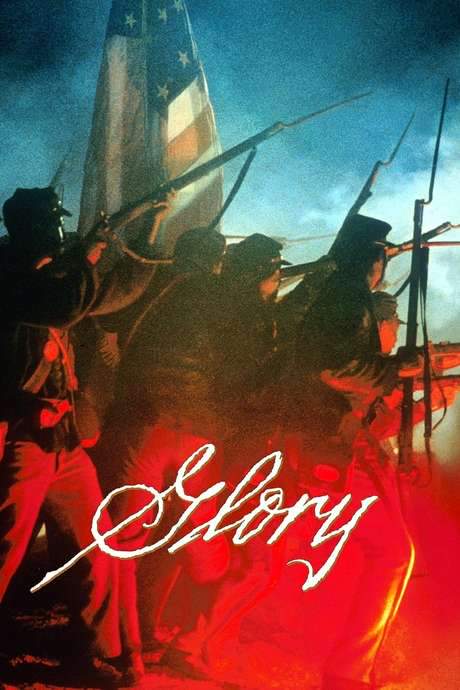
Glory (1989) movie poster

Timeline

Glory (1989) Timeline Explained – Every Event in Order

Release, runtime and language
1989 · 122 mins · English
JustWatch #1,386 119
Directed by
Edward Zwick
Starring
Morgan Freeman, Jay O. Sanders, Matthew Broderick, Jane Alexander, Denzel Washington, RonReaco Lee

They are innocent, their heritage and lives at stake. Robert Gould Shaw commands the Union’s first all‑Black volunteer regiment, the 54th Massachusetts, confronting prejudice from both his own army and the Confederate forces. Their courage challenges entrenched racism and proves their worth on the battlefield.

On this page (6)
  1. 1 Where to watch
  2. 2 Events in order (14)
  3. 3 Timeline questions answered
  4. 4 Movie threads
  5. 5 Movies like Glory
  6. 6 Every angle

Where to watch

Where to Watch Glory (1989)

Where can you watch Glory? Stream, rent or buy it in the US, including on Tubi TV, Amazon Video and Apple TV Store: current JustWatch availability with up-to-date prices.

Streaming availability powered by JustWatch

14 events in order · contains spoilers

Glory Timeline: Events in Chronological Order

Every key event of Glory (1989) in order, scene by scene, with when and where it takes place. Use it to untangle flashbacks, time jumps and parallel storylines, to refresh your memory before the sequel or to find the exact scene you are thinking of.

  1. Shaw's return and recruitment of the 54th

    Captain Robert Shaw is wounded at Antietam and returns home to Boston on medical leave. He accepts promotion to Colonel and takes command of the newly formed 54th Massachusetts Volunteer Infantry. He recruits a diverse group of volunteers, including Cabot Forbes, Thomas Searles, John Rawlins, Jupiter Sharts, Trip, and a mute drummer.

    When
    After Antietam, 1862
    Where
    Boston
  2. Post-Emancipation realities and grueling training begins

    Following the Emancipation Proclamation, the 54th is told that Confederate forces will execute Black soldiers in Union uniforms along with their white officers. Despite this, the men decline an honorable discharge and begin rigorous training under Sergeant-Major Mulcahy.

    When
    After Emancipation Proclamation (1863)
    Where
    Training camp
  3. Trip’s AWOL and punishment

    Trip is arrested for being AWOL and is flogged. Shaw learns he left camp to replace his worn-out shoes, exposing the strain on the troops and the fragility of discipline.

    When
    During training period (1863)
    Where
    Camp
  4. Shaw confronts the racist quartermaster

    Shaw directly confronts the base's racist quartermaster who is withholding supplies from the unit. The confrontation highlights the systemic racism and the obstacles Black soldiers face even before seeing combat.

    When
    During training period (1863)
    Where
    Base camp
  5. Pay inequity sparks a collective stance

    The men learn that Black soldiers are paid about three-quarters of what white soldiers receive. Trip encourages them to refuse their pay, and Shaw tears up his own pay stub in solidarity with the others.

    When
    During training period (1863)
    Where
    Base camp
  6. Rawlins earns a promotion

    Thomas Searles, known for his bookish intellect and leadership, is promoted to Sergeant-Major in recognition of his mentorship and morale-boosting counsel to the younger troops.

    When
    During training period (1863)
    Where
    Camp
  7. Orders to Darien: a brutal assignment proposed

    Under General Charles Harker and Colonel James Montgomery, the 54th is ordered to sack and burn Darien, Georgia. Shaw initially refuses the assignment, but agrees under threat of relief from command.

    When
    After training, 1863-1864
    Where
    Darien, Georgia
  8. Shaw demands a combat role

    Tired of seeing his men used for manual labor and raids on civilians, Shaw tells Harker and Montgomery he will report profiteering to the War Department unless the 54th is given a combat assignment.

    When
    Before combat deployment (1863-1864)
    Where
    Darien, Georgia
  9. First combat: James Island

    The 54th goes into battle at James Island, South Carolina and repels a Confederate attack. Thomas Searles is wounded while saving Trip's life, demonstrating the unit's courage under fire.

    When
    1863
    Where
    James Island, South Carolina
  10. General Strong outlines a Charleston campaign

    General George Strong informs the regimental commanders of a major campaign to secure Charleston Harbor, describing Morris Island and the foreboding Fort Wagner as the next objective. Shaw volunteers the 54th for the assault.

    When
    Prior to Fort Wagner assault (1863)
    Where
    Charleston area, Morris Island / Fort Wagner
  11. Religious service before the attack

    The night before the assault on Fort Wagner, the Black soldiers hold a religious service to give thanks and seek God’s help. The moment underscores their resolve and unity in the face of danger.

    When
    Night before assault, 1863
    Where
    Fort Wagner, Morris Island
  12. The assault on Fort Wagner

    At dawn, the 54th makes a frontal assault on Fort Wagner and suffers devastating losses as they advance across the open beach. Shaw is killed during the assault, and Trip lifts the regimental flag, guiding the remaining troops toward the fort before he is mortally wounded. Forbes leads a party into the fort's outer defenses where Charlie Morse is killed and Thomas is wounded. A small group of survivors, including Forbes and Rawlins, faces a Confederate gun as the scene fades to black.

    When
    Dawn of assault, 1863
    Where
    Fort Wagner, Morris Island, South Carolina
  13. Aftermath and burial

    After sunrise, Confederate soldiers recover the bodies and raise their flag over the fort while burying the fallen in a mass grave. Shaw's body is found in the trench beside Trip, symbolizing their shared sacrifice.

    When
    Next day after assault, 1863
    Where
    Fort Wagner site, South Carolina
  14. Epilogue: impact on the war effort

    The epilogue notes that although Fort Wagner was not captured, the 54th's courage helped persuade the Union Army to recruit thousands more Black soldiers for combat. President Lincoln credits this shift as a turning point in the war.

    When
    Post-Fort Wagner, 1863-1865
    Where
    Nationwide / United States

Last updated: October 09, 2025 at 14:30

Was this helpful?

Timeline questions answered

Glory Timeline Explained: Your Questions Answered

When does it happen, and why in that order? The questions people ask about the chronology of Glory (1989): time jumps, flashbacks, cause and effect between scenes and the correct order of events, each answered with spoilers.

Q1

Why did Colonel Shaw volunteer his regiment for the Fort Wagner assault?

Shaw volunteered the 54th for the assault on Fort Wagner because General George Strong described it as a major campaign to secure Charleston Harbor, and Shaw wanted his men to have a true combat assignment rather than being used for manual labor and raids on civilians. After confronting Harker and Montgomery about profiteering, Shaw was determined to prove his men's worth in actual battle rather than being relegated to brutal supporting roles.

Foreshadowing: Earlier in the film, Shaw demands a combat assignment, telling Harker and Montgomery he will report profiteering to the War Department unless the 54th is given a real fighting chance.

  • fort wagner
  • charleston
  • shaw
  • volunteer
  • assault
  • 54th regiment
Q2

Why was Private Trip arrested and flogged?

Trip was arrested for being AWOL because he left camp to find new shoes, his were completely worn out. This highlights the quartermaster's racism in withholding supplies from the Black soldiers. Shaw discovers the real reason behind Trip's absence and confronts the racist quartermaster directly.

Foreshadowing: The flogging scene early in training establishes the harsh treatment and supply disparities the 54th faces.

  • trip
  • awol
  • shoes
  • flogged
  • arrested
  • supplies
Q3

Why did Shaw agree to burn Darien, Georgia?

Shaw initially refused the order to sack and burn Darien, but agreed only when Colonel James Montgomery threatened to relieve him of command. Shaw was tired of seeing his men used for brutal labor and civilian raids, and he saw this as a way to keep his command intact while hoping for a real combat opportunity later.

Foreshadowing: This moment shows Shaw's internal conflict between following orders and protecting his men from degrading tasks.

  • darien
  • burn
  • montgomery
  • orders
  • shaw
  • sack
Q4

Why did the 54th Regiment refuse their pay?

The Black soldiers learned they were paid only about three-quarters of what white soldiers received. Trip urged a collective refusal of pay in protest of this injustice. Shaw showed solidarity by tearing up his own pay stub, demonstrating his commitment to equality for his men.

Foreshadowing: The pay disparity was a recurring theme showing the systemic racism within the Union army itself.

  • pay
  • refuse
  • inequality
  • black soldiers
  • trip
  • shaw
Q5

Why was Colonel Shaw buried in the same grave as Trip?

After the assault, Confederate soldiers buried the Union dead in a mass grave. Shaw's body was placed in the same trench as Trip, the Black soldier he had led. This striking image symbolizes the equality Shaw always advocated for, Black and white officers dying side by side, their lives equally sacrificed for the cause.

Foreshadowing: Throughout the film, Shaw consistently treats his Black soldiers with dignity and equality, making this burial a fitting final statement.

  • burial
  • grave
  • trip
  • shaw
  • confederate
  • mass grave
Q6

Why did Trip decline to bear the regimental flag in battle?

Trip declined Shaw's offer to carry the flag because he was uncertain whether the war would actually bring about a better life for enslaved people. Despite his courage in combat, Trip struggled with doubt about whether the sacrifice would mean anything meaningful for his people.

Foreshadowing: This moment reveals Trip's internal conflict about the war's purpose and whether liberation would truly come.

  • trip
  • flag
  • battle
  • declined
  • enslaved
  • liberation
Q7

Why did Thomas Searles save Trip during the James Island battle?

During the 54th's first combat at James Island, Thomas Searles was wounded while saving Trip's life. This act demonstrates the bond that formed between the men despite their different backgrounds, Thomas, the bookish free Black man, and Trip, the wary young recruit, proving their unity as true comrades in arms.

Foreshadowing: Earlier scenes show Thomas and Trip's relationship developing through training and shared hardship.

  • thomas
  • trip
  • james island
  • wounded
  • save
  • combat
Q8

Why would the Confederacy execute Black soldiers captured in uniform?

After the Emancipation Proclamation, the Confederate forces made it known they would execute any Black soldiers captured wearing Union uniforms, along with their white officers. This brutal policy represented the Confederacy's refusal to recognize Black soldiers as legitimate combatants, viewing them as escaped slaves rather than enemy soldiers.

Foreshadowing: This threat hangs over the entire narrative, adding deadly stakes to every battle the 54th faces.

  • confederate
  • execute
  • captured
  • black soldiers
  • emancipation
  • uniforms
Q9

What was the impact of the 54th Regiment's sacrifice at Fort Wagner?

Although Fort Wagner was never captured, the 54th's courage at Fort Wagner helped persuade the Union Army to recruit thousands of Black soldiers for combat roles. President Abraham Lincoln credited this shift as a turning point in the war, making the 54th's sacrifice a pivotal moral victory that changed the course of Union military policy.

Foreshadowing: The epilogue reveals that the battle, though militarily lost, achieved a greater strategic purpose.

  • 54th
  • fort wagner
  • impact
  • recruitment
  • lincoln
  • black soldiers
Q10

Why did Robert Shaw accept command of the 54th Massachusetts?

Shaw was wounded at Antietam and returned to Boston on medical leave, where he was promoted to Colonel to command the newly formed 54th Massachusetts, one of the Union Army's first all-Black volunteer regiments. Despite knowing his men would face prejudice from both the Union and Confederate forces, Shaw accepted the position and recruited his friend Cabot Forbes as second in command.

Foreshadowing: Shaw's decision sets up the entire story of fighting racism while leading his men into battle.

  • shaw
  • command
  • 54th
  • colonel
  • boston
  • recruit

Movie threads

More Movies Like Glory, by Mood & Story

Curated lists built around what makes Glory tick: the same mood, the same kind of story or the same emotional payoff. Each list explains why these movies belong together.

Movies about bittersweet sacrifice like Glory

Stories where a noble fight ends in tragedy, but the moral victory remains. If you were moved by the tragic but heroic ending of Glory, explore these movies like it. This collection features similar stories where characters fight for a greater good, facing a bittersweet or costly conclusion that cements their legacy. These films share a heavy emotional weight and a focus on the moral victory within a physical defeat.

  • tragic
  • inspiring
  • sobering
  • hopeful
  • somber
  • heroic
  • Tone: bittersweet, inspiring, tragic
  • Pacing: steady, building
Why these movies?

The story pattern: Films in this thread typically follow a group or individual who takes a principled stand against injustice or oppression. The narrative builds investment in their cause and camaraderie, leading to a climactic confrontation that results in significant loss. However, the story frames this sacrifice not as a pure failure, but as a pivotal moment that fuels future change and honors the fallen.

Why they belong together: These movies are grouped by their powerful emotional core, which balances the grim reality of sacrifice with the hopeful light of legacy. They share a specific tone where sadness and inspiration are intertwined, creating a deeply resonant and thought-provoking viewing experience centered on the cost of progress.

Movies about underdog units like the 54th Regiment in Glory

Films about an underestimated group earning respect through shared struggle. For viewers who enjoyed the story of the 54th Massachusetts Regiment in Glory, this list features similar movies about disciplined underdog units fighting prejudice. These films showcase a diverse group bonding through rigorous training and facing a ultimate challenge, often in a military or high-stakes team setting, blending intense drama with themes of dignity and brotherhood.

  • tense
  • inspiring
  • gritty
  • brotherhood
  • disciplined
  • underdog
  • Tone: gritty, hopeful, tense
  • Pacing: steady, methodical
Why these movies?

The story pattern: The narrative pattern involves the formation of a team from disparate, often disrespected, individuals. A significant portion of the story is dedicated to their arduous training and internal dynamics, building a strong sense of camaraderie. The central conflict is twofold: overcoming internal doubts and uniting as one, while also confronting external systemic bias, culminating in a demonstration of their collective skill and courage.

Why they belong together: These films share a powerful focus on camaraderie forged in adversity, the tension of proving oneself against low expectations, and the catharsis of earning hard-won respect. The combination of a steady, character-driven pace with high-stakes intensity creates a consistently engaging and emotionally satisfying formula.

If you liked this

Movies Like Glory

Similar movies to Glory: the same genre, themes or kind of story. Each one comes with its own plot summary, timeline and ending explained.

Browse all movie summaries

Every angle

Glory (1989) Explained: Plot, Timeline & Characters

Everything about Glory in one place: what happens in the plot summary, the timeline in chronological order, the characters and meaning and a spoiler-free summary. What's After the Movie adds the cast, box office and post-credit scenes.

Coming soon on iOS and Android

The Plot Explained Movie Summary App

Plot summaries, endings explained and timelines on your phone. Catch up on any movie in minutes, save your favorites and never miss a twist again.

Be the first to know when we launch. Your email stays private, always.

Learn more about the app