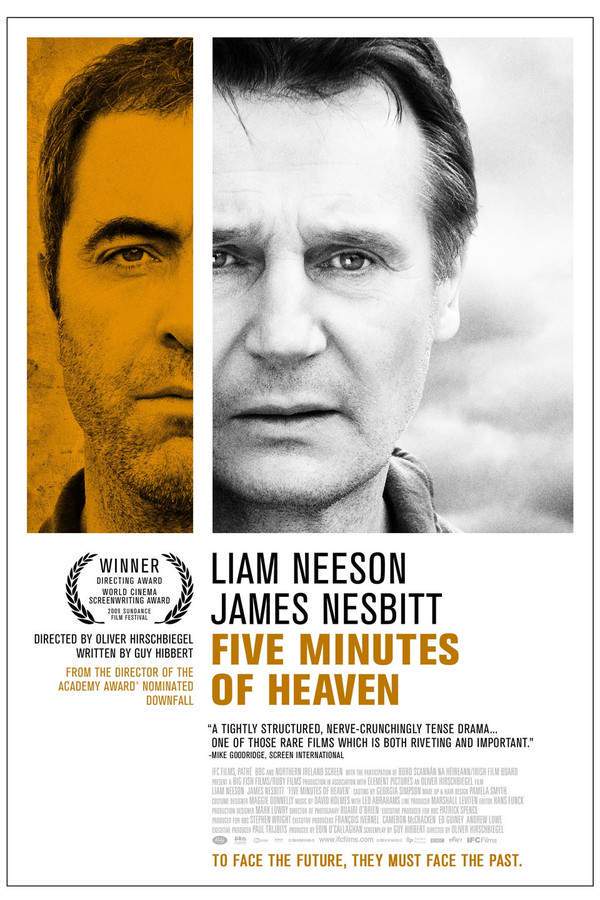
In 1975, sectarian tensions in Northern Ireland escalate. Alistair Little, a young loyalist, commits a violent act that is witnessed by 11-year-old Joe Griffin. Thirty years later, the two men are brought together in an attempt at reconciliation. However, Joe is secretly planning to confront Alistair and seek vengeance for his brother's death, with the confrontation intended to be broadcast live.
Find where to stream, rent, or buy Five Minutes of Heaven (2009) in the US with current JustWatch availability, up-to-date pricing, and platform listings for subscription, rental, and digital purchase options.
Warning: spoilers below!
Haven’t seen Five Minutes of Heaven yet? This summary contains major spoilers. Bookmark the page, watch the movie, and come back for the full breakdown. If you're ready, scroll on and relive the story!
Trace every key event in Five Minutes of Heaven (2009) with our detailed, chronological timeline. Perfect for unpacking nonlinear stories, spotting hidden connections, and understanding how each scene builds toward the film’s climax. Whether you're revisiting or decoding for the first time, this timeline gives you the full picture.
Last updated: November 15, 2024 at 17:47
Find frequently asked questions about the Five Minutes of Heaven (2009) timeline, including chronological order, nonlinear jumps, cause-and-effect links, and scene sequence clarifications. This timeline FAQ helps explain when key events happen, how moments connect, and why the story unfolds in that specific order.
Alistair Little, a 17-year-old leader of a UVF cell, received orders to target a Catholic man as retaliation for IRA attacks on loyalists. James Griffin was selected as part of the ongoing cycle of sectarian violence during the Troubles. Little carried out the murder as an act of revenge against Catholics he believed were militant republicans, driven by the violent political climate of 1975 Northern Ireland.
Earlier scenes establish the escalating tensions between the IRA and UVF, setting the context for Little's orders.
Joe Griffin spent 33 years carrying the trauma of watching his brother James being murdered as a child. Rather than seeking genuine reconciliation, Joe used the reconciliation initiative as an opportunity to confront Alistair Little with the intent of killing him. His plan was to seek personal vengeance for his brother's death, and he brought a knife specifically to carry out this act.
The film establishes early on that Joe witnessed his brother's murder as an 8-year-old, leaving him deeply scarred.
At the abandoned home where James Griffin was killed, Joe ambushes Alistair Little with his knife, initiating a violent confrontation. The struggle escalates as both men crash through a second-story window, resulting in injuries to both. During their raw, emotional encounter, Alistair speaks to Joe, urging him to abandon his quest for vengeance and instead focus on cherishing his family.
The choice of location, the exact site of James Griffin's murder, intensifies Joe's emotional state and foreshadows the violent confrontation.
During their intense confrontation, Alistair Little directly addressed Joe Griffin, speaking honestly about his actions and encouraging him to choose a different path. Rather than seeking revenge, Alistair urged Joe to cherish his family instead of continuing the cycle of violence. This emotional exchange, combined with Joe's own internal struggle, led him to abandon his plan for vengeance.
Joe's earlier storming out shows his inner conflict between his desire for revenge and his better impulses.
When Joe Griffin contacts Alistair Little and says "We're finished," he is deliberately choosing to end their confrontation and walk away from vengeance. This message represents Joe's decision to break free from the cycle of retribution that has defined his life since childhood. It is both a conclusion to their conflict and a statement of Joe's commitment to moving forward rather than seeking further confrontation.
The therapy scene where Joe discusses wanting to be a better father foreshadows his choice to prioritize healing over revenge.
Joe Griffin's anger and anxiety boiled over just before he and Alistair Little were set to be filmed for the reconciliation program. The intense pressure of facing his brother's killer, combined with his unresolved rage and grief, became overwhelming. Rather than proceed with the staged reconciliation, Joe stormed out, unable to contain his emotions in that controlled setting.
Joe's decision to bring a knife to the reconciliation indicates his true intentions were not peaceful.
During their raw encounter at the abandoned house, Alistair Little spoke candidly to Joe Griffin, offering clarity about his past actions. He addressed the emotional trauma between them and urged Joe to abandon his quest for vengeance. Rather than defending himself, Alistair encouraged Joe to cherish his family and choose a different path, leading to the pivotal moment where Joe decides to let go.
Alistair's willingness to meet at the site of the murder suggests he intended to confront his past directly.
Alistair Little proposed meeting at the abandoned home where James Griffin was murdered. This location was deliberately chosen because it was the exact site of the original crime, where Joe witnessed his brother's killing. By returning to this haunted place, Alistair likely intended to force both men to confront the full weight of their shared history and the trauma that had defined Joe's life.
The site carries enormous symbolic weight, as it represents the origin of Joe's lifelong trauma and desire for revenge.
Joe Griffin ambushed Alistair Little at the abandoned house, leading to a violent struggle between the two men. During the fight, both Joe and Alistair crashed through a second-story window, falling to the ground below. Both men were injured in the fall, with the window crash marking the violent climax of their confrontation.
Joe's ambush with the knife directly leads to the physical struggle and subsequent fall.
As an 8-year-old boy, Joe Griffin witnessed his older brother James Griffin being murdered by Alistair Little. This traumatic event occurred in 1975 during the sectarian violence of the Northern Irish Troubles. The shock of watching his brother die left a deep psychological scar on young Joe, shaping his entire life and fueling his desire for revenge against Little.
The opening scenes establish the devastating impact of this witnessed murder on Joe's future.
During a therapy group session, Joe Griffin opened up about his struggles and expressed a deep desire to be a better father to his daughters. This moment of vulnerability revealed Joe's internal journey toward healing and his recognition that he needed to break free from his past trauma. The session represents a turning point where Joe begins to consciously choose a different path for himself and his family.
Joe's therapy work foreshadows his ultimate decision to reject vengeance and pursue healing.
Alistair Little served 19 years in prison for the murder of James Griffin. After being released, he became eligible to participate in the 2008 reconciliation initiative that brought him face to face with Joe Griffin, the younger brother of the man he killed.
Little's long prison sentence and subsequent release set the stage for the reconciliation attempt.
Discover curated groups of movies connected by mood, themes, and story style. Browse collections built around emotion, atmosphere, and narrative focus to easily find films that match what you feel like watching right now.
Characters are forced to face the people and events that haunt them.If you were gripped by the tense meeting in Five Minutes of Heaven, explore more movies where characters are brought together by a shared violent past. These psychological dramas and thrillers focus on raw confrontations, unresolved grief, and the difficult path toward revenge or reconciliation.
Stories in this thread typically involve a long-delayed meeting between a victim (or their family) and a perpetrator. The narrative builds deliberately towards this confrontation, exploring the psychological state of both parties. The climax is often a dialogue-heavy, emotionally explosive scene where the past is laid bare, leading to an ambiguous or bittersweet resolution rather than clear-cut vengeance or forgiveness.
Movies are grouped here because they share a core narrative structure centered on a high-stakes, personal confrontation stemming from trauma. They create a similar mood of extreme anxiety and emotional rawness, prioritizing psychological depth over physical action.

Stories where heavy choices lead to ambiguous, imperfect closure.Like the ending of Five Minutes of Heaven, these films explore the difficult aftermath of violence and guilt. If you appreciate stories where characters carry heavy moral burdens and find uncertain, bittersweet closure rather than neat solutions, you'll find similar powerful dramas here.
The narrative follows a character living with the weight of a past transgression or trauma. The plot forces them to confront this history, often leading to a moment of truth or catharsis. However, the resolution is never clean; it acknowledges the pain caused while allowing for a tentative, often solitary, step forward. The focus is on the emotional cost and the fragile nature of healing.
These movies are connected by their shared exploration of moral complexity and their commitment to emotionally honest, non-cathartic endings. They resonate through their bleak yet hopeful tone, leaving viewers with a profound, contemplative feeling about the nature of guilt and forgiveness.
Don't stop at just watching - explore Five Minutes of Heaven in full detail. From the complete plot summary and scene-by-scene timeline to character breakdowns, thematic analysis, and a deep dive into the ending - every page helps you truly understand what Five Minutes of Heaven is all about. Plus, discover what's next after the movie.
Read a complete plot summary of Five Minutes of Heaven, including all key story points, character arcs, and turning points. This in-depth recap is ideal for understanding the narrative structure or reviewing what happened in the movie.
Discover the characters, locations, and core themes that shape Five Minutes of Heaven. Get insights into symbolic elements, setting significance, and deeper narrative meaning - ideal for thematic analysis and movie breakdowns.
Discover movies like Five Minutes of Heaven that share similar genres, themes, and storytelling elements. Whether you’re drawn to the atmosphere, character arcs, or plot structure, these curated recommendations will help you explore more films you’ll love.
Five Minutes of Heaven (2009) Plot Summary & Movie Recap
Five Minutes of Heaven (2009) Scene-by-Scene Movie Timeline
Five Minutes of Heaven (2009) Spoiler-Free Summary & Key Flow
Movies Like Five Minutes of Heaven – Similar Titles You’ll Enjoy
3 1/2 Minutes, 10 Bullets (2015) Full Movie Breakdown
Belfast (2021) Detailed Story Recap
15 Minutes (2001) Complete Plot Breakdown
90 Minutes in Heaven (2015) Full Movie Breakdown
South of Heaven (2021) Ending Explained & Film Insights
Small Things Like These (2024) Full Summary & Key Details
Heaven (2019) Plot Summary & Ending Explained
The Five Minutes (2019) Spoiler-Packed Plot Recap
Omagh (2004) Complete Plot Breakdown
The Five People You Meet In Heaven (2004) Spoiler-Packed Plot Recap
A Little Trip to Heaven (2005) Movie Recap & Themes
Four Days in July (1984) Ending Explained & Film Insights
Five Corners (1987) Full Movie Breakdown
Nothing Personal (1995) Detailed Story Recap
Love Lies Bleeding (1993) Spoiler-Packed Plot Recap