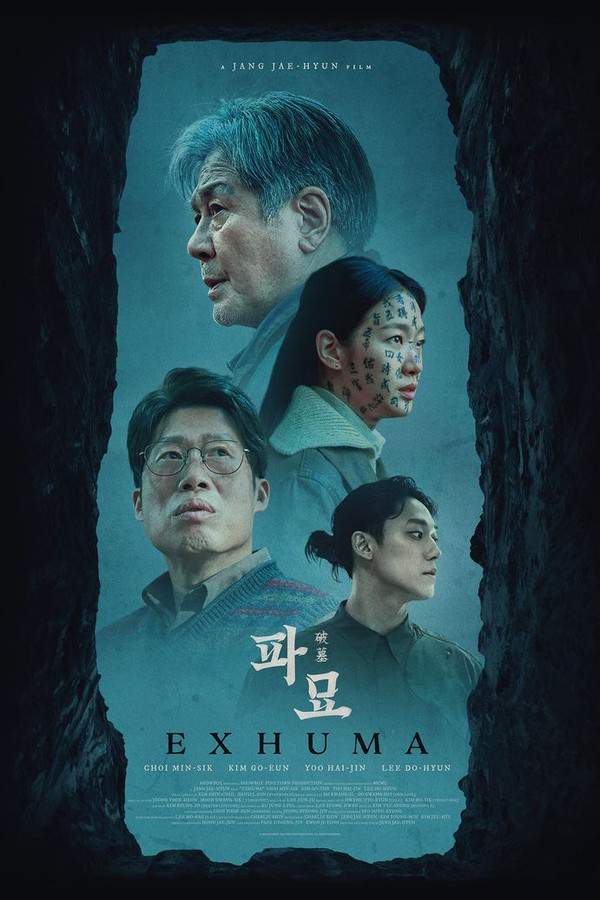
Exhuma’s ending reveals a story deeply rooted in Korean history, mythology, and spiritual practices. The spirit of Grandfather Park, a betrayed ancestor whose grave was dishonorably placed on a mountain infested with foxes, has been haunting his family for over a century because of a curse tied to his improper burial and his betrayal during Japan’s colonization of Korea. The ghost was furious because his burial site was noxious to his spirit, which led to a series of violent hauntings that culminated in the death of Ji-yong’s parents and Ji-yong himself. These tragic events were driven by the spirit’s desire to reclaim his family and punish the descendants who ignored his suffering.
The core of the film’s mystery involves a secret buried beneath the family’s history: Ji-yong’s grandfather was a traitor who sold out Korea to the Japanese during their occupation. His betrayal was concealed by his burial on a mountain, purposely chosen to hide an ancient iron stake—a remnant of Japanese colonial terror meant to weaken Korea’s spiritual and national energy. This iron stake was symbolized by a coffin buried with a cursed, supernatural vessel, the Anima, a Japanese samurai turned demonic spirit, which was intentionally placed underground to act as a boundary or anchor for the stake.
The climax sees Sang-deok, Hwarim, and their allies discovering that the Anima isn’t just a ghost but a powerful vessel created by Gisune—a wicked fox spirit and Onmyoji who manipulated the situation. Gisune transformed the samurai into a deadly spirit linked to a cursed katana, making the Anima a living iron stake embedded in the earth. To defeat this creature, Sang-deok uses traditional Feng Shui principles and elemental magic. Instead of finding a literal iron stake, he realizes that the key to defeating the Anima is to upset its elemental balance: using water and wood to nullify fire and metal—the elements that empower the spirit. By soaking a weapon in his blood and attacking the Anima with elements that counteract it, Sang-deok effectively destroys the demonic vessel, restoring harmony and ending the curse.
In the final moments, Sang-deok’s knowledge of Korean history, mythology, and Feng Shui allows him to outwit the powerful spirit. As the Anima is subdued by the elemental attack, peace is restored to the land, and the centuries-old curse is finally broken. The story ends with a note of hope and a deeper understanding that the true battle was not just against supernatural forces, but also against the hidden horrors of betrayal and colonization that still affect the present. Through teamwork, courage, and cultural wisdom, the characters succeed in destroying the malevolent spirit, bringing peace to their family and their nation.