

Plot Explained Spoilers guaranteed!
Plot Explained

Browse by genre

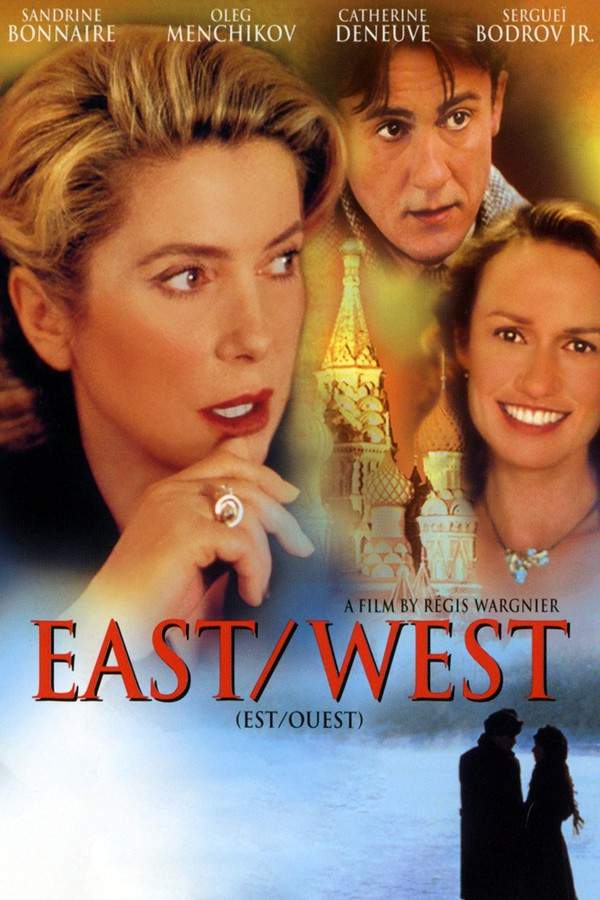
East/West (1999) movie poster

Timeline

East/West (1999) Timeline Explained – Every Event in Order

Release, runtime and language
1999 · 121 mins · French
Directed by
Régis Wargnier
Starring
Catherine Deneuve, Sandrine Bonnaire, Daniel Martin, René Féret, François Caron, Oleg Menshikov

In June 1946 Stalin publicly urges Russian émigrés to return, but the invitation is deadly. When a French ship lands in Odessa, only a physician, his French wife and their children avoid execution or prison. They are sent to Kiev, where she longs to flee back to France while he knows they are essentially captives, forcing them to watch every move.

On this page (6)
  1. 1 Where to watch
  2. 2 Events in order (14)
  3. 3 Timeline questions answered
  4. 4 Movie threads
  5. 5 Movies like East/West
  6. 6 Every angle

Where to watch

Where to Watch East/West (1999)

Where can you watch East/West? Stream, rent or buy it in the US, including on Amazon Video: current JustWatch availability with up-to-date prices.

Streaming availability powered by JustWatch

14 events in order · contains spoilers

East/West Timeline: Events in Chronological Order

Every key event of East/West (1999) in order, scene by scene, with when and where it takes place. Use it to untangle flashbacks, time jumps and parallel storylines, to refresh your memory before the sequel or to find the exact scene you are thinking of.

  1. Stalin's invitation and hopeful voyage

    In 1946 Stalin invites all White Russian émigrés to return and offers them citizenship. The Golovin family boards a crowded ship with other French émigrés, sharing songs and hopeful chatter about a peaceful rebirth of their homeland. The trip marks the start of a perilous new chapter as they approach the Soviet Union.

    When
    1946
    Where
    Aboard ship bound for the USSR
  2. Odessa arrival and the 'fit' vs. 'unfit' split

    Upon docking in Odessa, officials sort the returnees into 'fit' and 'unfit' groups, signaling the fragile promise behind Stalin's welcome. A young man is shot while trying to run back to his father, underscoring the peril behind the rhetoric. The Golovins sense the danger of what awaits them in the Soviet system.

    When
    1946
    Where
    Odessa, Ukraine
  3. Branded as spies and a new home in Kyiv

    Marie is branded a spy by a Soviet official and her French passport is torn up in front of her. The family moves into a cramped communal apartment in Kyiv, where suspicion and control tighten around them. The hopeful welcome gives way to constant vigilance and fear.

    When
    1946
    Where
    Kyiv, Ukraine
  4. Denunciation, shelter, and Sasha's arrival

    An elderly housekeeper who speaks French befriends Marie but is quickly denounced and taken away, foreshadowing the danger around them. Sasha, the housekeeper's grandson, arrives and loses his grandmother's room to others, prompting Marie to invite him to share the Golovins' space. Quiet acts of mercy become quiet acts of resistance.

    When
    1946
    Where
    Kyiv, communal apartment
  5. Marie longs for France and seeks help

    Marie yearns to return to France and pressures Soviet authorities to repatriate her, risking further trouble for the family. She also reaches out to the visiting French actress Gabrielle, hoping for an external lifeline. The tension between home and safety grows heavier with each attempt.

    When
    1946
    Where
    Kyiv
  6. Public duties, training, and a secret job

    Alexei publicly aligns with the party as a public health official, while Marie drifts toward quieter, covert actions. She helps Sasha train to regain his spot on the swimming team, seeing sport as a potential escape route. She also takes a job ironing costumes for the military choir in Kyiv.

    When
    1946
    Where
    Kyiv
  7. Couple's rift deepens and infidelity revealed

    Marie and Alexei's relationship deteriorates after he publicly thanks the Soviet government, a gesture she perceives as betrayal. He admits to sleeping with a neighbor, Olga, when Marie grew distant, and she throws him out. He moves into Olga's room, widening the distance between them.

    When
    1946-1947
    Where
    Kyiv
  8. Sasha's victory and the danger of secrets

    Sasha wins the trials and is selected for the European championships in Vienna. After the selection, he spends the night with Marie, a closeness that leads to trouble when her letters to France are found in his bags. The coach warns Marie to keep her distance.

    When
    1946-1947
    Where
    Vienna, Austria
  9. Escape plans take shape by the Black Sea

    While Sasha trains at a camp by the Black Sea, he arranges to be smuggled out of the USSR and Marie provides the money for the plan. Marie arrives in the port city with the military choir, ready to help execute the escape to the West. The scheme shifts from possibility to peril.

    When
    1947
    Where
    Black Sea coast / port city
  10. The escape attempt and KGB interrogation

    The ship captain initially resists the escape plan, but Sasha undertakes the dangerous voyage anyway. Marie is brutally interrogated by the same KGB official she first met, revealing the depth of the state's control. A French magazine later confirms Sasha's successful escape to the West, and Marie is jailed for six years.

    When
    1947-1948
    Where
    Offshore / port area; Moscow jurisdiction
  11. Release and family reunion

    Marie is released after six years and is reunited with her now-teenage son and her husband, who remains by her side. The reconciliation rekindles a fragile hope, with Alexei insisting that he still loves her despite everything. They attempt to rebuild their lives amid ongoing repression.

    When
    1953
    Where
    USSR
  12. Two years later: Sofia delegation and Gabrielle's role

    Two years after the reunion, the family travels on a delegation to Sofia, Bulgaria, where Alexei reveals that he arranged Marie's escape by writing to the actress Gabrielle. Marie and her son then escape with Gabrielle to the French embassy, seeking sanctuary in the West. The act marks a turning point in their struggle for freedom.

    When
    1955
    Where
    Sofia, Bulgaria
  13. Arrest of Alexei and the Sakhalin Gulag

    Marie and her son manage to reach the French embassy, but Alexei is arrested for complicity and sent to be a medic in a Gulag on Sakhalin. The family's escape does not guarantee safety for all, and the cost of resistance becomes clear. The separation foreshadows a long, uncertain exile.

    When
    1955
    Where
    French embassy; Sakhalin Gulag
  14. Glasnost and a distant return to France

    With the advent of glasnost in the Soviet Union, Alexei eventually returns to France in 1987, closing the long odyssey and allowing the family some measure of closure. The film ends on a note of cautious reconciliation and the enduring price paid for the pursuit of freedom. The era's changes finally bring a semblance of resolution after decades of hardship.

    When
    1987
    Where
    France

Last updated: December 04, 2025 at 15:32

Was this helpful?

Timeline questions answered

East/West Timeline Explained: Your Questions Answered

When does it happen, and why in that order? The questions people ask about the chronology of East/West (1999): time jumps, flashbacks, cause and effect between scenes and the correct order of events, each answered with spoilers.

Q1

Why did Stalin invite Russian émigrés to return if he planned to punish them?

Stalin's 1946 invitation was a deliberate trap. While publicly offering citizenship and promising a peaceful rebirth, the Soviet government actually used the return as a way to identify, neutralize, and eliminate White Russians who had opposed the Bolshevik regime. Upon arrival in Odessa, returning émigrés were sorted into 'fit' and 'unfit' groups, those deemed useful were sent to work, while others faced execution or Gulag sentences. The invitation was propaganda to lure exiles back into Stalin's control.

Foreshadowing: The hopeful atmosphere on the ship, filled with songs about returning to the motherland, contrasts sharply with the deadly reality that awaits in Odessa.

  • stalin invitation
  • émigrés
  • odessa
  • gulag
  • trap
Q2

Why was Marie Golovin branded a spy?

Marie was branded a spy primarily because she was French, a foreigner in the Soviet system, which automatically made her suspect. When a Soviet official tore up her French passport in front of her, she became stateless and trapped. Her persistent attempts to contact French authorities and seek repatriation further reinforced Soviet suspicions that she was working as a foreign agent, making her a target for surveillance and interrogation.

Foreshadowing: The moment her passport is destroyed marks the point of no return for Marie's freedom.

  • marie spy
  • passport
  • french wife
  • kgb
  • suspicion
Q3

Why did Alexei Golovin publicly support the Soviet government?

Alexei supported the Soviet government because he genuinely believed in Stalin's promises of reconstruction and saw compliance as the only way to protect his family. As a doctor, he was also given a public health role that required party alignment. His public support was a survival strategy, he believed that by appearing loyal, he could keep his family safe from the worst consequences of the regime, though this choice ultimately drove a wedge between him and Marie.

Foreshadowing: Alexei's public speech thanking the Soviet government directly triggers Marie's explosion of anger and their marital breakdown.

  • alexei
  • soviet support
  • party line
  • doctor
  • survival
Q4

Why did Alexei have an affair with neighbor Olga?

Alexei's affair with Olga stemmed from the growing coldness in his marriage. Marie had become increasingly distant and obsessed with escaping back to France, pushing Alexei away. When he confessed, he explained that Marie's emotional distance had hardened their relationship, and he sought comfort elsewhere. The affair also represented Alexei's partial integration into Soviet life, he was becoming complicit in the very system Marie resisted.

Foreshadowing: The affair deepens the rift between Marie and Alexei, pushing their marriage beyond repair and symbolizing their diverging paths.

  • alexei
  • olga
  • affair
  • marriage
  • distance
Q5

How did Sasha plan to escape the Soviet Union?

Sasha used his position as a competitive swimmer to orchestrate his escape. After earning a spot at the European Championships in Vienna, he traveled to a training camp by the Black Sea, where he arranged for a ship captain to take him offshore. He planned to swim six hours through dangerous waters to reach the vessel, which would then carry him to the West. Marie provided the money for this dangerous escape attempt.

Foreshadowing: Sasha's swimming talent, which Marie helped him train to reclaim, becomes his literal lifeline to freedom.

  • sasha escape
  • swimming
  • black sea
  • captain
  • vienna
Q6

Why was Marie imprisoned for six years?

Marie was sentenced to six years in prison because she helped orchestrate Sasha's escape attempt. When the KGB interrogated her, brutally, using the same official who had initially branded her a spy, they connected her to the smuggling operation. A French magazine later reported that Sasha had successfully reached the West, confirming Marie's involvement in the escape plot. Her role in facilitating defection was considered treasonous by Soviet authorities.

Foreshadowing: The coach's warning to Marie about keeping her distance from Sasha foreshadows the danger her connection to him would bring.

  • marie prison
  • imprisonment
  • kgb
  • interrogation
  • sasha escape
Q7

How did the family finally escape from the Soviet Union?

The family escaped two years after Marie's release when Alexei, still in the USSR, wrote to the French actress Gabrielle, who Marie had approached years earlier for help. Gabrielle responded, and the family traveled to Sofia, Bulgaria, as part of a delegation. From there, Marie and her son escaped with Gabrielle to the French embassy, finally reaching Western safety.

Foreshadowing: Gabrielle's earlier refusal to help Marie, when the Soviet system still held total control, contrasts with her later intervention during a more permissive political era.

  • sofia
  • bulgaria
  • gabby
  • french embassy
  • escape
  • delegation
Q8

Why was Alexei arrested after Marie escaped?

Alexei was arrested for complicity in his wife's escape. By writing to Gabrielle and facilitating the plan for Marie and their son to flee to the French embassy, Alexei committed an act of treason against the Soviet state. He was sent to a Gulag on Sakhalin Island, where he worked as a medic. His choice to help his family escape, knowing the consequences, represented his final rejection of the Soviet system, and the ultimate price he paid for freedom.

Foreshadowing: Alexei's earlier compliance with the regime makes his final act of resistance all the more significant and costly.

  • alexei arrest
  • sakhalin
  • gulag
  • complicity
  • consequences
Q9

What happened to the housekeeper who befriended Marie?

The elderly housekeeper who spoke French and befriended Marie was quickly denounced by someone in the building and taken away by Soviet authorities. She died as a result of her detention. Her grandson, also named Sasha, was left homeless when another couple took over her room, and Marie invited him to live with the Golovins. This event demonstrated the deadly danger of any connection to foreigners or suspected dissidents.

Foreshadowing: The housekeeper's fate foreshadows the constant peril facing anyone who shows kindness or connection to those marked as suspicious.

  • housekeeper
  • denouncement
  • death
  • sasha
  • kyiv apartment
Q10

Did Sasha successfully escape to the West?

Yes, Sasha successfully escaped to the West. After his dangerous swim to meet the ship offshore, he reached safety. His successful escape was later confirmed by a French magazine article, which is what triggered Marie's imprisonment, the Soviet authorities learned of her involvement through this foreign press coverage.

Foreshadowing: The dramatic escape attempt, which takes place while Marie performs with the military choir at the port, represents the story's most direct hope for freedom.

  • sasha
  • west
  • escape
  • france
  • successful
  • swim
Q11

How did Marie and Alexei reconcile after her release?

When Marie was released after six years, her husband and now-teenage son were waiting for her. Despite everything, their separation, his affair, his complicity with the Soviet system, they chose to reconcile. Alexei told Marie he still loved her, and they attempted to rebuild their family together. This reconciliation was tentative, shadowed by their difficult past, but they remained united until their eventual escape.

Foreshadowing: The family's reunion in 1953 sets the stage for the second escape attempt that finally succeeds years later.

  • reconciliation
  • family
  • prison release
  • reunion
  • marriage
Q12

When did Alexei finally return to France?

Alexei finally returned to France in 1987, decades after his family escaped. He had been imprisoned in the Sakhalin Gulag but survived, likely because his medical skills made him useful. His return came with the advent of glasnost under Gorbachev, which opened the Soviet Union and allowed many political prisoners and exiles to leave. This marks the end of the family's long ordeal, nearly 41 years after they first arrived in the USSR.

Foreshadowing: The film ends on a note of cautious hope, the price of freedom was enormous, but the family eventually found partial resolution.

  • glasnost
  • 1987
  • alexei
  • france
  • return
  • sakhalin

Movie threads

More Movies Like East/West, by Mood & Story

Curated lists built around what makes East/West tick: the same mood, the same kind of story or the same emotional payoff. Each list explains why these movies belong together.

Movies about life under oppressive regimes like East/West

Stories of individuals trapped by totalitarian states, where the walls are politics. Explore films similar to East/West that depict the claustrophobic reality of life under authoritarian rule. If you liked the tense atmosphere and high-stakes survival in Stalinist Russia, you'll find more movies about political prisoners, forced exile, and the fight for human dignity against overwhelming odds.

  • oppressive
  • anxious
  • claustrophobic
  • desperate
  • somber
  • tense
  • Tone: bleak, tense
  • Pacing: steady, methodical
Why these movies?

The story pattern: Narratives in this thread typically follow ordinary people caught in the machinations of a brutal state. The central conflict is between the individual's will to live freely and the suffocating control of the regime, often involving failed escape attempts, interrogations, and the moral compromises required to survive.

Why they belong together: Movies are grouped here for their shared atmosphere of political oppression and the intense focus on survival. They share a bleak tone, high emotional weight, and a pervasive sense of claustrophobia, making the viewer feel the characters' desperation and the immense pressure of the system.
Movies about relationships tested by hardship like in East/West

Love stories tested to the breaking point by circumstances beyond their control. Find more films like East/West that explore how love and commitment are challenged by extreme circumstances. If you were moved by the story of a marriage strained by political imprisonment and exile, this collection features similar dramas about relationships pushed to their limits.

  • melancholic
  • desperate
  • somber
  • emotional
  • marital strife
  • heartbreaking
  • Tone: somber, desperate, bittersweet
  • Pacing: steady, character-driven
Why these movies?

The story pattern: The narrative pattern revolves around a couple whose unity is shattered by an external crisis. The story charts their emotional separation as they react differently to the pressure—one may cling to hope or pragmatism, while the other seeks escape or rebellion—leading to profound personal sacrifice and a bittersweet resolution.

Why they belong together: These films are connected by their core focus on a relationship as the emotional anchor amidst overwhelming hardship. They share a heavy emotional weight, a steady pacing that allows for deep character exploration, and often a bittersweet or bleak ending reflecting the cost of survival.

If you liked this

Movies Like East/West

Similar movies to East/West: the same genre, themes or kind of story. Each one comes with its own plot summary, timeline and ending explained.

Browse all movie summaries

Every angle

East/West (1999) Explained: Plot, Timeline & Characters

Everything about East/West in one place: what happens in the plot summary, the timeline in chronological order, the characters and meaning and a spoiler-free summary. What's After the Movie adds the cast, box office and post-credit scenes.

Coming soon on iOS and Android

The Plot Explained Movie Summary App

Plot summaries, endings explained and timelines on your phone. Catch up on any movie in minutes, save your favorites and never miss a twist again.

Be the first to know when we launch. Your email stays private, always.

Learn more about the app