Plot Explained Spoilers guaranteed!
Plot Explained

Browse by genre

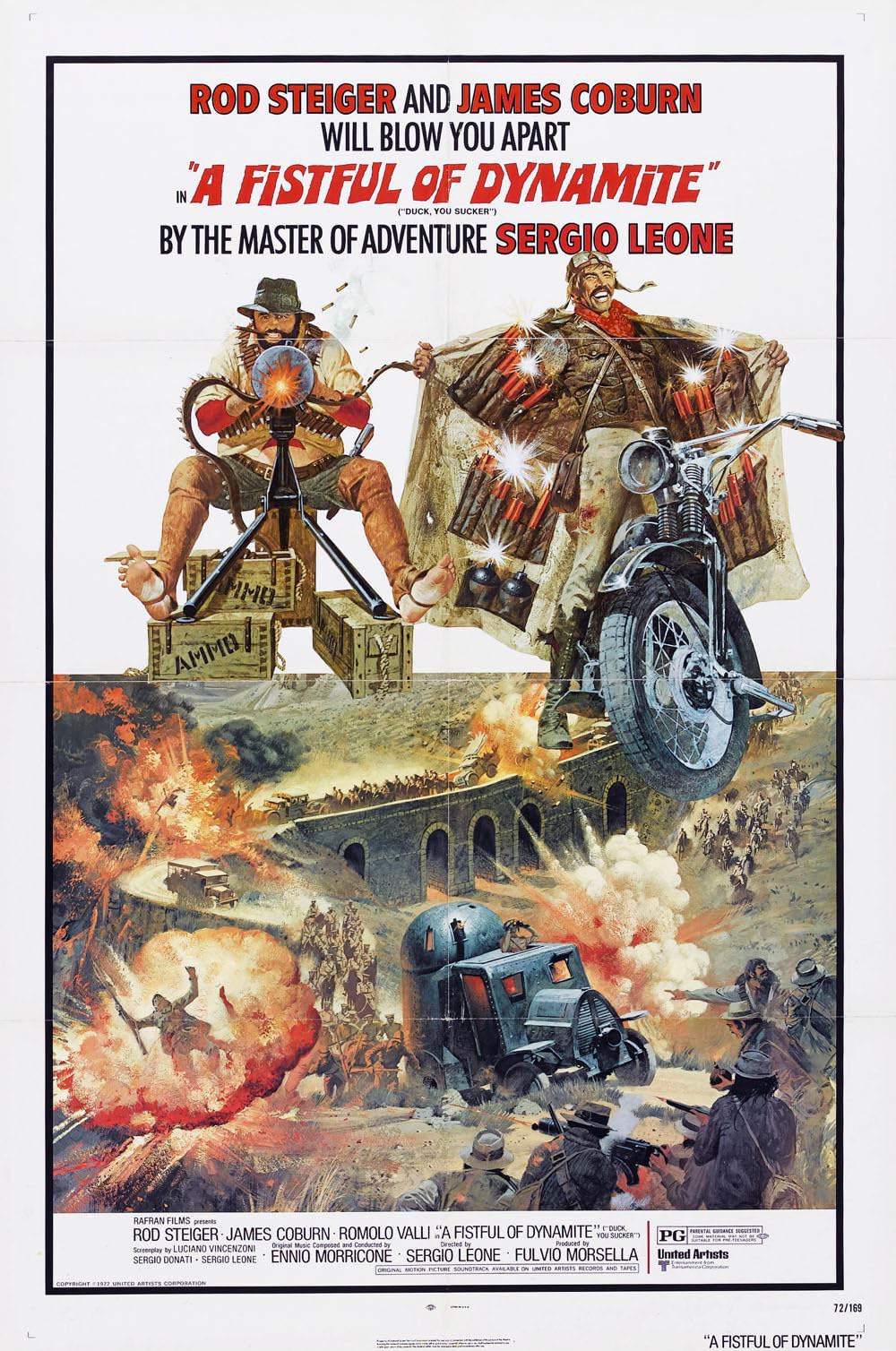
Duck, You Sucker (1972) movie poster

Plot Summary

Duck, You Sucker (1972) Plot Summary Explained

Release, runtime and language
1972 · 138 min
JustWatch #1,506 16
Directed by
Sergio Leone
Starring
Rod Steiger, James Coburn

A hardened outlaw and a young Irish revolutionary find themselves unexpectedly allied in revolutionary Mexico. Their shared defiance of authority ignites a rebellion, transforming them from wanted criminals into celebrated figures fighting for freedom. The conflict escalates as they navigate a landscape of danger and uncertainty, facing powerful forces determined to suppress their fight.

On this page (5)
  1. 1 Where to watch
  2. 2 What happens: full plot
  3. 3 Plot questions answered
  4. 4 Movie threads
  5. 5 Every angle

Where to watch

Where to Watch Duck, You Sucker (1972)

Where can you watch Duck, You Sucker? Stream, rent or buy it in the US, including on Amazon Prime Video, Amazon Prime Video Free and Tubi TV: current JustWatch availability with up-to-date prices.

Streaming availability powered by JustWatch

Full plot summary · contains spoilers

What Happens in Duck, You Sucker: Full Plot Summary

The whole story of Duck, You Sucker (1972) explained, from the opening scene to the final frame: every key event, every twist and what it all adds up to. Read it as a quick recap before the sequel, to check a scene you missed, or to finally understand what really happened.

In the turbulent landscape of 1913 Mexico, where revolution hangs in the air, outlaw Juan Miranda heads a gang of bandits. The story begins when he and his crew rob a coach filled with wealthy travelers, leading to a violent encounter that sees him assault a female passenger who dares to insult him. Amid this chaos, an Irish Republican explosives expert, John H. Mallory, passes by on his motorcycle. Juan, eager for wealth and power, implores John—initially introducing himself as "Seán"—to assist in robbing the Mesa Verde National Bank. When John declines, Juan cunningly frames him for the murders of his employer and several soldiers, branding him a wanted criminal. He offers John a dubious protection in exchange for his cooperation, forcing John to reluctantly agree to the robbery. However, seeing an opportunity, John escapes before reaching the bank.

Arriving in the city ahead of Juan, John allies himself with revolutionaries led by the physician Dr. Villega. The pair orchestrates a daring attack on the Mexican army by targeting the bank, but Juan is taken aback to discover that the bank serves not merely as a financial institution, but rather as a prison for political dissidents. In an unexpected turn, Juan emerges from the mission as a celebrated figure among revolutionaries after liberating several prisoners.

However, the tide turns as Colonel Günther Reza leads an army detachment to pursue the revolutionaries into the hills. John and Juan, equipped with explosives, bravely volunteer to stay behind and hold their ground. An explosive battle ensues, causing massive casualties when John detonates a bridge, but Reza survives the encounter. Following the chaos, both John and Juan are devastated to find that many of their comrades, including Juan's family members, have perished due to the army's brutality. Overcome by grief and rage, Juan vows to confront the army single-handedly, leading to his capture.

At this point, John infiltrates the enemy camp where he witnesses a brutal execution of revolutionaries, shockingly revealing Dr. Villega's role in informing on them. This betrayal sparks painful memories for John of his past in Ireland, where his own friend, Nolan, had betrayed him, setting him on a path of violence and exile. Just as Juan faces the firing squad, John intervenes, using dynamite to free him.

The pair successfully escape on a motorcycle, seeking refuge in the animal compartment of a train. Fate has them encounter the tyrannical Governor Don Jaime, who is escaping with his riches. When revolutionary forces ambush the train, John presents Juan with a harrowing choice: kill Jaime or accept a bribe. In an unexpected move, Juan chooses to kill Jaime, seizing his loot. Upon exiting the train, he is triumphantly hailed as a hero once again amidst the revolutionaries.

As they travel with the revolutionary command, John and Juan are rejoined by the escaping Dr. Villega, although only John knows of Villega’s treachery. Faced with a looming threat from Pancho Villa's forces and an impending train packed with enemy soldiers, John devises a bold plan to rig a locomotive with dynamite to thwart their enemy. When it comes time to select a partner for this dangerous mission, John chooses Villega over Juan, despite Juan's eagerness to help. Despite John's pleas for Villega to abandon the train before it crashes, the latter's guilt keeps him aboard. John leaps to safety just in time, while the trains’ collision results in the death of Villega and many Mexican soldiers.

While the initial ambush is successful, John suffers a critical injury from Reza's gunfire during the aftermath. Enraged, Juan retaliates, killing Reza, but as John lays dying, he is haunted by memories of Nolan and a shared love interest. As Juan kneels beside him, seeking information about Villega's fate, John only remarks that Villega "died a hero of the revolution." With Juan rushing to find help, John triggers an explosive charge he secretly planted, obliterating everything. Later, as he watches John's charred remains, Juan reflects despondently on their journey, whispering, “What about me?”
Last updated: November 16, 2024 at 11:29

Was this helpful?

Plot questions answered

Duck, You Sucker Plot Explained: Your Questions Answered

The questions people ask most about Duck, You Sucker (1972): what happens in the confusing scenes, why the characters do what they do, the twists, hidden details and what the ending means. Each answer contains spoilers.

Q1

Why does Juan frame John for the murders?

Juan frames John for the murders of his employer and several soldiers because John initially refuses to help him rob the Mesa Verde National Bank. Faced with John's refusal, Juan uses the framing as a way to force John into cooperation, by making him a wanted criminal, Juan presents himself as John's only protection. This cunning manipulation forces John to reluctantly agree to participate in the robbery under threat of capture.

Foreshadowing: Earlier, Juan's violent assault of the female passenger establishes his willingness to use coercion and violence to get what he wants.

  • Juan Miranda
  • John Mallory
  • framed murder
  • Mesa Verde bank robbery
  • coercion
Q2

Why does the bank serve as a prison for political dissidents?

In revolutionary Mexico of 1913, the Mesa Verde National Bank was being used by the government as a detention facility for political prisoners, revolutionaries who opposed the regime. This dual purpose was a common practice during the Mexican Revolution, where institutions were repurposed to suppress opposition. When John and the revolutionaries attack the bank, they discover it houses these prisoners, which shifts their mission from a simple robbery to a liberation act.

  • Mesa Verde bank
  • political prisoners
  • Mexican revolution
  • prison
  • bank heist
Q3

Why does Juan become a hero among the revolutionaries?

Juan becomes a revolutionary hero because during the bank attack, he helps liberate the political dissidents imprisoned within the facility. Rather than simply robbing the bank, Juan participates in freeing these prisoners, which transforms his image from a selfinterested outlaw to a champion of the revolutionary cause. His willingness to fight alongside the revolutionaries and his role in the liberation earns him celebrated status.

Foreshadowing: Juan's initial motivation is wealth and power, but his exposure to the revolutionaries' cause begins shifting his priorities.

  • Juan Miranda
  • revolutionary hero
  • liberation
  • political prisoners
  • Mesa Verde
Q4

Why does Dr. Villega betray the revolutionaries?

Dr. Villega betrays the revolutionaries by informing Colonel Reza's forces of their location, leading to the execution of captured revolutionaries. The exact motivation isn't fully detailed in the film, but his betrayal appears motivated by self-preservation, attempting to save himself when facing capture or coercion from the Mexican army. His betrayal mirrors John's past experience with Nolan in Ireland, where a friend's treachery led to violence and exile.

Foreshadowing: The meta notes establish betrayal as a recurring theme in the narrative, connecting to John's Irish memories.

  • Dr. Villega
  • betrayal
  • Colonel Reza
  • revolutionaries
  • informer
Q5

Why does John choose Villega for the train mission instead of Juan?

John chooses Villega for the dangerous dynamite mission despite Juan's eagerness to help because John knows Villega has betrayed the revolutionaries. By selecting Villega, John is effectively condemning the doctor to die, a form of revenge for the betrayal that led to the death of many comrades. John urges Villega to abandon the train before the crash, but Villega's guilt keeps him aboard, resulting in his death in the collision.

Foreshadowing: John's knowledge of Villega's betrayal was established when he infiltrated the enemy camp and witnessed the execution.

  • John Mallory
  • Villega
  • train explosion
  • dynamite mission
  • revenge
Q6

Why does Juan kill Governor Don Jaime instead of taking the bribe?

Juan kills Governor Don Jaime rather than accepting the bribe because by 1913, Juan has undergone a genuine transformation from self-interested outlaw to committed revolutionary. When faced with the choice between personal wealth and eliminating a tyrannical leader of the regime, Juan chooses the revolutionary act. This decision marks his complete ideological shift, killing Jaime symbolizes his commitment to the cause over personal gain, which is why he is hailed as a hero once again.

Foreshadowing: Juan's earlier role in liberating political prisoners already demonstrated his shift toward revolutionary ideals.

  • Juan Miranda
  • Governor Don Jaime
  • kill
  • bribe
  • revolutionary hero
  • train ambush
Q7

Why does John trigger the final explosion that kills himself?

John triggers the final explosion as he lies dying from Colonel Reza's gunfire, haunted by memories of Nolan and a shared love interest from his past. The explosion serves as his final act, a self-inflicted death rather than allowing himself to be captured or dying slowly from his wounds. This tragic end reflects the film's dark, cynical tone about revolution and violence, where even the heroes meet grim fates.

Foreshadowing: John's painful memories of Nolan's betrayal and his own path of violence foreshadow his self-destructive ending.

  • John Mallory
  • final explosion
  • death
  • Colonel Reza
  • self-sacrifice
Q8

Why does John tell Juan that Villega died a hero?

John tells Juan that Villega died a hero of the revolution despite knowing Villega was a traitor, likely to spare Juan the painful truth at that moment. Juan is already grieving the loss of his partner and family, and learning of Villega's betrayal would add to his suffering. This final lie maintains Juan's idealized view of the revolution and their journey together, though it also underscores the film's themes of deception and the complex morality of revolutionary struggle.

Foreshadowing: John's knowledge of the betrayal was established when he witnessed Villega's role in the executions at the enemy camp.

  • John Mallory
  • Villega
  • died a hero
  • lie
  • revolution
  • betrayal
Q9

What does the title "Duck, You Sucker" mean?

"Duck, You Sucker" is an English rendering of the Italian title "Giù la testa" (literally "Duck your head"), which itself comes from the expression "Impiccato più in alto dell'alto" (roughly "You'll be hung higher than the tall one"). In the context of the film, the title refers to the need to duck when passing beneath gallows, a darkly ironic warning about the inevitable fate awaiting those involved in violence and revolution. It encapsulates the film's fatalistic view of the characters' journey.

  • title meaning
  • Giù la testa
  • Italian title
  • fate
  • revolution
Q10

Why does Juan assault the female passenger during the coach robbery?

Juan assaults the female passenger who insults him during the coach robbery as a display of power and dominance. The attack establishes Juan's character as a violent, volatile outlaw with no regard for those who challenge or disrespect him. This early act of brutality sets the tone for his transformation throughout the film, making his later evolution into a revolutionary hero more significant and complex.

Foreshadowing: This violent temperament later transforms through his experiences with the revolutionaries.

  • Juan Miranda
  • female passenger
  • coach robbery
  • assault
  • violence

Movie threads

More Movies Like Duck, You Sucker, by Mood & Story

Curated lists built around what makes Duck, You Sucker tick: the same mood, the same kind of story or the same emotional payoff. Each list explains why these movies belong together.

Gritty Revisionist Westerns like Duck, You Sucker

Anti-heroic tales that deconstruct the myths of the old west with brutal honesty. If you liked the cynical, violent, and anti-heroic perspective of Duck, You Sucker, explore these other gritty revisionist Westerns. These movies deconstruct the myths of the old west, focusing on morally complex characters and the brutal realities of conflict, offering a darker, more realistic take on the genre.

  • gritty
  • violent
  • cynical
  • brutal
  • unforgiving
  • melancholic
  • Tone: dark, cynical, melancholic
  • Pacing: fast, driven by action and conflict
Why these movies?

The story pattern: Stories in this thread often follow flawed, pragmatic protagonists navigating a world where traditional heroism is futile or punished. The narrative journey typically involves a descent into violence, confrontations with systemic corruption, and endings that are bittersweet or bleak, challenging the notion of a triumphant frontier spirit.

Why they belong together: Movies are grouped here for their shared dark tone, high-intensity violence, and a fundamentally cynical view of history and heroism. They prioritize gritty atmosphere, complex character motivations over clear morality, and an emotional weight that comes from portraying the unforgiving nature of their worlds.

Movies with Unlikely Partnerships like in Duck, You Sucker

Mismatched allies forged in fire, facing overwhelming odds together. Fans of the dynamic between Juan and John in Duck, You Sucker will enjoy these films about unlikely partnerships. These stories feature mismatched duos—often a pragmatist and an idealist—whose bond is tested by violence and tragedy, creating powerful narratives of survival and reluctant camaraderie.

  • tense
  • desperate
  • tragic
  • brutal
  • gritty
  • melancholic
  • Tone: dark, tense, tragic
  • Pacing: fast, action-oriented
Why these movies?

The story pattern: The narrative pattern revolves around the development of a relationship between two contrasting characters—such as a cynical realist and a passionate idealist. Their journey is defined by shared danger, moments of betrayal or sacrifice, and a final bond that is profoundly impactful, often culminating in a bittersweet or tragic conclusion that highlights the cost of their alliance.

Why they belong together: These films are connected by their focus on a central, compelling duo dynamic. The similarity lies in the emotional arc of the partnership itself, set against a backdrop of high stakes and violence. The pacing is often fast, driven by the duo's escapes and confrontations, and the tone is dark due to the harsh world they navigate.

Every angle

Duck, You Sucker (1972) Explained: Plot, Timeline & Characters

Everything about Duck, You Sucker in one place: what happens in the plot summary, the timeline in chronological order, the characters and meaning and a spoiler-free summary. What's After the Movie adds the cast, box office and post-credit scenes.

Coming soon on iOS and Android

The Plot Explained Movie Summary App

Plot summaries, endings explained and timelines on your phone. Catch up on any movie in minutes, save your favorites and never miss a twist again.

Be the first to know when we launch. Your email stays private, always.

Learn more about the app