Plot Explained Spoilers guaranteed!
Plot Explained

Browse by genre

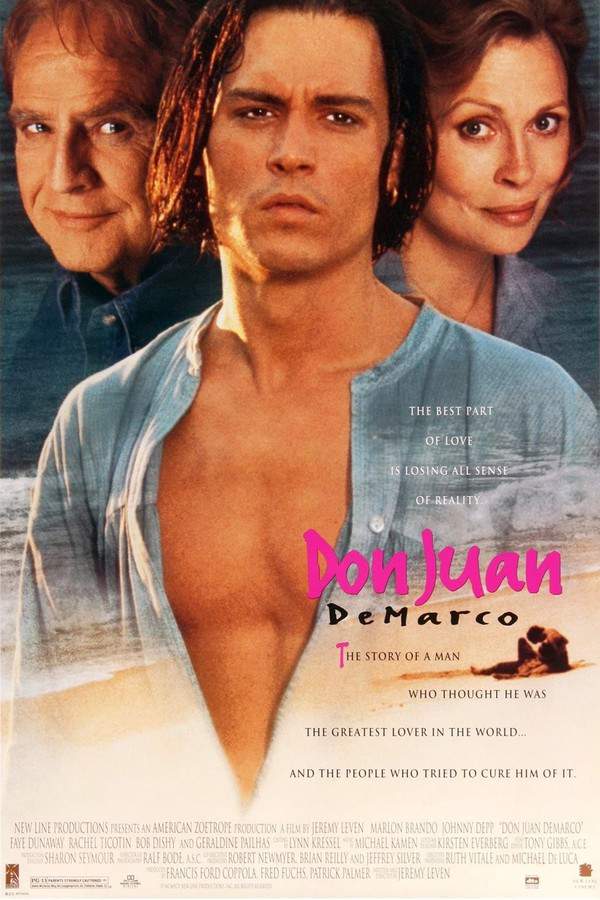
Don Juan DeMarco (1995) movie poster

Plot Summary

Don Juan DeMarco (1995) Plot Summary Explained

Release, runtime and language
1995 · 97 min · English
JustWatch #32,288 3
Directed by
Jeremy Leven
Starring
Johnny Depp, Marlon Brando
Budget
$25M

A world-weary psychiatrist finds his professional and personal life disrupted when a charismatic young man enters his office claiming to be the legendary lover, Don Juan. As the psychiatrist tries to understand this unusual patient, he's forced to confront his own cynicism and question his understanding of love and life. The encounter proves to be transformative for both men.

On this page (6)
  1. 1 Where to watch
  2. 2 What happens: full plot
  3. 3 Plot questions answered
  4. 4 Movie threads
  5. 5 Movies like Don Juan DeMarco
  6. 6 Every angle

Where to watch

Where to Watch Don Juan DeMarco (1995)

Where can you watch Don Juan DeMarco? Stream, rent or buy it in the US, including on YouTube Free, Amazon Video and Apple TV Store: current JustWatch availability with up-to-date prices.

Streaming availability powered by JustWatch

Full plot summary · contains spoilers

What Happens in Don Juan DeMarco: Full Plot Summary

The whole story of Don Juan DeMarco (1995) explained, from the opening scene to the final frame: every key event, every twist and what it all adds up to. Read it as a quick recap before the sequel, to check a scene you missed, or to finally understand what really happened.

John Arnold DeMarco, clad in full Zorro regalia, steps into the spotlight as Don Juan, a vibrant 21-year-old brimming with dramatic flair. In a moment of despair, he contemplates taking his life on a billboard, but is rescued by psychiatrist Jack Mickler, who adopts the persona of Don Octavio de Flores to prevent this tragedy. Subsequently, John finds himself confined at a mental institution for observation, where Mickler, nearing retirement, decides to perform an extensive evaluation without resorting to sedatives.

As Mickler listens to John's fantastical tales, still embodying the charming Don Octavio, he becomes aware of several discrepancies, such as John's distinct Castilian accent. Regardless, Mickler plays along with John's stories, allowing himself to be swept away by the youth's spirited enthusiasm.

Meanwhile, back in his mundane life, Mickler's daily routine with his wife Marilyn feels dull in comparison. However, John's presence at the hospital has a surprising impact on the staff; it distracts the women and even prompts a male attendant to showcase his dancing skills on the lawn. This newfound energy inspires Mickler to revisit his love for opera and reignite the passion in his marriage.

As their conversations unfold, Mickler finds himself increasingly entangled in John's narrative, even while questioning the authenticity of the young man's claims. John's grandmother arrives, providing a stark contrast to John's grand tales: he actually hails from Phoenix, Arizona, and tragically lost his father in a car crash. John vehemently dismisses her revelations, accusing her of sharing the same cruelty displayed by his mother, whom he insists is now a nun.

Mickler, undeterred, shares a poignant story about another young man who longed to connect with a woman he admired but faced a harsh rejection that led him to attempt suicide. This story strikes a chord with John, evoking a visceral reaction and violent anger at the mention of such despair.

As John's evaluation deadline draws closer, Mickler feels the weight of expectations to recommend the youth's indefinite confinement—an outcome he is growing increasingly uncomfortable with. The enigmatic circumstances surrounding John's mother, currently a nun, add to the mounting intrigue. In their final session, Mickler probes deep into John's feelings, hinting at possible infidelities of his mother, which provokes an explosive response from John.

As the finale approaches, it becomes evident that John's existence has been a tapestry woven with intense passions and heartaches. After enduring two challenging years in a luxurious harem as the cherished of the Sultaness, he believed he found his true love in Doña Ana, only to face cruel rejection on a picturesque Greek island. In a profound twist, Mickler concludes that John truly embodies Don Juan DeMarco, the most legendary lover known to mankind. When John questions Mickler's own identity, the seasoned psychiatrist reveals himself as Don Octavio de Flores, claiming that his various personas were merely disguises that John has expertly dismantled.

As their transformative journey approaches its end, Mickler successfully persuades John to confront reality by taking his medication and gently clarifying that not everyone perceives him as Don Juan. Before Mickler's retirement, he facilitates a crucial meeting between John and the board, where John, dressed casually and speaking with an American accent, narrates his true life story: born in Queens, facing familial loss, and grappling with the truth of his mother's unfaithfulness. Armed with this clarity, John is finally set free from his fantasies, ready to pursue a fresh start in life, accompanied by Mickler and the doctor's wife, as they embark on a journey to the remote Greek island where Don Juan first met his one true love.
Last updated: November 21, 2024 at 11:15

Was this helpful?

Plot questions answered

Don Juan DeMarco Plot Explained: Your Questions Answered

The questions people ask most about Don Juan DeMarco (1995): what happens in the confusing scenes, why the characters do what they do, the twists, hidden details and what the ending means. Each answer contains spoilers.

Q1

Why does Dr. Mickler play along with John's Don Juan persona instead of treating him immediately?

Mickler recognizes that John's fantasy serves as a protective mechanism against his real trauma. By engaging with John as Don Octavio, Mickler builds trust and gradually uncovers the painful truths beneath the fantasy. This approach allows John to feel understood rather than dismissed, ultimately making him receptive to confronting reality.

Foreshadowing: Early in their sessions, Mickler notices inconsistencies in John's stories but chooses to explore rather than confront them.

  • psychiatric treatment
  • fantasy
  • therapy approach
  • patient trust
Q2

Why does John react with violent anger when Mickler suggests his mother was unfaithful?

John's entire fantasy identity as Don Juan is built around rejecting his mother's real betrayal. The truth, that his mother was unfaithful and his father died as a result, is too painful to accept, so John constructed an elaborate alternate reality where his mother is a virtuous nun. Mickler's direct confrontation of this lie threatens the entire psychological framework John uses to survive.

Foreshadowing: John's grandmother earlier revealed that John's mother is not a nun, setting up this confrontation.

  • mother infidelity
  • trauma
  • rejection
  • fantasy identity
Q3

What is the significance of Mickler revealing he is also Don Octavio?

Mickler's reveal that he has been wearing his own personas, pretending to be Don Octavio, demonstrates that both men have been living behind masks. This moment blurs the line between therapist and patient, showing John that everyone constructs identities to cope with life's disappointments. It validates John's journey while also encouraging him to shed his fantasy and face reality.

Foreshadowing: Mickler's own life dissatisfaction and dormant passion for opera have been subtly revealed throughout the film.

  • identity
  • personas
  • transformation
  • psychologist-patient relationship
Q4

What happened to John's father and why does it matter?

John's father died in a car crash, a loss that profoundly scarred John. This trauma underlies his entire psychological breakdown. The death appears connected to his mother's infidelity, when Mickler hints at this connection, John's violent reaction confirms the depth of his pain. Losing his father made John reject reality altogether and retreat into fantasy.

Foreshadowing: John's grandmother mentions his father's death when she tries to pull him back to reality.

  • father death
  • car crash
  • trauma
  • childhood loss
Q5

Why did John choose to become Don Juan instead of just being delusional about something else?

John's adoption of Don Juan specifically represents his attempt to become the ideal lover who never experiences rejection, the opposite of what happened to him with Doña Ana on the Greek island. Don Juan is legendary for being irresistible, so John became him to never again feel the devastating pain of rejection he experienced when his true love turned him away.

Foreshadowing: John's story of rejection by Doña Ana on the Greek island is presented as the triggering event for his breakdown.

  • don juan
  • rejection
  • idealization
  • escapism
Q6

Why does Mickler recommend John's release at the end?

Mickler recognizes that John is no longer a danger to himself and has gained genuine insight into his situation. By revealing his true story at the board meeting, accepting his origins in Queens and his mother's betrayal, John demonstrates he's ready to live in reality rather than fantasy. The transformation is complete when John willingly takes his medication and chooses to face life honestly.

Foreshadowing: John's final conversation with Mickler about taking medication shows his willingness to confront reality.

  • release
  • recovery
  • insight
  • board meeting
Q7

Why does John believe his mother is a nun when she's not?

John's claim that his mother became a nun is part of his fantasy constructed to cope with her real betrayal. In his imagination, his mother is pure and virtuous, a nun, rather than the unfaithful woman who may have contributed to his father's death. This lie John tells himself protects him from the painful truth that his mother was disloyal to his father.

Foreshadowing: The revelation that John's mother is actually not a nun comes from his grandmother early in the evaluation.

  • mother
  • nun
  • fantasy
  • denial
Q8

What is the significance of John's claimed experience in a harem?

John's tale of spending two years in a luxurious harem as the cherished companion of a Sultaness represents his fantasy of complete acceptance and adoration, a stark contrast to the rejection he experienced from Doña Ana. This period in his story represents the idealized love he craves but couldn't find in reality, further illustrating how his fantasy provides what real life denied him.

Foreshadowing: The harem story contrasts with the painful rejection John experienced on the Greek island.

  • harem
  • fantasy
  • rejection
  • idealized love
Q9

Why is John dressed as Zorro when he climbs the billboard?

John's Zorro costume represents his romantic self-image as a dashing hero who rescues others, not himself. This theatrical choice reflects his need to perform heroism even in despair. The costume also connects to his broader fantasy identity, Zorro and Don Juan are both legendary romantic figures from Spanish literary tradition that John uses to construct his ideal self.

Foreshadowing: John's full commitment to romantic personas is established from the very first scene.

  • zorro
  • costume
  • theatricality
  • identity
Q10

How does John's presence at the hospital affect Mickler's marriage?

John's infectious enthusiasm and romantic outlook revive the passion in Mickler's marriage to Marilyn. Watching John pursue grand romantic ideals sparks Mickler to reconnect with his forgotten love of opera and to see his wife anew. This revitalization mirrors John's own journey, both men escape from cynicism and rediscover wonder and love.

Foreshadowing: Mickler's mundane routine with Marilyn is established early, making his transformation more meaningful.

  • marriage
  • revitalization
  • passion
  • opera
Q11

Why do they go to the Greek island at the end of the movie?

The Greek island is where John's fictional Don Juan first met Doña Ana, his one true love who rejected him. By journeying there with Mickler and Marilyn, John symbolically confronts the place where his fantasy shattered. This represents his commitment to facing reality rather than running from it, while also honoring the emotional journey that transformed him.

Foreshadowing: John's rejection by Doña Ana on this island is presented as the catalyst for his breakdown.

  • greek island
  • dona ana
  • rejection
  • confrontation

Movie threads

More Movies Like Don Juan DeMarco, by Mood & Story

Curated lists built around what makes Don Juan DeMarco tick: the same mood, the same kind of story or the same emotional payoff. Each list explains why these movies belong together.

Movies about therapeutic role reversal like Don Juan DeMarco

Stories where an unusual patient forces a jaded professional to rediscover life. Discover movies like Don Juan DeMarco where the patient-doctor dynamic is flipped. If you enjoyed the story of a psychiatrist revitalized by his patient's fantastical tales, you'll find similar films about jaded professionals transformed by those they are meant to treat.

  • redemptive
  • introspective
  • uplifting
  • melancholic
  • transformative
  • dialogue-driven
  • Tone: whimsical, melancholic, uplifting
  • Pacing: steady, conversational
Why these movies?

The story pattern: The narrative follows a world-weary professional whose cynicism is challenged by an extraordinary patient. Through sessions and interactions, the patient's perspective—whether fantastical, naive, or deeply wounded—acts as a catalyst, forcing the professional to confront their own unhappiness and re-engage with life, love, or their own forgotten passions.

Why they belong together: These films are grouped by their shared focus on mutual healing and the blurring of traditional roles. They share a moderate emotional weight, a steady pacing driven by dialogue and revelation, and a tone that balances melancholic realism with hopeful, transformative outcomes.

Movies where fantasy redeems reality like Don Juan DeMarco

Characters escape painful reality by constructing elaborate, life-affirming fantasies. Explore films similar to Don Juan DeMarco that celebrate the power of imagination. If you liked the theme of a character's elaborate fantasy bringing joy and change to a cynical world, you'll enjoy these stories about beautiful delusions that heal and transform.

  • whimsical
  • imaginative
  • dreamlike
  • melancholic
  • uplifting
  • escapist
  • Tone: whimsical, imaginative, bittersweet
  • Pacing: steady, contemplative
Why these movies?

The story pattern: The narrative centers on a character who constructs an elaborate alter ego or fantasy world to cope with loss, pain, or a dull existence. This fantasy initially seems like escapism but is gradually revealed to be a source of strength, creativity, and connection, ultimately blurring the lines between what is real and what is beneficial.

Why they belong together: These movies are united by their whimsical tone and their exploration of the line between fantasy and reality. They share a moderate complexity stemming from this duality, a medium intensity that handles serious themes with a light touch, and an ending feel that is ultimately happy or uplifting, affirming the value of imagination.

If you liked this

Movies Like Don Juan DeMarco

Similar movies to Don Juan DeMarco: the same genre, themes or kind of story. Each one comes with its own plot summary, timeline and ending explained.

Browse all movie summaries

Every angle

Don Juan DeMarco (1995) Explained: Plot, Timeline & Characters

Everything about Don Juan DeMarco in one place: what happens in the plot summary, the timeline in chronological order, the characters and meaning and a spoiler-free summary. What's After the Movie adds the cast, box office and post-credit scenes.

Coming soon on iOS and Android

The Plot Explained Movie Summary App

Plot summaries, endings explained and timelines on your phone. Catch up on any movie in minutes, save your favorites and never miss a twist again.

Be the first to know when we launch. Your email stays private, always.

Learn more about the app