Plot Explained Spoilers guaranteed!
Plot Explained

Browse by genre

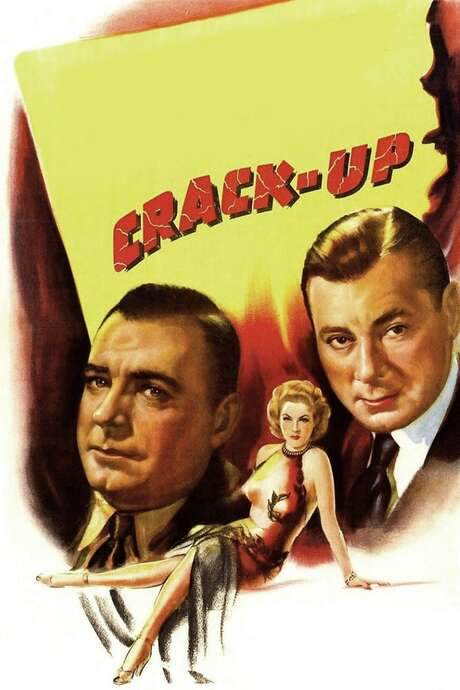
Crack-Up (1946) movie poster

Timeline

Crack-Up (1946) Timeline Explained – Every Event in Order

Release, runtime and language
1946 · 96 mins · English
Loading streaming availability…
Directed by
Irving Reis
Starring
Claire Trevor, Tommy Noonan, Pat O'Brien, Ellen Corby, Erskine Sanford, Ray Collins

Could I KILL … and not remember? Art curator George Steele experiences a train wreck…which never happened. Is he cracking up, or the victim of a plot?

On this page (6)
  1. 1 Where to watch
  2. 2 Events in order (12)
  3. 3 Timeline questions answered
  4. 4 Movie threads
  5. 5 Movies like Crack-Up
  6. 6 Every angle
Loading streaming availability…

12 events in order · contains spoilers

Crack-Up Timeline: Events in Chronological Order

Every key event of Crack-Up (1946) in order, scene by scene, with when and where it takes place. Use it to untangle flashbacks, time jumps and parallel storylines, to refresh your memory before the sequel or to find the exact scene you are thinking of.

  1. Museum break-in and arrest

    George Steele violently forces entry into the Manhattan Museum of Art and is quickly apprehended by a patrolman. He claims he was involved in a train wreck, a story that triggers police interest and confusion about his mental state. Lieutenant Cochrane notes there is no record of any recent accident, while Steele begins to recount the strange events he has experienced.

    When
    Present
    Where
    Manhattan Museum of Art
  2. Lecture clash with Barton

    Earlier that day, Steele's enthusiastically received lecture is followed by a rebuke from museum director Barton who denies access to X-ray equipment to prove a forged painting, the Adoration of the Magi. The clash reveals the institution's grip on his work and foreshadows the personal costs of his method. This confrontation frames the stakes of his subsequent investigation.

    When
    Earlier that day
    Where
    Manhattan Museum of Art
  3. Urgent call and Grand Central rush

    While sharing a drink with his girlfriend Terry Cordell, Steele receives an urgent call that his mother has been taken to a hospital. He rushes to Grand Central Station and boards the last train, hoping to reach her in time. The sudden crisis intensifies his mounting paranoia as the day spirals out of control.

    When
    Same day
    Where
    Grand Central Station
  4. The train wreck

    About 40 minutes after boarding, Steele watches helplessly as another train crashes into his own car. The disaster fuels his confusion and becomes the central mystery the police struggle to verify. It marks the dramatic turning point that drives the rest of the plot.

    When
    About 40 minutes after boarding
    Where
    On train
  5. Investigations and witnesses

    Cochrane finds no record of a train wreck or his mother's hospital visit, while Barton pleads with him not to arrest Steele. Stevenson and Dr. Lowell vouch for Steele's character, complicating the case and keeping Steele on the museum's radar. The fragile boundary between truth and image in the art world becomes a central tension.

    When
    After arrest
    Where
    Police/Museum
  6. Traybin’s covert interest and Steele’s release

    Traybin, a British art expert and undercover investigator, signals that he wants Steele freed, prompting the police to keep a discreet watch on him. Steele is released, but the museum board cancels his lectures and suspends him for unstable behavior. The conflict between law, reputation, and artistic integrity continues behind the scenes.

    When
    After release
    Where
    Police/Museum
  7. Reenacting the train trip and forged painting suspicion

    Determined to clear his name, Steele attempts to reenact the train voyage and learns that a drunk passenger was removed from the train by two men, suggesting an impersonation. He informs Stevenson and begins to suspect that a Gainsborough loaned to the museum was actually a forged copy. The case widens into a suspected theft scheme.

    When
    Shortly after release
    Where
    Train/Museum
  8. Vault warning and Stevenson’s murder

    Steele is warned that the fire destroying the Gainsborough was not an accident, and he and Stevenson arrange to meet in the museum vault. When he arrives, he finds Stevenson dead and flees as a watchman spots him. The murder escalates the conspiracy and shatters any remaining trust.

    When
    Later
    Where
    Museum vault
  9. Arson aboard the vessel and rescue

    Traybin and Cochrane appear just as Steele is cornered by arsonists aboard the vessel; the crew intervenes and Steele escapes back to shore. He is secretly disembarked and collected by Terry, who has driven Traybin to the pier. The team consolidates their pursuit of the truth.

    When
    During efforts to retrieve the painting
    Where
    On ship / Pier
  10. X-ray reveal and kidnapping

    Back ashore, Steele persuades Barton's secretary Mary to arrange an X-ray of the painting, confirming that the Gainsborough is a copy. As they leave, Steele is knocked unconscious and Mary brandishes a gun at Terry, signaling the shift to danger. They are taken to the estate of Dr. Lowell, who is revealed to be behind the thefts.

    When
    After ship incident
    Where
    X-ray lab / Dr. Lowell’s estate
  11. Narcosynthesis and capture

    At Lowell's estate, the doctor explains his motive as a frustrated art lover who could never acquire masterpieces legitimately, and uses narcosynthesis on Steele to coax the truth. Traybin and Cochrane burst in just in time, shooting Lowell dead and saving Steele and Terry. The conspiracy begins to unravel as investigators close in on the culprit.

    When
    During confrontation
    Where
    Dr. Lowell’s estate
  12. Final unmasking and restitution

    Traybin is revealed to be an undercover Scotland Yard inspector who had been investigating the Gainsborough theft and the Dürer’s fate all along, and he orchestrates the safe return of the Dürer. Mary shows Traybin where the stolen artworks are hidden, bringing the case to a close. The film ends with justice served and the truth about the forgeries laid bare.

    When
    Resolution
    Where
    Lowell’s estate / final reveal

Last updated: October 09, 2025 at 14:04

Was this helpful?

Timeline questions answered

Crack-Up Timeline Explained: Your Questions Answered

When does it happen, and why in that order? The questions people ask about the chronology of Crack-Up (1946): time jumps, flashbacks, cause and effect between scenes and the correct order of events, each answered with spoilers.

Q1

Why does George Steele claim he was in a train wreck that never happened?

Steele genuinely believes he experienced a train wreck because Dr. Lowell used narcosynthesis, a form of drug-induced questioning, to manipulate his memory. Lowell orchestrated the entire false train wreck scenario to discredit Steele and prevent him from exposing the art forgery conspiracy. The fictional disaster was planted in Steele's mind to make him appear mentally unstable when he tried to reveal the truth about the stolen paintings.

Foreshadowing: Earlier in the film, Steele's obsession with authenticity and detecting forgeries makes him a threat to Lowell's scheme, setting the stage for his manipulation.

  • narcosynthesis
  • memory manipulation
  • dr. lowell
  • frame job
  • train wreck hoax
Q2

Who killed Stevenson and why?

Dr. Lowell killed Stevenson, the museum curator, because Stevenson was about to expose the forgery scheme. When Steele and Stevenson arranged a meeting in the museum vault to discuss the suspicious Gainsborough painting, Lowell silenced Stevenson permanently to keep the conspiracy hidden. Stevenson knew too much about the forged paintings and was becoming a liability to the operation.

Foreshadowing: Stevenson hints at a critical meeting in the museum vault that will reveal whether the loss is part of a larger scheme, foreshadowing his dangerous knowledge.

  • stevenson murder
  • curator killed
  • dr lowell
  • art theft conspiracy
  • museum vault
Q3

What is narcosynthesis and how does Dr. Lowell use it on Steele?

Narcosynthesis is a psychological technique using sedative drugs to access a person's subconscious mind. At his estate, Dr. Lowell uses narcosynthesis on Steele to extract information and plant false memories, specifically convincing him that he experienced a train wreck that never occurred. This allows Lowell to discredit Steele's investigation while extracting any knowledge Steele had about the forgeries.

Foreshadowing: Dr. Lowell's dual role as a board member and medical professional establishes him as someone with both the access and expertise to manipulate others psychologically.

  • narcosynthesis
  • drugs
  • mind control
  • dr lowell
  • false memory
  • psychological manipulation
Q4

Why is Dr. Lowell stealing paintings from the museum?

Dr. Lowell is a wealthy but frustrated art collector who could never legitimately acquire the masterpieces he desired. His pathological passion for owning authentic great works drove him to orchestrate the thefts and forgeries. He orchestrated the scheme to swap the original paintings with forgeries, keeping the real masterpieces for himself while the copies remained in the museum's collection.

Foreshadowing: Stevenson and Dr. Lowell testify to Steele's character, with Lowell's defense masking his own guilt, his passion for collecting is mentioned as a defining trait.

  • dr lowell
  • motive
  • art theft
  • forgery
  • collector
  • obsession
Q5

Who is Traybin really and what is his role in the investigation?

Traybin is revealed to be an undercover Scotland Yard inspector who has been secretly investigating the art theft case. Throughout the film, he appears to guide events from the shadows, ultimately helping Steele and the police confront Lowell. He orchestrates the recovery of the stolen artworks, including the genuine Dürer print, ensuring they are returned to their rightful owners.

Foreshadowing: Traybin signals for Steele to be freed early on, showing his covert involvement and authority within the investigation.

  • traybin
  • scotland yard
  • undercover
  • investigator
  • police
  • art recovery
Q6

What happened to the original Gainsborough painting?

The original Gainsborough painting was stolen in a staged maritime fire and replaced with a convincing forgery. The fire was deliberately set to cover the theft, making it appear as though the painting was lost at sea. Dr. Lowell kept the original painting hidden as part of his collection while the fake remained on display at the museum.

Foreshadowing: Steele suspects the Gainsborough that vanished in a maritime fire might actually be a clever counterfeit masking the theft of the original.

  • gainsborough
  • original painting
  • stolen
  • forgery
  • fire
  • art theft
Q7

How does Steele prove the Gainsborough painting is a forgery?

Steele persuades Barton's secretary Mary to arrange an X-ray examination of the painting, which reveals the work waiting in London's shipment is a copy rather than the original. The X-ray analysis exposes the layers beneath the surface that don't match an authentic Gainsborough, providing concrete proof of the forgery and strengthening Steele's case against the conspirators.

Foreshadowing: Earlier, Steele demands access to X-ray equipment to prove a forged painting, but Barton denies him, foreshadowing the importance of this technology to uncovering the truth.

  • x-ray
  • forgery detection
  • gainsborough
  • proof
  • examination
Q8

Why was George Steele framed with a fake train wreck?

Steele was framed to silence him because his investigation into art forgeries threatened Dr. Lowell's scheme. By convincing Steele he experienced a train wreck that never happened, Lowell made him appear mentally unstable, destroying his credibility as an art critic and discrediting any claims he would make about the forgeries. This also gave Lowell time to continue operating his theft ring while Steele was dismissed as unreliable.

Foreshadowing: The museum board cancels Steele's lectures and suspends him for unstable behavior, exactly as Lowell's plan intended.

  • frame up
  • discredit
  • conspiracy
  • mental instability
  • steele
Q9

Why was Stevenson killed for knowing about the forgeries?

Stevenson was killed because he possessed critical knowledge about the forgery scheme and was preparing to meet Steele in the museum vault to discuss it. As the curator who had been directly involved with the paintings, Stevenson knew the truth about the stolen Gainsborough and the Dürer. His death ensured this dangerous knowledge would die with him.

Foreshadowing: The timeline shows Steele is warned that the fire destroying the Gainsborough was not an accident, and he and Stevenson arrange a meeting that proves fatal.

  • stevenson
  • curator
  • killed
  • motive
  • conspiracy
  • knowledge
Q10

What happened to the stolen Dürer print?

The genuine Dürer print was stolen as part of Lowell's broader art theft scheme and was scheduled to be shipped back to London. Steele infiltrates the vessel and manages to physically separate the genuine painting from its frame before escaping. After Lowell's defeat, Traybin orchestrates the safe return of the Dürer along with the other stolen artworks.

Foreshadowing: Steele learns that a shipment of the forged Dürer print is scheduled to go back to London, turning the recovery into a race against time.

  • durer
  • print
  • stolen
  • recovered
  • shipment
  • london

Movie threads

More Movies Like Crack-Up, by Mood & Story

Curated lists built around what makes Crack-Up tick: the same mood, the same kind of story or the same emotional payoff. Each list explains why these movies belong together.

Psychological gaslighting thrillers like Crack-Up

Stories where a protagonist's reality is systematically dismantled by unseen forces. If you enjoyed the mind-bending paranoia of Crack-Up, this thread features movies where characters are manipulated and their reality is questioned. Discover similar suspenseful crime and mystery films centered on psychological unraveling and gaslighting plots.

  • paranoid
  • unsettling
  • mind-bending
  • anxious
  • claustrophobic
  • deceptive
  • Tone: tense, unsettling, paranoid
  • Pacing: fast, relentless
Why these movies?

The story pattern: The narrative follows a character, often an ordinary person, who is targeted by a hidden conspiracy or manipulator. Their environment is turned against them through staged events, forged evidence, and psychological tricks, forcing them to uncover the truth while fighting to maintain their own grip on reality.

Why they belong together: These movies are grouped by their shared focus on psychological manipulation as the primary source of conflict and suspense. They create a specific, anxious mood where the viewer shares the protagonist's paranoia, driven by fast pacing and high tension as the character races to expose the deception.

Art world crime mysteries similar to Crack-Up

Elegant settings conceal forgery, theft, and murder in high-stakes conspiracies. For viewers who liked the art forgery and museum conspiracy in Crack-Up, this collection features movies with similar themes of crime within the art world. Explore more suspenseful thrillers and murder mysteries set in galleries and museums, filled with deception and high stakes.

  • sophisticated
  • suspenseful
  • deceptive
  • unsettling
  • obsessive
  • crime
  • Tone: tense, sophisticated, cynical
  • Pacing: fast, investigative
Why these movies?

The story pattern: Stories typically center on an expert—a curator, critic, or investigator—who uncovers a sophisticated criminal operation within the art establishment. The narrative is a race against time to expose the truth, often involving a personal stake for the protagonist and a web of betrayal among trusted colleagues.

Why they belong together: They share a specific thematic focus on art-related crime, which provides a unique blend of intellectual intrigue and classic thriller suspense. The setting creates a tone of elegant tension, where the pursuit of beauty and wealth leads to moral corruption and violent consequences.

If you liked this

Movies Like Crack-Up

Similar movies to Crack-Up: the same genre, themes or kind of story. Each one comes with its own plot summary, timeline and ending explained.

Browse all movie summaries

Every angle

Crack-Up (1946) Explained: Plot, Timeline & Characters

Everything about Crack-Up in one place: what happens in the plot summary, the timeline in chronological order, the characters and meaning and a spoiler-free summary. What's After the Movie adds the cast, box office and post-credit scenes.

Coming soon on iOS and Android

The Plot Explained Movie Summary App

Plot summaries, endings explained and timelines on your phone. Catch up on any movie in minutes, save your favorites and never miss a twist again.

Be the first to know when we launch. Your email stays private, always.

Learn more about the app