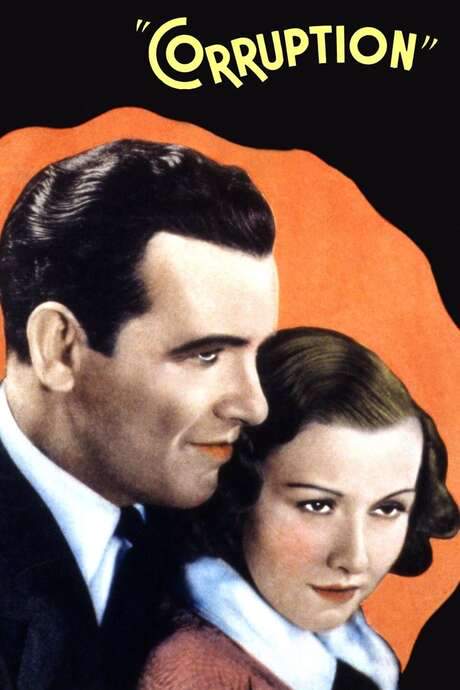
Year: 1932
Runtime: 69 mins
Language: English
Director: Edward L. Cahn
A Dramatic expose of Graft-ridden Politics! Corrupt politicians resort to murder and blackmail when a young boy accidentally witnesses them taking payoffs.
Warning: spoilers below!
Haven’t seen Afraid to Talk yet? This summary contains major spoilers. Bookmark the page, watch the movie, and come back for the full breakdown. If you're ready, scroll on and relive the story!
Read the complete plot breakdown of Afraid to Talk (1932), including all key story events, major twists, and the ending explained in detail. Discover what really happened—and what it all means.
In a Depression-era metropolis, a corrupt political machine centered on Mayor Billy Manning [Berton Churchill] works to polish his image as he seeks re-election. When a local mobster is shot in his hotel room by a speakeasy owner/racketeer named Jig Skelli [Edward Arnold], the crime is witnessed by bellhop Eddie Martin [Eric Linden], who is quickly taken into custody by the police. The city’s powerful A.D.A. John Wade [Louis Calhern], allied with Manning’s circle, pressures Eddie to name Jig as the killer, going so far as to block any warning from Eddie’s wife, Peggy [Sidney Fox], who fears for their safety. With the media already naming Eddie as the prime witness, the stage is set for a high-stakes confrontation between truth and a carefully managed political narrative.
Jig Skelli’s brother Joe Skelli [Matt Mchugh] steps in, presenting courtiers with documents from the dead man that lay bare the corrupt dealings of Manning’s cronies and their ties to the underworld. To protect their interests, they maneuver to derail the case and push for the charges to be dropped, aiming to free Jig. Eddie and Peggy are promised a safe move to New York to escape retaliation, a glimmer of hope in a city where power can erase inconvenient truths.
As Jig’s associates celebrate his (temporary) freedom, they unleash a barrage of gunfire that devastates a neighborhood and kills an innocent child. Faced with the difficulty of reindicting Jig without risking exposure of deeper corruption, Manning’s circle shifts the theory to frame Eddie as the killer. Eddie is arrested again, and the interrogation grows violently coercive in an attempt to secure a confession. A doctor at the scene warns that Eddie could die if he isn’t treated, and A.D.A. Wade reluctantly allows him to be rushed to a hospital for care.
In the hospital, a sympathetic doctor brings in a progressive lawyer who helps gather evidence to counter the city’s case. The tension rises as the conspirators move to a drastic measure: a manufactured hanging intended to eliminate Eddie. But Police Commissioner Garvey [Frank Sheridan], who has quit in protest of the frame-up, races to the detention facility and saves Eddie from execution.
Public exposure follows as the press uncovers the breadth of Manning’s corruption and the collusion of his lieutenants. Yet while the party chairman and A.D.A. Hyde manage to shield themselves from the formal records, Hyde’s reckless affair with Jig Skelli’s girlfriend Marge Winters [Mayo Methot] seals his fate when he is killed by the Skellis. In the aftermath, the party chair faces a stark, sobering question about the city’s leadership: who will rise to uphold integrity when entrenched power clings to its own gains?
Last Updated: October 09, 2025 at 09:11
Discover curated groups of movies connected by mood, themes, and story style. Browse collections built around emotion, atmosphere, and narrative focus to easily find films that match what you feel like watching right now.
Fast-paced exposés where individuals are crushed by ruthless, powerful systems.If you liked the relentless exposure of graft and political rot in Afraid to Talk, explore these movies. This thread gathers tense, fast-paced dramas from the pre-Code era and beyond, where innocent witnesses are pitted against an all-powerful and corrupt establishment.
Stories in this thread typically follow a rapid descent, where a chance witness or ordinary citizen uncovers deep-seated corruption. They are swiftly targeted by a network of powerful figures who use intimidation, blackmail, and violence to silence them. The narrative is a race against time, often involving a last-minute, morally ambiguous resolution that exposes the villains but rarely fixes the broken system.
These movies are grouped by their shared focus on systemic corruption as the central antagonist. They deliver a consistently tense, anxious, and cynical viewing experience, driven by a fast pace and high stakes where the individual is pitted against an immovable, malicious establishment.
Stories of ordinary people destroyed by forces far beyond their control.For viewers who appreciated the heavy emotional burden and themes of injustice in Afraid to Talk, this list features films with similar narratives. Discover stories where an average person is tragically ensnared and psychologically crushed by corrupt police, political machines, or criminal organizations.
The narrative pattern follows a simple, straightforward arc: an average person's life is shattered when they accidentally become a target for powerful, malevolent forces. The conflict is overwhelmingly one-sided, with the protagonist enduring coercion, framing, and brutality with little ability to fight back. The journey is one of survival and enduring trauma, rather than triumphant victory.
This grouping is defined by a shared protagonist archetype and emotional core: the innocent victim. The viewing experience is heavy, oppressive, and tense, generating empathy for a character being systematically broken down by an unstoppable adversary, be it the state, criminals, or both.
Don't stop at just watching — explore Afraid to Talk in full detail. From the complete plot summary and scene-by-scene timeline to character breakdowns, thematic analysis, and a deep dive into the ending — every page helps you truly understand what Afraid to Talk is all about. Plus, discover what's next after the movie.
Track the full timeline of Afraid to Talk with every major event arranged chronologically. Perfect for decoding non-linear storytelling, flashbacks, or parallel narratives with a clear scene-by-scene breakdown.
Discover the characters, locations, and core themes that shape Afraid to Talk. Get insights into symbolic elements, setting significance, and deeper narrative meaning — ideal for thematic analysis and movie breakdowns.
Get a quick, spoiler-free overview of Afraid to Talk that covers the main plot points and key details without revealing any major twists or spoilers. Perfect for those who want to know what to expect before diving in.
Visit What's After the Movie to explore more about Afraid to Talk: box office results, cast and crew info, production details, post-credit scenes, and external links — all in one place for movie fans and researchers.
Discover movies like Afraid to Talk that share similar genres, themes, and storytelling elements. Whether you’re drawn to the atmosphere, character arcs, or plot structure, these curated recommendations will help you explore more films you’ll love.
Afraid to Talk (1932) Scene-by-Scene Movie Timeline
Afraid to Talk (1932) Movie Characters, Themes & Settings
Afraid to Talk (1932) Spoiler-Free Summary & Key Flow
Movies Like Afraid to Talk – Similar Titles You’ll Enjoy
City of Fear (2000) Full Summary & Key Details
Dirty Affair (1990) Plot Summary & Ending Explained
I Was Framed (1942) Spoiler-Packed Plot Recap
House of Blackmail (1953) Film Overview & Timeline
I Am Afraid (1977) Complete Plot Breakdown
Corruption (1933) Film Overview & Timeline
The Captive City (1952) Film Overview & Timeline
Crime, Inc. (1945) Story Summary & Characters
The Underworld Story (1950) Movie Recap & Themes
Knock on Any Door (1949) Ending Explained & Film Insights
Fear (1946) Story Summary & Characters
The Fearmakers (1958) Plot Summary & Ending Explained
Man Afraid (1957) Full Movie Breakdown
Tell No Tales (1939) Detailed Story Recap
The Man Who Talked Too Much (1940) Spoiler-Packed Plot Recap