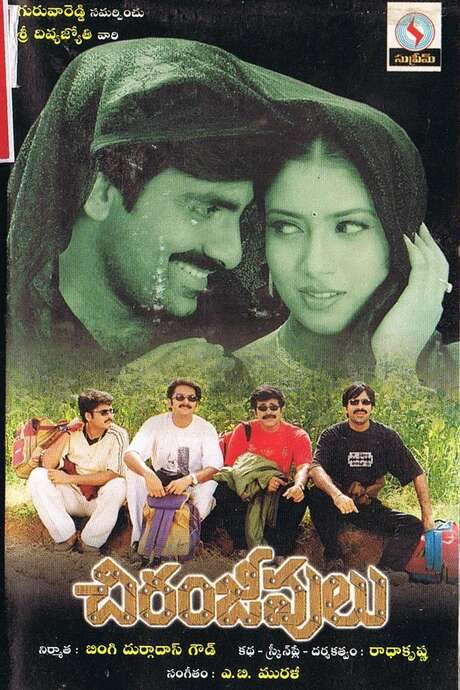
Four friends—Charan, Kiran, Giri, and Chanti—share a close bond built on days spent together, with Charan and Kiran as orphans and Giri and Chanti fighting an uphill battle against a terminal illness while being treated at a hospital. One fateful day, while visiting the hospital nurse Sudha, they witness a local MLA and his brother mistreating her. In a desperate bid to protect Sudha, they intervene and accidentally kill the MLA. Fearing that the police won’t believe their story, they choose to flee, becoming fugitives in an unknown village.
In that village, the four friends are drawn into a volatile power struggle between the village president Satyamurthy and the late, well-respected president Nagendra. They fail to save Nagendra’s son Rajan from Satyamurthy’s henchmen, which brings Satyamurthy’s attention to these four outsiders. A Panchayat meeting is called, and Satyamurthy demands the four city youths be expelled from the village, but the scenario changes when Nagendra’s widow Devi steps forward. She had witnessed the four friends trying to save Rajan and publicly adopts them, claiming them as her own sons. Devi then shares the backstory: Nagendra was honest and beloved by the villagers, a contrast to Satyamurthy, who grows jealous and schemes to tarnish Nagendra’s image.
The tension deepens as Nagendra foils a clumsy plan by Satyamurthy to steal temple jewelry through his servant, though Nagendra cannot prove the theft. Within this web of personal and political rivalries, Nagendra’s daughter Radha confesses her love for Anand, Satyamurthy’s son. Nagendra, moved by their affection, supports the match and proposes their marriage, only to provoke Satyamurthy, who insists Nagendra step down from the elections so he can win unopposed. Nagendra refuses, and the vendetta escalates: Satyamurthy ultimately orchestrates Nagendra’s death with a snake attack, pretending it was an accident. After hearing Devi’s account, the four friends vow to seek justice, and Charan also finds himself falling for a village girl named Kaveri.
When Satyamurthy spies Anand and Radha together, he reacts with brutal violence, attempting to force Radha into a crime while tying Anand to the scheme. Charan and his friends intervene just in time to save Radha, but Kaveri soon learns the truth of their origins and chooses to keep it to herself. The situation grows more perilous when Charan and the others overhear a plan involving smugglers who want to traffic the temple jewelry. Satyamurthy discovers their presence, and his men trap the four in quicksand, leaving them to die. He then hatches a new plan to steal the temple jewelry and pin the theft on Charan and his friends. They narrowly survive with the timely help of Kaveri and an inspector who had come to arrest them; Charan pleads for a window to surrender, and the inspector agrees.
United by courage, the friends thwart the theft and expose Satyamurthy and the smugglers in front of the Panchayat. Radha and Anand’s marriage is celebrated openly as a united gesture against Satyamurthy’s manipulation. Enraged by his defeat, Satyamurthy launches a violent assault on the village in a last-ditch effort to crush the opposition. In this brutal assault, Giri and Chanti lose their lives while trying to protect Radha and Anand. In the final act of vengeance, Charan kills Satyamurthy with the same snake attack that had claimed Nagendra, bringing justice to their friend and mentor’s memory.
In the closing moments, Charan and Kiran surrender to the inspector and head back to the city, their deeds framed by a solemn voiceover that proclaims they have become chiranjeevulu—the immortals. Their journey from four fugitives to village champions is told with a steady, clear tone, underscored by themes of friendship, sacrifice, justice, and the enduring power of communal memory.