Year: 1978
Runtime: 127 mins
Language: German
Director: James Fargo
Budget: $14M
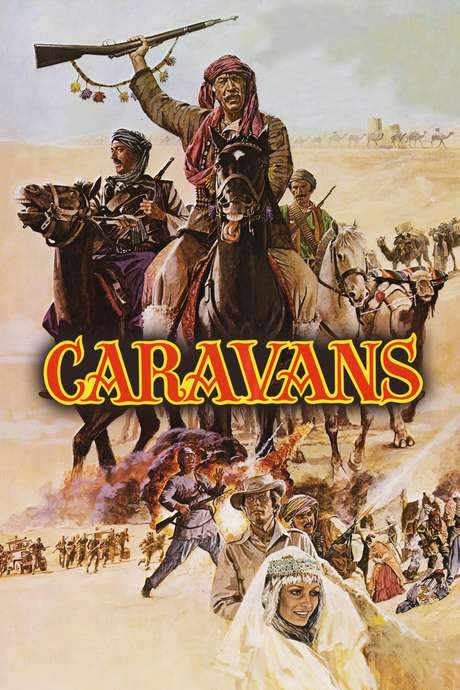
Based on James Michener’s novel, this epic adventure‑drama follows a young American embassy official dispatched into the Middle‑Eastern desert to locate a US senator’s missing daughter. She has abandoned her husband, a colonel in the Shadom, to join a nomadic tribe. The diplomat finds her, joins the caravan, and tries to convince her to return.
Find where to stream, rent, or buy Caravans (1978) in the US with current JustWatch availability, up-to-date pricing, and platform listings for subscription, rental, and digital purchase options.
Warning: spoilers below!
Haven’t seen Caravans yet? This summary contains major spoilers. Bookmark the page, watch the movie, and come back for the full breakdown. If you're ready, scroll on and relive the story!
Read the complete plot breakdown of Caravans (1978), including all key story events, major twists, and the ending explained in detail. Discover what really happened, and what it all means.
In the fictional Middle Eastern nation of Zadestan, set in 1948, Mark Miller from the American Embassy is drawn into a tense, morally charged mission. He is tasked with locating Ellen Jasper, the daughter of a U.S. senator, who vanished long after marrying Nazrullah, a man in a position of power who is desperate to find her. The case is complicated by law and loyalty: Ellen had relinquished her U.S. citizenship upon marriage, a fact that raises questions about jurisdiction, protection, and whether anyone outside the country can truly intervene.
As Miller digs for answers, the trail leads to a rough, diffuse world of nomads who drift across the desert and operate on the edges of legality. Ellen has found herself with them, entwined with a group of gun-runners led by Zulfiqar. The revelation paints a portrait of a woman torn between a loveless, imposed union and a sense of autonomy she’s never allowed to claim. Ellen is not eager to return to a life she did not choose; she remains estranged from both her husband and her parents, who had forced the marriage in the first place. Miller recognizes the peril in her situation and respects her reluctance, yet his duty compels him to seek proof that she is alive and well before any decision about her future can be made.
The tension intensifies as Nazrullah takes a ruthless approach to reclaim what he believes is his. He lures the nomads into a trap, turning the pursuit into a dangerous confrontation that forces Miller to be separated from the group he’s pursuing. In the midst of tension and shifting loyalties, Ellen is faced with a stark choice: return to a life she never accepted, or cling to a fragile sliver of freedom she has managed to salvage. She refuses to abandon her own dignity, even as the odds remain against her.
Before the danger reaches its end, Ellen passes a note to Miller, a last line of communication meant for her family and perhaps a glimmer of hope for the future. As the nomads begin to disperse, Nazrullah orders his troops to open fire on the retreating group. Ellen is killed in a moment of selfless courage, attempting to rescue a child caught in the violence. The film closes on a somber note as Nazrullah carries away the body of his wife, a symbol of a conflict where love, power, and tragedy are intertwined in a landscape of dust, heat, and unspoken longing.
Last updated: February 18, 2026 at 23:46
Explore frequently asked questions about Caravans (1978) with spoiler-rich answers covering the full plot summary, major story beats, character motivations, hidden details, and ending meaning. This movie summary FAQ helps explain confusing scenes, plot twists, and narrative decisions in clear, searchable detail.
Ellen Jasper left her husband Colonel Nazrullah after an arranged marriage she never wanted. Her parents forced her into the union with the powerful man, and she eventually abandoned that loveless life to join Zulfiqar's group of nomads. Among them, she found a sense of autonomy and freedom she had never experienced.
The summary notes Ellen was estranged from both her husband and parents, hinting at the forced nature of her marriage.
When Ellen married Nazrullah, she relinquished her US citizenship. This meant she was no longer under American jurisdiction or protection, limiting what US officials could legally do to retrieve her. Miller had to find proof of her condition before any decisions could be made about her future.
Miller's assignment was specifically to locate her and determine if she was alive, not to forcibly return her.
Nazrullah was desperate to reclaim Ellen as his wife. He engineered a trap to draw the nomads away from Miller and eliminate the gun-running operation, using the situation to isolate Ellen and force her return. His approach was ruthless because he viewed her as his property to retrieve by any means necessary.
The timeline shows Nazrullah as a man in a position of power who was desperate to find Ellen.
Ellen refused because she had no desire to return to a life she never chose. She was estranged from both her husband and her parents who forced the marriage. Among the nomads, she had found genuine independence and dignity, however fragile, and she was unwilling to surrender that for a loveless existence.
Miller recognized the peril in her situation and respected her reluctance, indicating her decision was understandable.
When the nomads attempted to retreat under pressure, Nazrullah commanded his soldiers to open fire on the fleeing group. This was his final attempt to either capture Ellen or punish those who helped her escape his control, turning the confrontation into a deadly battle.
Nazrullah's earlier trap and his confrontation with Ellen about returning had already shown his ruthless determination.
Ellen was killed during the violent confrontation when she attempted to rescue a child caught in the crossfire between Nazrullah's troops and the departing nomads. Her death was an act of selfless courage that ended her brief pursuit of freedom.
The story's tone was described as having tragic inevitability, with emotional weight heavy throughout.
After Ellen died, Nazrullah personally retrieved and carried her body from the desert battlefield. This final act revealed the complex emotional reality beneath his ruthless pursuit, his love for her was real, even if his methods were controlling and destructive. It symbolized the tragic intertwining of love, power, and loss.
The summary describes their conflict as one where love, power, and tragedy are intertwined.
Ellen passed a note to Miller as her last form of communication with her family. With her estrangement from her parents and her likely death, the note served as a final message to them, a possible glimmer of hope and closure, and proof of her circumstances.
The note was intended for her family, suggesting she still harbored some hope of reconciliation.
Mark Miller from the American Embassy was assigned to locate Ellen Jasper because her disappearance concerned her father, a US senator. The mission required someone to enter dangerous territory and determine whether she was alive and well before any decisions about her future could be made.
Miller refused to return without proof of her condition, showing the serious nature of the assignment.
Ellen Jasper's parents arranged her marriage to Colonel Nazrullah, a man of significant power and position in Zadestan. The union appears to have been a strategic alliance rather than a love match, reflecting the cultural conflict between traditional expectations and Ellen's personal desires.
The story emphasizes the clash between traditional and modern worlds as a central theme.
Ellen joined the nomadic group led by Zulfiqar, who operated as illegal gun-runners in the desert. This wasn't because she supported their criminal activities, but because they offered her escape from her confined life. Her association with them was primarily about finding freedom, not participating in their trade.
Ellen was described as entwined with the group but focused on her autonomy rather than their operations.
Discover curated groups of movies connected by mood, themes, and story style. Browse collections built around emotion, atmosphere, and narrative focus to easily find films that match what you feel like watching right now.
High-stakes journeys across treacherous landscapes, steeped in political intrigue.Explore movies like Caravans that feature tense, high-stakes journeys across treacherous desert landscapes. If you enjoyed the search mission and political intrigue set against a backdrop of desolate beauty, you'll find similar stories of survival and discovery here.
Stories in this thread typically follow a linear, mission-driven narrative. A protagonist, often an outsider, must navigate a dangerous desert environment to achieve a goal, facing obstacles from hostile forces and the elements alike. The journey is as much an internal reckoning as an external challenge.
These films are grouped by their shared atmospheric pressure, derived from the combination of a high-stakes plot and an inhospitable desert setting. They feature a steady, purposeful pace that builds tension, culminating in dramatic confrontations shaped by the landscape's inherent danger.
Love stories doomed by irreconcilable cultural differences and societal pressures.Discover tragic romance films similar to Caravans, where love is thwarted by cultural divides and societal expectations. If you were moved by the story of a relationship doomed by tradition and a bleak ending, this collection of melancholic and heavy dramas is for you.
The narrative pattern involves a romance that defies cultural norms, leading to increasing tension and desperation. The characters are often trapped by circumstances beyond their control, such as arranged marriages or political allegiances. The story arc typically builds toward an inevitable, sad conclusion that highlights the cost of the cultural conflict.
These movies share a melancholic and heavy mood, driven by the central theme of love being destroyed by external pressures. The tone is consistently tense and dramatic, with a steady pacing that allows the tragic inevitability to unfold, resulting in a profoundly sad or bleak ending.
Don't stop at just watching - explore Caravans in full detail. From the complete plot summary and scene-by-scene timeline to character breakdowns, thematic analysis, and a deep dive into the ending - every page helps you truly understand what Caravans is all about. Plus, discover what's next after the movie.
Track the full timeline of Caravans with every major event arranged chronologically. Perfect for decoding non-linear storytelling, flashbacks, or parallel narratives with a clear scene-by-scene breakdown.
Discover the characters, locations, and core themes that shape Caravans. Get insights into symbolic elements, setting significance, and deeper narrative meaning - ideal for thematic analysis and movie breakdowns.
Discover movies like Caravans that share similar genres, themes, and storytelling elements. Whether you’re drawn to the atmosphere, character arcs, or plot structure, these curated recommendations will help you explore more films you’ll love.
Caravans (1978) Scene-by-Scene Movie Timeline
Caravans (1978) Movie Characters, Themes & Settings
Caravans (1978) Spoiler-Free Summary & Key Flow
Movies Like Caravans – Similar Titles You’ll Enjoy
Captive of the Desert (1990) Story Summary & Characters
Sahara (1983) Film Overview & Timeline
Gypsy Wildcat (1944) Plot Summary & Ending Explained
Caravan (1946) Movie Recap & Themes
The Magic Carpet (1951) Movie Recap & Themes
Saadia (1953) Story Summary & Characters
The White Caravan (1964) Plot Summary & Ending Explained
Adventure in Sahara (1938) Plot Summary & Ending Explained
Outpost in Morocco (1949) Ending Explained & Film Insights
The White Sun of the Desert (1969) Story Summary & Characters
Wagon Wheels (1934) Complete Plot Breakdown
The Covered Wagon (1923) Story Summary & Characters
Bagdad (1949) Spoiler-Packed Plot Recap
The Carabineers (1963) Movie Recap & Themes
Caravan (2025) Complete Plot Breakdown