Year: 1983
Runtime: 22 mins
Language: English
Director: Don McBrearty
Directed by Don McBrearty, this 1983 Canadian short adapts Alice Munro’s 1968 story “Boys and Girls.” It portrays a coming‑of‑age tale of a farm‑grown girl who learns that society will forever see her as “only a girl,” confronting the limits imposed by gender expectations. The film was honored with the 1984 Academy Award for Best Short Subject.
Find where to stream, rent, or buy Boys and Girls (1983) in the US with current JustWatch availability, up-to-date pricing, and platform listings for subscription, rental, and digital purchase options.
Warning: spoilers below!
Haven’t seen Boys and Girls yet? This summary contains major spoilers. Bookmark the page, watch the movie, and come back for the full breakdown. If you're ready, scroll on and relive the story!
Trace every key event in Boys and Girls (1983) with our detailed, chronological timeline. Perfect for unpacking nonlinear stories, spotting hidden connections, and understanding how each scene builds toward the film’s climax. Whether you're revisiting or decoding for the first time, this timeline gives you the full picture.
Last updated: November 22, 2025 at 16:00
Find frequently asked questions about the Boys and Girls (1983) timeline, including chronological order, nonlinear jumps, cause-and-effect links, and scene sequence clarifications. This timeline FAQ helps explain when key events happen, how moments connect, and why the story unfolds in that specific order.
The girl makes a split-second decision not to close the door when Flora, the nervous mare, approaches it. While her father had kept Flora inside to prevent escape, the girl cannot bring herself to trap the horse again. She acts on a moment of empathy and rebellion against the farm's cycle of confinement and killing, though she cannot fully explain her reasoning when confronted later. The act represents her first conscious challenge to her father's authority and the brutal routine that defines their lives.
Earlier, the girl witnessed Mike being shot and felt the emotional weight of the farm's cruelty, which builds toward her small act of defiance.
When the girl confesses to opening the door, her father dismisses her action with "It doesn't matter… She's just a girl." This crushing remark reveals his belief that her gender makes her actions inconsequential and that girls are less capable or significant than boys. It reflects the societal expectations of the era and the farm's patriarchal structure, where the father values obedience and utility above all else. The comment seals the girl's realization that she will never be seen as equal to her brother in her father's eyes.
The story hints at gender imbalance throughout, as the girl adopts ladylike behavior to cope with her harsh environment and senses the limits of her father's patience.
Mike is an old horse no longer useful to the fox operation, so he is shot as part of the farm's brutal cycle. In winter, the family keeps horses until the trade requires them, then kills them to sustain the fox business. The girl and her brother Laird witness the shooting, which becomes a turning point in their understanding of their father's world and the violent reality underlying their livelihood.
The farm's rhythm of killing is established early, with autumn fox harvests and winter horse slaughters forming a predictable but harsh cycle.
The girl avoids her grandmother and adopts a more ladylike demeanor as a coping mechanism to deal with the harsh environment of the fox farm. Faced with the violence and cruelty surrounding her, she attempts to find a different identity by fitting into more traditional feminine expectations. This behavior reflects her subconscious search for escape or acceptance in a world that offers her few options beyond the farm's brutal reality.
Her ladylike behavior foreshadows her father's later dismissal of her as "just a girl," showing how gender expectations already shape her choices.
The fox farm functions as a confined world that mirrors the limitations imposed on the girl. The high fence around the fox enclosures and the locked gate create a medieval-like boundary, trapping animals in a cycle of breeding, killing, and skinning. The farm's rigid routine and the father's absolute authority over life and death represent the societal constraints the girl cannot escape. Her act of leaving the door open represents a momentary break in this enforced confinement.
The enclosure is described as a "created realm" from the beginning, establishing the theme of captivity that culminates in the barn door incident.
Flora escapes through the open barn door and moves toward the plant area, disrupting the farm's routine. However, after the truck arrives and the father returns, he retrieves Flora, bringing the mare back into the cycle. The escape highlights the fragile line between control and freedom on the farm, but the father's stubborn attachment to his animals ensures the cycle continues despite the risk of losing control.
Flora's near-escape mirrors the earlier moment when Mike was killed, showing two possible fates for the farm's animals.
The children are exposed to the violent reality of the farm because their father involves them in the family business without shielding them from its harsh truths. They watch foxes being skinned, see the naked bodies bagged and buried, and witness Mike being shot. This exposure shapes their understanding of life, death, and their father's authority. The girl, in particular, feels the emotional weight of what she witnesses, which ultimately drives her act of rebellion with Flora's door.
The children's presence at these events builds their emotional turmoil, leading to the confrontation at dinner.
The film illustrates gender expectations through the father's dismissive attitude toward his daughter. Despite her contributions and emotional intelligence, he reduces her to her gender when he says "She's just a girl." The girl herself tries to navigate these limitations by acting ladylike with her grandmother, seeking an alternative identity. The story depicts a world where girls are expected to be less significant or capable than boys, a reality the girl confronts painfully at the film's climax.
The title "Boys and Girls" itself hints at the divide, and the girl's growing awareness of her limited place in the family mirrors her witnessing of the animals' confined existence.
The barn door incident represents the girl's first act of rebellion against her father's authority and the farm's cruel cycle. By choosing not to close the door, she asserts her own moral judgment over the enforced routine. However, when confronted by her brother and father, she cannot defend her choice, and her father's crushing remark reveals that her gender means her actions will always be dismissed. This moment forces her into painful self-awareness, marking her loss of childhood innocence and her dawning understanding of the limitations imposed on her.
Earlier events, including witnessing Mike's death and her emotional fallout, build toward this moment of reckoning.
The ending is bittersweet because the girl gains painful self-awareness but loses her childhood sense of freedom and belonging. She now understands that her father and society will never see her as equal to her brother, no matter what she does. Her act of rebellion was not heroic or transformative, it was quietly dismissed. The realization marks her transition from innocence to a harder understanding of gender limits, leaving her emotionally isolated but more conscious of her circumstances.
The girl's emotional fallout after witnessing Mike's death foreshadows this deeper disillusionment.
Discover curated groups of movies connected by mood, themes, and story style. Browse collections built around emotion, atmosphere, and narrative focus to easily find films that match what you feel like watching right now.
Stories of young people confronting harsh realities in isolated country settings.If you liked the quiet, melancholic awakening in Boys and Girls, you may enjoy these other movies. This list features similar coming-of-age tales set in rural landscapes, where characters grapple with family expectations and their place in the world.
These narratives typically follow a young protagonist in a rural setting who begins to chafe against the limitations of their environment and the roles assigned to them. A pivotal event or series of realizations leads to a loss of innocence, culminating in a sobering but nuanced understanding of the world.
Movies are grouped here for their shared atmosphere of rural melancholy, their focus on a young character's internal struggle for identity, and their use of a slow, reflective pace to mirror the gradual process of disillusionment and self-discovery.
Character-driven stories about subtly challenging prescribed societal roles.Fans of Boys and Girls and its portrayal of a girl confronting limiting gender roles will find similar themes here. These films explore the personal toll of societal expectations and the subtle ways individuals push back against them.
The pattern involves a protagonist becoming acutely aware of the invisible cage of gender roles within their family or community. The story builds through small, significant moments of resistance rather than overt rebellion, leading to a conclusion that is more about a shift in self-perception than a dramatic external victory.
These films are connected by their central theme of grappling with gender identity and expectations. They share a character-driven, often melancholic approach, prioritizing emotional authenticity and the quiet tension of internal conflict over loud dramatics.
Don't stop at just watching - explore Boys and Girls in full detail. From the complete plot summary and scene-by-scene timeline to character breakdowns, thematic analysis, and a deep dive into the ending - every page helps you truly understand what Boys and Girls is all about. Plus, discover what's next after the movie.
Read a complete plot summary of Boys and Girls, including all key story points, character arcs, and turning points. This in-depth recap is ideal for understanding the narrative structure or reviewing what happened in the movie.
Discover the characters, locations, and core themes that shape Boys and Girls. Get insights into symbolic elements, setting significance, and deeper narrative meaning - ideal for thematic analysis and movie breakdowns.
Discover movies like Boys and Girls that share similar genres, themes, and storytelling elements. Whether you’re drawn to the atmosphere, character arcs, or plot structure, these curated recommendations will help you explore more films you’ll love.
Boys and Girls (1983) Plot Summary & Movie Recap
Boys and Girls (1983) Scene-by-Scene Movie Timeline
Boys and Girls (1983) Spoiler-Free Summary & Key Flow
Movies Like Boys and Girls – Similar Titles You’ll Enjoy
Boys on the Side (1995) Complete Plot Breakdown
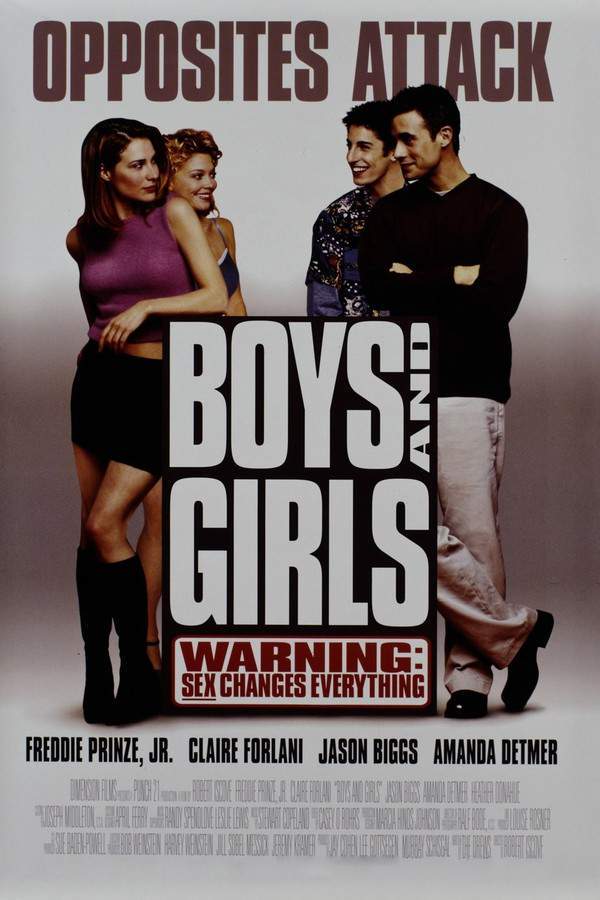
Boys and Girls (2000) Film Overview & Timeline
Boys vs. Girls (2020) Plot Summary & Ending Explained
The Orphan Muses (2000) Detailed Story Recap
Boys vs. Girls (2019) Movie Recap & Themes
Boys Will Be Boys (1000) Full Summary & Key Details
New Boy (2007) Complete Plot Breakdown
A Girl’s Own Story (1984) Ending Explained & Film Insights
Boys (2020) Plot Summary & Ending Explained
Boyhood (1951) Complete Plot Breakdown
The Girls (1978) Detailed Story Recap
Some Boys Don’t Leave (2009) Movie Recap & Themes
Boys Will Be Boys (1976) Spoiler-Packed Plot Recap
The Girl (1968) Full Movie Breakdown
Best Offer (1993) Ending Explained & Film Insights