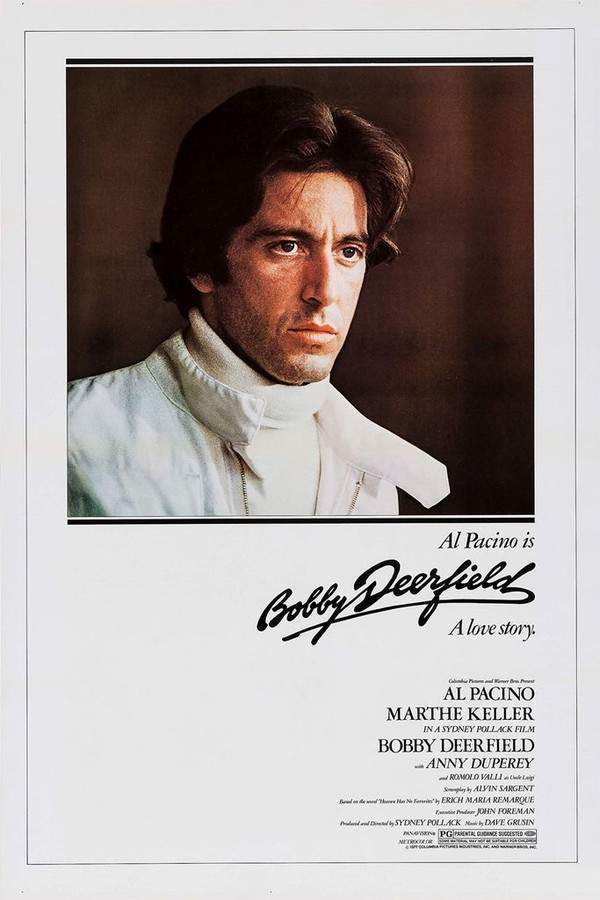
Bobby Deerfield, Al Pacino, a dedicated Formula 1 race driver, starts on a track where he stares at skid marks and searches for clues to a recent crash. In a vivid dream, he sees his friend Bertrand Modave near his car and keeps asking for a key, only to awaken with a jolt. He flicks on the bedside lamp, visits the bathroom, and then lies awake again, replaying that day. The scene then shifts to a race where fans crowd the pit with chants of his name, and his French girlfriend Lydia, Anny Duperey, stands nearby. The race itself becomes chaotic: one car clips another and explodes, a reminder of the danger that surrounds them. After Modave’s funeral, Bobby tells his pit crew that he won’t climb into another Formula 1 car until they understand what happened to Modave’s vehicle, since their cars are identical.
The story then moves to Paris, where Bobby reconnects with his brother Leonard, Walter McGinn. Their conversation is thin, hinting at a shared history they barely discuss. Bobby can’t remember much from their Newark, New Jersey upbringing, including the way his Mae West impersonation always drew their mother’s laughter. Leonard’s insistence on legal papers concerning their mother’s property—and a packet of boyhood photos—exposes a family divide. Bobby isn’t interested in the property, and the prospect of being contacted when their mother dies is met with a blunt push of his sunglasses.
A trip to Leukerbad, Switzerland, follows, where the surviving driver Karl Holtzmann, Stephan Meldegg, recovers after the crash. Bobby asks Karl for his take on the disaster, but Karl maintains that Modave simply misjudged the turn. The mood shifts when a patient, Lillian Morelli, Marthe Keller, asks Bobby for his butter and probes into personal topics. Their conversation drifts to speed, danger, and death, and Lillian suggests that racing is a dull pursuit if one only avoids thinking about risk. After dinner, as they watch a magic show with other patients, she questions whether Bobby believes in magic, destiny, or God, and later, a nurse brings medications that Lillian refuses, vowing she will face death on her own terms.
The next morning, Bobby leaves, but Lillian appears with a bag, seeking a ride to Florence. He agrees to take her, yet she keeps teasing him, joking about his “feminine touch” on the steering wheel and insinuating that his car is an extension of his body. In a tunnel, she presses him to scream in the dark, hoping to share a moment of fear. After a tense ride, they stop at a hotel in Bellagio, and Bobby calls his Paris mechanic to swap the steering linkages from Modave’s car and his own, asking for footage of the accident to be ready when he returns. At dinner, Lillian affectionately calls him a “turtle” for his calculated risks, and she urges him to hold her. They retreat to her room, disrobe, and fall into bed, where she quietly dozes off as Bobby strokes her hair and notices a few strands coming away.
The morning after, Lillian longs to follow a hot air balloon drifting above Lake Como, but Bobby refuses. Later, in Florence, he drops Lillian off at her uncle Luigi’s house (an option he explores to understand her) and is asked to stay for a Bocce game that Lillian always attends. When they walk the streets together, she urges him to remove his sunglasses so he can see himself reflected in mirrors; he takes them off, and a small crowd gathers as she shouts Bobby Deerfield’s name with a sly smile of satisfaction. They also share a wine-and-cheese picnic, and she critiques his reluctance to experience life fully, a theme that threads through their growing bond. She tells him a dramatic tale about her father’s death, then admits it was a lie, and Bobby explains that he fears a similar emotional distance in himself. Lillian argues that telling a lie can feel more meaningful than small talk, and their kiss seals a tentative closeness. Before they part, she leaves a newspaper clipping about a balloon regatta.
Back in Paris, Lydia reveals that she knows about Lillian Morelli and the fragile truth that Bobby has not fully grasped—Lillian is in fact dying. The revelation hits after Bobby reviews the crash footage, hoping for a clear answer. The projectionist slows and freezes a frame, but nothing in the frame provides clarity for Bobby. He heads toward another race, preparing for Jarama in Spain on May 2, 1976, even filming a television commercial in Paris, all the while feeling unsettled. He returns to Florence to seek Lillian, hoping for more than a fleeting chance.
Luigi’s perspective hints at Lillian’s temperament—she’s outspoken and difficult, but Bobby persists in pursuing her. She arrives at Bocce again and asks Bobby to drop the sunglasses permanently, a symbolic move toward honesty and vulnerability. As they walk through a city where no one recognizes him, she makes a bold move to remove the barrier he’s built around himself. They share a quiet moment of mutual recognition, and a toast to taking chances. A private picnic follows, where Lillian questions the absence of photos of his mother in the boyhood album, inviting Bobby to reveal more of himself.
The boat outing becomes a pivotal scene: Lillian grows weaker, and Bobby’s stories—some true, some invented—reveal his complex attempt to connect. He realizes how deeply she has affected him, even as her illness deepens. Lillian’s condition worsens, and she eventually asks to return to Leukerbad for treatment. On their final days together, a pair of American tourists photograph them, promising to mail the image, but Bobby keeps faith with Lillian by staying present. He remains by her side in Leukerbad as she fades away, and after her death, he drives alone back to Paris, carrying the weight of their shared moments and the lessons they brought him about risk, joy, and the truth they chose to live.
- Everything is sweeter when you take a chance.