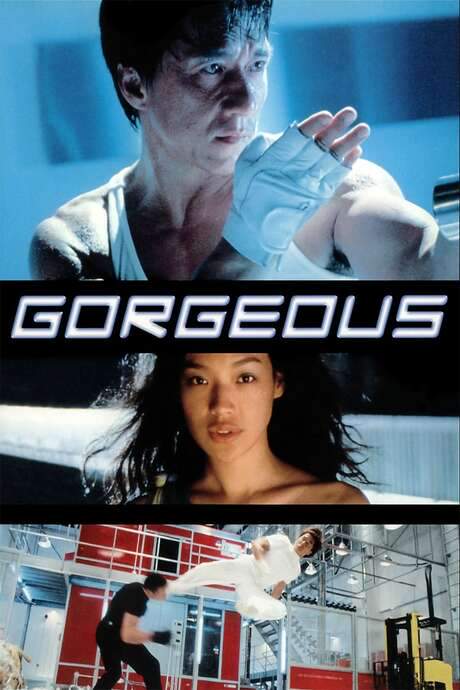
Chi-Mo’s daily routine centers on a quiet, unassuming life: he works in a small restaurant owned and operated by his pre-operative transsexual boss who is in the process of transitioning. His other regular obligation is delivering meals to a mysterious occupier who always leaves the money waiting on the lamp outside the door. This simple pattern slowly pulls him into a wider, more dramatic world when a visit to the Swan Lake dance school introduces him to Yan-Yan, the girl of his dreams. He is drawn to her charm, even lending her the string that holds up his pants when her shoes break, a small gesture that foreshadows the larger, more complicated feelings to come. The dance school itself becomes a stage for both romance and danger when it closes abruptly and Yan-Yan is attacked by a gang. Chi-Mo rushes to her aid, but Yan-Yan manages to fend off the attackers on her own and disappears, leaving him with questions rather than answers.
Later, a second, more dangerous encounter awaits. Yan-Yan’s kidnapping pulls Chi-Mo into a web of crime and intrigue tied to a feared loan shark who presides over the gang responsible for the assault. The person behind the kidnapping is a force in the city’s underworld, a ruthless figure who uses fear to extract payment and obedience. In the midst of this crisis, the woman who receives Chi-Mo’s regular deliveries steps into the story with a startling transformation. What begins as a kitchen confidant and helper becomes a figure of legend and street justice—the Black Rose. Nancy Sit Ka-Yin embodies this Robin Hood-like heroine who dedicates herself to aiding the people of Hong Kong, even as she keeps her own secrets close.
Black Rose’s emergence shatters Chi-Mo’s perception of power and control. She locks him in a room with Lui Kei, a wily strategist who has spent thirty years in confinement for reasons tied to Black Rose’s past. She has kept Lui Kei hidden away so that her students, Piu-hung and Yum-fan, would not stumble upon him. This setting—a trap turned classroom—becomes a crucible in which Chi-Mo is forced to learn a new discipline: kung fu. To teach him, Lui Kei turns the tables, assigning Chi-Mo to a regimen of grueling housework and chores, slowly building his physical courage and mental resolve. The dynamic between the two men grows more complex as Chi-Mo’s co-worker Dan, a pre-operative transsexual like him, becomes entangled in the same peril, ending up trapped in the same house.
As the plot accelerates, Black Rose pulls out every tool in her arsenal, including an array of unusual gadgets, to battle the gang led by the loan shark and to rescue Yan-Yan. The struggle leads to a climactic sequence on stage at a club, where music and mayhem collide in a spectacle that tests the limits of courage and loyalty. Amid the chaos, Lui Kei confesses a long-held truth: his feelings for Black Rose have endured for years, and he promises to stand by her as a partner. Together, they embark on a daring escape with Yan-Yan, while Black Rose’s allies in the fight press on.
Back at Black Rose’s residence, the freed captives—Yan-Yan, Chi-Mo, and Dan—begin to rebuild their lives while Lui Kei nurses the wounded heroism of the title character. The plan to marry provides a hopeful counterpoint to the violence they’ve endured, and the moment Black Rose releases her captives signals a fragile peace. Yet Sandra’s gang returns, and the clever traps built into Black Rose’s home become weapons of distraction, drawing the attackers into a deadly dance. In the ensuing mêlée, Chi-Mo and Yan-Yan find themselves sharing a kiss that crystallizes their budding affections and the film’s central theme: love can bloom even in the midst of danger.
The film’s revelations twist through a long-held feud. Sandra—the loan shark behind Yan-Yan’s peril—is exposed as Suen May-tong, the daughter of Black Rose’s sworn enemy, Suen Big-ling, a figure connected to the legendary Invincible Flying Rings. The revelation reframes the conflict as a legacy duel between generations, with Black Rose facing Suen May-tong in a duel of skill and will. The confrontation escalates into a final, dramatic confrontation in which Black Rose wields her Rose Sword to challenge Suen May-tong. For a moment, it seems the hero’s cause may falter, and the room fills with tension as the fight rages on.
The tide turns in a brutal, almost cinematic sequence. Suen May-tong draws a machine gun, decimating her own gang in a startling display of power, and then she removes her mask to reveal that she herself is the true Black Rose—only this time, she has already defeated Suen May-tong once before. Her farewell to Chi-Mo, Yan-Yan, and Dan is tempered with a lesson about love and friendship: those bonds are real, and they bring happiness in place of despair. With those words, she vanishes alongside Lui Kei, leaving the future uncertain but hopeful for the younger trio.
In the closing moments, Dan is shown moving forward with a new relationship, signaling a note of redemption and forward-looking optimism for the characters who survived. The film blends action, romance, and comedy with a distinctive Hong Kong sensibility, weaving through private identities, street-level heroism, and a chorus of characters who carve out a place for themselves in a world that is often hostile but always alive with possibility.
- Boxing School Owner Donnie Yen plays a pivotal role as the figure who represents grit and determination in the opening acts.
- Hung Mo-Daan, portrayed by Sandra Ng Kwan Yue, anchors the emotional and ethical core of the story.
- A Miu/Mo is introduced by Jan Lam Hoi-Fung, whose arc dovetails with the film’s themes of transformation and courage.
- Black Rose, a central, armature-hero figure, appears as Nancy Sit Ka-Yin and drives the narrative forward with her blend of justice and mystery.
- Lui Kei’s growth and charm are captured by Spencer Lam Seung-Yi, whose partnership with Black Rose gives the story its emotional resonance.
- Yan, shown by Lam Gei-Wan as Daap Tong / Yan, anchors the personal stakes of Chi-Mo’s journey.
- The dramatic antagonist Suen Mooi-Tong is rendered with style by Blackie Ko Shou-Liang, while a cameo from Lowell Lo Koon-Ting punctuates key moments in the film’s tempo.